The Quick Read
India's largest recorded gatherings include the 2025 Maha Kumbh at Prayagraj (Jan 13–Feb 26), with an official estimate of 66 crore pilgrims, and the 2024 Lok Sabha election, with about 642 million voters. Earlier historic Indian events and gatherings, such as the 1930 Dandi March, shaped history without reliable headcounts. Most figures are official estimates.
Key Takeaways
- Most Indian crowd records are official estimates, not verified headcounts.
- The 2025 Maha Kumbh reported 66 crore pilgrims across 45 days.
- Total attendance over weeks differs sharply from the peak crowd on one day.
- Elections and the 2020 general strike set records across many sites.
- A run of stampedes from 2024 to 2026 exposed gaps in crowd planning.
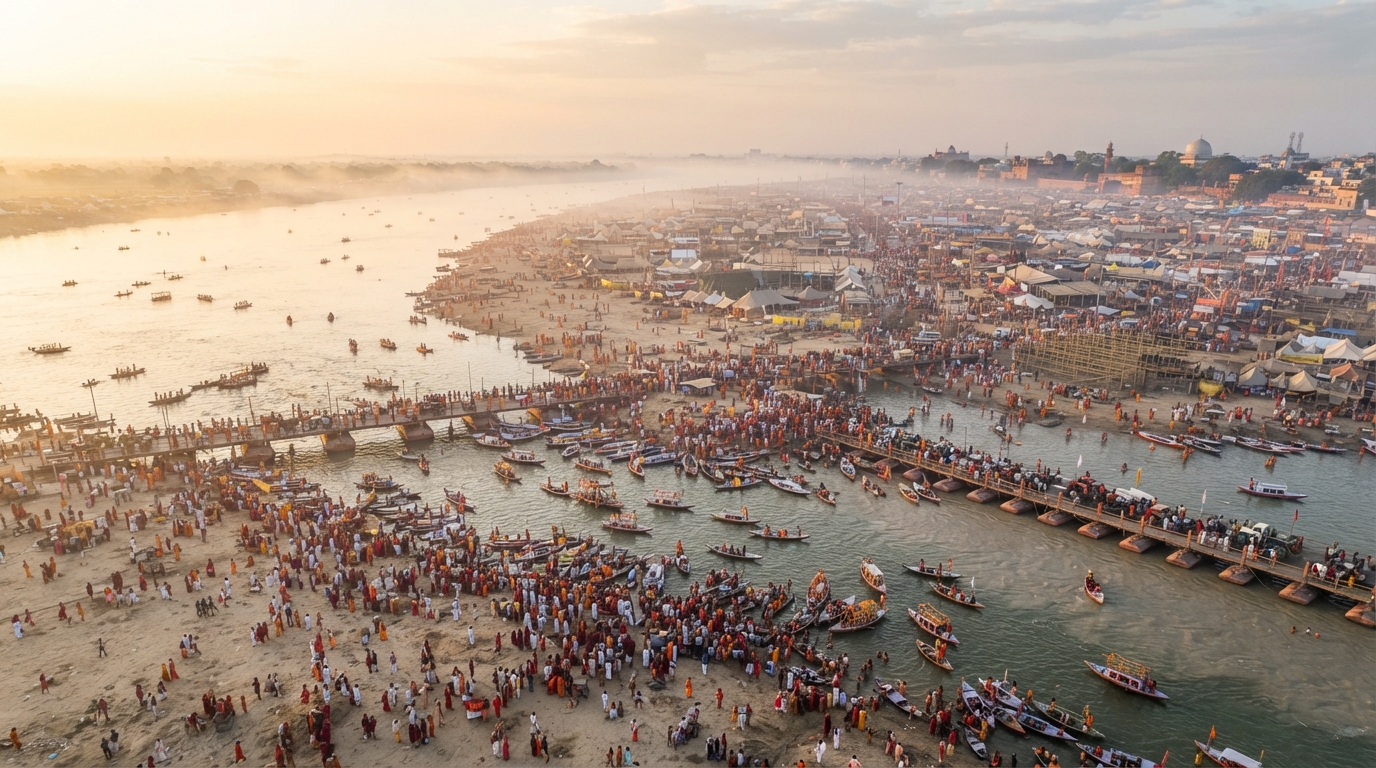
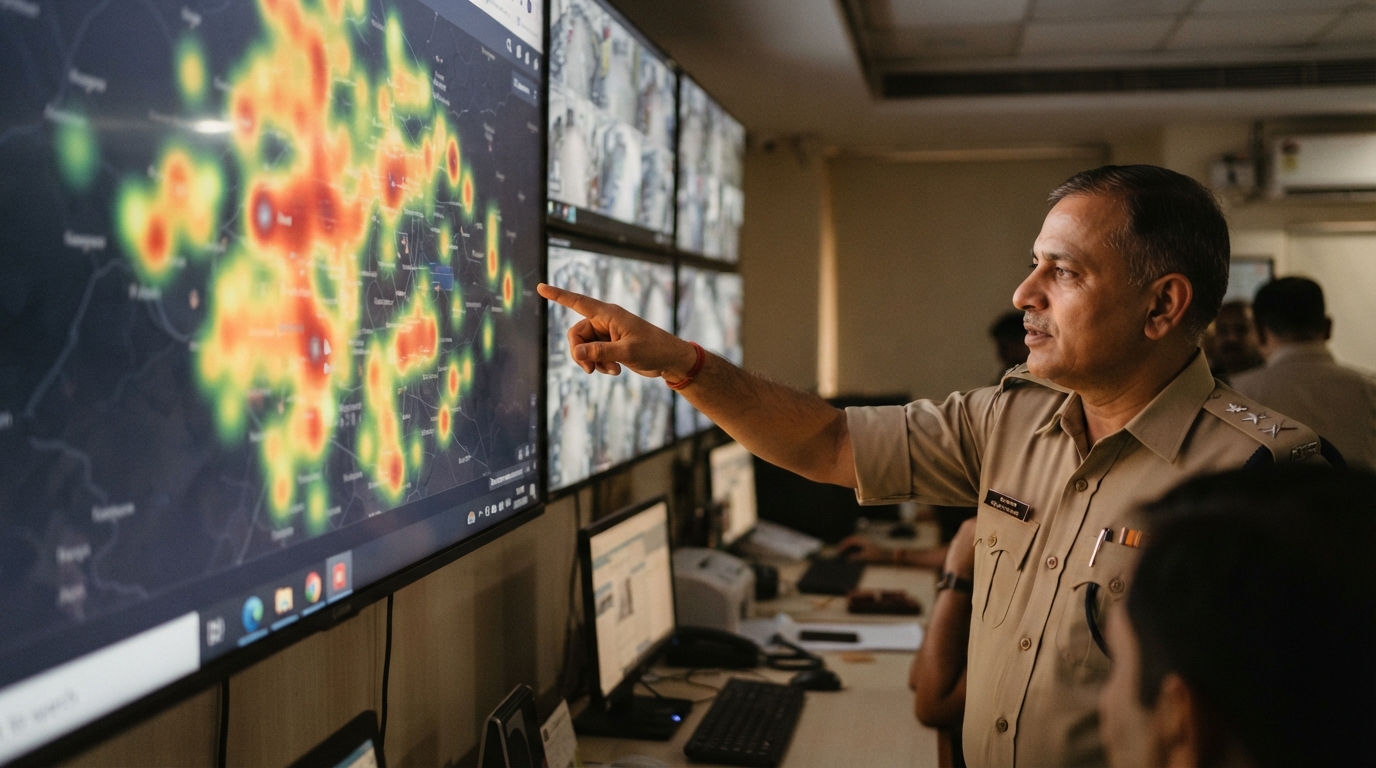
The ghats at the Sangam in Prayagraj fill before sunrise. Pilgrims wade into the meeting point of the Ganga and Yamuna while loudspeakers call out lost-and-found names. In a control room nearby, staff watch feeds from about 2,700 CCTV cameras, 1,800 of them inside the mela grounds (Drishti IAS, 2025). That scene, repeated daily from 13 January to 26 February 2025, produced the biggest crowd figure India has ever announced. Behind every record like it sits a date, a place, and a counting method. This guide maps the key dates of historic Indian events and gatherings, from ancient festival roots to modern documented milestones. It also explains how much weight each number can bear.
What are the largest historic Indian events and gatherings on record?
India's biggest documented gatherings fall into two groups. Single-site events, led by the Kumbh Mela, pack crowds into one place. Distributed events, such as national elections and general strikes, involve hundreds of millions of people spread across the country. Both count as records, but they measure very different things.
The ranking at a glance
The table below lists the major recorded events with their dates and reported figures. Each number comes from an official body, organiser, or record keeper, not from an independent count.
| Event | Date | Type | Reported figure | Source |
|---|---|---|---|---|
| Maha Kumbh, Prayagraj | 13 Jan–26 Feb 2025 | Single site, 45 days | 66 crore (660 million) pilgrims | UP government, via ETV Bharat, 2025 |
| Lok Sabha general election | 19 Apr–1 Jun 2024 | Nationwide | 642 million voters, 65.79% turnout | CEC Rajiv Kumar, via The Statesman, 2024 |
| Nationwide general strike | 26 Nov 2020 | Nationwide, one day | About 250 million participants | Guinness World Records, 2020 |
| Ayodhya Ram Mandir, first public day | 23 Jan 2024 | Single site, one day | About half a million visitors | CNN, 2024 |
| Ardh Kumbh, Prayagraj | 2019 | Single site | About 50 million | Wikipedia, Prayag Kumbh Mela |
Why the Kumbh leads most lists
The Kumbh Mela tops most rankings because its crowd gathers in one zone along the riverbanks. UNESCO added it to its Intangible Cultural Heritage list in December 2017. It described the Kumbh as the world's largest peaceful gathering of pilgrims. That outside recognition gives the festival a status no other Indian event holds. It also explains why media lists repeat the 66 crore figure so often.
What the table leaves out
A table flattens real differences. The election figure counts people who voted at their local booths over six weeks. The strike figure counts workers who stayed away from work on a single day. The Kumbh figure adds up visits over 45 days. Putting them side by side is useful for scale, but it isn't a fair contest.
How did the Kumbh Mela grow from ancient ritual to a world record?
The Kumbh Mela draws on Hindu myth, a fixed cycle of rivers and stars, and centuries of pilgrim tradition. Its modern scale comes from roads, railways, and state planning. The festival's recorded attendance has climbed sharply in recent cycles, peaking with the official estimate of 66 crore pilgrims in 2025.
Myth, rivers, and a 12-year cycle
The Kumbh Mela's 12-year cycle is a rotation of full festivals among four river sites: Prayagraj, Haridwar, Nashik-Trimbak, and Ujjain. Hindu tradition links these four sites to the Samudra Manthan myth. Each site hosts a full Kumbh roughly every 12 years, with the timing set by the positions of Jupiter and the Sun.
The festival's origin story comes from the Samudra Manthan, the churning of the ocean. In the Samudra Manthan myth, drops of the nectar of immortality fell at those four places. Prayagraj and Haridwar also hold an Ardh (half) Kumbh about six years after each full Kumbh. Organisers framed 2025 as a rare "once in 144 years" alignment. The "once in 144 years" claim is astrological, not historical, and the claim can't be checked against records.
Early written records
The earliest written record often linked to the Kumbh Mela is the account of Xuanzang, a Chinese traveller who visited Prayag in the 7th century CE. Xuanzang described a large gift-giving assembly held by King Harshavardhana at the river confluence, though historians debate whether that assembly was a Kumbh in the modern sense.
Writers often cite Xuanzang's account as an early record of a mass gathering at the Prayag confluence. Historians still debate whether Harshavardhana's assembly describes the Kumbh as we know the festival today. For a history archive, the safest framing is that Prayag hosted large river assemblies long before modern records began. For a date-by-date look at the festival's milestones, see our planned guide to Kumbh Mela history and key dates.
From 2013 to 2025: the modern counts
Recent figures show how fast the reported numbers have grown. Wikipedia's Prayag Kumbh Mela page lists about 30 million for the 2013 Maha Kumbh. It lists about 50 million for the 2019 Ardh Kumbh. Before 2025, officials expected 40–45 crore people (Webindia123/IANS, December 2024). The final official figure of 66 crore beat that forecast by a wide margin. Treat the earlier figures with care, since reports for the same years vary widely by source.
Which pre-2000 dates defined mass gatherings in Indian history?
Several pre-2000 gatherings changed the course of Indian history, but none has a reliable headcount. Their importance lies in what happened, not in how many attended. Key dates include 13 April 1919, 12 March 1930, 15 August 1947, and 31 January 1948. Treat any crowd number for these dates with caution.
13 April 1919: Jallianwala Bagh
The Jallianwala Bagh massacre is the shooting of an unarmed crowd in the Jallianwala Bagh garden in Amritsar on 13 April 1919, Baisakhi day. British troops under Brigadier-General Reginald Dyer fired on the gathered crowd without warning, and the massacre became a turning point in India's freedom struggle.
On Baisakhi day in 1919, the crowd had gathered in the walled Jallianwala Bagh garden when Dyer's troops opened fire. Casualty figures from 1919 differ sharply between official British accounts and Indian accounts. Our article on the events that followed Jallianwala Bagh traces the weeks after 13 April 1919.
12 March 1930: the Dandi March begins
The Dandi March is the salt protest that Mahatma Gandhi began on 12 March 1930, walking with 78 followers from Sabarmati Ashram near Ahmedabad to the coastal village of Dandi. Gandhi and his marchers reached Dandi on 6 April 1930, where Gandhi broke the British salt law by picking up natural salt.
Gandhi's 78 followers set out from Sabarmati Ashram on foot toward the Gujarat coast. Crowds joined and watched the marchers along the route through Gujarat. The Dandi March grew from a small group into a national movement within weeks. The Dandi March remains a key date for students studying civil disobedience.
15 August 1947 and 31 January 1948
Independence on 15 August 1947 brought huge crowds into the streets of Delhi and other cities. Jawaharlal Nehru raised the national flag at the Red Fort on 16 August 1947. Five months later, Gandhi was shot at Birla House in Delhi on 30 January 1948. His funeral procession and cremation at Raj Ghat followed on 31 January. Both events drew vast crowds, yet no trusted count survives. Our visual history of the independence movement covers these dates in order.
How are crowds at historic Indian events and gatherings counted?
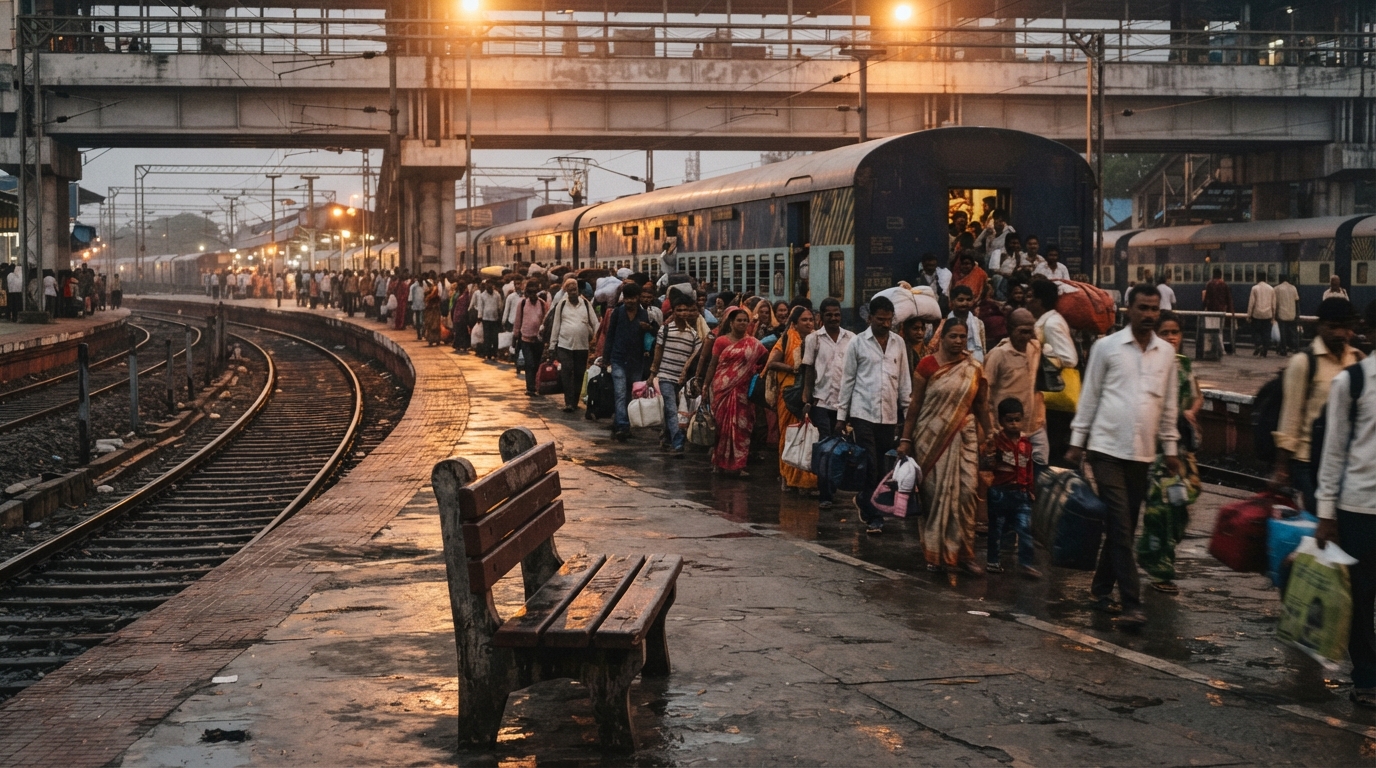
Most large crowd figures in India are official estimates built from sampling, cameras, and transport data. The key distinction is between total footfall over many days and the peak crowd in one place. The 66 crore Kumbh figure is a cumulative total over 45 days, not the number present at once.
Cumulative footfall versus peak crowd
Cumulative footfall is the total of every visit recorded across an event's full length, while peak crowd is the number of people standing in one area at a single moment. For the 2025 Kumbh Mela, the official 66 crore figure is cumulative footfall over 45 days, not a peak crowd present at once.
Under a footfall count, a pilgrim who bathes on five different days may count five times. Drishti IAS (2025) reported that officials counted 50–60 lakh visitors on a normal Kumbh day. Main bathing days ran far higher than the 50–60 lakh normal-day level. The Wire questioned whether the 66 crore total was plausible, given those daily levels. Students should always ask whether a source is giving a cumulative footfall figure or a peak crowd figure.
The tools behind the 2025 count
The Uttar Pradesh government promised the "world's largest AI-powered headcount" before the 2025 mela (Webindia123/IANS, December 2024). Its system combined several data streams:
- About 2,700 CCTV cameras, with 1,800 inside the mela area (Drishti IAS, 2025)
- AI-based software for crowd prediction and density estimates
- Railway data covering 17,152 trains and 4.24 crore passengers at nine key stations (Railways Minister Ashwini Vaishnaw, via The Wire, February 2025)
- Road traffic and parking counts at entry points
Railway numbers offer a useful cross-check. They cover only one mode of travel, so they can't confirm the full total alone.
How to cite these figures responsibly
A crowd number is only as strong as its source and method. Write "an official estimate of 66 crore" rather than "66 crore people attended." Name the body that released it and the time window it covers. Avoid comparing a 45-day total with a one-day total as if they were equal. These habits make a school project or lesson plan far more accurate.
Which Indian record events happened outside a single venue?
India also holds records for events spread across the whole country. The 2024 Lok Sabha election involved about 642 million voters. The 26 November 2020 general strike drew about 250 million participants, according to Guinness World Records. These are mass participation events rather than crowds in one place.
The 2024 Lok Sabha election
Polling ran in seven phases from 19 April to 1 June 2024, with results declared on 4 June. Chief Election Commissioner Rajiv Kumar put the number of voters at 642 million, with 65.79% turnout (The Statesman, 2024). Election Commission of India data released later revised the figure to 646.4 million (Business Standard, December 2024). In December 2024, the ECI published what it calls the world's largest electoral dataset. The election is a record of participation, held at booths in every state. For other milestones from this period, see our timeline of Indian events from 2000 to 2025.
26 November 2020: the largest general strike
About 250 million people joined a nationwide general strike on 26 November 2020. Guinness World Records lists it as the "largest general strike." Ten central trade unions called it, together with farmer groups. Participants stayed away from work rather than gathering at one site. The record shows that some of India's largest events happen in many towns at once.
22 January 2024: Ayodhya consecration
The Ram Mandir in Ayodhya was consecrated on 22 January 2024. About half a million people visited on its first public day, the day after the ceremony (CNN, 2024). Unlike the election or strike, this was a single-site crowd. It sits on a smaller scale than the Kumbh but drew national attention as a dated milestone.
What have recent crowd disasters taught India about large events?
A series of deadly crushes between 2024 and 2026 showed that India's crowd planning has not kept pace with its crowd sizes. Inquiries have blamed organisers and passive local officials. The Observer Research Foundation (2025) notes that, apart from NDMA guidelines, no state or city follows a uniform protocol for large events.
A timeline of crushes, 2024–2026
Most lists of record gatherings skip this part of the story. The dates below come from news reports and official statements:
- July 2024, Hathras: 121 people died at a religious gathering in Uttar Pradesh.
- 29 January 2025, Prayagraj: police first reported 30 dead and 60 injured on Mauni Amavasya. Other sources put the toll at 37–82 (Tribune; Wikipedia, 2025).
- 4 June 2025, Bengaluru: 11 people died at the RCB IPL victory celebration at Chinnaswamy Stadium (AIR News, 2025).
- June 2025, Puri: 3 people died and hundreds were injured during the Rath Yatra (Odisha Connect; The Logical Indian, 2025).
- 27 September 2025, Karur: 41 people died at a political rally in Tamil Nadu (Al Jazeera, 2025).
- 31 March 2026, Nalanda: 8 people died at a fair at Sheetla Mata Temple in Bihar (IANS/NewsGram, 2026).
What the inquiries found
The judicial commission on Hathras reported its findings in March 2025. It blamed the organisers and cleared the preacher known as "Bhole Baba." It also recommended laws against superstition (India TV; LatestLY, 2025). The commission found that local police and administration stayed passive. They left crowd control entirely to the organisers' volunteers, known as sevadars (Madhyamam, 2025). A judicial probe was ordered after the Kumbh crush, and Odisha ordered one after Puri.
The policy gap
The National Disaster Management Authority has issued guidelines for managing crowds at events and venues. Adoption is uneven, and each state and city runs events its own way. The Observer Research Foundation (2025) argues that crowds are always vulnerable. It says tragedies come from failing to "plan, learn, and act." Huge totals like 66 crore make headlines, but the safety record depends on the peak moments.
Related Reading
- What Are the Major Events in Indian History? (FAQ Archive)
- 25 Historic Indian Events from 2000 to 2025: A Timeline
- Historic Milestones of Indian Cinema on the Global Stage
- Historic Milestones in Indian Athletics: Track and Field Records
FAQ
Q: What is the largest recorded gathering in Indian history? The 2025 Maha Kumbh at Prayagraj holds the largest reported figure, with an official estimate of 66 crore (660 million) pilgrims. That number is a cumulative total across 45 days, from 13 January to 26 February 2025. It is not the number of people present at any one time.
Q: When did UNESCO recognise the Kumbh Mela? UNESCO added the Kumbh Mela to its Intangible Cultural Heritage list in December 2017. It described the festival as the world's largest peaceful gathering of pilgrims. The listing covers the tradition across all four host cities.
Q: Are there reliable crowd figures for the Dandi March or Gandhi's funeral? No trusted headcounts exist for these events. The Dandi March began on 12 March 1930 with 78 marchers, and many more joined along the way. Gandhi's funeral on 31 January 1948 drew vast crowds, but no reliable count survives.
Q: Why do different sources give different numbers for the same event? Sources use different methods and time windows. Some report daily peaks, while others add up visits over weeks. Official, organiser, and media figures can also differ, so always note who released a number and how it was measured.
Pick one date from the table in this guide, such as 26 November 2020 or 12 March 1930, and look it up in the IndiaOnThisDay Browse Dates archive. Read the event card, then write a one-line note naming the source and whether its figure is a peak or a total. That small habit will sharpen how you read every crowd record you meet in a textbook or news report about historic Indian events and gatherings.
Sources
- Maha Kumbh 2025: World's Largest Religious Congregation Concludes, 66 Crore Took Holy Dip; CM Yogi Thanks PM Modi — ETV Bharat, 2025. Supports: The 2025 Maha Kumbh at Prayagraj (13 Jan–26 Feb) had an official Uttar Pradesh government estimate of 66 crore pilgrims over 45 days.
- 66 Crore Visitors, 30 Dead in Stampede, Why Govt's Maha Kumbh Numbers Don't Add Up — The Wire, 2025. Supports: Railways Minister Ashwini Vaishnaw's figures of 17,152 trains and 4.24 crore passengers, and the questions over whether the 66 crore total is plausible.
- Largest general strike — Guinness World Records, 2020. Supports: About 250 million people joined India's nationwide general strike on 26 November 2020, which Guinness lists as the "largest general strike."
- Inscription of Kumbh Mela on the Representative List of Intangible Cultural Heritage of Humanity — District Administration Prayagraj, Government of India, 2017. Supports: UNESCO added the Kumbh Mela to its Intangible Cultural Heritage list in December 2017.
- We Have Created World Record Of 642 Million Voters, Says CEC Rajiv Kumar On Lok Sabha Elections 2024 — India.com, 2024. Supports: Chief Election Commissioner Rajiv Kumar put the number of voters in the 2024 Lok Sabha election at 642 million.
- Photos: Ayodhya Ram Mandir temple saw half a million visitors on its first day open to the public — CNN, 2024. Supports: About half a million people visited the Ayodhya Ram Mandir on its first public day, the day after the 22 January 2024 consecration.
- Hathras Stampede: Judicial Commission Gives Clean Chit to 'Bhole Baba' Aka Suraj Pal in 2024 Stampede Which Claimed 121 Lives in UP, Holds Event Organizers Responsible — LatestLY, 2025. Supports: The Hathras judicial commission, investigating the July 2024 stampede that killed 121, blamed the organisers and cleared "Bhole Baba."
- Human Flow, Systemic Flaws: Rethinking Safety at Mass Gatherings in India — Observer Research Foundation, 2025. Supports: ORF's argument that crowds are always vulnerable but tragedies come from failing to "plan, learn, and act," and its point about gaps in crowd-safety planning.