Ancient Indian Empires Timeline: From the Indus Cities to the Guptas
TL;DR
An ancient Indian empires timeline begins with the Indus Valley Civilization (mature phase c. 2600–1900 BCE). It moves through the Vedic age, the Mahajanapadas and Magadha's Nandas. Then come the Mauryas (c. 321–185 BCE), regional powers like the Satavahanas and Kushans, and the Guptas (c. 320–550 CE). Southern Chera, Chola and Pandya kingdoms ran in parallel.
Key Takeaways
- Indian empires overlapped, so a single straight line hides the southern kingdoms.
- The Maurya Empire covered an estimated 3.4 to 5.0 million km² at its peak.
- Many ancient dates are approximate, and the Gupta start date is still debated.
- The Indus script remains unread despite a $1 million prize announced in 2025.
- Keeladi's radiocarbon dates place a Tamil Nadu settlement as early as c. 580 BCE.
Ananya is a Class 11 student in Madurai with a history test on Monday. Her textbook shows a neat chain of empires moving from Pataliputra to Ujjain. Then her teacher mentions Keeladi, a dig site about 12 km from the city. Its radiocarbon dates go back to roughly 580 BCE, and suddenly the neat chain looks incomplete.
That gap is the main weakness of most ancient Indian empires timeline charts. They're tidy. The evidence isn't. This guide lays out the standard sequence students need for exams. It also marks where dates are firm, where they're estimates, and where scholars still disagree.
The Ancient Indian Empires Timeline at a Glance
The core sequence runs from Indus cities to Vedic communities, then the Mahajanapadas, Magadha, the Mauryas, a period of regional powers, and the Guptas. Most textbooks end the ancient period around 550–650 CE. The table below gives approximate dates, key centres and the main evidence for each stage.
| Period or empire | Approx. dates | Key centre | Notable ruler or feature | Main evidence |
|---|---|---|---|---|
| Indus Valley (mature phase) | c. 2600–1900 BCE | Harappa, Mohenjo-daro, Dholavira | Planned cities, undeciphered script | Excavations, seals |
| Vedic period | c. 1500–500 BCE | Punjab, Ganga plain | Composition of the Rigveda | Oral texts |
| Mahajanapadas | c. 600–345 BCE | Magadha, Kosala, Avanti | 16 rival states | Buddhist and Jain texts |
| Nanda dynasty | c. 345–321 BCE | Pataliputra | Mahapadma Nanda | Greek and Indian texts |
| Maurya Empire | c. 321–185 BCE | Pataliputra | Chandragupta, Ashoka | Ashokan edicts, Megasthenes |
| Shunga dynasty | c. 185–73 BCE | Pataliputra, Vidisha | Pushyamitra Shunga | Inscriptions, Bharhut stupa |
| Satavahanas | c. 1st century BCE–3rd century CE | Pratishthana (Paithan) | Gautamiputra Satakarni | Coins, Nashik inscriptions |
| Kushan Empire | c. 30–375 CE | Purushapura, Mathura | Kanishka | Coins, Rabatak inscription |
| Sangam kingdoms | c. 300 BCE–300 CE | Madurai, Uraiyur, Vanji | Cheras, Cholas, Pandyas | Tamil poetry, Keeladi |
| Gupta Empire | c. 320–550 CE | Pataliputra | Samudragupta, Chandragupta II | Allahabad pillar, gold coins |
How to read ancient dates
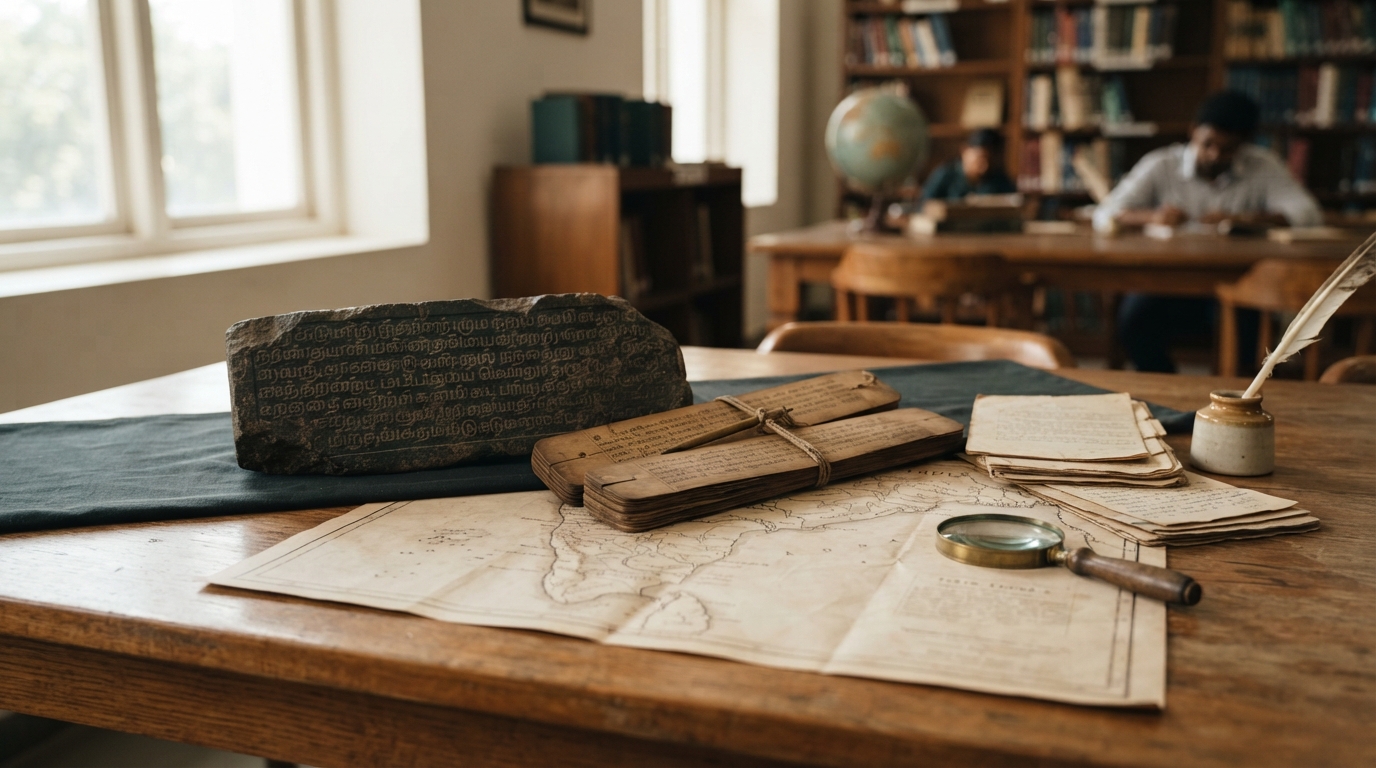
The letter "c." stands for circa, meaning "about." BCE years count down toward year 1, so 321 BCE comes before 185 BCE. Most dates before the Mauryas rest on texts and modern reconstruction, not on dated records.
One anchor holds the whole chain together. In 1793, the scholar William Jones matched "Sandrokottos" in Greek accounts with Chandragupta Maurya. Greek sources date Alexander's campaign in north-west India to 326 BCE. That link gave Indian chronology its first fixed point.
Where the ancient period ends
Textbooks don't agree on an end date. Some stop at the Gupta decline around 550 CE. Others stop at the death of Harsha in 647 CE. For a broader view of what follows, our Indian history timeline chart carries the sequence forward into the medieval and modern eras.
How Did Early Cities and Kingdoms Grow Into Empires?
India's first empire grew out of more than 2,000 years of earlier change. Indus cities came first, then the Vedic communities of the north, then sixteen rival states called Mahajanapadas. Magadha, a kingdom based in south Bihar, beat its neighbours one by one. By about 345 BCE, its Nanda kings ruled most of the Ganga plain.
The Indus Valley Civilization (c. 2600–1900 BCE)
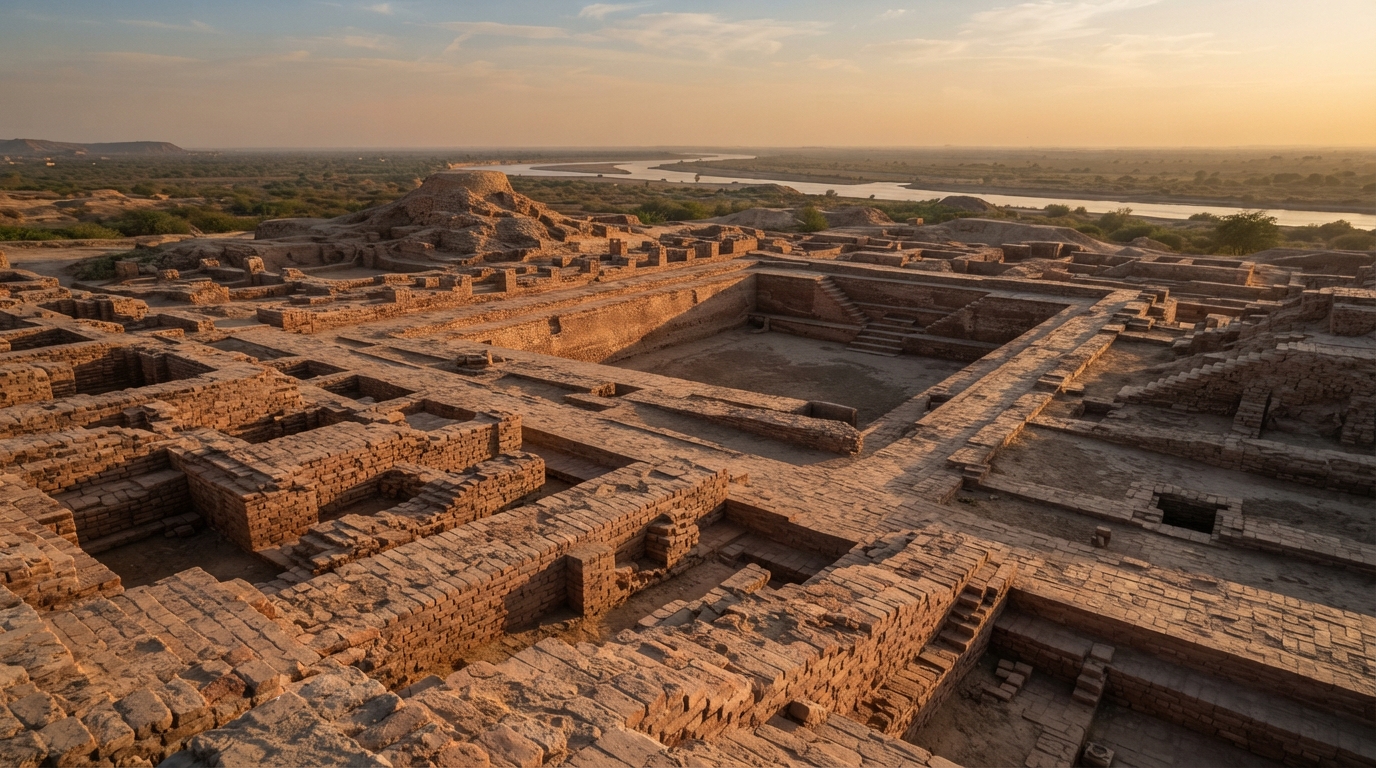
The Indus cities reached their mature phase between about 2600 and 1900 BCE, according to ClearIAS (2025). Sites like Mohenjo-daro and Dholavira had grid streets, drains and standard brick sizes. Their script is still undeciphered.
Here's a point many timelines skip. The Indus Valley was a civilization, not an empire. Archaeologists haven't found clear palaces, royal tombs or named kings. We know its reach from shared seals, weights and pottery instead.
That reach keeps growing. In 2025, Harappan remains turned up near Jaisalmer in Rajasthan, as reported by WION. Finds included pottery, bangles, bricks and a furnace, and reports called it the first Harappan site in the Thar desert. Our planned Indus Valley Civilization timeline will track sites like this one.
The Vedic period and the Mahajanapadas
The Rigveda was likely composed around 1500–1000 BCE, though this is an estimate. Early Vedic society was pastoral and based in Punjab. Later, communities moved east into the Ganga plain. Iron tools helped clear forests for farming there.
By about 600 BCE, Buddhist texts such as the Anguttara Nikaya list sixteen Mahajanapadas, or "great realms." Key names to remember:
- Magadha, in south Bihar
- Kosala, around Ayodhya and Shravasti
- Avanti, centred on Ujjain
- Vatsa, with its capital at Kaushambi
Magadha's rise and the Nandas
Magadha won for practical reasons. It had fertile land, iron deposits nearby and rivers for transport. Kings Bimbisara and Ajatashatru of the Haryanka dynasty expanded it in the 6th and 5th centuries BCE.
The Nandas took over around 345 BCE. Greek writers describe their large army. In 326 BCE, Alexander's troops refused to cross the Beas River, and accounts of the Nanda forces are often cited as one reason.
Was the Maurya Empire a Network or a Solid Block?
The Maurya Empire (c. 321–185 BCE) was the largest state in ancient South Asia, covering an estimated 3.4 to 5.0 million km² around 261–250 BCE. Recent scholarship, summarised in Encyclopedia.com and WarHistory.org entries, describes the Maurya Empire as core regions linked by roads and rivers. That network picture replaces the older idea of one evenly governed block of land.
Chandragupta and Pataliputra
Chandragupta Maurya overthrew the Nandas around 321 BCE. Tradition credits his adviser Chanakya, also called Kautilya, with planning the move. Around 303 BCE, Chandragupta made a treaty with Seleucus I. Greek sources say Chandragupta gave 500 war elephants in the deal.
Chandragupta's capital was Pataliputra, near modern Patna. The Greek envoy Megasthenes described Pataliputra as a large walled city along the Ganga. Visitors to Patna today can see Mauryan remains at Kumhrar.
You'll often see a population figure of 50 million for Chandragupta's empire. Treat that figure with care. The 50 million number comes from a secondary encyclopedia (New World Encyclopedia, 2021), not a primary estimate.
What Did Ashoka Do After the Kalinga War?
Ashoka was the Maurya emperor who ruled from about 268 to 232 BCE and fought the Kalinga war, in present-day Odisha, around 261 BCE. Ashoka's own Rock Edict XIII records that 100,000 people were killed and 150,000 were deported. Rock Edict XIII expresses regret and marks Ashoka's turn toward dhamma, a moral code of conduct.
Ashoka's inscriptions appear in Prakrit, Greek and Aramaic. The Ashokan edicts use the Brahmi and Kharosthi scripts. James Prinsep deciphered Brahmi in 1837, and Prinsep's work made the edicts readable again after centuries. For more on both dynasties, see our guide to the Maurya and Gupta empires.
Why the old maps mislead
Older histories described the Mauryas as a uniform, centralized bureaucracy. Encyclopedia.com and WarHistory.org entries note that recent work traces this picture to modern theories of the state. The Mauryan sources don't support it as strongly.
Ashoka's edicts cluster along trade routes and river valleys. Large forest zones between them were probably governed loosely or not at all. A solid shaded map hides that.
This creates a real tradeoff for students. Exam answers usually expect the solid-map version. We'd recommend learning that map for the exam, and remembering that it simplifies a patchy reality. The Maurya Empire ended around 185 BCE, when Pushyamitra Shunga killed the last Maurya ruler, Brihadratha.
The Centuries Between the Mauryas and Guptas Were Crowded
The roughly 500 years between the Mauryas and the Guptas weren't a dark age. Power split among regional dynasties: the Shungas in the Ganga plain, the Satavahanas in the Deccan, Kharavela in Kalinga, and Central Asian rulers like the Kushans in the north-west. Trade, coinage and Buddhist art all grew in this period.
Shungas, Kanvas and Satavahanas
The Shungas held the Ganga heartland from about 185 to 73 BCE. Carvings at the Bharhut stupa date to this era. The short-lived Kanva dynasty followed them.
In the Deccan, the Satavahanas ruled from Pratishthana, modern Paithan in Maharashtra. Their dates are debated, roughly the 1st century BCE to the 3rd century CE. Gautamiputra Satakarni is the best-known ruler. A Nashik cave inscription by his mother, Gautami Balashri, records his victories.
Indo-Greeks, Shakas and Kushans
Several groups from the north-west ruled parts of India in this era:
- Indo-Greeks, including Menander (Milinda), who ruled around 150 BCE
- Shakas, or Indo-Scythians, who later ruled western India from Ujjain
- Kushans, from about 30 CE, with capitals at Purushapura (Peshawar) and Mathura
Kanishka is the best-known Kushan king. Many historians date his reign from around 127 CE. The Saka era, starting in 78 CE, still matters today. India's national calendar, adopted in 1957, is based on it.
Who Was Kharavela of Kalinga?
Kharavela was a king of Kalinga, in present-day Odisha, who ruled in the 1st century BCE, after Kalinga recovered from Ashoka's conquest around 261 BCE. Kharavela's Hathigumpha inscription at Udayagiri, near Bhubaneswar, lists his military campaigns year by year, so historians can follow his reign in sequence.
The Hathigumpha inscription is one of the few ancient Indian records arranged like a reign diary. For students, Kharavela's record shows Kalinga acting as an independent regional power again in the 1st century BCE, alongside the Shungas and Satavahanas.
Where Do the Guptas and the Southern Kingdoms Fit?
The Guptas ruled much of north India from about 320 to 550 CE, though some historians place the family's origins as early as 240 CE. The far south had its own long history at the same time. Sangam-era Cheras, Cholas and Pandyas traded with Rome, and Keeladi shows a settlement there by c. 580 BCE.
Gupta rulers and their dates
The Gupta era begins in 319–320 CE, linked to Chandragupta I. The family's founder, Sri Gupta, is dated anywhere from c. 240 to 280 CE. That's why sources give different start dates.
Key rulers and events:
- Samudragupta expanded the empire. His poet Harisena recorded his conquests on the Allahabad pillar.
- Chandragupta II ruled around 375–415 CE. The Chinese pilgrim Faxian travelled in India during his reign.
- Aryabhata completed the Aryabhatiya, a work on astronomy and mathematics, in 499 CE.
- Skandagupta fought off Huna attacks in the mid-5th century.
The "Golden Age" label is popular. It mostly describes north India, though, and it leaves out the south.
The Sangam kingdoms and Keeladi
Tamil Sangam poetry describes three ruling families: the Cheras, Cholas and Pandyas. Roman coins found across south India point to busy sea trade. Muziris, on the Kerala coast, was a major port.
Keeladi, near Madurai, adds hard dates. Radiocarbon tests place the settlement around 580–200 BCE. The site covers 32.37 hectares, according to Tamil Nadu State Archaeology. The ASI dug there from 2014 to 2017. The Tamil Nadu archaeology department took over in 2018.
The site's dating is disputed. In 2025, Union Culture Minister Gajendra Singh Shekhawat said excavator Amarnath Ramakrishna's report was not "technically well-supported" (Vajiram, June 2025). The ASI says it raised concerns about the report's methods and chronology, and the report remains unpublished (The Federal, July 2025). Students should note both the dates and the open review. We're planning a fuller Sangam age timeline on this period.
Who Ruled After 550 CE? Chalukyas, Pallavas and Harsha
The post-Gupta period after 550 CE is the era when regional dynasties replaced Gupta rule. The Chalukyas of Badami rose from 543 CE under Pulakeshin I, the Pallavas ruled from Kanchipuram, and Harsha ruled north India from Kannauj between 606 and 647 CE. Many textbooks close the ancient period with Harsha's death in 647 CE.
The Chalukyas and Pallavas ruled the Deccan and the far south in the same era as Harsha. Pulakeshin II, a later Chalukya king of Badami, stopped Harsha's push south at the Narmada River.
Why the Ancient Indian Empires Timeline Keeps Changing
Ancient Indian history is still being revised. Scripts remain unread, key numbers rest on modern estimates, and new digs shift dates and borders. In 2025 alone, a Harappan site turned up near Jaisalmer, and a $1 million Indus script prize drew global attention. The Piprahwa gems also returned to India.
The Indus script puzzle
In January 2025, Tamil Nadu Chief Minister M.K. Stalin offered a $1 million prize for deciphering the Indus script. He announced it at a Chennai conference marking 100 years since John Marshall announced the civilization's discovery (Archaeology Magazine; Business Standard, 2025). The ASI also held a three-day national conference in Greater Noida, titled "Decipherment of Indus Script: Current Status and Way Forward."
Scholars are testing new approaches. Victor Mair of the University of Pennsylvania discussed fresh methods and the prize's effect on Language Log in March 2025. Independent researcher Bahata Ansumali Mukhopadhyay, covered by the New York Times in 2025, argues that ancestral Dravidian languages were widely spoken in the civilization. She suggests the seals may record trade, taxation and control of goods.
Which Ancient Indian Numbers Are Disputed?
Disputed numbers are headline figures about ancient India, such as world GDP share or Gupta population, that circulate widely online without solid sourcing. Estimates based on Angus Maddison's work put India at about 32% of world GDP in 1 CE (ThePrint, 2023). A higher 33–35% figure for the Gupta era, found on Wikipedia, rests on loose secondary citations.
Big figures travel fast online. The sources behind those figures often don't. The Maddison-based 32% estimate at least has a named method behind it, while the 33–35% Gupta-era figure does not.
We found no reliable figures for the Gupta Empire's land area or population. Any site that gives one exact number for Gupta area or population should show its source. If the site doesn't, treat the number as a guess.
Heritage returns: the Piprahwa gems
William Claxton Peppé dug up the Piprahwa relics in 1898, near the India–Nepal border. The find included 334 gems linked to the Buddha's remains. In 2025, Sotheby's Hong Kong withdrew them from auction after India threatened legal action. They returned in July 2025, 127 years after leaving (Artnet; ABC News, 2025). An Indian businessman bought them, which raised ethics questions about private ownership of sacred objects.
Museums abroad are revisiting this history too. The British Museum opened "Ancient India: Living Traditions," curated by Sushma Jansari, in May 2025. To build these events into a study plan, try our guide on learning Indian history with chronological timelines.
Related Reading
- Indian History Milestones: The Maurya and Gupta Empires
- Indian History Timeline Chart: Key Milestones (Digital Reference)
- 25 Historic Indian Events from 2000 to 2025: A Timeline
- Milestones in Indian Women's History: A Chronological Guide
FAQ
Q: Which was the first empire in ancient India? Most historians call the Maurya Empire (c. 321–185 BCE) India's first large empire. Magadha under the Nandas was a strong earlier kingdom. It didn't reach the same size, though.
Q: What is the correct order of ancient Indian empires? The standard order is Indus Valley, Vedic period, Mahajanapadas, Nanda, Maurya, Shunga, Satavahana and Kushan, then Gupta. The Sangam kingdoms of the south ran alongside several of these. Many students list them separately for that reason.
Q: Why is the Gupta period called a Golden Age? The label reflects advances in mathematics, astronomy, Sanskrit literature and art, such as Aryabhata's work in 499 CE. Many historians now treat the term with caution. It mainly describes north India and elite culture.
Q: Was the Indus Valley Civilization an empire? No clear evidence shows a single ruler or capital. Archaeologists see shared standards in bricks, weights and seals across a wide area. Until the script is read, its political system remains unknown.
Draw a two-column chart today covering 600 BCE to 650 CE, with north Indian empires on the left and southern kingdoms on the right, and mark every date that's still debated with a question mark. That one sheet turns a flat ancient Indian empires timeline into an honest study tool. Keep it beside you when you check each day's events on IndiaOnThisDay.
Sources
- Tamil Nadu CM announces $1 million for deciphering Indus Valley script: Business Standard, 2025. Supports: M.K. Stalin offered a $1 million prize for deciphering the Indus script at a Chennai conference marking the centenary of John Marshall's discovery.
- Decipherment of Indus Script: Current Status and Way Forward: Archaeological Survey of India, 2025. Supports: The ASI held a national conference under this title in Greater Noida (20–22 August 2025).
- Unknown Harappan settlement discovered in Thar desert for the first time: WION, 2025. Supports: Harappan remains, including pottery and a furnace, were found near Jaisalmer, the first Harappan site reported in the Thar desert.
- Keeladi report: Politics, proof, and buried history: The Federal, 2025. Supports: Union Culture Minister Gajendra Singh Shekhawat said the Keeladi findings were "not technically well supported," and Amarnath Ramakrishna's report remains in dispute.
- Under Ashoka, Chandragupta, India accounted for 32% of the world's GDP: ThePrint, 2023. Supports: Estimates based on Maddison's work put India at about 32% of world GDP in 1 CE.
- Sacred Piprahwa relics of Lord Buddha return home after 127 years: All India Radio News, July 2025. Supports: The Piprahwa relics, found in 1898, came back to India in July 2025 after 127 years, after they had appeared at an international auction.
- Buddhist gem relics return to India after Hong Kong auction halted: The Value, 2025. Supports: Sotheby's pulled the Piprahwa gems from its Hong Kong auction, and an Indian buyer (Godrej Industries Group) acquired them before they returned to India.
- Ancient India: living traditions: British Museum, 2025. Supports: The British Museum opened "Ancient India: Living Traditions" in May 2025 (22 May–19 October), curated by Sushma Jansari.