The Quick Read
Indian immigration history in North America is a timeline that began in the 1890s, not the 1960s. Punjabi Sikh workers reached British Columbia around 1903 and moved south into Washington, Oregon, and California. Exclusion laws in Canada and the United States slowed Indian migration for nearly four decades, from Canada's 1908 continuous journey rule until the U.S. Luce-Celler Act of 1946.
Doors reopened with the U.S. Luce-Celler Act in 1946, Canada's 1947 reforms, and the 1965 Hart-Celler Act. The scale of migration since then is large. About 3.2 million Indian immigrants lived in the U.S. in 2024, according to the Migration Policy Institute (MPI, 2026).

Key Takeaways
- Indian migration to North America started in British Columbia around 1903, not 1965.
- Canada's 1908 "continuous journey" rule blocked most Indian arrivals until 1947.
- The 1923 Thind ruling stripped over fifty South Asian Americans of citizenship.
- Punjabi men in California formed families with Mexican women when the law barred new arrivals.
- The U.S. and Canadian stories are one connected history across a shared border.
Many people believe Indian immigration history in North America began with the engineers and doctors who arrived after 1965. That belief misses six decades of history. The first wave came in the early 1900s. It was made up mostly of Punjabi Sikh farmers and former soldiers who landed in Vancouver and worked in lumber mills, on railroads, and in orchards. They faced riots, exclusion laws, and court rulings that took away their citizenship. This timeline follows those early arrivals date by date, across both Canada and the United States.
Why Does Indian Immigration History in North America Start in Canada?
The story starts in Canada because British Columbia was the first stop. Indians were British subjects, and Canada was part of the British Empire. That made Vancouver an easier entry point than San Francisco. Many of the first Indians in the United States crossed south from Canada after arriving there.
1897: Soldiers Pass Through British Columbia
The first recorded Punjabi visitors to British Columbia were Sikh soldiers. They passed through in 1897 on their way home from Queen Victoria's Diamond Jubilee in London, according to the Canadian Encyclopedia. These men saw a lightly populated province with plenty of work. Some carried word of it back to Punjab. Within a few years, small groups began making the long sea journey via Hong Kong. The jubilee trip was a military event, not a migration. Still, it planted the idea.
1903 to 1908: The First Wave Lands in Vancouver
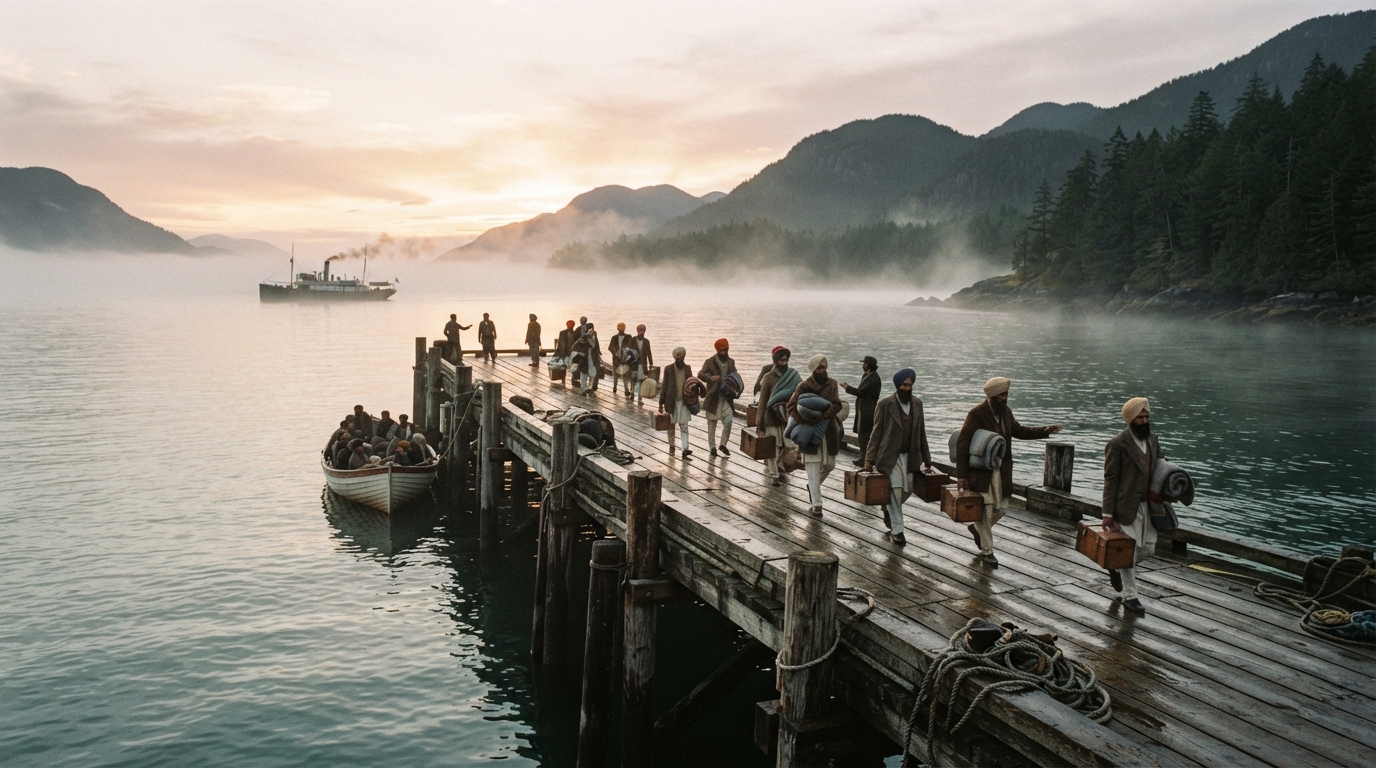
Real migration began around 1903. More than 5,000 South Asians came to British Columbia before Canada restricted their entry, and more than 90 percent of them were Sikhs, according to the Canadian Encyclopedia. Most were young men from rural Punjab. Many had served in the British Indian Army. They took jobs in sawmills, on the Canadian Pacific Railway, and in land clearing. Wages in BC were far higher than anything available at home. That gap pulled thousands across the Pacific in just five years.
Moving South: Washington, Oregon, and California
The border was easy to cross in this era. Sikhs first arrived in the United States by way of Vancouver, according to the Pluralism Project at Harvard. They moved into lumber towns in Washington and Oregon, then down to California farms. That movement brought conflict. On September 4, 1907, about five hundred white working men in Bellingham, Washington, gathered to drive out a community of South Asian mill workers, according to the University of Washington Civil Rights and Labor History Project. Most of the targeted workers fled the city within days. Many headed north to Canada or south to California.
Exclusion Laws Shaped the First Four Decades
From 1908 to 1946, laws in both countries were written to keep Indians out. Canada used shipping rules and cash requirements. The United States used geographic bans and court rulings on race. Together, these laws froze the Indian population in North America at a few thousand people for nearly forty years.
1908: Canada's "Continuous Journey" Rule
Canada could not ban British subjects outright without straining imperial ties. So the Canadian government found an indirect method. A 1908 regulation required immigrants to arrive by a "continuous journey" from their country of birth. No shipping line offered direct passage from India to Canada at the time. A separate rule required Asian immigrants to carry $200, a large sum for a Punjabi laborer. The continuous journey rule remained in effect until 1947, according to the Government of Canada. In practice, the rule stopped Indian migration to Canada almost completely.
1914: The Komagata Maru
Gurdit Singh, a Sikh businessman, chartered a Japanese ship called the Komagata Maru to test the rule. The Komagata Maru reached Vancouver on May 23, 1914, carrying 376 passengers, according to CBC (2016). Canadian officials refused to let most of the passengers land. The ship sat in the harbor for two months while passengers ran short of food and water. The Komagata Maru was forced to leave in July 1914. When the ship reached Budge Budge, near Calcutta, British police clashed with the returning passengers, and nineteen were killed, according to a University of Michigan journal. Prime Minister Justin Trudeau formally apologized in the House of Commons in 2016. In 2024, the City of Vancouver gave Canada Place the honorary name "Komagata Maru Place."
1917: The U.S. "Barred Zone" Act
The Barred Zone Act is the common name for the U.S. Immigration Act of 1917, a law that became effective on February 5, 1917, and created an "Asiatic Barred Zone" covering most of Asia. Unlike Canada's indirect shipping rule, the United States took a more direct route to stopping Indian migration.
The Asiatic Barred Zone was intended to prohibit the entry of migrants from India, according to the South Asian American Digital Archive (SAADA). Congress passed the Immigration Act of 1917 over President Woodrow Wilson's veto. With the Barred Zone Act in force, legal entry from India to the U.S. effectively stopped. The ban on Indian entry would stay in place for almost three decades, until the Luce-Celler Act of 1946.
Who Were the Early Pioneers?
The early pioneers were farmers, students, activists, and soldiers who built community under heavy restrictions. They founded a gurdwara in Stockton, launched a political movement against British rule, fought for citizenship in court, and formed new families in California. Their names and dates are the core of this period.
The Stockton Gurdwara and the Ghadar Party
In 1912, Sikh settlers founded a gurdwara (Sikh temple) in Stockton, California. It was the first in the United States, and for 55 years it was the only gurdwara in the western U.S., according to the California State Library. It worked as a temple, a meeting hall, and a shelter for new arrivals. One year later, in 1913, Indian workers and students formed the Ghadar Party. It was born out of a need to advocate for a free India, according to SAADA. Sources differ on where it was founded. Some point to Astoria, Oregon, and others to San Francisco, where the party ran its newspaper. Either way, the Ghadar movement shows that early migrants stayed deeply tied to events back home.
Bhagat Singh Thind and Vaishno Das Bagai
U.S. citizenship law in the 1920s was open only to "free white persons" and people of African descent. Bhagat Singh Thind, a Sikh U.S. Army veteran, argued that Indians were Caucasian and therefore white. On February 19, 1923, the Supreme Court ruled against him in United States v. Bhagat Singh Thind. The decision led to the denaturalization of over fifty South Asian Americans who had already become citizens, according to SAADA. Vaishno Das Bagai was one of them. He lost his citizenship, his store, and his ability to travel on a U.S. passport. Bagai took his own life in 1928 and left a letter describing the loss. His case shows the human cost of a single court ruling.
Punjabi-Mexican Families in California
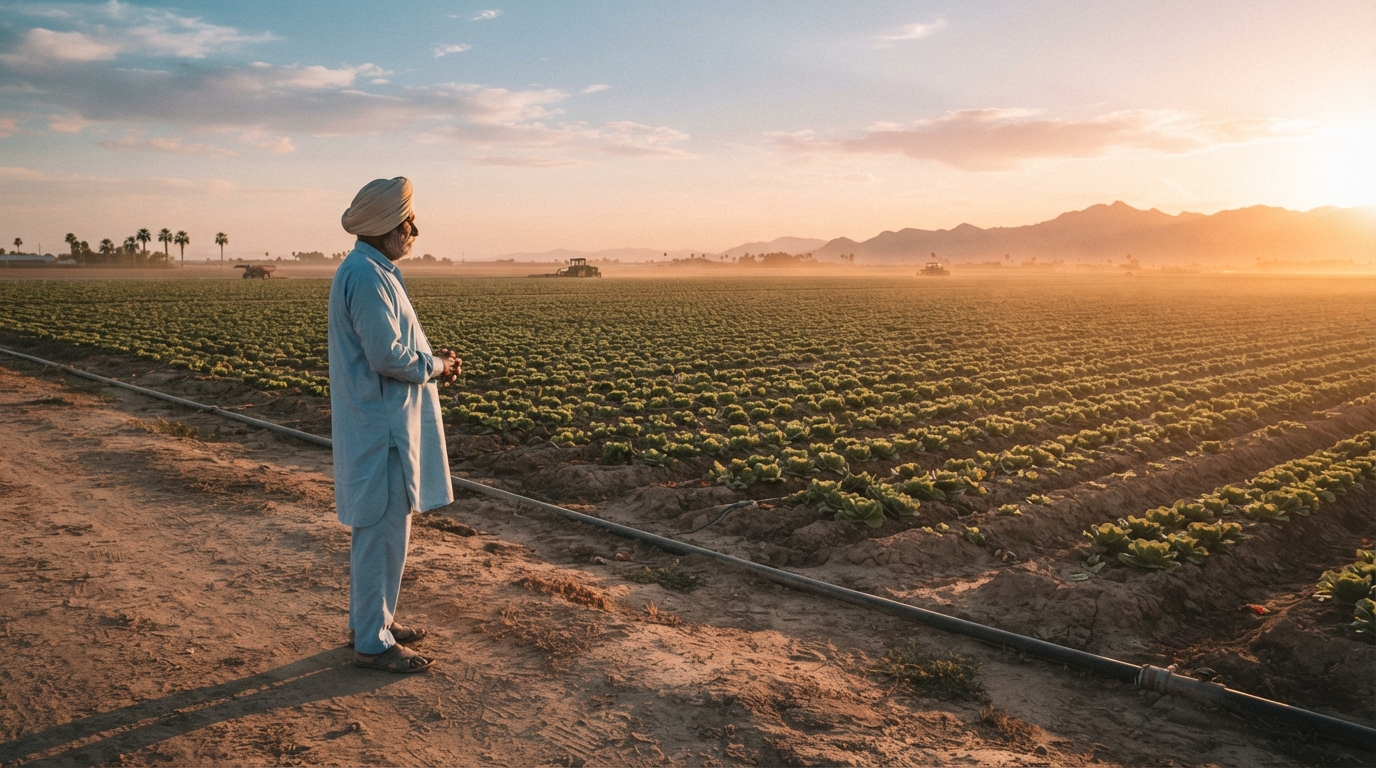
California's 1913 Alien Land Law barred noncitizens from owning farmland. The 1917 ban also meant Punjabi men could not bring wives from India. Many married Mexican women who worked alongside them in the Imperial and Sacramento valleys. By 1946, an estimated 400 Punjabi families lived in California, and 80 percent were Punjabi men married to Mexican women, according to the Karen Leonard archives at Dartmouth. Leonard, a historian at UC Irvine, has noted that the two groups shared similar rural cultures. At the county records office, both partners could mark their race as "brown." Some families still run restaurants and farms in Yuba City today.
The Doors Reopened Between 1946 and 1967
The reopening of North America to Indian immigrants was a staged process that unfolded between 1946 and 1967, after World War II. The U.S. Luce-Celler Act of 1946 allowed 100 Indians a year to immigrate and to naturalize. Canada dropped its continuous journey rule in 1947. The U.S. Hart-Celler Act of 1965 and Canada's 1967 points system then removed national-origin barriers.
Together, the 1965 and 1967 reforms opened the door to large-scale skilled migration. The Indian immigrant population in the U.S. increased fivefold from 1980 to 2000, according to the Migration Policy Institute (MPI, 2026).
1946: The Luce-Celler Act
President Harry Truman signed the Luce-Celler Act on July 2, 1946. The Luce-Celler Act allowed 100 Indians a year to immigrate and gave Indians the right to naturalize, according to Bryn Mawr College's historical records. One hundred a year was a tiny number. The bigger change was citizenship. For the first time since the 1923 Thind ruling, Indians already living in the U.S. could become citizens and own land in their own names. India's independence followed a year later, on August 15, 1947. In Canada, 1947 also brought the end of the continuous journey rule and voting rights for South Asians in British Columbia.
1956: Dalip Singh Saund Goes to Congress
Dalip Singh Saund came to the U.S. as a student in 1920 and earned a PhD at UC Berkeley. Saund farmed in the Imperial Valley and became a citizen in 1949, after Luce-Celler made naturalization possible. In 1956, Saund became the first Asian American, first Indian American, and first Sikh elected to Congress, according to Britannica. Saund represented a California district for three terms. His career went from legal exclusion to federal office in less than a decade after naturalization.
1965 and 1967: The Skilled Migration Era
The Immigration and Nationality Act of 1965, known as Hart-Celler, ended the national-origin quota system in the U.S. Canada adopted a points-based system in 1967. Both systems favored education and job skills. The shift to skills-based selection changed who came. Instead of Punjabi farmers, the new arrivals were often doctors, engineers, and scientists from across India. Historians often call this period the "brain drain." The growth that followed was steep. The Indian immigrant population in the U.S. increased fivefold from 1980 to 2000, according to the Migration Policy Institute (MPI, 2026).
Indian Immigration History in North America Reaches Far Beyond Punjab
The full story of Indian migration to Canada and the United States is broader than Punjabi pioneers and post-1965 professionals. Indo-Caribbean families arrived by a separate route through Trinidad and Guyana, beginning with indentured laborers who reached British Guiana on May 5, 1838. Present-day population figures show how far that migration has grown.
The scale today is measurable. Statistics Canada counted 1,858,755 Indian Canadians in the 2021 census, and the Migration Policy Institute (MPI, 2026) reports about 3.2 million Indian immigrants in the U.S. in 2024. A date-based reference helps students track every milestone across both countries.
The Indo-Caribbean Route
Many people of Indian descent in Toronto and New York did not come from India directly. Their ancestors were indentured laborers taken to British Caribbean colonies after slavery ended. The first ships carrying Indian indentured laborers reached British Guiana (now Guyana) on May 5, 1838. The Fatel Razack reached Trinidad on May 30, 1845, a date still marked there as Indian Arrival Day. From the 1960s onward, many Indo-Caribbean families moved north to Canada and the U.S. Most timelines leave Indo-Caribbean migrants out. A fuller account of the Caribbean route belongs in a dedicated Indian indenture timeline.
The Numbers Today
The small communities of 1910 have become two of the largest diasporas anywhere. Here are the latest figures:
- United States: About 3.2 million Indian immigrants lived in the U.S. in 2024. That is 6 percent of the 50.2 million foreign-born population, second only to Mexican immigrants (MPI, 2026).
- U.S. ancestry: In 2024, 5,559,778 people reported Indian ancestry, or 1.63 percent of the population (ACS 1-Year Estimates, 2024).
- Canada: The 2021 census counted 1,858,755 Indian Canadians, or 5.1 percent of the population (Statistics Canada, 2021).
- Skilled visas: Indian nationals received 71 percent of all U.S. H-1B visas in FY2024 (MPI, 2026).
One limitation is worth flagging for students. Reliable counts of Indians in the U.S. before 1965 are hard to find. Census categories shifted often, and records from that era don't agree. Use exact pre-1965 totals only when a primary source supports them.
A Date-by-Date Reference
This date-by-date reference is a table of 13 key milestones in Indian migration to Canada and the United States, running from the 1897 passage of Sikh soldiers through British Columbia to Canada's 1967 points-based immigration system. The table covers exclusion laws, court rulings, community institutions, and the reforms that reopened both countries.
The table works well as a study card for exams or classroom timelines.
| Date | Country | Event |
|---|---|---|
| 1897 | Canada | Sikh soldiers pass through BC after Diamond Jubilee |
| Sept 4, 1907 | U.S. | Bellingham riot drives out South Asian workers |
| 1908 | Canada | Continuous journey rule introduced |
| 1912 | U.S. | Stockton Gurdwara founded |
| 1913 | U.S. | Ghadar Party formed |
| May 23, 1914 | Canada | Komagata Maru arrives in Vancouver |
| Feb 5, 1917 | U.S. | Barred Zone Act becomes law |
| Feb 19, 1923 | U.S. | Supreme Court rules against Bhagat Singh Thind |
| July 2, 1946 | U.S. | Luce-Celler Act signed |
| 1947 | Canada | Continuous journey rule ends |
| 1956 | U.S. | Dalip Singh Saund elected to Congress |
| Oct 3, 1965 | U.S. | Hart-Celler Act signed |
| 1967 | Canada | Points-based immigration system begins |
For more on reading history through dates, see our guide on learning Indian history with chronological timelines. Our Indian history timeline chart places these events beside major milestones at home in India.
Related Reading
- Milestones in Indian Women's History: A Chronological Guide
- 1,000 Years of Indian Medical History: A Chronological Guide
- Economic Milestones in Indian History: From 1947 to Present
- What Are the Major Events in Indian History? (FAQ Archive)
FAQ
Q: When did the first Indians arrive in North America? The first recorded Punjabi visitors were Sikh soldiers who passed through British Columbia in 1897. Steady migration began around 1903, mostly into Vancouver. By 1908, more than 5,000 South Asians had arrived in BC, according to the Canadian Encyclopedia.
Q: What was the Komagata Maru incident? The Komagata Maru was a ship that reached Vancouver on May 23, 1914, with 376 passengers from India. Canadian officials refused to let most of them land under the continuous journey rule. The ship was forced back to India, where nineteen passengers were killed at Budge Budge.
Q: Why was the Thind case important? In 1923, the U.S. Supreme Court ruled that Bhagat Singh Thind could not be a citizen because Indians were not legally "white." The ruling led to the denaturalization of over fifty South Asian Americans, according to SAADA. It stayed in force until the Luce-Celler Act of 1946.
Q: Who was the first Indian American elected to Congress? Dalip Singh Saund was elected in 1956 from a California district. He was the first Asian American, first Indian American, and first Sikh in Congress, according to Britannica. He served three terms.
Q: How did the 1965 Hart-Celler Act change Indian immigration? It ended the national-origin quota system and favored skilled workers and family ties. That brought large numbers of Indian doctors, engineers, and scientists to the U.S. The Indian immigrant population grew fivefold from 1980 to 2000, according to MPI.
Pick one date from the reference table and trace it to a primary source today. The Komagata Maru passenger list, the full text of the 1923 Thind decision, and the Stockton Gurdwara's founding records are all available through public archives like SAADA and the Library and Archives Canada. Reading one original document will show you more about this period than any summary can, and it will give you a fact you can cite with confidence in class or in your own writing.
Sources
- Indian Immigrants in the United States — Migration Policy Institute, 2026. Supports: About 3.2 million Indian immigrants lived in the U.S. in 2024, which is 6 percent of the 50.2 million foreign-born population and second only to Mexican immigrants. Indian nationals also received 71 percent of H-1B visas in FY2024.
- Sikhism in Canada — The Canadian Encyclopedia. Supports: More than 5,000 South Asians came to British Columbia before Canada restricted their entry, and more than 90 percent of them were Sikhs.
- Sikhism in America — The Pluralism Project, Harvard University. Supports: Sikhs first came to the United States by way of Vancouver in the early 1900s.
- The 1907 Bellingham Riots in Historical Context — Seattle Civil Rights and Labor History Project, University of Washington. Supports: On September 4, 1907, about five hundred white working men in Bellingham gathered to drive out South Asian mill workers.
- Significant events in the history of Asian communities in Canada — Government of Canada. Supports: In 1908 Canada added the "continuous journey" regulation to its immigration law, which barred immigrants who did not arrive by continuous journey from their home country.
- Komagata Maru apology: Ship's story represents 'dark chapter' of Canada's past — CBC News, 2016. Supports: The Komagata Maru carried 376 passengers to Vancouver in 1914.
- Justin Trudeau apologizes in House for 1914 Komagata Maru incident — CBC News, 2016. Supports: Prime Minister Justin Trudeau formally apologized in the House of Commons in 2016.
- Stockton is Home to Nation's First Gurdwara — California State Library. Supports: The Stockton gurdwara was founded in 1912 as the first in the U.S., and for 55 years it was the only gurdwara in the western U.S.
- Part I: United States v. Bhagat Singh Thind — South Asian American Digital Archive (SAADA). Supports: On February 19, 1923, the Supreme Court ruled against Thind, barring South Asians from citizenship and denaturalizing those who were already citizens.
- The Luce-Celler Act of 1946: White Nationalism, Indian Nationalism and the Cosmopolitan Elite — Bryn Mawr College. Supports: The Luce-Celler Act of 1946 allowed 100 Indians a year to immigrate and gave Indians the right to naturalize.
- Dalip Singh Saund — Encyclopaedia Britannica. Supports: In 1956 Dalip Singh Saund became the first Asian American, first Indian American, and first Sikh elected to Congress.