The Quick Read
A pre-1947 Indian history timeline is a date-ordered record of the subcontinent from early farming at Mehrgarh, now redated to about 5200 BCE, to Partition in August 1947. Between those two endpoints come the Indus cities, the Maurya, Gupta, Chola and Mughal states, Company rule, and the British "Indian Empire." The sites on this timeline now lie across India, Pakistan and Bangladesh. Several key dates, including the start of farming at Mehrgarh, are still being revised.
Key Takeaways
- Farming at Mehrgarh now dates to about 5200 BCE, not 8000 BCE.
- Many key sites of undivided India now sit in Pakistan and Bangladesh.
- India's share of world GDP fell from 24.4% in 1700 to 4.2% by 1950.
- The Indus script is still undeciphered, and a $1 million prize remains unclaimed.
- Partition uprooted about 15 million people and killed 200,000 to 2 million.
Lahore and Amritsar sit roughly 50 kilometres apart. Before August 1947, a train between them crossed no international border. Both cities belonged to the same province, Punjab, and shared the same rail line, newspapers and markets. That single stretch of track holds the idea behind this pre-1947 Indian history timeline. For about 7,000 years, the subcontinent's cultural, architectural and administrative story was told as one story. This guide walks through it in order, flags the dates that have recently changed, and keeps the cross-border view the word "undivided" demands.
The pre-1947 Indian history timeline starts earlier and shifts often
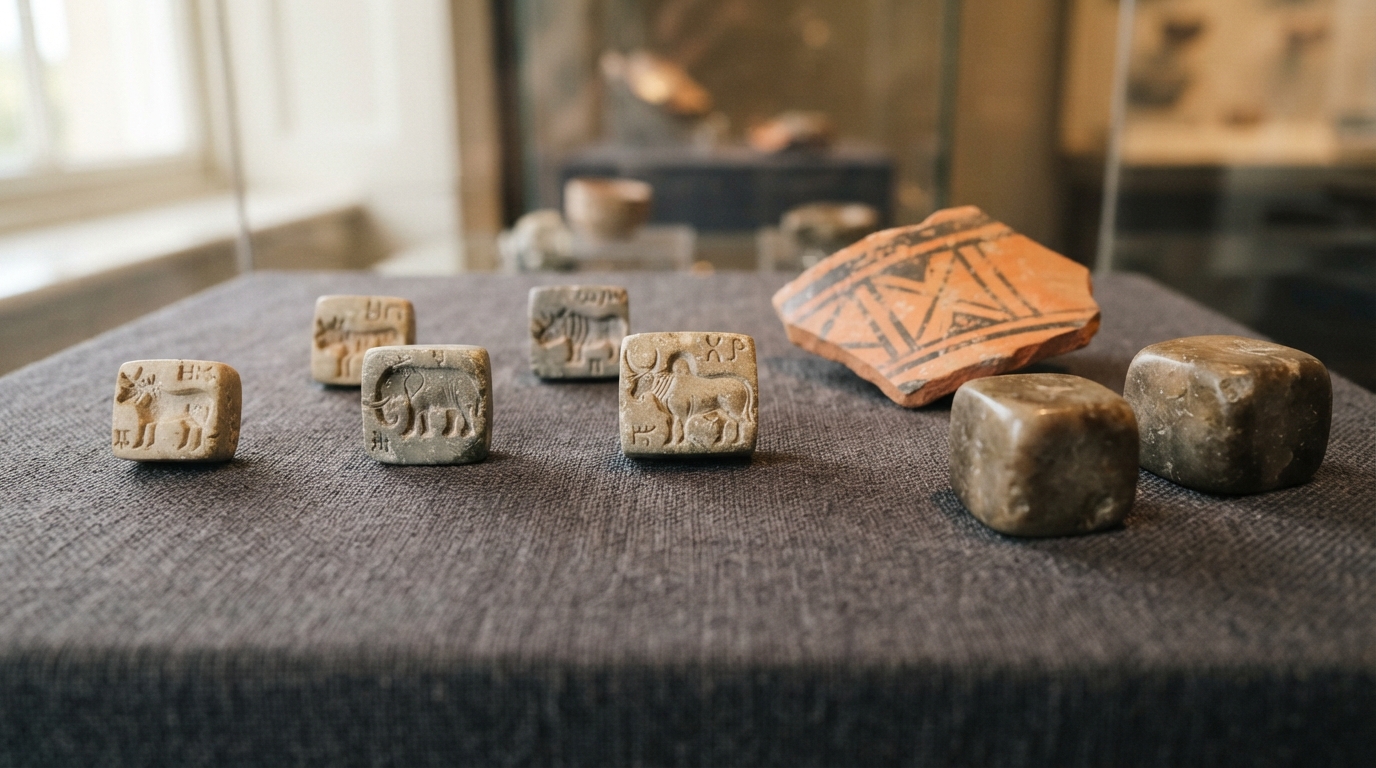
The opening entries of any subcontinental timeline are the least settled. New dating methods have moved the start of farming at Mehrgarh, the Indus script is still unread, and two southern sites are at the centre of active disputes. Treat every ancient date as a current best estimate rather than a fixed fact.
Mehrgarh's new date: about 5200 BCE
Most textbooks open with farming at Mehrgarh around 8000 BCE. A 2025 study using AMS radiocarbon dating moved that start to about 5200 BCE (Mutin et al., Scientific Reports, 2025). That's a shift of nearly 3,000 years for the first entry on the page. Mehrgarh sits in Balochistan, in present-day Pakistan. Any timeline that calls itself "Indian" but skips it leaves out the earliest chapter. When we update a date card after a revision like this, we keep the old figure in a note. Readers who learned 8000 BCE in school need to see why the number changed.
The Indus cities sit across today's border
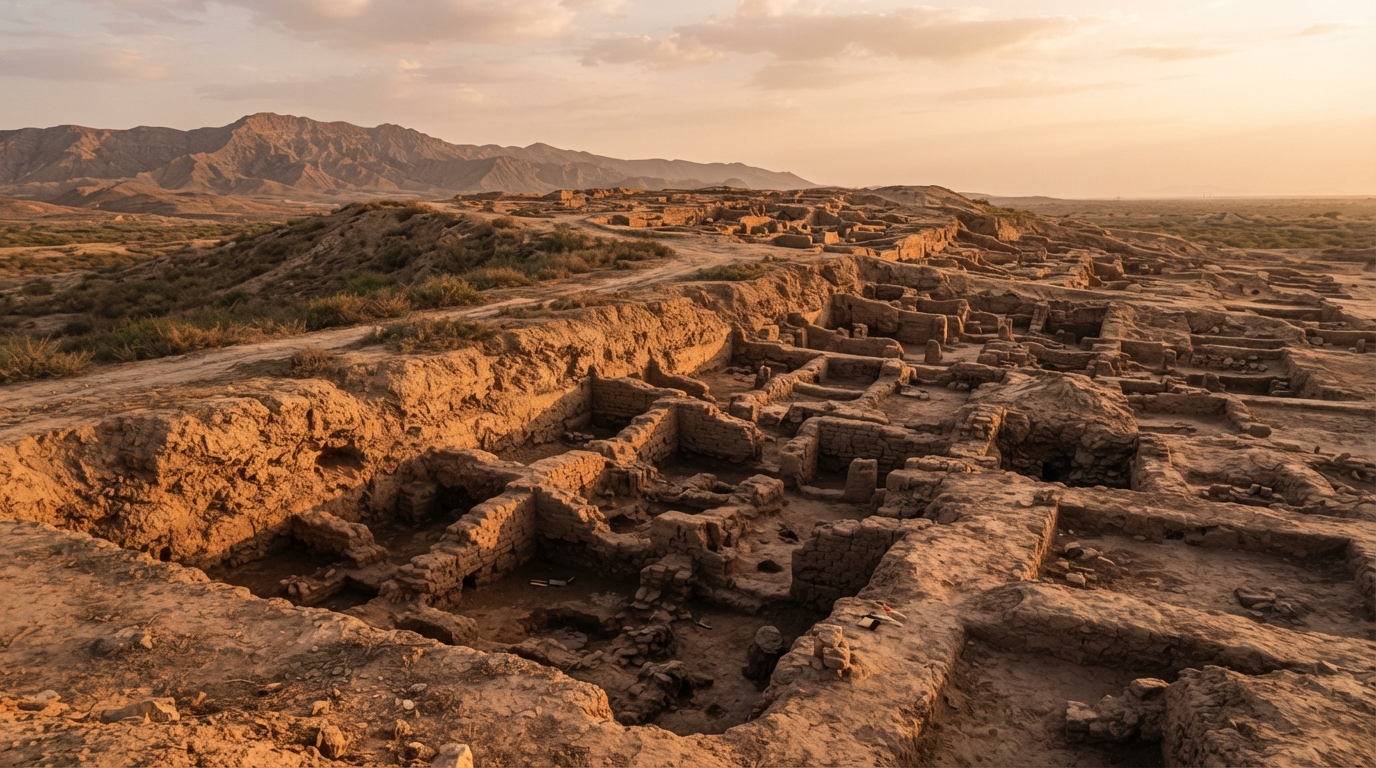
Harappa was excavated by Daya Ram Sahni in 1921, and Mohenjo-daro by R.D. Banerji from 1922. Both cities lie in Pakistan today. Rakhigarhi, in Haryana, is one of the largest Indus sites on the Indian side. DNA from a woman buried there around 2500 BCE showed a mix of Iranian-related farmer ancestry and Ancient Ancestral South Indian (AASI) ancestry, with no steppe pastoralist DNA (Shinde et al., 2019). The script these cities used remains undeciphered. One open research project describes its status as "partial structural and functional decipherment; no phonetic reading" (open-indus, Nov 2026). Tamil Nadu's $1 million prize for decoding it is still unclaimed (Archaeology Magazine, 2025).
Contested claims: Sivagalai and Keezhadi
The Tamil Nadu government says charcoal and potsherds from Sivagalai date to 2953–3345 BCE. It presents this as the earliest use of iron in the world (TN State Archaeology, 2025). The claim hasn't been independently confirmed, so it belongs on a timeline with a clear "claimed" label. Keezhadi, near Madurai, raises a related problem. In a letter dated June 24, the Archaeological Survey of India said its review found "certain deficiencies" in the report on the 2014–16 excavations (ETV Bharat, 2026). In February 2026, archaeologist Amarnath Ramakrishna said his findings followed established procedures (ETV Bharat, 2026). Both positions are on record, and neither has been resolved.
Empires built a shared administrative and architectural base
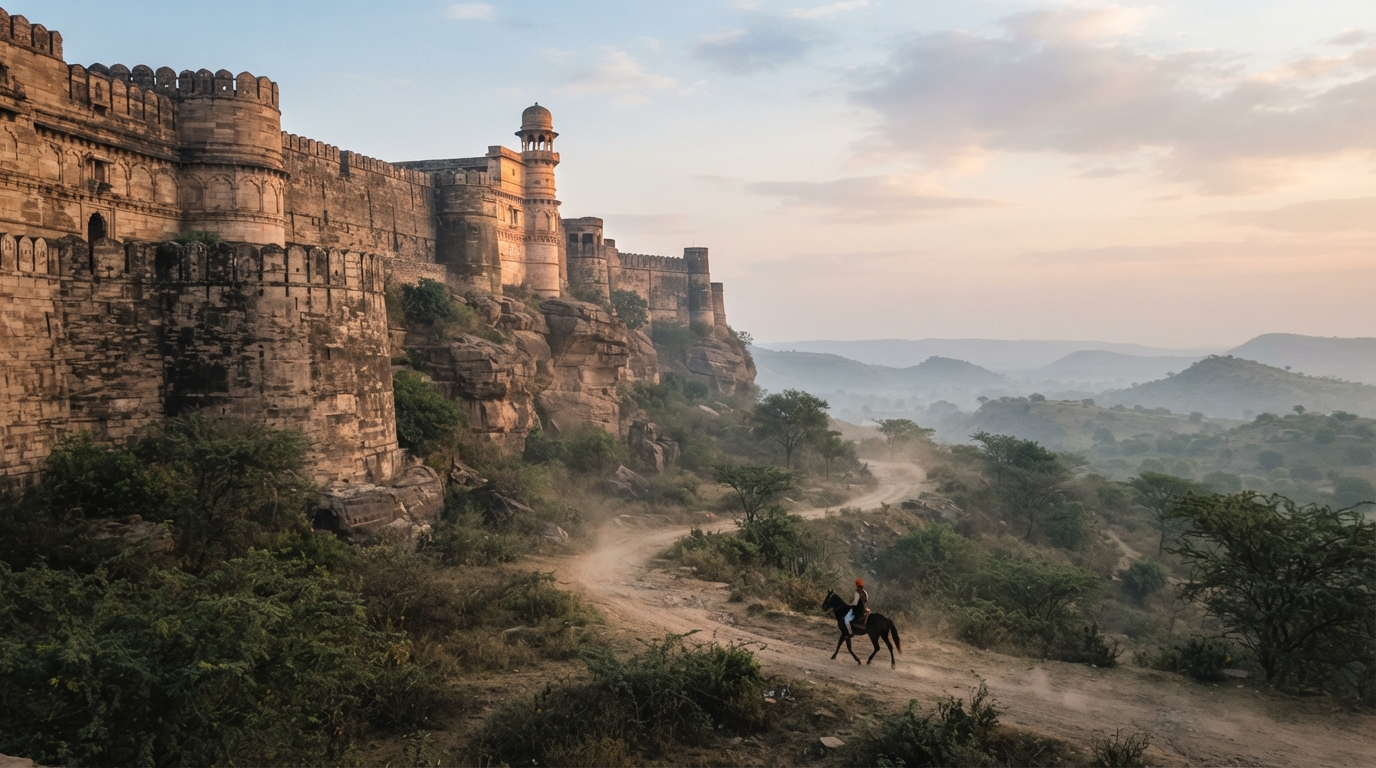
The imperial era of undivided India is the span from about 321 BCE to 1707 CE. During that span, the Maurya, Gupta, Chola, Ahom, Delhi Sultanate and Mughal states built road networks, revenue systems and monuments that outlasted the dynasties themselves. These empires rose in the north, the south and the northeast. Together these states set patterns of rule that later Company and Crown governments inherited and reused.
Maurya and Gupta foundations (c. 321 BCE–550 CE)
The Maurya and Gupta empires are the two northern states that laid the early administrative and scientific foundations of the subcontinent between about 321 BCE and 550 CE. Chandragupta Maurya founded the Maurya Empire around 321 BCE. His grandson Ashoka left edicts carved across the subcontinent after the Kalinga war of about 261 BCE. Ashoka's edicts are written mostly in Brahmi script. In the northwest, at Shahbazgarhi in Pakistan, the edicts use Kharoshthi, and at Kandahar in Afghanistan they appear in Greek and Aramaic. That spread of four scripts shows how far one Mauryan administration reached. The Gupta period, from about 320 CE, produced Aryabhata's Aryabhatiya (499 CE) and the rust-resistant Iron Pillar now in Delhi. Our guide to the Maurya and Gupta empires breaks these centuries into date-wise entries.
The South and the Northeast built their own states
Southern and northeastern history frequently gets a single line in standard timelines. The history of the Tamil, Chola and Ahom states deserves more. Sangam poetry from Tamil Nadu, dated roughly to the 3rd century BCE through the 3rd century CE, records kings, trade and daily life. The Cholas completed the Brihadeeswarar temple at Thanjavur around 1010 CE. Chola copper-plate grants show how land was gifted and taxed in detail. The Ahom kingdom, founded by Sukaphaa in 1228, ruled the Brahmaputra valley for close to 600 years. The Ahom general Lachit Borphukan defeated a Mughal force at the Battle of Saraighat in 1671.
Sultanate and Mughal centuries (1206–1707)
The Delhi Sultanate began in 1206, and work on the Qutb Minar had already started around 1199. Babur won the First Battle of Panipat in 1526 and founded Mughal rule. Under Akbar, Todar Mal organised a land revenue system based on measured fields. Parts of Todar Mal's revenue system carried into British-era revenue records. Shah Jahan began the Taj Mahal in 1632. Aurangzeb's death in 1707 is the usual marker for the start of Mughal decline. NCERT's 2025–26 Class 7 textbook removed chapters on the Delhi Sultanate and the Mughals (Business Standard, 2025). Students using the 2025–26 NCERT Class 7 textbook may need outside references, like the date-based summaries in our archive, for these five centuries.
Company rule and the "Indian Empire" reshaped the subcontinent
Company rule and the "Indian Empire" are the two phases, from 1757 to 1947, in which the East India Company and then the British Crown governed the subcontinent as one administrative unit. The two phases added railways, a census and a new capital at Delhi. Company and Crown rule also presided over a steep fall in India's share of world output, from 24.4% in 1700 to 4.2% by 1950 by Angus Maddison's estimate. Both the gains and the losses belong on the same timeline.
From Plassey to the Crown, 1757–1858
The East India Company won the Battle of Plassey on 23 June 1757. In 1765 the Company gained the diwani, the right to collect revenue, in Bengal, Bihar and Orissa. India's first passenger train ran from Bombay to Thane on 16 April 1853. The revolt of 1857 spread across northern and central India. The Government of India Act 1858 then moved control from the Company to the British Crown. Rani Lakshmibai of Jhansi and her soldier Jhalkari Bai both fought in 1857 and appear in our November date cards for 19 and 22 November.
What "Indian Empire" meant
"Indian Empire" was the formal name for British India plus the princely states under British paramountcy. Parliament passed the Royal Titles Act in 1876. Queen Victoria was proclaimed Empress of India at the Delhi Durbar on 1 January 1877. The Indian Empire included more than 500 princely states alongside directly ruled provinces. The Indian Empire's capital moved from Calcutta to Delhi after the 1911 Durbar. New Delhi, designed by Edwin Lutyens and Herbert Baker, was inaugurated in 1931.
The economic story belongs on the timeline
Standard timelines list battles and acts but leave out the economy. Angus Maddison estimated India's share of world GDP at 24.4% in 1700, falling to 4.2% by 1950 (Maddison, OECD). Economist Utsa Patnaik used about two centuries of tax and trade data to estimate the wealth taken from India between 1765 and 1938. Brought forward to 2017 values, Patnaik puts that drain at $45 trillion (Patnaik, 2017; Al Jazeera, 2018). Other economists dispute the $45 trillion figure, so it should be read as Patnaik's estimate. Placing Maddison's GDP shares and Patnaik's drain estimate beside the political dates helps students see what colonial rule cost in concrete terms.
November dates link the daily archive to this era
The November date cards are six entries in the daily archive, dated 17 to 24 November, that point straight back to pre-1947 history. The six cards cover Lala Lajpat Rai, V.O. Chidambaram Pillai, Rani Lakshmibai, Jhalkari Bai, Jagadish Chandra Bose and Lachit Borphukan, with figures from Punjab, Tamil Nadu, Bundelkhand, Bengal and Assam. These are November dates that readers search for most. Read together, the six cards work as a mini-timeline of undivided India.
A November card set
| Date | Event | Year | Region (then → now) |
|---|---|---|---|
| 17 November | Lala Lajpat Rai dies after injuries from a police lathi charge during a Simon Commission protest | 1928 | Lahore, Punjab → Pakistan |
| 18 November | V.O. Chidambaram Pillai dies; he founded the Swadeshi Steam Navigation Company in 1906 | 1936 | Madras Presidency → Tamil Nadu |
| 19 November | Rani Lakshmibai is born in Varanasi | 1828 (commonly cited) | United Provinces → Uttar Pradesh |
| 22 November | Jhalkari Bai, soldier in Lakshmibai's army, is born | 1830 | Bundelkhand → Uttar Pradesh |
| 23 November | Scientist Jagadish Chandra Bose dies in Giridih | 1937 | Bihar Province → Jharkhand |
| 24 November | Ahom general Lachit Borphukan is born; observed as Lachit Divas | 1622 | Ahom kingdom → Assam |
How to read a date card
A single date card is a starting point, not a full account. Birth years for 19th-century figures can vary between sources. Some sources give Rani Lakshmibai's birth year as 1835 instead of 1828. When we publish a date card, we list the most widely cited year and note the alternative. Students should check two sources before quoting a year in an exam answer. A planned page on special days in November in Indian history will gather these November entries in one place.
Partition closed the undivided chapter in 1947
The last stretch of a pre-1947 Indian history timeline runs from the founding of the Indian National Congress in 1885 to independence and Partition in August 1947. Famine and mass migration mark its final years. Death tolls for both events are best reported as ranges, because estimates vary widely.
Movement milestones, 1885–1942
The organised freedom movement followed a clear sequence of dates:
- 28 December 1885: The Indian National Congress holds its first session in Bombay.
- 16 October 1905: The partition of Bengal takes effect; it is reversed in 1911.
- 13 April 1919: Troops fire on a crowd at Jallianwala Bagh, Amritsar.
- 12 March–6 April 1930: Gandhi leads the Salt March to Dandi.
- 8 August 1942: The Quit India resolution is passed in Bombay.
Our visual history of the independence movement expands each of these into its own card.
Famine and Partition in numbers
The Bengal famine of 1943–44 killed between 800,000 and 3.8 million people in Bengal alone, depending on the estimate (summary of the scholarship, Wikipedia). India became independent on 15 August 1947. The Radcliffe Line, which set the new borders, was made public on 17 August. Close to 15 million people were uprooted, and between 200,000 and 2 million died (Asia Society). Harvard's Jennifer Leaning, who led a study on Partition, argues the deaths exceeded commonly estimated figures (The Tribune). No single number is reliable, so we give ranges on every Partition card.
Repatriation and memory today
Objects from the undivided era are still coming home. Relics linked to the Buddha from Piprahwa were headed for a Sotheby's auction. They were returned to India on 30 July 2025 through a partnership between the government and the Godrej group (PIB, 2025). The Chola-era Leiden Plates came back from the Netherlands in May 2026 (Organiser, 2026). The government says 668 antiquities have been repatriated since 2014 (ThePrint, 2026). Oxford's Pitt Rivers Museum agreed to return 39 colonial-era human remains to the Naga people (ARTnews, 2026). The Partition Museum in Amritsar opened on 17 August 2017, exactly 70 years after the Radcliffe Line was published.
Related Reading
- Indian History Timeline Chart: Key Milestones (Digital Reference)
- Indian History Milestones: The Maurya and Gupta Empires
- Economic Milestones in Indian History: From 1947 to Present
- Milestones in Indian Women's History: A Chronological Guide
FAQ
Q: What is the starting point of a pre-1947 Indian history timeline? Most timelines begin with early farming at Mehrgarh, in present-day Pakistan. A 2025 study dated that start to about 5200 BCE, replacing the older figure of 8000 BCE. The Indus cities of Harappa and Mohenjo-daro follow from around 2600 BCE.
Q: What was the "Indian Empire"? It was the formal name for British India together with the princely states under British paramountcy. The Royal Titles Act of 1876 led to Queen Victoria's proclamation as Empress of India on 1 January 1877. It lasted until 15 August 1947.
Q: Why are some ancient Indian dates disputed? New lab methods, such as AMS radiocarbon dating, can move dates by thousands of years. Some claims, like the Sivagalai iron dates, haven't been independently confirmed. Others, like the Keezhadi report, are under review by the Archaeological Survey of India.
Q: How many people were affected by Partition? Close to 15 million people were uprooted, according to Asia Society. Deaths are estimated at between 200,000 and 2 million. Researchers still debate the exact figure.
Your next move: Pick one era from this timeline and match it to a date you'll study this week. If you're preparing for an exam, start with the five movement milestones from 1885 to 1942, because they're the most frequently tested. If you're teaching, open the November card set and check each birth year against a second source. For a broader overview, our Indian history timeline chart is the next page to bookmark.
Sources
- New radiocarbon dates of human tooth enamel reveal a late appearance of farming life in the Indus Valley — Mutin et al., Scientific Reports, 2025. Supports: A 2025 AMS radiocarbon study moved the start of farming at Mehrgarh from about 8000 BCE to about 5200 BCE.
- $1 million prize offered to decipher 5,300-year-old Indus Valley script — Archaeology Magazine, 2025. Supports: Tamil Nadu has offered a $1 million prize for deciphering the Indus script.
- Keezhadi Excavation Report: ASI To Conduct On-Site Review, Director General Confirms — ETV Bharat, 2026. Supports: In a letter dated June 24, the ASI said its review found "certain deficiencies" in the report on Amarnath Ramakrishna's Keezhadi excavations.
- New NCERT textbooks: Mughals, Delhi Sultanate dropped; Maha Kumbh added — Business Standard, 2025. Supports: NCERT's new Class 7 textbook dropped the material on the Delhi Sultanate and the Mughals.
- How Britain stole $45 trillion from India — Al Jazeera, 2018. Supports: Utsa Patnaik used nearly two centuries of tax and trade data to estimate a drain of nearly $45 trillion from India between 1765 and 1938.
- The Ongoing Legacies of the Partition of British India — Asia Society. Supports: Close to 15 million people were uprooted by Partition, and between 200,000 and 2 million died.
- Sacred Piprahwa Relics of Lord Buddha Return Home to India — Press Information Bureau, Government of India, 2025. Supports: The Piprahwa relics were brought back to India through a partnership between the government and the Godrej group.
- India gets back Chola-era bronze artefacts from US; Centre says 668 antiquities repatriated since 2014 — ThePrint, 2026. Supports: The government says 668 antiquities have been repatriated since 2014. (Another report quotes the minister as saying 668 in total, with 653 since 2014.)
- Historic Homecoming: Netherlands returns 11th-century Leiden Copper Plates to India — Organiser, 2026. Supports: The Netherlands returned the Chola-era Leiden Plates during PM Modi's visit. (Leiden University announced the return in May 2026.)
- Oxford University Museum to Repatriate 39 Colonial-Era Human Remains — ARTnews, 2026. Supports: Oxford's Pitt Rivers Museum agreed to return 39 colonial-era human remains to the Naga people.