TL;DR
The 1947 Partition of India unfolded over about 18 months. Direct Action Day in August 1946 deepened communal violence. In February 1947, Britain set a June 1948 deadline, then moved independence up to 15 August 1947. Cyril Radcliffe drew the Punjab and Bengal borders in roughly five weeks. The line was published on 17 August.
Key Takeaways
- The Radcliffe Line was published on 17 August 1947, two days after independence.
- Britain moved its handover deadline from June 1948 forward to August 1947.
- Scholars estimate 12–20 million people displaced and 200,000–2 million deaths.
- Radcliffe drew only the Punjab and Bengal borders. Other provinces kept existing lines.
- Migration and violence continued for months in Punjab and for years in Bengal.
On the morning of 15 August 1947, crowds in Amritsar and Lahore celebrated independence. Many of them still didn't know which country their village belonged to. The boundary award had been finished, but it stayed sealed in Government House in New Delhi. Families in districts like Gurdaspur and Murshidabad raised flags based on rumour, not maps. That gap between freedom and the border is the clearest way into any 1947 partition of India timeline. The dates below follow the decisions of the 1940s in order. Each section explains what changed, who decided it, and what it meant for the people living through it.
The road to Partition began with wartime politics (1940–1945)
The road to Partition began during the Second World War. Between 1940 and 1945, three developments set the direction: the Muslim League's Lahore Resolution, failed British offers of self-government, and the mass arrest of Congress leaders after Quit India. By the war's end, the main parties had very different visions of a free India.
1940: The Lahore Resolution
The All-India Muslim League met in Lahore in March 1940. On 23 March, it put forward a resolution calling for "independent states" in Muslim-majority regions in the northwest and east. The resolution did not use the word "Pakistan," but the press quickly attached the name to it. Muhammad Ali Jinnah led the League at this session. The demand gave the League a clear political goal for the rest of the decade. It also set the terms for every negotiation that followed. From 1940 on, any plan for independence had to answer one question: would British India stay one country?
1942: The Cripps Mission and Quit India
Britain sent Sir Stafford Cripps to India in March 1942 with an offer of dominion status after the war. Congress rejected it because it promised too little, too late. The offer also let provinces opt out of a future union, which many saw as an opening for division. On 8 August 1942, Congress launched the Quit India Movement. The British arrested Gandhi, Nehru, and most of the Congress leadership within hours. Many of them stayed in prison until 1944 or 1945. This left the political field more open to the League during the war years. Our timeline of Gandhi's nonviolent movements covers Quit India in more detail.
1945: The Simla Conference and new elections
Viceroy Lord Wavell called the Simla Conference in June 1945 to form a new executive council. It broke down in July over who had the right to nominate Muslim members. Elections followed in the winter of 1945–46. Congress won most general seats. The Muslim League won the large majority of reserved Muslim seats. These results gave both parties a strong claim to speak for their supporters. Compromise became harder after this point, not easier.
1946 turned negotiation into crisis
1946 is the year when negotiations over India's future collapsed and violence spread. The Cabinet Mission offered a loose federal plan in May 1946 that briefly looked workable, but the plan collapsed within weeks. Direct Action Day in Calcutta on 16 August then set off riots across Bengal and Bihar. By December 1946, India was moving toward division.
March–June 1946: The Cabinet Mission Plan
The Cabinet Mission Plan is the 16 May 1946 proposal by three British ministers, Lord Pethick-Lawrence, Sir Stafford Cripps, and A.V. Alexander, for one Indian union with a weak centre. The three ministers arrived in India in March 1946. Of all the plans in this period, the Cabinet Mission Plan came closest to keeping India united. Under the plan, provinces would be grouped into three sections, two of them Muslim-majority. Both Congress and the Muslim League first accepted parts of the plan. Disagreement over whether provinces could leave their groups soon ended that agreement. By late July 1946, the League had withdrawn its acceptance.
16 August 1946: Direct Action Day
The League called for "Direct Action" on 16 August 1946 to press its demand for Pakistan. In Calcutta, the day turned into four days of killing. An estimated 5,000–10,000 people died and about 15,000 were wounded, according to History is Now Magazine. The violence became known as the Great Calcutta Killings. Riots spread to Noakhali in East Bengal in October and to Bihar soon after. Gandhi walked through Noakhali villages for weeks to calm the region. For many historians, this is the moment Partition began to look unavoidable.
September–December 1946: An uneasy interim government
An interim government took office on 2 September 1946, with Jawaharlal Nehru as its leading figure. The League joined in October but refused to cooperate on most issues. The Constituent Assembly first met on 9 December 1946. The League boycotted it. India now had two major parties sharing power on paper and working against each other in practice. That deadlock pushed London to act.
The 1947 partition of India timeline sped up after February 1947
British policy changed sharply in early 1947. Prime Minister Clement Attlee set a firm deadline, a new Viceroy arrived, and the deadline moved forward by more than ten months. Between February and July, Britain went from promising a handover by 1948 to passing a law that created two nations.
20 February 1947: Attlee sets a deadline
Attlee told the House of Commons that Britain would transfer power "not later than June, 1948," as reported by UPI at the time. The same announcement confirmed that Wavell would step down. Lord Louis Mountbatten was named as the new Viceroy. The statement put a hard end date on British rule for the first time. It also raised the pressure on both parties to settle their claims fast. Riots broke out in Punjab in March, including in Rawalpindi district.
22 March 1947: Mountbatten arrives
Mountbatten landed in Delhi on 22 March 1947 and was sworn in two days later. He held a long series of meetings with Nehru, Jinnah, Vallabhbhai Patel, and others. Within weeks, he concluded that a united India was no longer possible. His advisers drafted a plan for division. One early version would have let provinces choose independence on their own. Nehru objected strongly, and the plan was revised.
3 June 1947: The Mountbatten Plan
The final plan was announced on 3 June 1947. It accepted Partition and moved independence forward to 15 August 1947. That cut the timeline from about 13 months to about 10 weeks. The plan let the Punjab and Bengal assemblies vote on dividing their provinces. Both voted for division in late June. Referendums followed in Sylhet and the North-West Frontier Province in July. The Indian Independence Act received royal assent on 18 July 1947.
The table below shows how quickly the key dates arrived:
| Date | Event | Days before independence |
|---|---|---|
| 20 Feb 1947 | Attlee's "not later than June, 1948" statement | 176 |
| 22 Mar 1947 | Mountbatten arrives in Delhi | 146 |
| 3 Jun 1947 | Mountbatten Plan announced | 73 |
| 8 Jul 1947 | Radcliffe arrives in New Delhi | 38 |
| 18 Jul 1947 | Indian Independence Act passed | 28 |
| 15 Aug 1947 | India becomes independent | 0 |
Radcliffe drew the line in five weeks
Sir Cyril Radcliffe, a British lawyer, chaired the two boundary commissions for Punjab and Bengal. He had about five weeks to divide land where roughly 88 million people lived. He had never been to India before. That rushed timetable shaped the border and the violence around it.
A lawyer with no India experience
Radcliffe arrived in New Delhi on 8 July 1947, according to GKToday (2026). He had never visited India. He chaired both commissions, each with four judges: two nominated by Congress and two by the League. The judges split along party lines on nearly every key question. In practice, Radcliffe made the final calls himself. He worked from census data, district maps, and party submissions. Summer heat and the tight deadline meant he did little travel in the areas he was dividing.
What the commissions actually decided
Radcliffe drew only two sections of the border, according to Wikipedia's summary of the award. Elsewhere, the line simply followed existing provincial boundaries. Sindh, Baluchistan, and the North-West Frontier went to Pakistan whole. The hard choices were in districts with mixed populations. Gurdaspur in Punjab is the best-known case. Most of it went to India, which kept a road link to Jammu and Kashmir. Rail lines, canals, and irrigation headworks were also split. That left farmers on one side cut off from water sources on the other.
The award was kept secret
The Radcliffe Award is the boundary decision dividing Punjab and Bengal, and Mountbatten kept the award secret until after independence. The award was reportedly ready around 12 August 1947. The award was published on 17 August 1947, two days after Pakistan and India became free (Britannica). The stated reason for the delay was to avoid spoiling the independence celebrations and to shift responsibility away from Britain. The effect of the delay on the ground was very different. People living near the new line spent several days not knowing which country they lived in. Timelines often skip this detail, but the delayed publication explains why panic spread so fast in the first weeks after 17 August.
Independence came before the border did
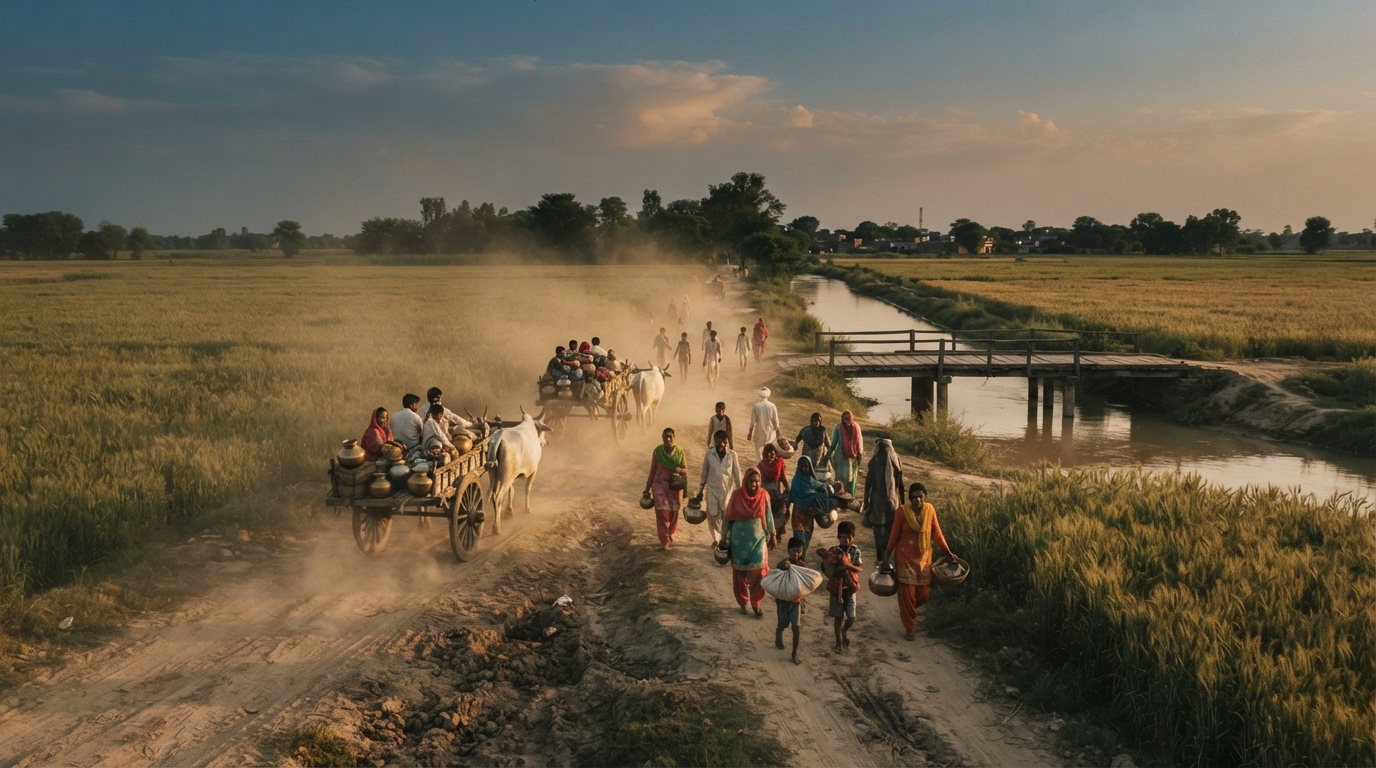
August 1947 brought freedom and fear in the same week. Pakistan became independent on 14 August and India on 15 August. The border was announced on 17 August. Mass migration across Punjab had already started. Bengal stayed calmer at first, partly because of Gandhi's presence in Calcutta.
14–15 August 1947: Two independence days
Pakistan's and India's independence days are 14 and 15 August 1947. Muhammad Ali Jinnah became Governor-General of Pakistan in Karachi on 14 August. At midnight, Jawaharlal Nehru gave his "Tryst with Destiny" speech to the Constituent Assembly in New Delhi, marking India's independence on 15 August. Lord Mountbatten stayed on as India's Governor-General. Mahatma Gandhi was not in Delhi for the celebrations. Gandhi spent the day in Calcutta, fasting and praying for peace. Our visual history of the independence movement traces the decades that led to this week.
Punjab and Bengal moved differently
Punjab saw a sudden, violent exchange of population in the weeks after the award. Bengal's migration was slower and stretched over years. Sindh had no boundary commission at all, but many Sindhi Hindus still left. Their story gets little coverage, as Organiser noted in 2025.
| Region | How the border was set | Pattern of migration |
|---|---|---|
| Punjab | Radcliffe boundary commission | Sudden, mass movement in late 1947 |
| Bengal | Radcliffe boundary commission | Slower, in waves through the 1950s and beyond |
| Sindh | Whole province to Pakistan | Steady departures, including after Karachi riots in January 1948 |
The human cost
Estimates vary widely. Between 12 and 20 million people were displaced, and deaths ranged from 200,000 to 2 million, according to Wikipedia's summary of Talbot and Singh (2009). The range is wide because records from the time are incomplete. The Partition Museum in Amritsar puts the number affected at up to about 18 million. Women faced abduction and violence on both sides. Many also helped each other survive, a theme the 1947 Partition Archive explored on its blog in January 2025. Any honest summary should give the range, not a single number.
Partition kept unfolding after August 1947
The Partition of India is a process that did not end when the Radcliffe border was published on 17 August 1947. Violence, migration, and disputes over princely states went on into 1948 and beyond. Kashmir remained unresolved, and the Bengal section of the Radcliffe line later became the India–Bangladesh border in 1971. Historians now study 1947 as a long process rather than one moment.
Kashmir and the princely states
Over 500 princely states had to choose a side. Most joined India or Pakistan by 15 August. Jammu and Kashmir did not. Maharaja Hari Singh signed the Instrument of Accession to India on 26 October 1947, after tribal raiders entered from Pakistan. The first war over Kashmir followed. Hyderabad joined India in September 1948 after military action. The Bengal border drawn in 1947 became the frontier of Bangladesh in 1971, covered in our 1971 India-Pakistan war timeline.
How historians see it now
Newer research widens the frame. Sam Dalrymple's Shattered Lands (June 2025) treats 1947 as one of five partitions that produced 12 modern nations, including Burma and the Gulf states. On Carnegie's Grand Tamasha podcast in October 2025, he argued that the breakup of the Indian Empire reached from the Red Sea to Southeast Asia. Yasmin Khan's The Great Partition remains a standard account of the process. These works push readers away from a single-date view. A full 1947 partition of India timeline starts before 1946 and runs well past 1947.
Where the memory lives
Survivor voices are now easier to access than ever. The 1947 Partition Archive has recorded more than 12,000 oral histories (1947 Partition Archive, 2025). Guneeta Singh Bhalla founded it after hearing her grandmother's story of August 1947. The Partition Museum opened in Amritsar's Town Hall on 25 August 2017. It describes itself as the world's first museum devoted to Partition. India marks Partition Horrors Remembrance Day each 14 August, and Victoria Memorial Hall held an exhibition from 12 to 17 August 2025.
Related Reading
- India at the Olympics: A Timeline of Historic Sporting Milestones
- The 1971 India-Pakistan War: Key Dates and Historical Summary
- Timeline of Mahatma Gandhi's Nonviolent Movements in India
- December 1984: A Historical Timeline of the Bhopal Gas Tragedy
FAQ
Q: When was the Radcliffe Line announced? The Radcliffe Line was published on 17 August 1947, two days after independence (Britannica). The award was reportedly ready around 12 August but was held back. This left many border communities unsure of their new country for several days.
Q: How many people were affected by Partition? Scholars estimate 12–20 million people were displaced and 200,000–2 million died (Talbot and Singh, 2009). The Partition Museum in Amritsar says up to about 18 million were affected. The wide range reflects gaps in records from 1947.
Q: Why was independence moved from 1948 to 1947? Attlee first set a deadline of June 1948 on 20 February 1947. Mountbatten's 3 June plan moved it to 15 August 1947 as violence grew and talks stalled. The earlier date left about ten weeks to divide the country.
Q: What are the main dates in a 1947 partition of India timeline? The core dates are 16 August 1946 (Direct Action Day), 20 February 1947 (Attlee's statement), 3 June 1947 (Mountbatten Plan), 18 July 1947 (Independence Act), 14–15 August 1947 (independence), and 17 August 1947 (Radcliffe Line). Kashmir's accession on 26 October 1947 is often added.
Your next move
Pick one region and follow it past August 1947: Punjab for the sudden exchange, Bengal for the long migration, or Sindh for the story most timelines miss. Then listen to one survivor interview from the 1947 Partition Archive for that region. For classroom use, pair it with our historic dates in modern India so students see what came next. One region, one voice, and one timeline will teach more than a list of twenty dates.
Sources
- British give date for Indian independence — UPI Archives, 1947. Supports: On 20 February 1947, Attlee told the House of Commons that Britain would hand over power "not later than June, 1948."
- This Day That Year: How the Radcliffe Line Redrew India–Pakistan Borders in 1947 — Open Magazine. Supports: The Radcliffe Line was published on 17 August 1947, two days after independence.
- Radcliffe Line — Wikipedia. Supports: The Radcliffe Line, drawn by two boundary commissions for Punjab and Bengal, dates from 17 August 1947.
- Partition of India — Wikipedia. Supports: Partition displaced 12–20 million people and caused between 200,000 and 2 million deaths.
- Radcliffe Award and Partition Boundaries — GKToday, 2026. Supports: Radcliffe had never been to India before he arrived in New Delhi on 8 July 1947, and dividing Punjab and Bengal affected more than 88 million people.
- About Us – The 1947 Partition Archive — The 1947 Partition Archive, 2025. Supports: Guneeta Singh Bhalla founded the archive, which has recorded more than 12,000 oral histories from Partition witnesses.
- Partition Museum — Wikipedia. Supports: The Partition Museum opened on 25 August 2017 in Amritsar's Town Hall.
- The Forgotten Partitions That Remade South Asia — Carnegie Endowment for International Peace, 2025. Supports: Sam Dalrymple talked about Shattered Lands and the breakup of the Indian Empire on Carnegie's Grand Tamasha podcast in October 2025.