Bottom Line
The history of Ramayana adaptations India has produced runs from Ramlila stages to Lanka Dahan in 1917 and regional epic films in the 1950s–70s. It peaked with Doordarshan's Ramayan (25 January 1987 to 31 July 1988), which drew an estimated 80–100 million viewers. Big-budget films like Adipurush (2023) and Nitesh Tiwari's Ramayana (2026) continue it.
Key Takeaways
- Doordarshan's 1987 Ramayan ran 78 episodes and reshaped Indian television viewing habits.
- Dadasaheb Phalke's Lanka Dahan (1917) was among India's earliest Ramayana films.
- Tamil and Telugu cinema produced major Ramayana films in 1958, 1963 and 1971.
- Many viewership records come from broadcasters themselves, not independent audits.
- Every adaptation picks from many Ramayanas, not one single original text.
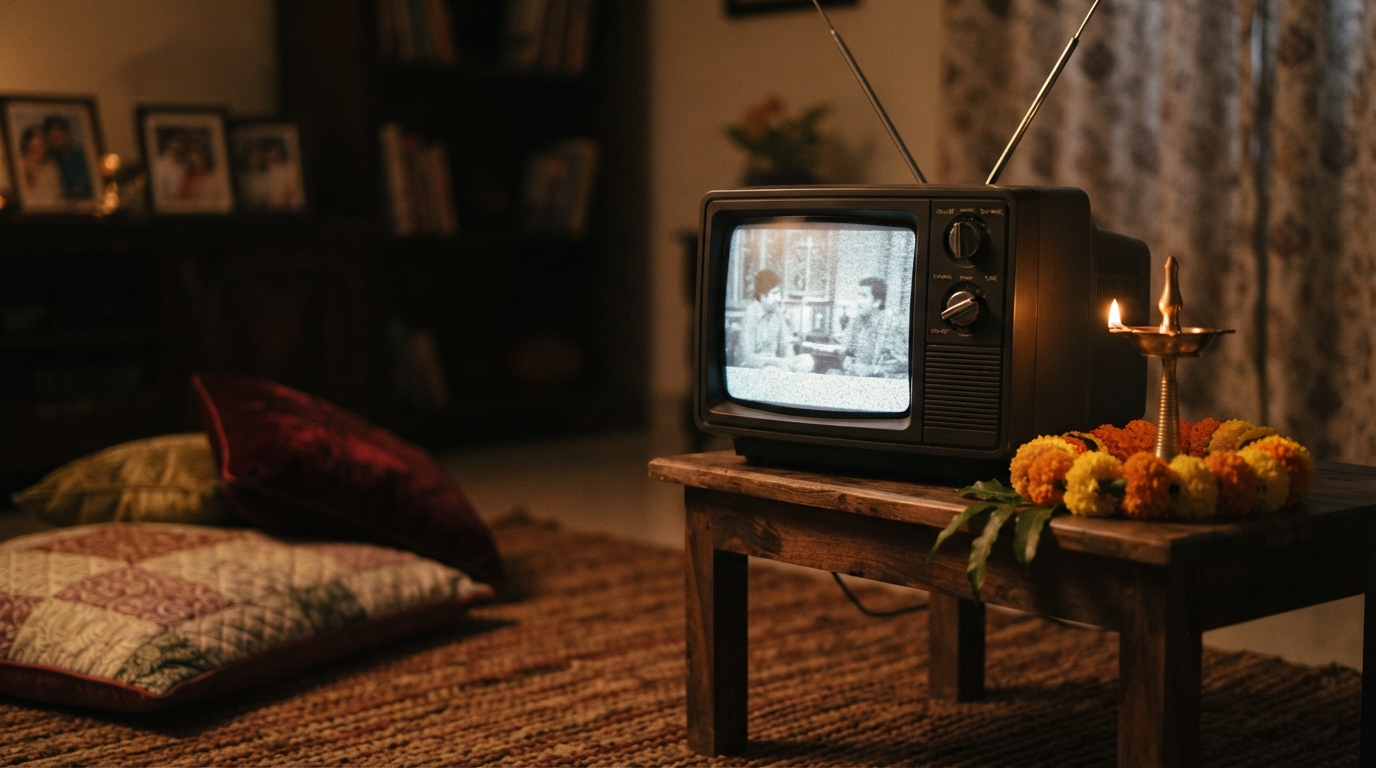
At 9:30 a.m. on a Sunday in early 1987, a schoolteacher in Pune named Meena Kulkarni shuts her front door. Six neighbours are already seated on her floor, facing the family's only television set. When her students later ask what year the "first" Ramayana reached the screen, she says 1987. She's off by seventy years.
That gap sits at the centre of the history of Ramayana adaptations India has built over the last century. Most people remember one broadcast. The actual record covers street theatre, silent film, regional studios, state television, anime and blockbusters. This archive puts those milestones in date order, so you can see how each one led to the next.
The History of Ramayana Adaptations India Produced Began on Stage and Silent Film
The history of Ramayana adaptations in India is a progression from live performance to film. Ramlila troupes and Parsi theatre companies staged the epic long before cinema arrived. Dadasaheb Phalke then filmed Lanka Dahan in 1917. By 1943, Vijay Bhatt's Ram Rajya showed that a polished studio version could reach national audiences.
Ramlila and Parsi theatre set the template
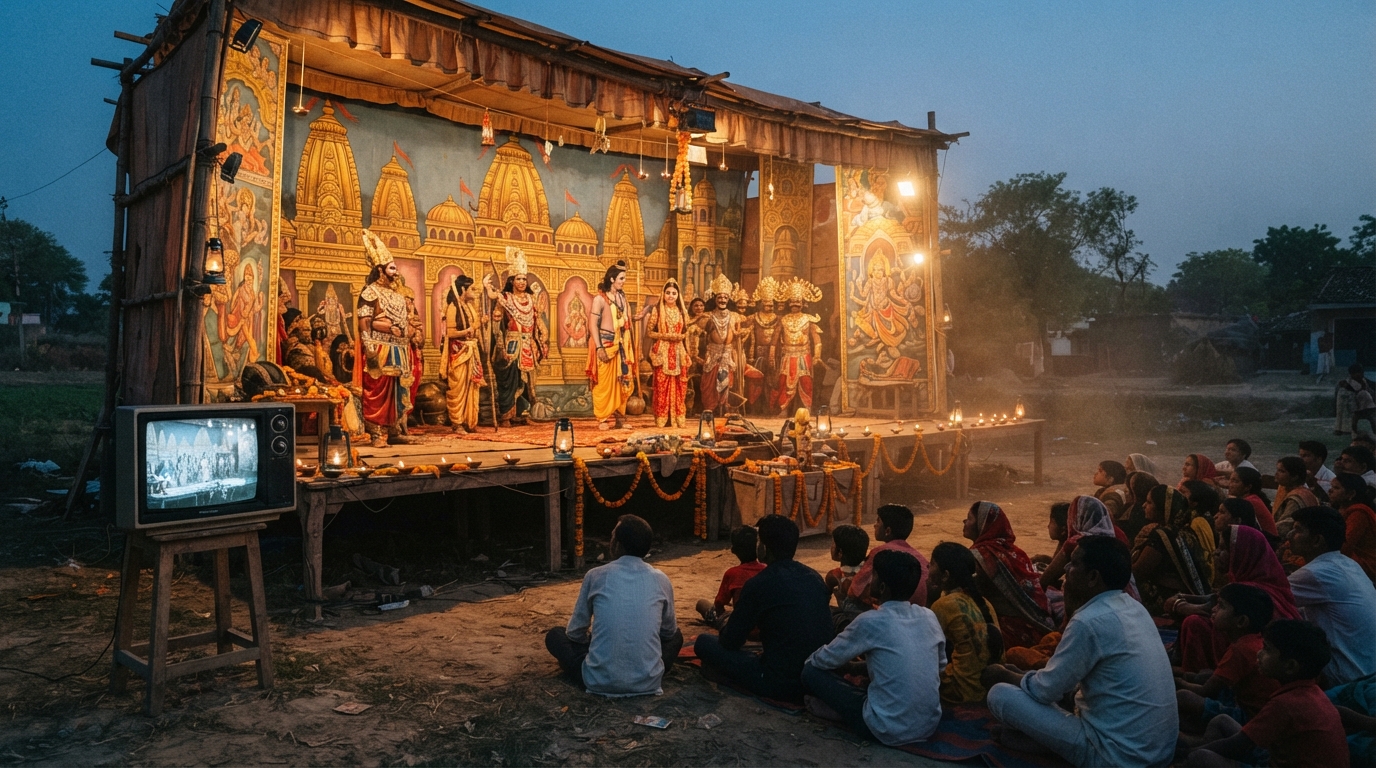
The Ramlila is the oldest living format in this timeline. It's a staged retelling of Rama's story, performed each autumn around Dussehra. The Ramnagar Ramlila near Varanasi runs for roughly a month, with scenes spread across different outdoor locations. UNESCO added Ramlila to its Representative List of the Intangible Cultural Heritage of Humanity in 2008. In the late 19th and early 20th centuries, Parsi theatre companies in Bombay also staged mythological plays for paying urban crowds. These shows taught audiences to expect painted backdrops, stage effects and dramatic songs. Early filmmakers borrowed all three.

Phalke's Lanka Dahan (1917) brought Rama to the screen
Dadasaheb Phalke released Raja Harishchandra, often called India's first full-length feature film, on 3 May 1913. Four years later he made Lanka Dahan (1917), which retold the burning of Lanka. Britannica notes that a public appeal by nationalist leader Bal Gangadhar Tilak helped Phalke raise funds during this period. The actor Anna Salunke played both Rama and Sita, since women rarely acted on screen then. Phalke was born on 30 April 1870, a date covered in our guide to late April milestones in Indian history.
Ram Rajya (1943) and the studio era
Ram Rajya (1943) is Vijay Bhatt's sound-era film of the later part of the Ramayana, made once sound films had replaced silent ones in India by the 1940s. Bhatt's film used songs, dialogue and studio sets to tell the later part of the epic, and the result became a template for screen Ramayanas.
Ram Rajya is widely reported to be the only feature film Mahatma Gandhi ever watched. The Gandhi story is repeated so widely that it's hard to trace to a primary source, so treat the claim as a popular account. The film's real contribution is easier to confirm. Ram Rajya set a visual style of crowns, costumes and gentle, idealised heroes that later filmmakers copied for decades.
Regional Cinema Built the Epic Film Tradition in the 1950s–1970s
South Indian studios made some of the most complete Ramayana films of the mid-20th century. Tamil cinema released Sampoorna Ramayanam in 1958. Hindi and Telugu films followed in 1961 and 1963. Bapu's Telugu Sampoorna Ramayanam (1971) closed the era. Most national summaries skip these films entirely.
Tamil Sampoorna Ramayanam (1958)
Sampoorna Ramayanam (1958) is a Tamil film directed by K. Somu that retells the whole Ramayana, with N. T. Rama Rao as Rama and Sivaji Ganesan as Bharata, the brother who rules in Rama's place. The title word sampoorna means "complete," signalling the film's ambition to cover the entire story.
Covering the full epic was a shift from earlier films that showed one episode, like the burning of Lanka in Phalke's Lanka Dahan (1917). The 1958 film also says something about Tamil audiences at the time. Viewers in Madras were ready to sit through a long, full retelling in their own language.
Hindi Sampoorna Ramayana (1961) and Telugu Lavakusa (1963)
Babubhai Mistry directed the Hindi Sampoorna Ramayana in 1961, with Mahipal as Rama and Anita Guha as Sita. Mistry was known for special effects, and his flying chariots and battle scenes drew crowds. Two years later, the Telugu film Lavakusa (1963) told the later story of Sita and her twin sons. N. T. Rama Rao returned as Rama. The film was shot in colour, which was still uncommon for Telugu cinema then. NTR's repeated casting as Rama and Krishna made him one of the most recognised mythological actors in South India.
Bapu's Sampoorna Ramayanam (1971)
The artist and director Bapu made a Telugu Sampoorna Ramayanam in 1971, with Sobhan Babu as Rama. Bapu was also an illustrator, and his films used a painterly look drawn from his own artwork. This gave his Ramayana a style distinct from the Bombay studio versions. For students, the 1958–1971 stretch shows a key pattern. Before television, the Ramayana travelled through regional languages first, not through one national version.
Doordarshan's 1987 Ramayan Changed Indian Television
Ramanand Sagar's Ramayan aired on Doordarshan from 25 January 1987 to 31 July 1988. It ran for 78 episodes on Sunday mornings. Scholar Philip Lutgendorf estimates it drew between 80 and 100 million viewers. It is the central date in the history of Ramayana adaptations India has on record.
25 January 1987: the first episode
The first episode aired on a Sunday morning on Doordarshan's national network. Arun Govil played Rama, Deepika Chikhlia played Sita, Sunil Lahri played Lakshmana and Dara Singh played Hanuman. Arvind Trivedi played Ravana. The series drew mainly on Valmiki's Sanskrit epic and Tulsidas's Ramcharitmanas, written in Awadhi in the 16th century. A sequel, Uttar Ramayan, followed and covered the story of Luv and Kush. Arun Govil later entered public life and was elected to the Lok Sabha from Meerut in 2024.
A state broadcaster airing an epic was new
Doordarshan was the only national television channel in 1987. Colour broadcasting had started just five years earlier, around the 1982 Asian Games in Delhi. Before Ramayan, the state broadcaster had largely avoided programming built around one religion's sacred text. Arvind Rajagopal of New York University argues in Politics After Television (Cambridge University Press, 2001) that the serial broke this long-standing taboo. He also links its timing to wider changes in Indian public life. You don't need to accept his full argument to see the broadcasting shift. A government channel had chosen a religious epic as prime Sunday content, and that choice set a precedent.
Mahabharat and the epic-serial format (1988–1990)
Mahabharat is B. R. Chopra's televised epic, which ran on Doordarshan from 2 October 1988 to 24 June 1990 across 94 episodes. The success of Ramanand Sagar's Ramayan led directly to Mahabharat, and the two Doordarshan serials together created a format that private channels still use: long-running, episode-by-episode retellings of epics.
Later Ramayana series followed the Doordarshan model. Sagar Arts made a new Ramayan for NDTV Imagine in 2008, and Star Plus aired Siya Ke Ram in 2015–16. For a wider view of this period, see our timeline of historic dates in modern India.
Viewership Records for Ramayana Broadcasts Need Careful Reading
Ramayana viewership claims are among the most repeated numbers in Indian media history. The 1987–88 estimate comes from academic research. The 2020 rerun figure of 77 million came from the broadcaster itself. Comparisons with Western TV finales use different measurement systems. Each number tells a different story, so read them with their source attached.
The 1987–88 numbers
Philip Lutgendorf's estimate of 80 to 100 million weekly viewers is the figure scholars cite most. It reflects a time when one television set often served a whole street. Ratings panels in the 1980s were limited, so this number is an informed estimate. It isn't a precise meter count. Stories of empty streets and paused trains during broadcasts are common in memoirs and press accounts. They show the scale of the event, but they're anecdotes rather than data.
The 2020 lockdown rerun
Doordarshan began rerunning Ramayan on DD National on 28 March 2020, during the first COVID-19 lockdown. Prasar Bharati then said the show was the most-watched entertainment programme in the world, with 77 million viewers on 16 April 2020 (YourStory, 2020). This is a broadcaster claim, not an independent audit. It also measured a single day, when most of the country was at home with few other options. The number is real as reported. The "world's most-watched" label is harder to verify.
How the numbers compare
Media outlets often set the 2020 figure against American TV finales. The table below shows those comparisons with their sources.
| Broadcast | Reported viewers | Source | What to keep in mind |
|---|---|---|---|
| Ramayan (1987–88), weekly | 80–100 million | Philip Lutgendorf | Academic estimate; group viewing common |
| Ramayan rerun, 16 April 2020 | 77 million | Prasar Bharati, via YourStory (2020) | Broadcaster's own claim; lockdown conditions |
| The Big Bang Theory finale | 23.44 million | Nielsen, via Filmibeat (2020) | US-only ratings panel |
| Game of Thrones finale | 19.3 million | Nielsen, via Filmibeat (2020) | US-only ratings panel |
The comparison is useful for scale. It's weak as a ranking. India's audience base, measurement panels and viewing conditions differ sharply from the US market. A fair reading: the Ramayan rerun drew one of the largest single-day TV audiences reported anywhere in 2020.
Big-Budget Ramayana Adaptations Since 1993 Show a Shift in Scale
After 1993, Ramayana adaptations moved toward international partners and very large budgets. An Indo-Japanese anime premiered in 1993. Adipurush (2023) reported a Rs 500 crore budget. Nitesh Tiwari's two-part Ramayana opened in November 2026. Higher spending has not guaranteed a warm reception, and the results vary widely.
The Indo-Japanese anime (1993, re-released 2025)
Ramayana: The Legend of Prince Rama premiered on 10 January 1993 at the International Film Festival of India. Japanese director Yugo Sako worked with Indian animator Ram Mohan on the project. For years it was hard to watch in India, and copies circulated mostly through television reruns and home video. A 4K remaster opened in Indian theatres on 24 January 2025 in English, Hindi, Tamil and Telugu, according to the film's official X account. The re-release gave a new generation a cinema screening more than three decades after the premiere.
Adipurush (2023)
T-Series released Adipurush on 16 June 2023, directed by Om Raut and starring Prabhas. Producer Bhushan Kumar said the budget was Rs 500 crore (Pinkvilla, 2022). The film faced criticism for its visual effects and for colloquial dialogue that many viewers felt didn't suit the epic (Outlook, 2023). The lesson for media historians is practical. Audiences who grew up with the 1987 serial had firm expectations about tone and language. A large budget couldn't override those expectations.
Nitesh Tiwari's Ramayana (2026) and Shrimad Ramayan (2024–25)
Nitesh Tiwari's Ramayana: Part 1 opened on 5 November 2026, with Ranbir Kapoor as Rama, Sai Pallavi as Sita and Yash as Ravana (Esquire India, 2026). Prime Focus and DNEG backed the production. Variety (2026) reports both parts together are budgeted at about $500 million. Other outlets give ₹835 crore for Part 1 alone, so the budget depends on which source you use. Wikipedia, citing Bollywood Hungama, lists a worldwide gross of ₹1,547.15 crore and ₹1,051.94 crore domestic. The film is still in theatres, so those totals will change. Part 2 is set for Diwali 2027 (Variety, 2026).
Television kept pace too. Sony's Shrimad Ramayan, produced by Siddharth Kumar Tewary, aired on Sony TV from 1 January to 9 August 2024. It then moved to Sony SAB from 12 August 2024 to 10 March 2025.
Every Ramayana Adaptation Draws on Many Versions
No single "original" Ramayana sits behind these films and serials. Valmiki's Sanskrit epic, Kamban's Tamil version, Krittivas's Bengali retelling and Tulsidas's Awadhi Ramcharitmanas all shape what adaptations show. Knowing this helps students read the history of Ramayana adaptations India has produced as a set of choices, not copies.
Valmiki, Kamban, Krittivas and Tulsidas
Valmiki's Sanskrit Ramayana is the oldest well-known version. Kamban wrote the Tamil Ramavataram around the 12th century. Krittivas Ojha's Bengali version dates to roughly the 15th century. Tulsidas began the Ramcharitmanas in the 16th century, and it became the most widely recited version across much of North India. These texts differ in tone, in scenes and in how characters behave. The 1987 Doordarshan serial leaned heavily on Tulsidas, which partly explains its devotional mood.
Why scholars push back on "the original"
The idea of a single "original" Ramayana is a framing that scholars push back on. Paula Richman of Oberlin College, editor of Many Ramayanas (University of California Press, 1991), argues that the Ramayana tradition's variety only becomes visible once readers stop treating Valmiki's version as the single original.
Many Ramayanas also includes A. K. Ramanujan's essay "Three Hundred Ramayanas." Ramayana versions also exist outside India, such as Cambodia's Reamker. For a student, Richman's argument changes the question to ask about any adaptation. Don't ask whether an adaptation is faithful. Ask which version the adaptation follows and what the adaptation leaves out.
A quick-reference date card
Use this card as a study aid. It pairs well with our guide on learning Indian history through chronological timelines.
| Date | Adaptation | Medium | Language |
|---|---|---|---|
| 1917 | Lanka Dahan (Phalke) | Silent film | Silent |
| 1943 | Ram Rajya (Vijay Bhatt) | Film | Hindi |
| 1958 | Sampoorna Ramayanam (K. Somu) | Film | Tamil |
| 1961 | Sampoorna Ramayana (Babubhai Mistry) | Film | Hindi |
| 1963 | Lavakusa | Film | Telugu |
| 1971 | Sampoorna Ramayanam (Bapu) | Film | Telugu |
| 25 Jan 1987 | Ramayan premieres on Doordarshan | TV serial | Hindi |
| 10 Jan 1993 | The Legend of Prince Rama premieres at IFFI | Anime film | English, Hindi |
| 28 Mar 2020 | Ramayan rerun begins on DD National | TV rerun | Hindi |
| 16 Jun 2023 | Adipurush released | Film | Hindi, Telugu |
| 1 Jan 2024 | Shrimad Ramayan begins on Sony TV | TV serial | Hindi |
| 5 Nov 2026 | Ramayana: Part 1 (Tiwari) opens | Film | Hindi |
Date cards like this sit alongside our daily pages for every calendar day. Readers searching for a November 17, 18 or 19 special day in India often find that culture and media dates appear next to political and military ones. Our Indian history timeline chart uses the same format, and a future guide on key dates in Doordarshan's history will expand the broadcasting thread.
Related Reading
- India at the Olympics: A Timeline of Historic Sporting Milestones
- Milestones in Indian Women's History: A Chronological Guide
- 1,000 Years of Indian Medical History: A Chronological Guide
- Economic Milestones in Indian History: From 1947 to Present
FAQ
Q: When did the Ramayan TV serial first air in India? Ramanand Sagar's Ramayan first aired on Doordarshan on 25 January 1987. It ran on Sunday mornings until 31 July 1988, across 78 episodes. Doordarshan reran it from 28 March 2020 during the COVID-19 lockdown.
Q: What was the first Ramayana film made in India? Dadasaheb Phalke's Lanka Dahan (1917) is one of the earliest and best-documented Ramayana films. It retold the burning of Lanka as a silent film. Anna Salunke played both Rama and Sita.
Q: What happened on 19 November for India? Rani Lakshmibai of Jhansi, a leading figure of the 1857 uprising, is commonly dated as born on 19 November 1828. Indira Gandhi, India's third Prime Minister, was born on 19 November 1917 in Allahabad. Our daily archive page for 19 November lists further events tied to the date.
Q: Are the Ramayan viewership records accurate? The 1987–88 estimate of 80–100 million viewers comes from scholar Philip Lutgendorf and is widely cited. The 2020 figure of 77 million on 16 April came from Prasar Bharati, the broadcaster itself. Treat it as a reported claim rather than an independent audit.
Q: Why are there so many different Ramayana adaptations? The Ramayana exists in many versions, including those by Valmiki, Kamban, Krittivas and Tulsidas. Each adaptation chooses which version to follow. Regional cinema, state television and modern studios have each made different choices for their audiences.
Your next move: Pick one adaptation from the date card and identify which source text it follows most closely. Use the 1987 serial if you want a well-documented starting point. Choose the 1958 Tamil or 1971 Telugu film if you want to explore the regional history most summaries skip. Then check the release date on our daily archive to see what else happened in India that day.
Sources
- The Gods on Television: Ramanand Sagar's Ramayan, Politics, and Popular Piety in Late Twentieth Century India — Academia.edu, n.d. Supports: On Sunday mornings from 25 January 1987 to 31 July 1988, between eighty and one hundred million Indians watched Ramayan, a 78-episode television series directed by Ramanand Sagar. The paper credits the figure to Kumar (2006), not to Lutgendorf.
- Return of Doordarshan: How Ramayan and other 90s reruns made DD a lockdown favourite — YourStory, 2020. Supports: On April 17, Prasar Bharati (the parent body of DD and All India Radio) announced in a tweet that Ramayan was the highest-watched entertainment programme globally, recording a viewership of 77 million. This is the broadcaster's own claim.
- Dadasaheb Phalke — Encyclopaedia Britannica. Supports: partly because of a public appeal made to nationalist leader Bal Gangadhar Tilak, Phalke was able to raise enough funds to produce Lanka Dahan (1917; "The Burning of Lanka").
- EXCLUSIVE: Adipurush budget to be Rs 500 crore; Costlier than Prabhas's Bahubali franchise — Pinkvilla, 2022. Supports: Bhushan Kumar told Pinkvilla, "Adipurush is made on a budget of Rs 500 crore."
- 'Adipurush' Movie Review: Stellar VFX, Rushed Storytelling, Cringe-worthy Dialogues — Outlook, 2023. Supports: Adipurush was criticized for its dialogue. The review says "Some of the dialogues seem outright cringy". However, its headline praises the VFX ("Stellar VFX"), so this review does not support the article's claim about poor visual effects.
- Ranbir Kapoor Unveiled as Lord Rama in Trailer for Nitesh Tiwari's Epic 'Ramayana' — Variety, 2026. Supports: the film is planned as a two-part global release, with Part 1 arriving during Diwali 2026 and Part 2 following on Diwali 2027, and the two films together are budgeted at approximately $500 million.
- Ramayana OTT Release: When And Where To Watch Ranbir Kapoor, Sai Pallavi And Yash — Esquire India, 2026. Supports: directed by Nitesh Tiwari and produced by Namit Malhotra, the film opened in theatres worldwide on November 5, 2026.
- Ramayana: The Legend of Prince Rama (Official) on X — Official X account, 2025. Supports: the 4K digitally remastered "Ramayana: The Legend of Prince Rama" is theatrically released in India on January 24th, 2025 in English, Hindi, Tamil and Telugu.
- Meerut, Lok Sabha 2024 — IndiaVotes, 2024. Supports: Lok Sabha 2024 result for Meerut (Uttar Pradesh). Winner: Arun Govil (BJP).
- Politics after Television: Hindu Nationalism and the Reshaping of the Public in India (review) — Modern Asian Studies, Cambridge University Press. Supports: the article's citation of Politics after Television: Hindu Nationalism and the Reshaping of the Public in India, by Arvind Rajagopal (Cambridge University Press, 2001).