The Indian Army in Persia: A Historical Timeline of the World Wars
Bottom Line
The bottom line of Indian Army World Wars history in Persia is that the British Indian Army served as the decisive military and logistical force protecting Anglo-Persian oilfields, blocking German and Ottoman expansion, and delivering 4.16 million tons of Lend-Lease aid to the Soviet Union between 1914 and 1945 across strategic Middle Eastern supply corridors.
Key Takeaways
- Indian troops secured critical oil installations at Abadan and Bushire across two world conflicts.
- The East Persia Cordon blocked German and Ottoman agents from reaching Afghanistan in 1915.
- Over 19,000 British and Indian soldiers spearheaded the joint 1941 Anglo-Soviet invasion of Iran.
- PAIFORCE maintained the Persian Corridor, delivering 4.16 million tons of supplies to Soviet forces.
- Indian engineering units modernized Iranian transport networks, including the Trans-Iranian Railway and Gulf ports.
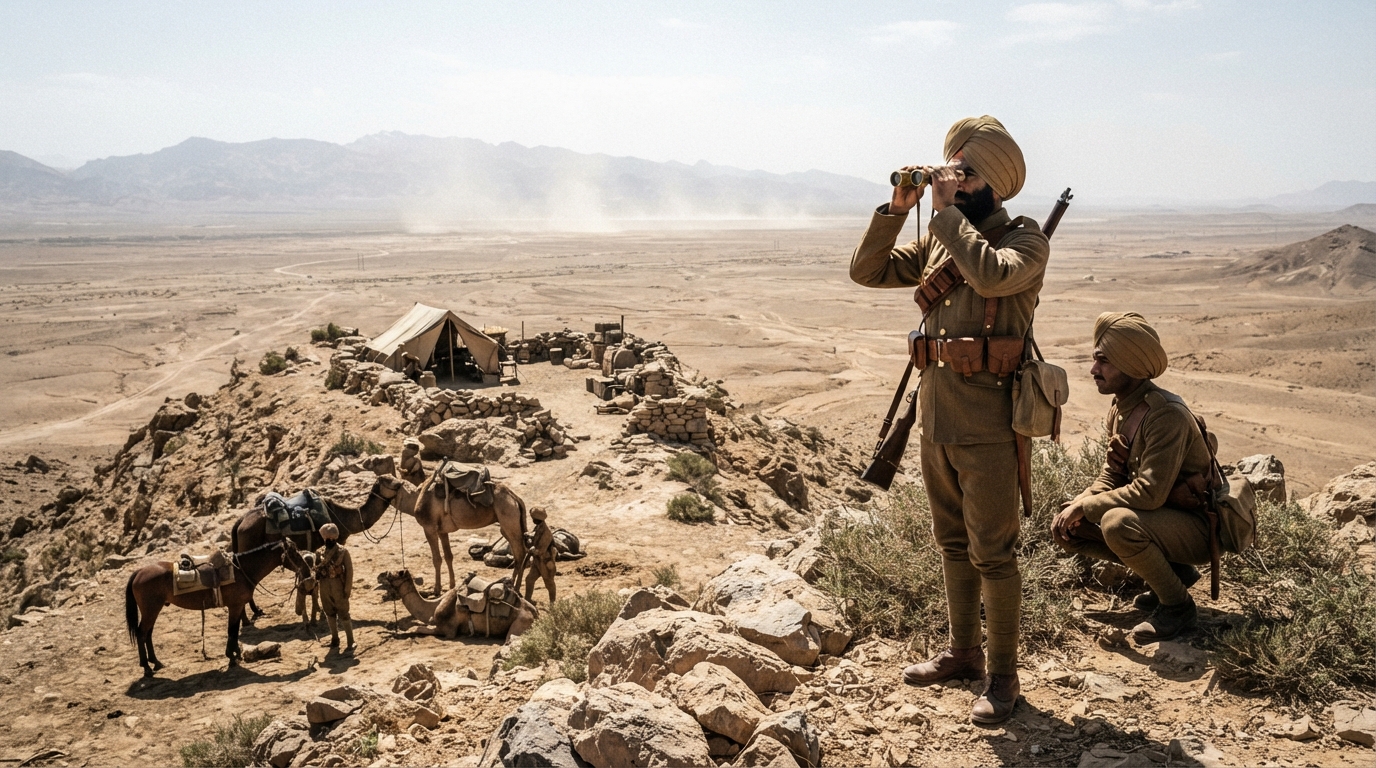
In July 1916, Captain Edward Noel rode through the scorching dust of the Dasht-e Kavir desert. His small detachment of Indian cavalrymen watched the horizon for German agents attempting to reach the Afghan border. With scarce water and temperatures exceeding 45 degrees Celsius, these troops held a remote frontier that guarded the eastern flank of the British Empire.
This remote desert post formed a vital link in a much larger strategic campaign. Examining Indian Army World Wars history reveals that the Persian theater was central to global conflict. Indian soldiers secured oil refineries, laid hundreds of miles of railway tracks, and guarded vital supply convoys across two world wars. You can explore broader imperial campaigns across our Indian history timeline chart.
The Strategic Value of Persia in Global Conflicts
The strategic value of Persia in global conflicts is its position as the geographic land bridge connecting the Mediterranean Sea, Central Asia, and British India during World War I and World War II. Allied control of Persia secured the Abadan oil refineries, halted Axis incursions, and maintained overland Lend-Lease corridors to Russia.
Guarding the Gateway to British India
Persia shared an extensive, poorly marked border with British Baluchistan. During the early twentieth century, British defense planners viewed this frontier as a major vulnerability. If hostile forces infiltrated Persia, those forces could destabilize the western borders of India.
Throughout Indian Army World Wars history, Persian territory served as a primary buffer against rival imperial powers. During World War I, Berlin sought to exploit this geographic opening. German military planners dispatched covert missions to persuade Persian tribes and the Afghan Amir to declare war against Britain. In response, the British Indian Army deployed mobile cavalry detachments to patrol the borderlands.
These cavalry units established outposts across hundreds of miles of arid terrain. British Indian Army soldiers intercepted foreign emissaries, collected intelligence, and prevented armed incursions. According to military analysis published in the Indian Express Military Digest (2026), these outposts formed an early model of imperial border control.
Protecting Anglo-Persian Oil Infrastructure
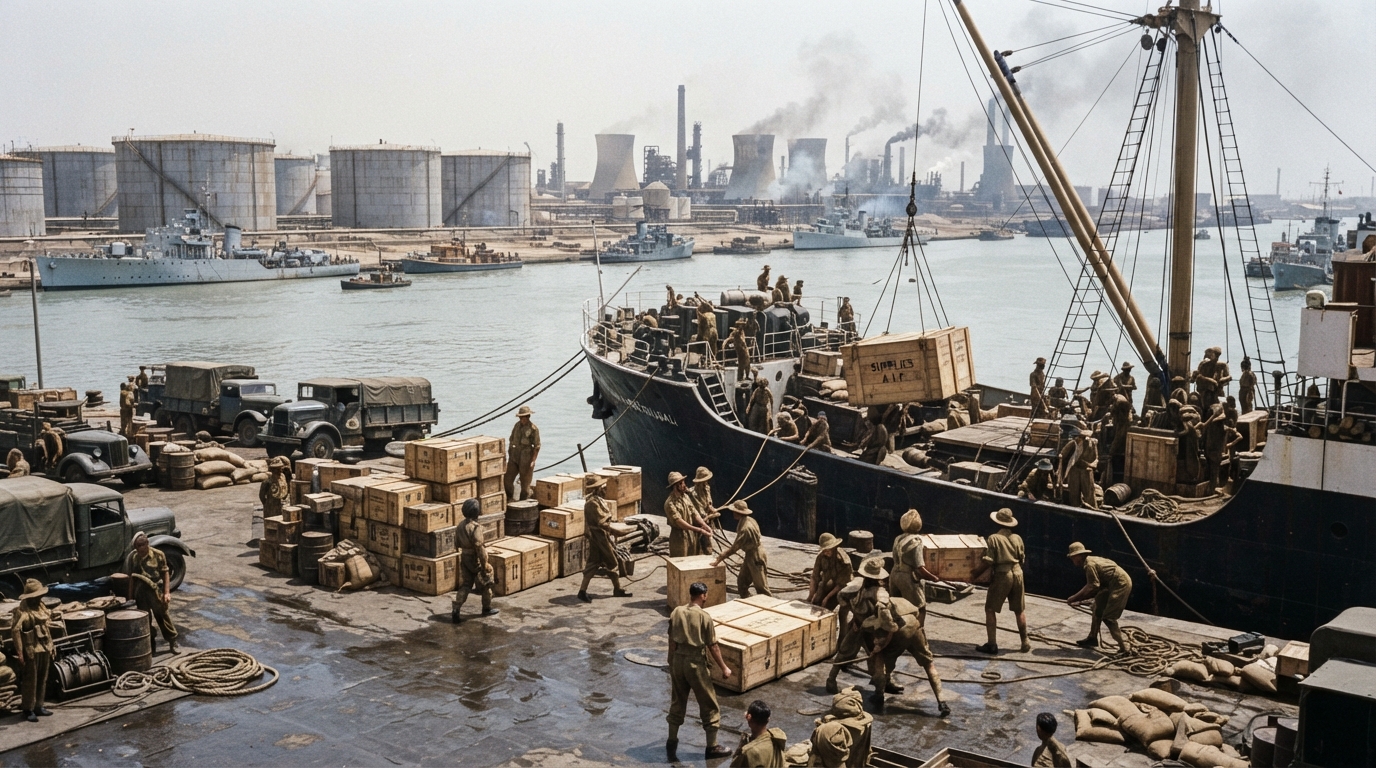
Modern warfare ran on oil. The Royal Navy shifted its fleet from coal to oil fuel in 1912, making the oilfields of southwestern Persia essential to imperial defense. The Abadan refinery, located on the Shatt al-Arab waterway, processed the crude oil extracted from the oilfields of Khuzestan.
Any disruption to Abadan threatened British naval operations across the Indian Ocean and the Mediterranean Sea. Indian Army units served as the primary defense force for these installations. Volunteer enlistments in the Indian Army reached 1.3 million during World War I and 2.5 million during World War II, according to data from Forces War Records (2014) and the UK National Archives (2024). This vast manpower pool allowed British commanders to station garrisons at Persian oil hubs without stripping soldiers from the Western Front or North Africa.
How Did Indian Soldiers Secure Persia During World War I?
Between 1914 and 1918, Indian Army units operated across southern, eastern, and northwestern Persia to counter Ottoman and German influence. These forces suppressed tribal insurgencies, established the East Persia Cordon along the Afghan border, and executed rapid expeditions toward the Caspian Sea to protect oil resources.
                  WWI PERSIAN THEATER TIMELINE
 1914          1915              1916             1918          1921
───┼─────────────┼─────────────────┼────────────────┼─────────────┼───
 Abadan       Seistan Force     South Persia      Dunsterforce  South Persia
 Garrisoned   East Persia       Rifles Formed     Reaches Baku  Rifles
              Cordon Active     (Maj. Sykes)      Oilfields     Disbanded
The East Persia Cordon and the Seistan Force (1915–1917)
In 1915, British intelligence identified German agents, led by Wilhelm Wassmuss and Fritz Niedermayer, attempting to cross Persia into Afghanistan. In response, the British military established the East Persia Cordon.
The Indian Army provided the backbone of this force, known as the Seistan Force. Brigadier General Reginald Dyer took command of operations in the region in 1916. Indian cavalry and infantry units established checkpoints stretching from Meshed in the north to the borders of Baluchistan in the south.
Recent research documented in ResearchGate (2026) highlights the harsh conditions these soldiers faced. Troops endured extreme temperature swings, dysentery, and supply shortages while policing local tribes. Their presence successfully prevented German missions from bringing Afghanistan into the war against the Allies.
The South Persia Rifles and Bushire Operations (1916–1921)
German agents stirred local Tangistani and Qashqai tribes against British commercial interests in southern Persia. To restore order, Major Percy Sykes raised a specialized military unit known as the South Persia Rifles in March 1916.
Although British officers led the force, Indian Army non-commissioned officers and soldiers formed the operational core alongside local Persian recruits. The unit guarded communication lines, telegraph cables, and trade routes linking Shiraz, Kerman, and the port of Bushire.
This campaign represented a grueling chapter in Indian Army World Wars history. Indian troops engaged in frequent skirmishes with hostile tribesmen in rugged mountain passes. By 1918, the force stabilized the southern transit routes, enabling continuous overland logistics across the region.
Dunsterforce and the Baku Mission (1918)
Following the collapse of the Russian Tsarist regime in 1917, the oil-rich city of Baku on the Caspian Sea stood vulnerable to Ottoman capture. The British government organized an elite mobile expedition named Dunsterforce, led by Major General Lionel Dunsterville.
The expedition set out from Baghdad in early 1918, traversing over 600 miles of mountainous Persian terrain to reach the port of Enzeli. Indian Army units, including infantrymen from the 1/4th Hampshire Regiment and the 1/2nd Gurkha Rifles, formed an essential component of this force.
Indian soldiers defended the perimeter of Baku against superior Ottoman forces for six weeks during August and September 1918. Their resistance delayed Ottoman access to vital oil supplies until Allied naval power secured the Black Sea.
Operation Countenance: The 1941 Anglo-Soviet Invasion
On August 25, 1941, British, Indian, and Soviet forces launched Operation Countenance, a surprise joint invasion of Iran to secure supply routes and oil installations. Indian Army divisions spearheaded the southern thrust into Khuzestan and Kermanshah, neutralizing Iranian resistance within four days and forcing the abdication of Reza Shah.
              OPERATION COUNTENANCE (AUGUST 1941)

      SOVIET FORCES (North)          BRITISH / INDIAN FORCES (South)
  ┌───────────────────────────┐      ┌───────────────────────────┐
  │ Advances toward Tabriz,   │      │ 8th Indian Division       │
  │ Rasht, and Tehran         │      │ • Amphibious landing      │
  └─────────────┬─────────────┘      │   at Abadan refinery      │
                │                    │ • Captures Khorramshahr   │
                │                    ├───────────────────────────┤
                │                    │ 10th Indian Division      │
                │                    │ • Overland thrust from    │
                │                    │   Khanaqin (Iraq)         │
                │                    │ • Clears Pai Tak Pass     │
                │                    │ • Captures Kermanshah     │
                │                    └─────────────┬─────────────┘
                ▼                                  ▼
           Tehran Occupied ──► Reza Shah Abdicates ──► Corridor Secured
The Amphibious Assault on Abadan and Khorramshahr
By the summer of 1941, Allied leaders grew alarmed by the large presence of German technicians and diplomats in Iran. Fearing Axis sabotage of oil facilities, British commanders prepared a coordinated military campaign.
According to historical records from Cambridge University Press (2022) and the Germans in Persia Archive (2025), Allied commanders mobilized 19,000 British and Indian troops for the southern offensive. The 8th Indian Infantry Division, commanded by Major General Charles Harvey, led the amphibious assault on Abadan and Khorramshahr.
On August 25, Indian troops landed from sloops and gunboats under the cover of darkness. The 2/12th Frontier Force Regiment assaulted the refinery perimeter and captured the facility before Iranian defenders could trigger demolition charges. At Khorramshahr, Indian soldiers quickly secured the naval base and captured several Iranian gunboats.
The 10th Indian Infantry Division at Pai Tak Pass
Simultaneously, the 10th Indian Infantry Division, led by Major General William Slim, launched an overland offensive from Khanaqin in Iraq toward Kermanshah. The primary objective was securing the fortified Pai Tak Pass in the Zagros Mountains.
Iranian forces had prepared defensive positions along the high ridges overlooking the roadway. Indian infantry regiments, supported by artillery, executed flanking maneuvers through steep mountain trails to outflank the defenders.
Faced with envelopment, the Iranian garrison abandoned the pass on August 27. The division pressed forward rapidly, capturing Kermanshah and establishing contact with Soviet forces moving south from Qazvin. The entire military operation concluded in less than one hundred hours. Readers can review other major strategic operations within our archive of major events in Indian history.
What Was PAIFORCE and the Persian Supply Corridor?
PAIFORCE (Persia and Iraq Command) is the British military command established in September 1942 under General Sir Henry Maitland Wilson to defend Persian oil reserves and operate the overland Persian Supply Corridor to the Soviet Union. As documented by the UK National Army Museum (2023), British Indian Army formations comprised the overwhelming majority of PAIFORCE personnel, contributing infantry divisions, pioneer units, and specialized transport companies. Between 1941 and 1945, the Persian Supply Corridor served as a vital Allied logistics pipeline, transporting 4.16 million tons of Lend-Lease war materiel from Persian Gulf ports across Iranian territory to Soviet forces on the Eastern Front, according to records from the U.S. Army Center of Military History (2022). Indian Army soldiers secured transit routes against sabotage, operated assembly plants, maintained desert supply depots, and managed critical arterial roads across Persia to ensure uninterrupted Allied supply deliveries throughout the Second World War.
Engineering the Trans-Iranian Railway
Delivering millions of tons of heavy military equipment to the Soviet Union required massive infrastructure improvements. The Trans-Iranian Railway, which linked Bandar Shahpur on the Persian Gulf to Bandar Shah on the Caspian Sea, ran through extreme desert heat and narrow mountain tunnels.
Indian Sappers and Miners, along with specialized Indian Railway Units, took charge of upgrading the southern half of the railway line. Indian Sappers expanded port docks, reinforced aging bridges, and laid miles of new siding tracks. This massive transport operation remains one of the largest engineering feats in Indian Army World Wars history.
Indian soldiers worked in brutal environmental conditions. Summer temperatures in Khuzestan regularly climbed above 50 degrees Celsius. Despite these hardships, Indian engineering companies increased the daily freight capacity of the Trans-Iranian Railway from 200 tons in 1941 to over 5,000 tons by late 1943.
Guarding the 4.16-Million-Ton Supply Line to Russia
Between 1942 and 1943, PAIFORCE maintained a peak strength between 134,000 and 200,000 troops, as documented by the National Army Museum UK (2023) and British Military History (2023). Indian Army formations made up the bulk of these forces.
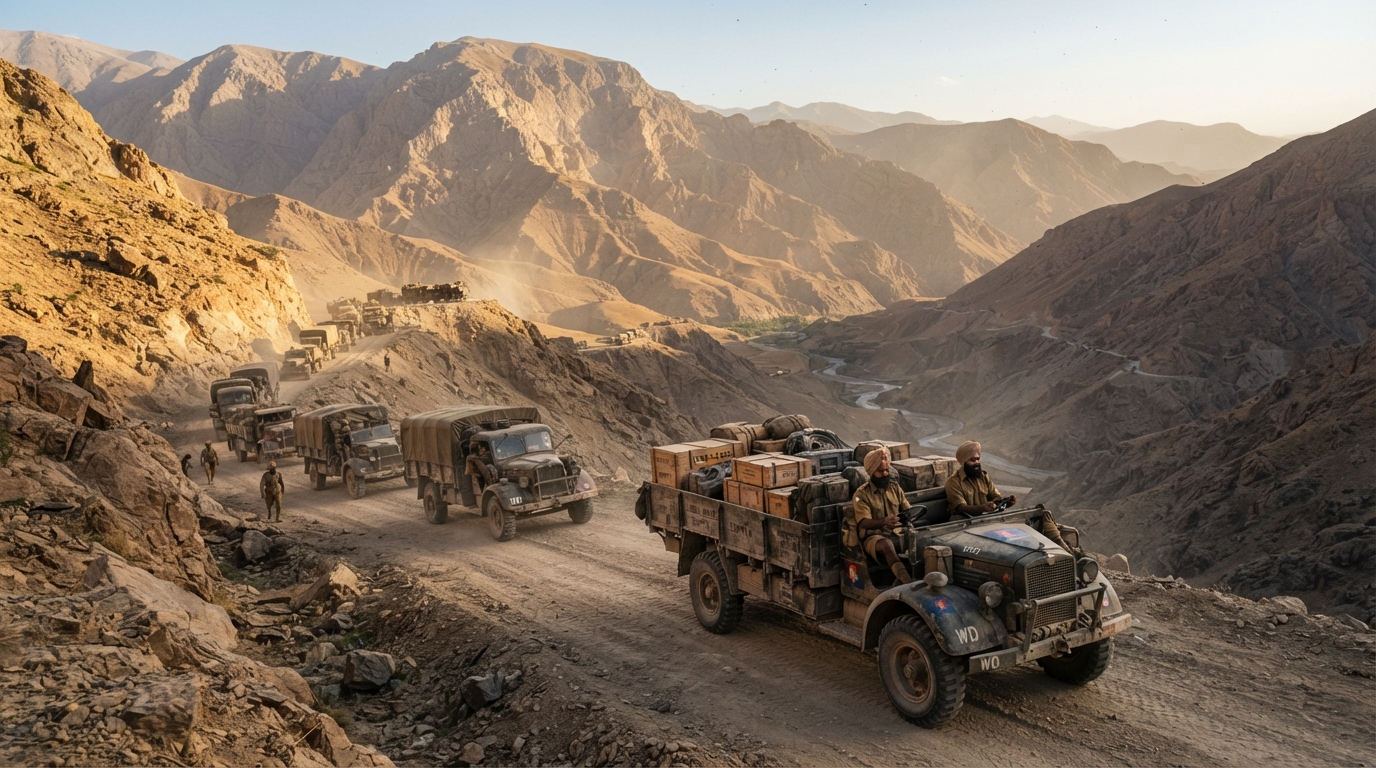
Indian motor transport companies drove heavily loaded trucks over the treacherous mountain roads of the Zagros range. Indian drivers carried aircraft components, Sherman tanks, raw aluminum, and food supplies destined for the Red Army.
Data from the U.S. Army Center of Military History (2022) confirms that the Persian Corridor delivered 4.16 million tons of Lend-Lease war materiel to the Soviet Union between 1941 and 1945. Without the continuous protection and labor provided by Indian soldiers, maintaining this northern supply pipeline would have been impossible. Digitized photographic collections released by New York University Libraries (2023) show the scale of Indian convoy camps and repair workshops established across Iran.
| Campaign / Operation | Primary Indian Units Involved | Operational Goal | Strategic Outcome |
|---|---|---|---|
| East Persia Cordon (1915–1917) | Seistan Force, Indian Cavalry detachments | Intercept German and Ottoman covert missions | Blocked Axis diplomatic access to Afghanistan |
| South Persia Rifles (1916–1921) | Indian NCOs, Persian recruits | Restore order along southern commercial corridors | Secured trade and telegraph lines between Bushire and Shiraz |
| Dunsterforce (1918) | 1/2nd Gurkha Rifles, 1/4th Hampshire Regiment | Defend Baku oilfields from Ottoman army | Delayed Ottoman oil capture for six critical weeks |
| Operation Countenance (1941) | 8th & 10th Indian Infantry Divisions | Seize oil refineries and clear supply corridor | Deposed Axis-leaning monarch; secured Abadan refinery |
| PAIFORCE Logistics (1942–1945) | Indian Sappers, Pioneers, Transport Companies | Expand Trans-Iranian Railway and move Lend-Lease cargo | Delivered 4.16 million tons of supplies to the USSR |
The Complex Legacy of Indian Army World Wars History in Iran
The complex legacy of Indian Army World Wars history in Iran is a dual record of decisive Allied logistical triumph and contentious colonial occupation between 1914 and 1945. While Indian Army units secured strategic oilfields and Lend-Lease supply lines, their military presence enforced British imperial control, causing deep socio-economic strain and local Iranian political resentment.
Imperial Policing and Local Friction
To Iranian nationalists and local communities, Indian soldiers were not viewed as liberating forces. Instead, Indian troops appeared as the armed enforcement arm of British imperial interests and the Anglo-Persian Oil Company.
During World War I, heavy grain requisitioning by British and Russian military forces contributed to severe food shortages and the devastating Persian Famine of 1917–1919. While Indian troops followed imperial military orders, the role of Indian soldiers in guarding grain depots and enforcing martial law created deep resentment among local populations.
Similarly, the 1941 Anglo-Soviet invasion forced Iranian authorities to yield control of domestic rail networks, food supplies, and communications. This reality illustrates a fundamental paradox in Indian Army World Wars history. Indian soldiers fought under the British flag overseas while the Indian population was actively campaigning for independence from colonial rule at home. For deeper historical context on this period, explore our online study materials and date indexes.
Transforming Colonial Logistics into Global Military Reach
The Persian campaigns transformed the British Indian Army from a regional frontier defense force into a globally sustained expeditionary army. Managing vast supply lines across Persia required advanced technical skills, coordinated motor transport, and complex civil-engineering capabilities.
Field Marshal Claude Auchinleck, Commander-in-Chief in India during World War II, stated in official records preserved at the UK National Army Museum Archive that British war efforts in both global conflicts would have collapsed without the operational depth, logistics, and manpower provided by the Indian Army.
Professor Santanu Das of the University of Oxford noted in research published by Oxford University Press (2015) that colonial troops from India converted these regional conflicts into fully sustained industrial campaigns. The road networks, port expansions, and railway lines built by Indian soldiers in Persia permanently modernized the region's transport infrastructure.
Related Reading
- Milestones in Indian Women's History: A Chronological Guide
- 1,000 Years of Indian Medical History: A Chronological Guide
- Economic Milestones in Indian History: From 1947 to Present
- What Are the Major Events in Indian History? (FAQ Archive)
FAQ
Q: Why was Persia important to the Indian Army during the World Wars? Persia bordered British India and contained vital oil refineries at Abadan that powered Allied naval and military operations. Deploying Indian troops prevented hostile German and Ottoman infiltration toward India and kept critical supply routes open.
Q: What was the primary objective of Operation Countenance in 1941? Operation Countenance was a joint Anglo-Soviet military invasion launched on August 25, 1941, to secure Iranian oilfields and establish the Persian Corridor supply route to the Soviet Union. The 8th and 10th Indian Infantry Divisions led the southern assault, securing key oil assets and neutralizing resistance in four days.
Q: How many supplies reached the Soviet Union through the Persian Corridor? Allied forces delivered approximately 4.16 million tons of Lend-Lease war materiel to the Soviet Union through the Persian Corridor between 1941 and 1945. Indian Army logistics, pioneer, and engineering units maintained the railway lines, expanded ports, and guarded the motor convoys that moved these supplies.
Q: What was the role of the South Persia Rifles during World War I? Created in March 1916 and led by Major Percy Sykes, the South Persia Rifles was an armed security force composed of Indian soldiers and local Persian recruits. The unit guarded vital communication lines, telegraph cables, and trade routes against pro-German tribal factions until 1921.
Practical Steps to Explore This History
The most practical way to explore Indian Army World Wars history in Persia is through the systematic cross-referencing of official British operational dispatches, published military division war diaries, archival Persian transport maps, and personal soldier memoirs. Analyzing these complementary primary sources reconstructs the full geopolitical scope, technical engineering achievements, and human realities of these Middle Eastern campaigns.
Further Reading
- The Indian Army in World War II (Kaushik Roy, 2013): A detailed military analysis of Indian division organization, recruitment, and expeditionary logistics across the Middle East.
- India at War: The Subcontinent and the Second World War (Yasmin Khan, 2015): An insightful study examining the social, economic, and political impact of military mobilizations on India and its overseas troops.
- The Persian Corridor and Aid to Russia (T.H. Vail Motter, U.S. Army Center of Military History): The definitive official history documenting the construction, transport statistics, and convoy management of the southern supply route to the USSR.
- Race, Empire and First World War Writing (Santanu Das, 2011): A critical examination of colonial soldier experiences, archival letters, and field testimonies from Middle Eastern theaters.
Sources
- Operation Countenance: The 1941 Invasion of Iran and the Clash of Propaganda Narratives — Cambridge University Press, 2022. Supports: The mobilization of 19,000 British and Indian troops for the joint invasion of Iran in August 1941.
- The Persian Corridor and Aid to Russia — U.S. Army Center of Military History, 1952. Supports: The strategic operation of the Persian Corridor delivering Lend-Lease war materiel to the Soviet Union.
- Chattri Memorial, 2008 — National Army Museum, London, 2008. Supports: Approximately 1.3 million Indian soldiers serving in the First World War.
- Soldiers of Empire — National Army Museum, London, 2020. Supports: The British Indian Army expanding to 2.5 million volunteer soldiers during the Second World War.
- Persia mission — National Army Museum, London, 2018. Supports: Major Percy Sykes raising the South Persia Rifles in 1916 to counter German espionage and protect communication and oil supply routes.
- Dunsterforce in the Caucasus — National Army Museum, London, 2018. Supports: Major General Lionel Dunsterville's 1918 expedition through Persia to defend the Baku oilfields.