The Dawn of Indian Electronics: Historical Tech Milestones
What Is the Bottom Line on the History of Electronics in India?
The history of electronics in India is the post-independence development of domestic hardware capabilities, initiated by state enterprises like Bharat Electronics Limited in 1954 and computing platforms like TIFRAC in 1960. While the 1984 Semiconductor Complex Limited fab reached near-global parity, a 1989 fire and economic shifts redirected national priorities toward software services.
Key Takeaways
- Bharat Electronics Limited started in 1954 to secure domestic defense communications.
- TIFRAC operated as India's first digital computer in Mumbai by 1960.
- The 1966 Bhabha Report created the blueprint for national electronics self-reliance.
- Mohali's Semiconductor Complex ran 5-micron chip fabrication in 1984 before TSMC existed.
- A 1989 fire destroyed India's primary chip plant, shifting policy toward software export.
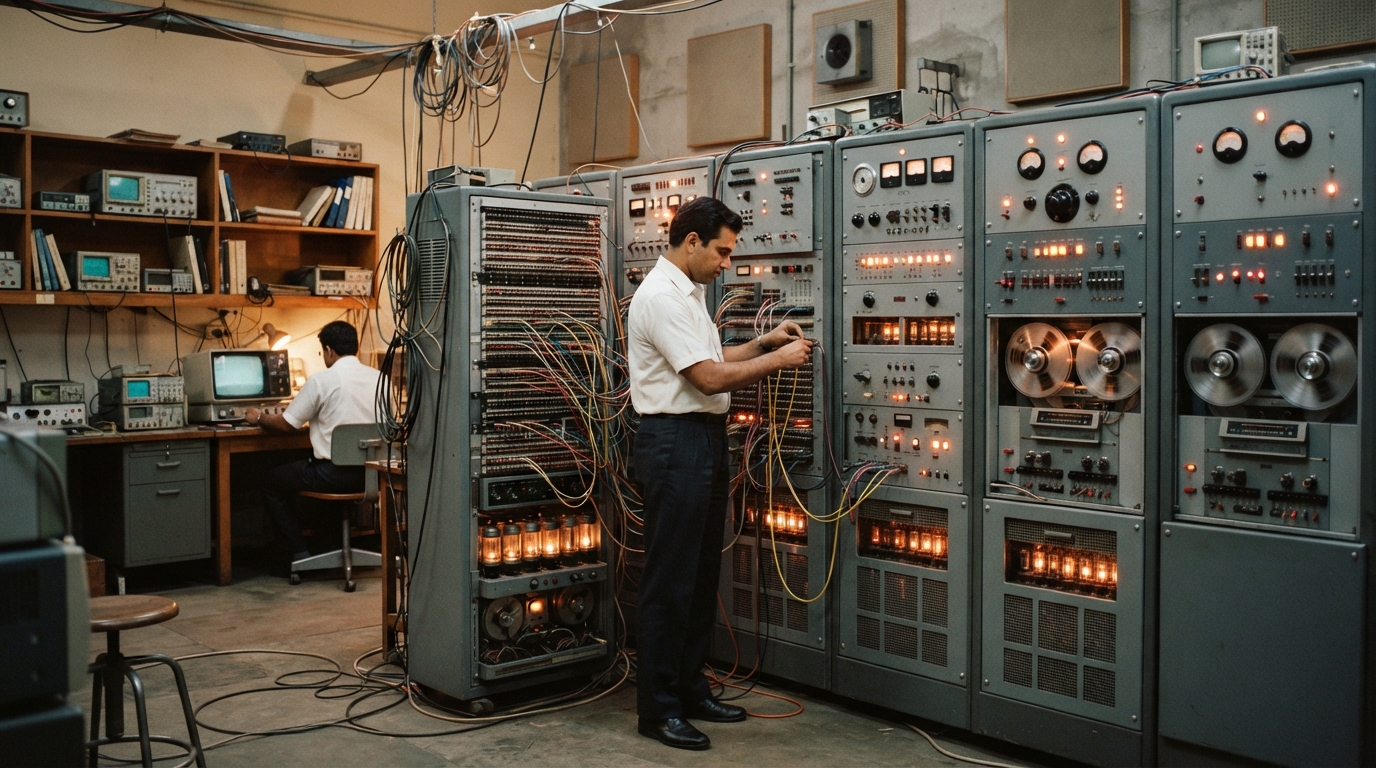
Inside a humid laboratory at the Tata Institute of Fundamental Research in Mumbai in 1956, engineers soldered thousands of vacuum tubes by hand. They were assembling the Tata Institute of Fundamental Research Automatic Calculator, known as TIFRAC. The machine used massive steel cabinets, manual wiring, and auxiliary cooling fans. It represented the earliest physical step in the history of electronics in India. Many modern observers assume Indian tech began with the software boom of the late 1990s. The real story started four decades earlier in state-funded research labs and defense workshops.
Building domestic electronics was a matter of national security for a newly independent nation. Indian planners needed communications equipment for the armed forces and precision instrumentation for atomic energy programs. Relying entirely on foreign suppliers created severe strategic vulnerabilities during border conflicts. By examining how early engineers built hardware under strict budget constraints, we can understand the origins of India's technical workforce. The journey reveals both visionary institutional planning and costly industrial setbacks.
How Did the Early History of Electronics in India Take Shape After 1947?
The history of electronics in India began as a state-driven effort to secure defense communications and atomic research. Between 1954 and 1970, the government established Bharat Electronics Limited, commissioned the landmark 1966 Bhabha Committee Report, and launched the Department of Electronics to build domestic industrial capacity from scratch.
+-------------------------------------------------------------------------+
| EARLY INSTITUTIONAL TIMELINE                                            |
|                                                                         |
| 1954: Bharat Electronics Limited (BEL) founded in Jalahalli, Bangalore  |
| 1960: TIFRAC computational system commissioned in Mumbai                |
| 1966: Homi Bhabha Electronics Committee Report submitted                |
| 1967: Electronics Corporation of India Limited (ECIL) established       |
| 1970: Department of Electronics (DoE) formed by Union Government        |
+-------------------------------------------------------------------------+
The Genesis of Bharat Electronics Limited (BEL) in 1954
Post-independence India faced an urgent shortage of military radio gear. The government established Bharat Electronics Limited (BEL) in Bangalore in 1954 to solve this operational problem [Bharat Electronics, 2026]. BEL started production in Jalahalli with a modest staff and licensed European designs. The initial product lines focused on basic radio transmitters, receivers, and vacuum tubes for the Indian Army.
BEL expanded quickly into radar manufacturing and naval communications. The company created an internal culture of precision assembly when private industry lacked capital for high-end equipment. Engineers learned how to build quartz crystals, specialized ceramic capacitors, and high-frequency communication sets. This work laid the foundation for Bangalore to become the central hub for Indian defense engineering. For readers exploring scientific milestones in Indian history, BEL represents the first large manufacturing base dedicated entirely to electronic hardware.
What Was the 1966 Bhabha Committee Report and Its Institutional Impact?
The 1966 Bhabha Committee Report is a ten-year national blueprint commissioned in 1963 by Prime Minister Jawaharlal Nehru and chaired by nuclear physicist Homi J. Bhabha to achieve technological self-reliance. Submitted in February 1966 [Dataquest, 2006], the report established the institutional framework for the Department of Electronics and the Electronics Commission formed in 1970.
Nuclear physicist Homi J. Bhabha recognized that atomic energy and national defense depended on domestic electronics. In 1963, Prime Minister Jawaharlal Nehru appointed Bhabha to chair the Electronics Committee. The committee submitted its final report in February 1966, shortly after Bhabha died in an air crash [Dataquest, 2006].
The Bhabha Report was a detailed industrial blueprint. It calculated that India needed to build an indigenous component supply chain within ten years to avoid technological dependency. The report warned against relying on turnkey foreign factories that did not transfer core engineering skills. Following its recommendations, the Union Government created the Department of Electronics (DoE) and the Electronics Commission in 1970 under Prime Minister Indira Gandhi. The DoE controlled industrial licensing, allocated research funds, and promoted regional electronic testing laboratories across the country.
Early Indigenous Computing: From TIFRAC to ECIL Mainframes
India built digital computational hardware long before commercial microprocessors became common. Between 1956 and 1960, a team under D. Y. Phadke constructed TIFRAC at the Tata Institute of Fundamental Research in Mumbai. The system used 2,000 vacuum tubes, consumed significant electrical power, and ran custom assembly code [Dataquest, 2006]. It provided critical computation time for Indian nuclear physicists and atmospheric researchers.
TIFRAC (1960)                TDC-12 (1969)                TDC-316 (1973)
[Vacuum Tubes]      --->     [Discrete Germanium]  --->   [Integrated Circuits]
Batch Processing             Real-Time Control            Multi-User Mainframe
Scientific Computing         Nuclear Instrumentation      Industrial Automation
TIFRAC was decommissioned in 1965 to make way for imported second-generation computers. The engineering experience gained from TIFRAC moved to Hyderabad. There, state teams began designing solid-state machines using discrete germanium transistors. These projects showed that Indian engineers could design working central processing units, magnetic core memory stacks, and input-output controllers without foreign technical staff on site.
What Role Did State Enterprises Play in Hardware Self-Reliance?
State-owned enterprises acted as the primary engine for early Indian hardware development. Electronics Corporation of India Limited, founded in 1967 by A. S. Rao, designed indigenous computers and control systems for nuclear reactors, bypassing Western import restrictions while navigating severe bureaucratic hurdles that deterred international private investment.
Who Was A. S. Rao and What Was the Role of ECIL?
Electronics Corporation of India Limited (ECIL) is a state-owned enterprise established in Hyderabad in April 1967 under the leadership of physicist A. S. Rao to commercialize indigenous electronics for atomic energy and defense. Spun off from the Bhabha Atomic Research Centre, ECIL manufactured domestic instrumentation, precision components, and computers without relying on foreign licensing agreements [Wikipedia / ECIL, 2026].
The Bhabha Atomic Research Centre (BARC) in Trombay housed an active electronics production division during the early 1960s. Physicist A. S. Rao led this group, building radiation counters, pulse analyzers, and control panels for atomic reactors. In April 1967, the Indian government spun off this division to form the Electronics Corporation of India Limited (ECIL) in Hyderabad.
Rao championed complete domestic self-reliance. Rao believed that developing local control systems was necessary for national sovereignty [Wikipedia / ECIL, 2026]. ECIL rejected foreign equity partnerships and foreign licensing agreements. Instead, ECIL commercialized laboratory designs created inside BARC and Indian universities. ECIL produced high-precision resistors, ceramic capacitors, television sets, medical instruments, and industrial control panels. ECIL proved that commercial-grade electronic hardware could be designed and manufactured entirely within India.
+--------------------------------------------------------------------------+
| ECIL STRATEGIC PRODUCT DIVISIONS (EST. 1967)                             |
|                                                                          |
| 1. Nuclear Control Systems  -> Reactor panels, radiation monitors        |
| 2. Digital Systems Group    -> TDC series computers, real-time telemetry |
| 3. Microwave & Defense      -> Antenna feeds, radar receivers            |
| 4. Consumer Hardware        -> Solid-state black-and-white television    |
+--------------------------------------------------------------------------+
Strategic Computing: The TDC-12 and TDC-316 Systems
ECIL's Digital Systems Division designed India's first commercial computers. In 1969, the team launched the TDC-12, a 12-bit real-time computer built using discrete transistors and ferrite core memory [Wikipedia / ECIL, 2026]. The TDC-12 was deployed in atomic power plants, defense radar installations, and university research labs across the country.
- TDC-12 (1969): 12-bit architecture, handled 250,000 additions per second, controlled real-time atomic instrumentation.
- TDC-312 (1971): Upgraded 12-bit system with integrated circuits, used in industrial automation and seismic data logging.
- TDC-316 (1973): 16-bit general-purpose computer, supported multi-user programming and FORTRAN compilers, widely used in Indian universities.
- TDC-332 (1978): 32-bit mainframe architecture, ran complex simulations for space and defense agencies.
These computers ran indigenous operating software developed by Indian programmers. They protected Indian scientific institutions from foreign trade embargoes. Students trained on TDC machines formed the first generation of systems programmers in the country. Readers tracking economic milestones in Indian history can observe how these early public computing investments built technical capital before the market opened to private enterprise.
The Bureaucratic Barrier: How Missed Foreign Partnerships Shaped the Sector
India's strict import substitution policies protected domestic firms, but they created unintended commercial isolation. In the mid-1960s, Fairchild Semiconductor evaluated options to build a semiconductor assembly plant in India [Meet Global, 2022]. Fairchild was a pioneer of the integrated circuit and sought low-cost assembly sites in Asia.
Indian government officials demanded that Fairchild share intellectual property and accept strict equity caps under the Foreign Exchange Regulation Act. Negotiations dragged on for months without approval. Fairchild canceled the proposal and built its assembly plant in Penang, Malaysia instead. Malaysia used that single investment to anchor a multi-billion-dollar semiconductor export industry. India's regulatory delays kept the domestic market isolated from high-volume global supply chains.
Why Was the Semiconductor Complex Limited (SCL) Mohali Breakthrough Significant?
Semiconductor Complex Limited in Mohali proved that India could manufacture integrated circuits at near-global standards during the early 1980s. Operating a 5-micron fabrication line in 1984, the facility produced custom silicon for telecommunications and defense before a devastating 1989 fire crippled commercial production for nearly a decade.
GLOBAL FABRICATION PROCESS COMPARISON (1983 - 1988)

1983-1984:
- SCL Mohali (India): 5.0-micron CMOS
- Intel (USA): 1.5-micron NMOS (Intel 80286)
- TSMC (Taiwan): Not yet founded

1987-1988:
- SCL Mohali (India): 0.8-micron CMOS development
- TSMC (Taiwan): 3.0-micron CMOS (Foundry model launch)
- Intel (USA): 0.8-micron CMOS (Intel 80486 development)
Establishing a 5-Micron CMOS Fabrication Plant in 1984
The Department of Electronics recognized that importing silicon chips created long-term vulnerability. In 1978, the central government approved the creation of Semiconductor Complex Limited (SCL) as a public enterprise. The government built the facility in Mohali, Punjab. SCL signed technology transfer agreements with American Microsystems Inc. (AMI) and Rockwell International to license complementary metal-oxide-semiconductor (CMOS) technology [Endless Ramblings, 2025].
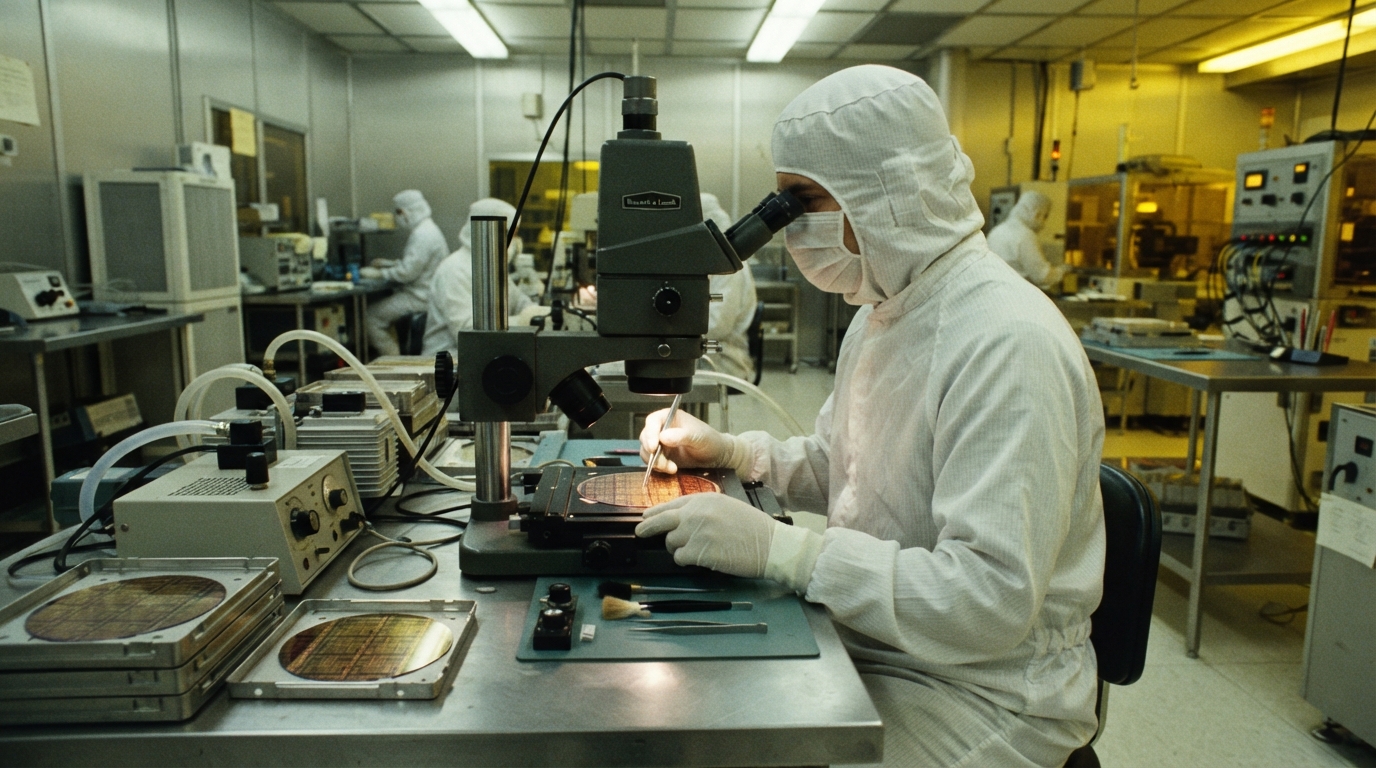
The Mohali plant started commercial operations in 1984 with a 5-micron fabrication line [Sixsense.ai, 2026]. The facility included class-10 cleanrooms, chemical etching equipment, and precision lithography systems. SCL engineers fabricated microprocessors, clock chips, telecom codecs, and custom Application-Specific Integrated Circuits (ASICs). By 1988, SCL advanced its process nodes down to 0.8-micron. The factory was running just one generation behind Intel and ahead of Taiwan Semiconductor Manufacturing Company (TSMC), which was founded in 1987 [YourStory, 2026].
+--------------------------------------------------------------------------+
| SCL MOHALI EARLY PRODUCT LINES (1984 - 1989)                             |
|                                                                          |
| * Custom ASICs          -> Electronic voting machines, telephone codecs  |
| * Microprocessors       -> Licensed 8-bit 6502 processing units          |
| * Digital Clock Circuits-> Domestic electronic watches and dashboards    |
| * Space-Grade Chips     -> Radiation-hardened controllers for ISRO       |
+--------------------------------------------------------------------------+
The 1989 Mohali Fire and the Disruption of Domestic Fabrication
On February 7, 1989, a catastrophic fire swept through the SCL Mohali complex. The blaze consumed the cleanroom facilities, fabrication modules, testing bays, and precision lithography machines. Direct asset losses totaled approximately ₹75 crore, a massive sum for an Indian public enterprise at the time [ThePrint, 2026, India Today, 2025].
The fire halted domestic silicon fabrication for eight years. While government committees debated reconstruction budgets and technology transfer terms, global semiconductor manufacturing accelerated. Asian competitors in Taiwan, South Korea, and Singapore invested billions of dollars in sub-micron cleanrooms. By the time SCL rebuilt its fab in 1997 with an older 0.8-micron process, the commercial market had moved to 0.25-micron nodes. The gap proved too wide for commercial competition, forcing SCL to pivot exclusively to strategic defense and space hardware.
Strategic Space Electronics and Radiation-Hardened Chips for ISRO
Despite losing commercial competitiveness, SCL remained indispensable for the Indian Space Research Organisation (ISRO). Western nations placed export restrictions on radiation-hardened components following India's nuclear tests. ISRO could not purchase high-reliability flight controllers on the open international market. SCL filled this gap by manufacturing custom radiation-tolerant integrated circuits [Medium / Vansh Singla, 2025].
SCL fabricated micro-electro-mechanical systems (MEMS), pressure sensors, and onboard processing chips for Indian launch vehicles. SCL silicon flew on the Polar Satellite Launch Vehicle (PSLV), the Geosynchronous Satellite Launch Vehicle (GSLV), and the Mars Orbiter Mission (Mangalyaan) [Wikipedia / Semi-Conductor Laboratory, 2026]. BEL provided complementary packaging and radio-frequency modules. These strategic successes kept specialized cleanroom engineering alive inside India during decades of commercial hardware decline.
How Does the History of Electronics in India Compare Across Major Milestones?
Tracing the history of electronics in India reveals a distinct progression from vacuum tube calculators to commercial semiconductor fabrication and eventual software dominance. Early state initiatives built foundational capabilities in instrumentation and defense, though industrial continuity suffered setbacks due to structural bottlenecks and changing global trade policies.
What Is the Chronological Breakdown of Foundational Milestones?
The chronological breakdown of foundational milestones in Indian electronics is a three-stage progression spanning post-war institution building in the 1950s, semiconductor indigenization in the 1970s and 1980s, and post-liberalization software diversification after 1991. This structured historical sequence illustrates how state-led research laboratories and public sector enterprises established domestic manufacturing capabilities across key decades [Dataquest, 2006].
Studying tech history requires viewing events in their sequence. When historians consult chronological timelines, historians see that Indian electronics evolved in three distinct phases: early post-war institution building (1950s–1960s), high-density indigenization (1970s–1980s), and the post-liberalization software pivot (1990s).
Researchers tracking archive records for today in Indian history find key policy decisions clustered around specific dates. For instance, archival records show how the Department of Electronics expanded its field offices every quarter during the 1970s. Historical date markers like 20 August in Indian history, 24 August special day in India, 31 August special day in India, and September 7 special day in India document institutional charters, scientific appointments, and laboratory inaugurations. Each date reflects a deliberate step to expand national capacity.
+--------------------------------------------------------------------------+
| THREE ERAS OF INDIAN TECH DEVELOPMENT                                    |
|                                                                          |
| Era 1 (1950-1969): Institution Building                                  |
| Focus: Defense communications, nuclear instrumentation, manual computing |
| Key Entities: BEL, TIFR, BARC, Early ECIL                                |
|                                                                          |
| Era 2 (1970-1989): Hardware Fabrication Attempt                          |
| Focus: Indigenous mainframes, telecommunications, CMOS silicon wafer fab |
| Key Entities: ECIL (TDC series), SCL Mohali, DoE Labs                    |
|                                                                          |
| Era 3 (1990-Present): Software Dominance & Modern Silicon Rebuilding     |
| Focus: IT services export, followed by modern India Semiconductor Mission|
| Key Entities: STPI, MeitY, Modernized SCL, Commercial Fab Consortiums    |
+--------------------------------------------------------------------------+
Comparison Table of Early Indian Electronics Enterprises
The table below contrasts the operational focus, founding dates, technology base, and legacy of early Indian hardware enterprises.
| Enterprise / Institution | Established | Core Technology Base | Primary Target Sector | Historical Outcome & Legacy |
|---|---|---|---|---|
| Bharat Electronics Limited (BEL) | 1954 | Vacuum tubes, quartz crystals, solid-state radar | Defense communication, army avionics, naval radar | Major defense PSU; key supplier of military electronics and EVMs [Bharat Electronics, 2026]. |
| TIFR Computer Group (TIFRAC) | 1956 | Thermionic valves, ferrite memory, paper tape | Nuclear physics, atmospheric calculation | Validated domestic computing skills; engineers later seeded ECIL [Dataquest, 2006]. |
| Electronics Corporation of India (ECIL) | 1967 | Discrete transistors, integrated circuits, mainframes | Nuclear reactor controls, university computing | Built India's first commercial mainframe line (TDC-12/316) [Wikipedia / ECIL, 2026]. |
| Semiconductor Complex Limited (SCL) | 1983 | 5-micron to 0.8-micron CMOS silicon wafers | Telecommunications, digital watches, space chips | Ran advanced fab until 1989 fire; pivoted to strategic components for ISRO [Endless Ramblings, 2025]. |
The Shift from Hardware Fabrication to Software Services
The economic crisis of 1991 altered Indian industrial policy. Facing severe balance-of-payments constraints, India opened its market to foreign consumer electronics and imported computer hardware. Tariffs on assembled computer systems dropped dramatically under World Trade Organization agreements. Domestic hardware manufacturers could not match the scale and prices of high-volume factories in East Asia.
Hardware Challenges (1990s)             Software Emergence (1990s)
- High capital costs for fabs    VS.    - Low capital startup costs
- Unreliable electrical grids           - Satellite data links (STPI)
- Complex customs paperwork             - English-speaking engineering pool
- Long supply chain lead times          - Immediate export billing in USD
Capital shifted toward software engineering and IT services. Software development required desktop computers, electricity, and reliable telecommunication links provided by Software Technology Parks of India (STPI). It did not require cleanrooms, complex chemical supply chains, or massive water purification facilities. India's technical workforce pivoted from hardware fabrication to writing enterprise software for global clients. This shift created immense economic value, but it left the country dependent on imported silicon. By 2024, India's semiconductor import bill reached $20 billion annually [India Today, 2025].
What Lessons from Early Indian Electronics Shape Current Policy?
Early hardware initiatives showed that domestic fabrication requires continuous capital, resilient supply chains, and strong commercial integration. Today, programs like the India Semiconductor Mission apply these historical lessons by subsidizing high-tech manufacturing, upgrading legacy research fabs, and shifting from basic assembly toward domestic component ecosystems.
+--------------------------------------------------------------------------+
| STRATEGY COMPARISON: 1980s VS 2020s                                      |
|                                                                          |
| 1980s Approach (SCL / ECIL)          2020s Approach (Semicon India / ISM)|
| * State-owned and funded             * Public-private joint ventures     |
| * Isolated domestic market           * Global supply chain integration   |
| * Single fabrication facility        * Multiple distributed packaging/fab|
| * Vulnerable to single accidents     * Capital subsidies up to 50%       |
+--------------------------------------------------------------------------+
What Is the Transition from Assembly to Component Manufacturing?
The transition from assembly to component manufacturing is an industrial strategy designed to replace low-value surface-mount device assembly with localized production of integrated sub-assemblies, printed circuit boards, and active silicon. According to Union Minister Ashwini Vaishnaw, developing domestic component ecosystems captures high manufacturing value and insulates domestic electronics factories from sudden international supply disruptions [YouTube / Ashwini Vaishnaw, 2026].
Modern electronics manufacturing in India began with smartphone assembly. Low-complexity surface-mount assembly lines allowed companies to assemble imported parts with local labor. Assembly creates jobs, but assembly captures only a fraction of the total product value. Most of the profit remains with the suppliers of displays, memory modules, processors, and camera sensors.
Union Minister for Electronics and IT Ashwini Vaishnaw pointed out that India's current strategy deliberately reverses decades of import reliance by shifting from simple assembly to component ecosystems [YouTube / Ashwini Vaishnaw, 2026]. To build lasting resilience, manufacturing policy now encourages local production of printed circuit boards (PCBs), connectors, power adapters, and passive components. This horizontal depth protects domestic plants from sudden international supply disruptions.
Rebuilding the Silicon Ecosystem Under the India Semiconductor Mission
The central government launched the India Semiconductor Mission (ISM) with an incentive outlay of ₹76,000 crore. As of 2026, the program has approved 12 commercial manufacturing and packaging projects worth ₹1.64 lakh crore [YourStory, 2026]. These projects combine private capital from domestic conglomerates with technical partnerships from global semiconductor firms.
+--------------------------------------------------------------------------+
| MODERN SEMICONDUCTOR INITIATIVES (2024-2026)                             |
|                                                                          |
| 1. Commercial Fabs      -> Joint ventures for automotive & power silicon |
| 2. ATMP / OSAT Units    -> Advanced packaging and chip testing facilities|
| 3. Modernizing SCL      -> MeitY modernization tender for Mohali 180nm   |
| 4. Compound Silicon     -> Silicon carbide & gallium nitride power plants|
+--------------------------------------------------------------------------+
As part of this modernization effort, the government transferred administrative control of SCL Mohali from the Department of Space to the Ministry of Electronics and Information Technology (MeitY) [Wikipedia / Semi-Conductor Laboratory, 2026]. Tenders have been issued to modernize its legacy 180nm R&D fabrication line. Contemporary tech analyses conclude that India never lacked the talent to build hardware [YourStory, 2026]. The early pioneers at BEL, ECIL, and SCL proved what was possible. Today's industrial policies provide the sustained capital and global integration needed to complete what those early engineers started.
What Are the Most Frequently Asked Questions About Indian Electronics History?
Q: what is on 26 august in india?
Archival records for 26 August in India feature various political, legal, and institutional milestones documented across national daily history registers. On this day, readers exploring historical tech archives track policy decisions and institutional announcements made by post-independence scientific departments.
Q: what is on 26th august in india?
In Indian daily history archives, 26th August marks notable civic events, regional institutional milestones, and leadership transitions across various public sectors. Researchers use date-wise indices to connect these calendar records with broader developments in national administration and scientific planning.
Q: What was India's first indigenous computer?
India's first digital computer was the TIFRAC (Tata Institute of Fundamental Research Automatic Calculator), commissioned in Mumbai in 1960. It was followed by the TDC-12 in 1969, which was the first commercial real-time solid-state computer built by ECIL in Hyderabad.
Q: Why did India fall behind in commercial semiconductor manufacturing?
India's semiconductor momentum slowed after a catastrophic fire destroyed the Semiconductor Complex Limited (SCL) fab in Mohali on February 7, 1989. The resulting eight-year reconstruction delay, combined with the post-1991 economic pivot toward software exports, allowed East Asian foundries to capture the commercial chip market.
If you are researching Indian technology history for academic or policy work, your next move is to study primary institutional reports. Review the 1966 Bhabha Committee Report and early DoE annual summaries to evaluate how public resource allocation shaped hardware capabilities. Cross-reference those findings with modern India Semiconductor Mission filings to compare historical import substitution with current public-private manufacturing models.
Related Reading
- India at the Olympics: A Timeline of Historic Sporting Milestones
- Milestones in Indian Women's History: A Chronological Guide
- 1,000 Years of Indian Medical History: A Chronological Guide
- Economic Milestones in Indian History: From 1947 to Present
Sources
- History — Bharat Electronics Limited, 2023. Supports: The founding of Bharat Electronics Limited (BEL) in Bangalore in 1954 to manufacture defense communication equipment and precision electronics.
- 1966-1975: Of Committees & Bodies — Dataquest, 2006. Supports: The submission of the Bhabha Committee Report in 1966 and the subsequent formation of the Department of Electronics in 1970.
- TIFRAC, India's First Computer - A Retrospective — Indian Academy of Sciences, 2008. Supports: The design and 1960 commissioning of TIFRAC at the Tata Institute of Fundamental Research as India's first digital computer.
- The first big byte — The Hindu, 2021. Supports: The establishment of Electronics Corporation of India Limited (ECIL) and the development of the Trombay Digital Computer (TDC-12).
- How the SCL fire in Mohali sabotaged India's chip dreams — India Today, 2024. Supports: SCL Mohali's 5-micron chip fabrication starting in 1984, the ₹75 crore damage caused by the February 7, 1989 fire, and India's subsequent $20 billion chip import dependency.
- Union Cabinet approves ₹76,000-crore push for semiconductor makers — The Hindu, 2021. Supports: The Union Cabinet's approval of the ₹76,000 crore India Semiconductor Mission incentive outlay to build domestic fabrication and packaging ecosystems.