The 1995 Purulia Arms Drop: A Chronological Timeline of Events
The Quick Read
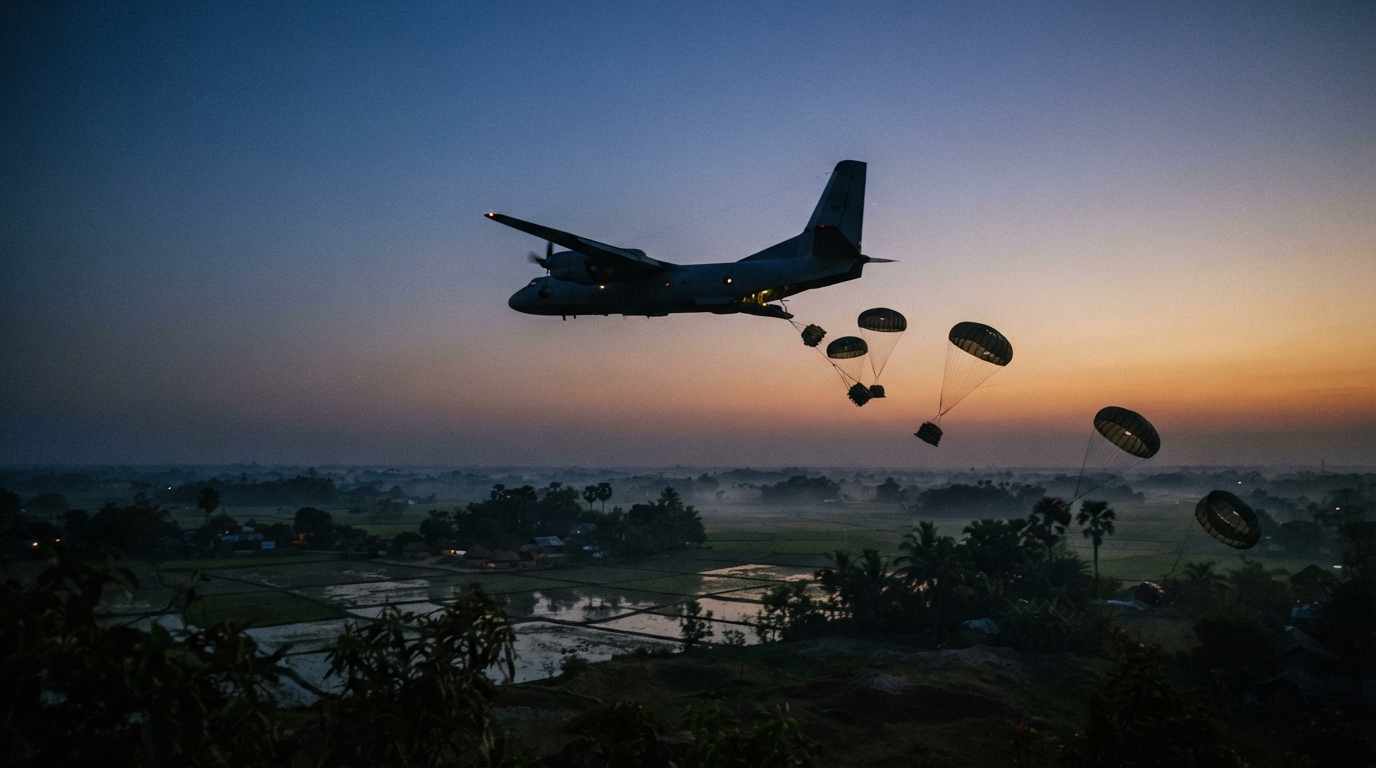
The Purulia arms drop timeline is the record of the December 17, 1995 unauthorized parachuting of four tonnes of military equipment into Purulia, West Bengal, by an Antonov An-26 aircraft. The incident sparked international diplomatic disputes, criminal convictions for British and Latvian operatives, and a decades-long extradition battle between India and Denmark.
Key Takeaways
- An Antonov An-26 dropped four tonnes of military weapons across rural West Bengal on December 17, 1995.
- Villagers recovered hundreds of AK-47 assault rifles, rocket launchers, anti-tank grenades, and thousands of live ammunition rounds.
- A Kolkata court convicted six foreign operatives in 2000, but all received early presidential remissions through diplomatic channels.
- Key conspirator Niels Holck escaped capture in Mumbai and avoided Indian extradition following multiple Danish court rulings through 2024.
Early on the morning of December 18, 1995, farmers in the Purulia district of West Bengal discovered wooden packing crates dangling from large military parachutes caught in banyan trees. Cardboard boxes lay cracked open across cultivated fields in the villages of Khatanga, Belamu, Jhalda, and Maramu. Inside were hundreds of automatic rifles, rocket launchers, and metal magazines packed in heavy grease. Understanding the Purulia arms drop timeline requires looking at cold-war military surpluses, private arms brokers, and severe intelligence coordination failures. This event remains one of the most unusual breaches of sovereign airspace in modern Indian history.
The Planning and Ingress of the Antonov An-26
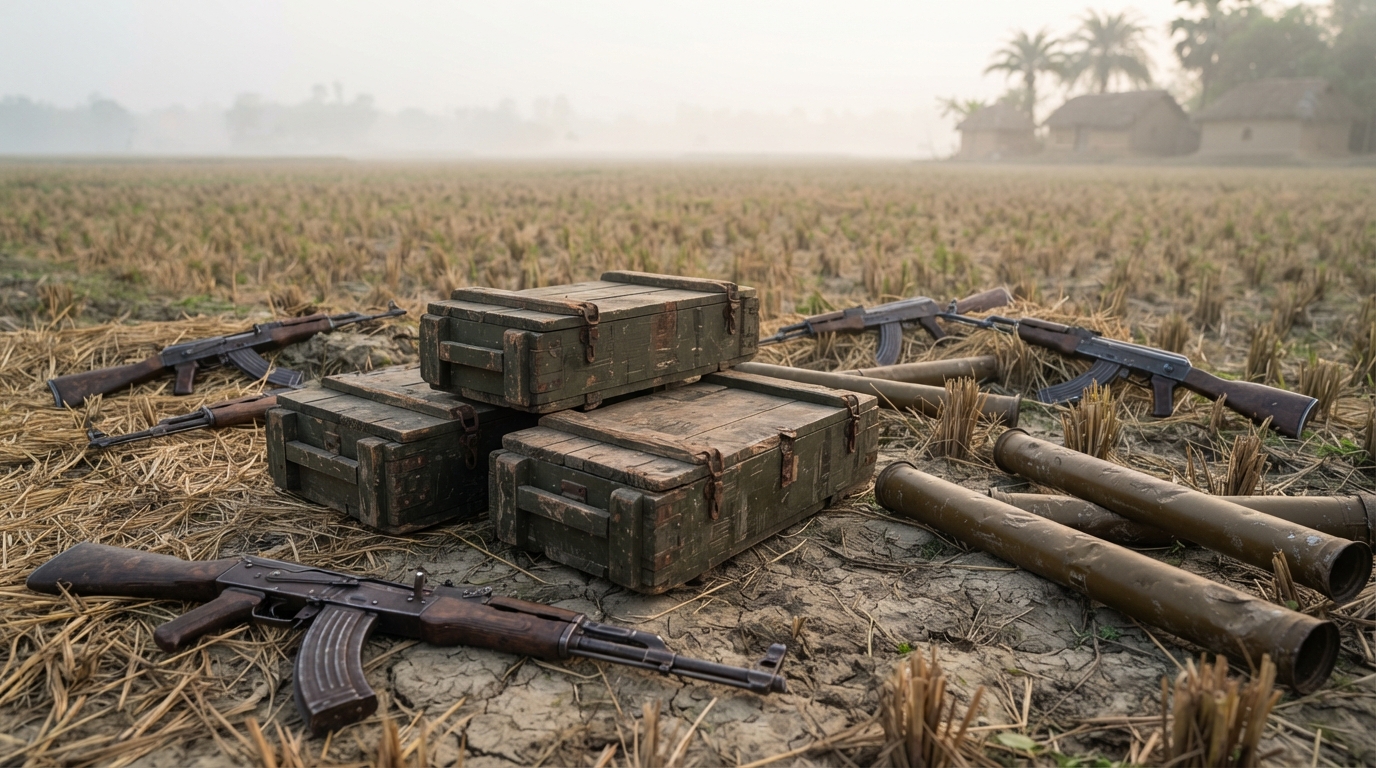
The planning and ingress of the Antonov An-26 is the covert 1995 logistical operation that transported four tonnes of Bulgarian weapons across Eastern Europe, Pakistan, and India. Conceived by British arms dealer Peter Bleach and Danish national Niels Holck, the operation secured surplus arms from Sofia and flew an Antonov An-26 through Varanasi into West Bengal on December 17, 1995.
1995 Logistical Corridor:
Bulgaria (Burgas) ──> Pakistan (Karachi) ──> India (Varanasi) ──> Purulia Drop Zone
Procuring Weapons Across Eastern Europe
Planning for the shipment accelerated during the summer of 1995. A British arms dealer named Peter Bleach operated a private firm named Border Technology and Systems. Bleach coordinated with a Danish citizen using the alias Kim Davy, whose real name was Niels Christian Holck.
The pair arranged to purchase military surplus goods from state arms manufacturer Arsenal in Sofia, Bulgaria. The cargo manifest claimed the consignment was destined for the armed forces of Bangladesh. The weapons cargo weighed roughly four tonnes [Reuters, 2024]. It included over 500 AK-47 assault rifles, 12 rocket launchers, 80 anti-tank grenades, and more than 25,000 rounds of 7.62mm ammunition [Frontline/India Today, 2024].
To move the cargo, the group bought a twin-engine Soviet-era Antonov An-26 cargo turboprop. The conspirators registered the plane in Latvia under the registration number YL-LIL.
The Flight Route from Burgas to Varanasi
The Antonov An-26 departed Burgas, Bulgaria, on December 15, 1995, loaded with dozens of wooden cases. The flight crew consisted of five Latvian airmen led by captain Alexander Klich. Niels Holck accompanied the crew on board the aircraft.
The aircraft flew first to Karachi, Pakistan, where the plane refueled and stayed overnight. On December 17, 1995, the plane entered Indian airspace and landed at Varanasi Airport in Uttar Pradesh. The crew filed a flight plan stating their destination was Yangon, Myanmar.
During the layover at Varanasi, airport authorities cleared the flight without conducting a thorough interior physical inspection of the cargo hold. The aircraft took off from Varanasi during the evening hours of December 17, heading east along domestic air corridors.
Intelligence Warnings and Communication Lapses
The Indian central government received warnings before the aircraft reached West Bengal. British intelligence agency MI5 learned about the pending shipment through Peter Bleach, who acted as an informant for UK authorities. MI5 relayed warning telexes to India's Research and Analysis Wing (R&AW) in late November 1995.
The warning described an illegal arms cargo entering Indian airspace via an Antonov An-26. However, institutional delays crippled the response. The central authorities forwarded the warning to West Bengal state officials through standard registered post.
The physical letter arrived at state police headquarters days after the drop had already happened. Military radar installations also faced gaps. The radar array at Kalaikunda Air Force Base was offline for routine maintenance during the transit of the Antonov An-26, allowing the plane to fly undetected at low altitudes.
What Happened During the Purulia Arms Drop Timeline on December 17, 1995?
The core event of the Purulia arms drop timeline unfolded during the late hours of December 17, 1995, when the Antonov An-26 deviated from its approved flight path. The plane dropped down into the low-altitude airspace of West Bengal to release its cargo over four designated village drop zones.
Drop Sequence (Dec 17, 1995):
[23:30 IST] Descent below radar ──> [23:45 IST] Tail ramp lowered ──> [00:15 IST] 4 tonnes dropped
The Midnight Airdrop over Ananda Nagar
At approximately 23:30 IST on December 17, 1995, the Antonov An-26 descended to an altitude of roughly 500 feet above ground level. The crew opened the rear cargo ramp while flying over the Purulia district.
The primary target zone was adjacent to Ananda Nagar, the international headquarters of the socio-spiritual organization Ananda Marga. Holck and his team pushed heavy wooden pallets out of the open cargo hold.
Large parachutes were rigged to deploy automatically upon leaving the aircraft hull. Wind currents and flight speeds dispersed the descending bundles across a four-kilometer radius instead of a concentrated drop zone.
Recovery of Arms in Four Purulia Villages
Villagers in Khatanga, Belamu, Jhalda, and Maramu woke up around midnight to deep engine roars and heavy thuds. By sunrise on December 18, local residents discovered the weapons scattered across agricultural land, roadsides, and school grounds.
| Village Location | Primary Equipment Recovered | Initial Discoverers |
|---|---|---|
| Khatanga | AK-47 rifles, metal magazines | Local farmers |
| Belamu | 9mm pistols, anti-tank grenades | Village residents |
| Jhalda | 7.62mm ammunition rounds | Local shopkeepers |
| Maramu | Rocket launchers, parachutes | School authorities |
Local police stations registered preliminary reports as villagers handed over recovered firearms [Frontline/India Today, 2024]. Over the following week, West Bengal police and central security forces combed forests and irrigation canals to recover leftover equipment.
The recovered inventory accounted for hundreds of weapons. However, security agencies suspected that local individuals or unknown recipients removed an unknown quantity of small arms before police cordoned the areas. Understanding these events is part of studying what are the major events in Indian history.
Recovered Military Hardware (Purulia Drop, Dec 1995):
┌────────────────────────────────────────────────────────┐
│ AK-47 Assault Rifles       : 500+ units                │
│ Rocket Launchers           : 12 units                  │
│ Anti-Tank Grenades         : 80 units                  │
│ Ammunition Rounds (7.62mm) : 25,000+ rounds            │
│ Total Drop Weight          : ~4 tonnes                 │
└────────────────────────────────────────────────────────┘
Flight to Phuket and the Unchecked Return
After releasing the cargo, the Antonov An-26 climbed back to its cruising altitude and flew out of Indian airspace toward Southeast Asia. The plane landed at Phuket Airport in Thailand on the morning of December 18, 1995.
The crew spent three days in Thailand resting and refueling the aircraft. On December 21, the Antonov An-26 took off from Phuket on a return flight to Europe. The aircraft re-entered Indian airspace without being flagged by air defense warning networks.
It landed at Meenambakkam Airport in Chennai to take on fuel. Airport ground controllers permitted the aircraft to refuel and depart without inspecting the plane, even though police across the country were actively searching for the aircraft.
The Interception, Arrests, and the Mumbai Airport Escape
The interception, arrests, and Mumbai airport escape is the December 21, 1995 security operation where the Indian Air Force forced the Antonov An-26 to land at Mumbai's Sahar International Airport. While Indian authorities arrested Peter Bleach and five Latvian crewmen, key conspirator Niels Holck escaped through the airport terminal and fled to Denmark via Nepal.
Forced Landing at Sahar Airport
Air traffic control operators at Mumbai contacted the flight crew as the Antonov An-26 crossed western Indian airspace. Indian Air Force MiG-21 interceptors shadowed the transport plane and ordered the crew to land immediately.
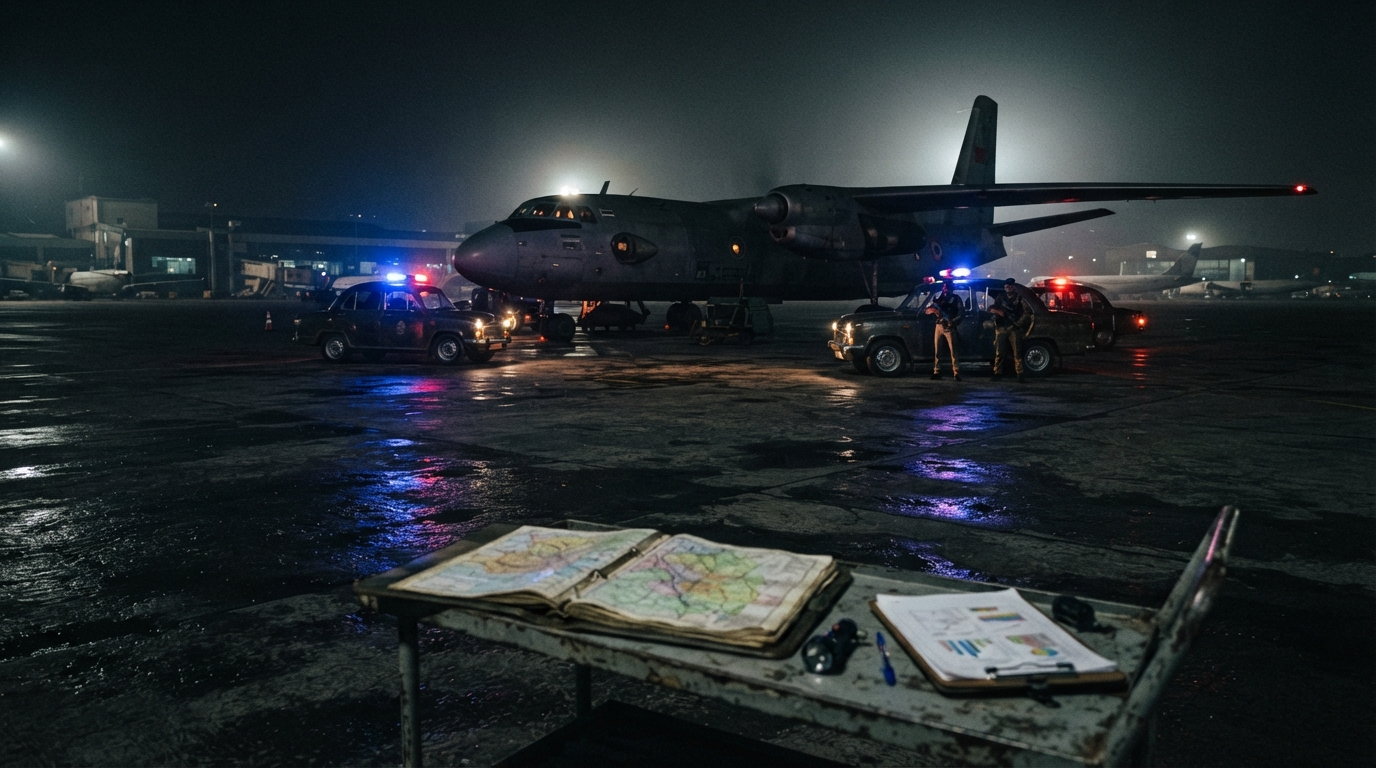
Captain Alexander Klich brought the turboprop down on the runway at Sahar International Airport shortly before midnight on December 21. Customs agents, airport security units, and Central Bureau of Investigation (CBI) officers quickly surrounded the transport plane on the apron.
Officials boarded the plane to detain the occupants. The authorities secured Peter Bleach and the five Latvian aircrew members directly inside the main cabin area.
The Escape of Kim Davy (Niels Holck)
During the confusion following the forced landing, Niels Holck took advantage of poor airport perimeter control. Former CBI lead investigator Loknath Behera stated that Holck used the procedural delays of paying landing fees and currency exchange to slip away from security personnel [The Week / India Today, 2024].
Holck walked out through the international arrival terminal into the city. Holck hailed a taxi to Pune and then traveled overland by bus and train toward northern India.
Within days, Holck crossed the open border into Nepal using fraudulent travel documents. From Kathmandu, Holck booked international flights that returned him safely to Denmark, leaving his operational team behind in Indian custody.
Detainment of Peter Bleach and the Latvian Crew
While Holck fled the airport grounds, Indian police secured the remaining six men. Peter Bleach was taken into custody alongside the five Latvian aircrew members:
- Alexander Klich (Captain)
- Igor Moskvitin (Co-Pilot)
- Oleg Gaidash (Navigator)
- Igor Timmerman (Flight Engineer)
- Evgeny Antimenko (Radio Operator)
The CBI registered formal charges against all six individuals under the Indian Penal Code, the Explosives Act, the Arms Act, and the Aircraft Act. Authorities transferred the prisoners to high-security cells at Presidency Jail in Kolkata to await criminal trial.
How Did the Legal Trials and Diplomatic Fallout Unfold?
The legal trials and diplomatic fallout of the Purulia arms drop are the judicial and international proceedings stemming from the 1995 incident. In February 2000, the Kolkata City Sessions Court sentenced six foreign operatives to life imprisonment, prompting diplomatic interventions from Russia and the United Kingdom that eventually secured presidential pardons for all six convicts.
Diplomatic & Legal Resolutions:
[Feb 2000] Conviction (Life Sentences)
   │
   ├──> [Jul 2000] Latvian Crew Remitted (Russian intervention)
   └──> [Feb 2004] Peter Bleach Pardoned (UK Prime Minister intervention)
The 2000 Trial and Life Sentences
The 2000 trial of the Purulia arms drop suspects is the Kolkata City Sessions Court legal proceeding that concluded in February 2000 with life sentences for British national Peter Bleach and five Latvian crew members. The court rejected Bleach's intelligence-informant defense, convicting all six defendants of waging war against the Government of India.
Prosecutors presented over one hundred witnesses and physical evidence recovered from the drop zones. Bleach argued in court that Bleach had acted as an intelligence operative for the British government, claiming Bleach believed Indian authorities were monitoring the flight to capture the end recipients.
The court rejected these defense claims. In February 2000, the judge convicted Peter Bleach and the five Latvian crew members of waging war against the State.
The court sentenced all six men to rigorous life imprisonment. The ruling documented how four tonnes of arms posed a severe threat to national security [MEA India, 2000].
Russian and British Diplomatic Interventions
Russian and British diplomatic interventions were the high-level bilateral negotiations from 2000 to 2004 that secured the release of the six convicted Purulia arms drop operatives. Following appeals from Russian President Vladimir Putin and UK Prime Minister Tony Blair, the President of India remitted the Latvian crew's sentences in 2000 and pardoned Peter Bleach in 2004.
The convictions immediately triggered diplomatic interventions from European governments. The Latvian crew held Russian citizenship passports before Latvia's separation, prompting the Russian government to lobby Indian officials for their release.
Russian President Vladimir Putin and members of the State Duma made direct requests to New Delhi. On July 21, 2000, the President of India remitted the sentences of the five airmen on humanitarian grounds, and the airmen returned to Russia [MEA India, 2000].
Peter Bleach remained in Presidency Jail, arguing that Bleach's continued detention was discriminatory. Following formal diplomatic requests from UK Prime Minister Tony Blair, India's President granted Bleach a pardon on February 4, 2004, leading to Bleach's immediate release and repatriation [The Hindu, 2004].
The Danish Extradition Battles (2002 to 2024)
India spent over twenty-two years attempting to extradite Niels Holck from Denmark [AP News, 2024]. India issued an international red corner notice through Interpol and submitted its first formal extradition request to Copenhagen in 2002.
The Danish government agreed to the extradition in 2010, but the High Court of Eastern Denmark blocked the order in 2011. The Danish judiciary cited poor conditions in Indian prisons under Article 3 of the European Convention on Human Rights.
India renewed its formal extradition request in 2016 with revised diplomatic assurances regarding separate housing and safety guarantees. Denmark's Director of Public Prosecutions agreed to send Holck to India in June 2023 [AP News, 2024].
However, defense attorney Jonas Christoffersen argued that diplomatic assurances could not guarantee safety [Reuters, 2024]. On August 29, 2024, the District Court of Hillerød formally rejected India's extradition plea [Reuters, 2024].
Extradition Timeline (Niels Holck / Kim Davy):
┌────────────────────────────────────────────────────────┐
│ 2002: India files first formal extradition plea        │
│ 2011: Danish High Court blocks extradition             │
│ 2016: India submits renewed plea with jail guarantees  │
│ 2023: Danish prosecution agrees to extradition         │
│ 2024: Danish District Court rejects extradition (Aug)  │
└────────────────────────────────────────────────────────┘
Key Timeline of the Purulia Arms Drop (1995–2024)
The Purulia arms drop timeline spans three decades of aviation movements, criminal trials, and international court rulings. Tracking these dates shows how a single unauthorized flight evolved into a lasting international dispute.
Complete Incident Arc:
[1995] Ingress & Drop ──> [2000] Convictions ──> [2004] Pardons ──> [2024] Extradition Rejection
Complete Chronology of Historic Dates
Below is the chronological sequence of confirmed historical dates surrounding the Purulia arms drop:
- November 1995: MI5 warns Indian intelligence about an illegal arms shipment heading for West Bengal.
- December 15, 1995: The Antonov An-26 takes off from Burgas, Bulgaria, carrying military supplies.
- December 17, 1995 (Day): The aircraft lands at Varanasi Airport for scheduled refueling.
- December 17, 1995 (Night): Four tonnes of weapons are dropped across Purulia villages.
- December 18, 1995: Local villagers discover the parachutes; the plane lands in Phuket, Thailand.
- December 21, 1995: Indian Air Force interceptors force the plane to land at Mumbai's Sahar Airport.
- December 22, 1995: Niels Holck slips out of the airport; Bleach and five crew members are detained.
- February 2, 2000: Kolkata City Sessions Court convicts all six detained operatives and hands down life sentences.
- July 21, 2000: India's President remits the sentences of the five Latvian aircrew members [MEA India, 2000].
- February 4, 2004: Peter Bleach receives a presidential pardon and returns to the United Kingdom [The Hindu, 2004].
- November 2010: Danish government approves Niels Holck's extradition to India.
- June 30, 2011: Danish High Court overturns the extradition order citing human rights concerns.
- August 29, 2024: Danish court rejects India’s renewed extradition request under Section 6 of Denmark’s Extradition Act [Reuters, 2024].
Studying chronological dates helps readers understand how to learn Indian history easily.
What Were the Unresolved Motives and Political Theories?
The ultimate objective of the Purulia arms drop remains a topic of historical debate among defense analysts and investigative journalists. Multiple theories attempt to explain why four tonnes of military equipment were dropped into a rural district.
The Ananda Marga Connection
The primary theory presented by the CBI during the Kolkata trial was that the weapons were intended for Ananda Marga. The drop coordinates lined up with the group's global compound in Ananda Nagar.
The socio-spiritual group had engaged in violent street clashes with cadres of West Bengal's ruling Communist Party of India (Marxist) during the 1980s and 1990s. The weapons drop occurred during a period of local tension between the group and state political leaders.
Ananda Marga spokespeople consistently denied any institutional involvement with the flight, Peter Bleach, or Niels Holck. No senior leaders from the organization were ever convicted in connection with the weapons cargo.
Geopolitical Destabilization Theories
An alternative theory suggests the shipment was part of an international intelligence plot to destabilize the Left Front government in West Bengal. Niels Holck made public statements claiming the operation was designed to supply anti-communist resistance groups in eastern India.
Holck asserted that elements within Indian intelligence agencies had prior knowledge of the supply drop. These claims were never corroborated in court documents.
Peter Bleach consistently rejected Holck's claims, describing the operation as a standard commercial black-market arms deal arranged for profit. The conflicting explanations leave the true end-user of the Purulia weapons unconfirmed in official public records.
Frequently Asked Questions
Q: What types of weapons were recovered in the Purulia arms drop? Villagers and police recovered roughly four tonnes of military equipment across four villages. The haul contained over 500 AK-47 assault rifles, 12 rocket launchers, 80 anti-tank grenades, and over 25,000 rounds of 7.62mm ammunition [Frontline/India Today, 2024].
Q: How did Kim Davy escape from Mumbai Airport in 1995? Kim Davy (Niels Holck) took advantage of weak security cordons while paying landing fees at Sahar Airport. He slipped into the terminal, took a taxi to Pune, and traveled overland to Nepal before flying back to Denmark [The Week / India Today, 2024].
Q: Why were the convicted crew members released before completing their life sentences? The five Latvian aircrew members received a presidential remission in July 2000 following direct requests from the Russian government [MEA India, 2000]. British dealer Peter Bleach received a presidential pardon in February 2004 following interventions by UK Prime Minister Tony Blair [The Hindu, 2004].
Q: Did Denmark ever extradite Niels Holck to face trial in India? No, Danish courts repeatedly rejected India's extradition requests. In August 2024, a Danish court ruled that sending Holck to an Indian prison would violate European human rights protections [Reuters, 2024].
Study the official court records and primary flight manifests from December 1995 to evaluate how regional air defense protocols changed after the incident.
Related Reading
- India at the Olympics: A Timeline of Historic Sporting Milestones
- December 1984: A Historical Timeline of the Bhopal Gas Tragedy
- Indian History Timeline Chart: Key Milestones (Digital Reference)
- The Dandi March Day-by-Day: A Timeline of the 1930 Salt Satyagraha
Sources
- Danish court rejects extradition to India of an arms smuggling suspect — Courthouse News / Associated Press, 2024. Supports: The August 29, 2024 Danish court rejection of India's extradition request for Niels Holck (Kim Davy) under Article 3 of the European Convention on Human Rights.
- Purulia arms drop case: Danish court rejects extradition of Kim Davy to India — India Today, 2024. Supports: The recovered cargo details (hundreds of AK-47 rifles, rocket launchers, anti-tank grenades, and over 25,000 rounds of ammunition) and the December 1995 airdrop over West Bengal.
- Q. 2091 - Purulia Arms Drop Case — Ministry of External Affairs, Government of India, 2000. Supports: The conviction and life sentences of the six foreign nationals and the President of India's July 21, 2000 remission of sentences for the five Latvian aircrew members following Russian appeals.
- Purulia arms drop timeline — Hindustan Times, 2011. Supports: The complete chronological sequence of events, including the December 21, 1995 Mumbai airport interception and Peter Bleach's presidential pardon on February 4, 2004.
- 1995 Purulia arms drop case: Denmark court rejects India's plea to extradite Niels Holck — The Week, 2024. Supports: The Danish legal proceedings, defense attorney arguments regarding prison conditions, and the flight's four-tonne weapons payload.