The Quick Read
April 14 Indian history is the collection of major governance, public safety, and defense milestones occurring on April 14 across the subcontinent. This date marks the 1891 birth of Constitution architect Dr. B.R. Ambedkar, the 1944 Bombay Dock explosion memorialized as National Fire Service Day, the 1984 military launch of Operation Meghdoot, and traditional solar New Year festivals.
Key Takeaways
- Dr. B.R. Ambedkar was born on April 14, 1891, establishing a national day for equality.
- The 1944 Bombay Dock explosion prompted India to institute National Fire Service Day on April 14.
- Operation Meghdoot secured the Siachen Glacier for the Indian Armed Forces in April 1984.
- Mesha Sankranti aligns diverse regional solar New Year celebrations across Indian states on this date.
On April 14, 1944, Sub-Officer Cedric Hodge of the Bombay Fire Brigade led his crew toward Victoria Dock. Thick smoke billowed from the cargo hold of the freighter SS Fort Stikine. Within forty minutes, roughly 1,400 tons of high explosives detonated, tearing through Bombay’s harbor and changing Indian disaster protocols forever.

Studying April 14 Indian history shows how a single calendar day can shape a nation's constitutional values, emergency services, territorial borders, and cultural calendars. Understanding these events helps readers track how past decisions influence present institutions. Readers exploring today in history india will find that April 14 carries an unusually dense concentration of decisive historic moments.
Dr. B.R. Ambedkar’s Birth Anniversary Reshaped Modern Indian Governance
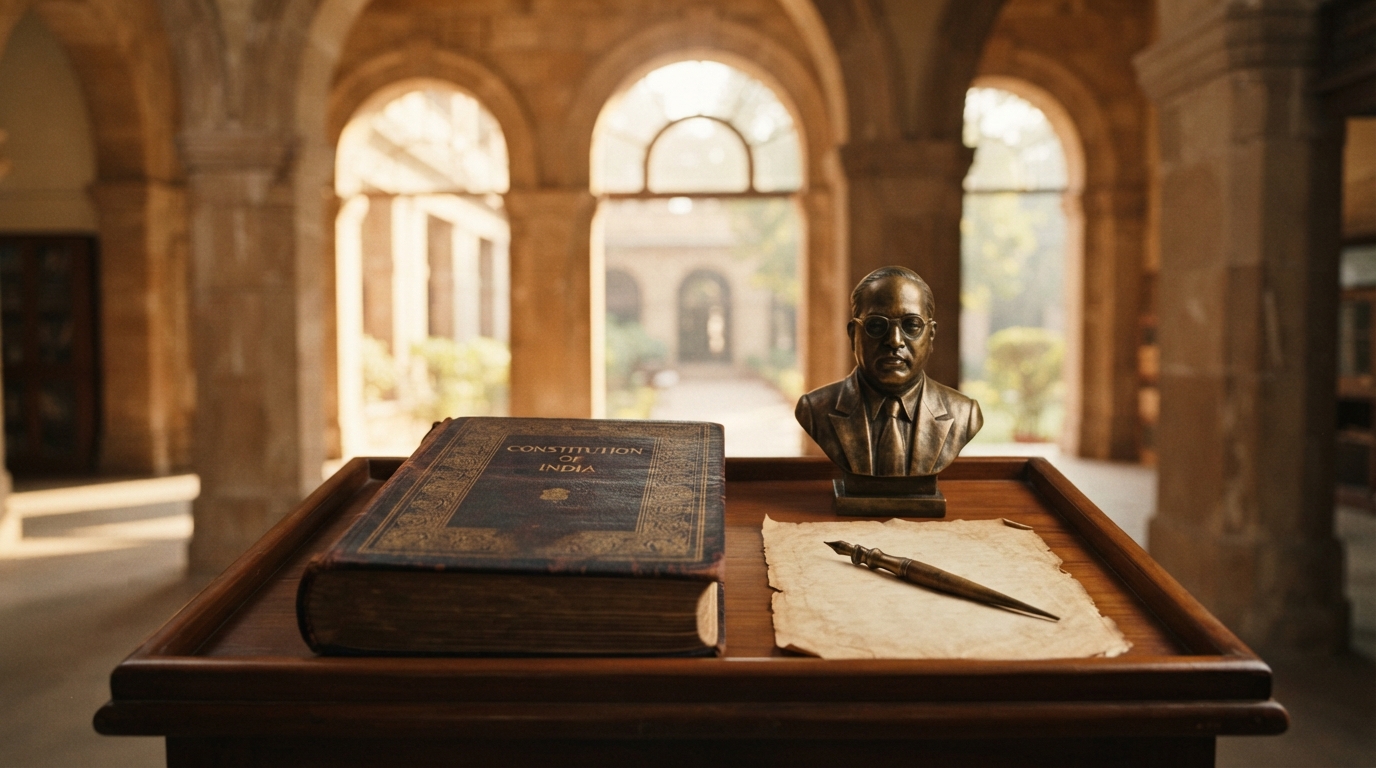
Dr. B.R. Ambedkar’s birth anniversary is a national commemoration observed on April 14 across India celebrating the chief architect of the Indian Constitution, born on April 14, 1891. Recognized as Ambedkar Jayanti or Equality Day across 28 states and 8 Union Territories, the day honors Dr. Ambedkar's legal scholarship, anti-caste reforms, and fundamental constitutional rights.
+-----------------------------------------------------------------------------+
| DR. B.R. AMBEDKAR: HISTORIC TIMELINE |
+-----------------------------------------------------------------------------+
| 1891: Born in Mhow, Central Provinces (now Madhya Pradesh) |
| 1927: Led the Mahad Satyagraha for equal water rights |
| 1947: Appointed Chairman of the Constitution Drafting Committee |
| 1956: Led the mass conversion to Buddhism at Deekshabhoomi, Nagpur |
| 1990: Posthumously conferred the Bharat Ratna, India's highest civil honor |
+-----------------------------------------------------------------------------+
The Early Life and Vision of Bhimrao Ramji Ambedkar
Dr. Ambedkar was born in the military cantonment town of Mhow in the Central Provinces (now Madhya Pradesh) on April 14, 1891 [Britannica, 2026]. Dr. Ambedkar faced severe caste discrimination from an early age. These early hardships shaped Dr. Ambedkar's lifelong focus on human dignity and civil rights.
Dr. Ambedkar pursued advanced degrees in economics, law, and political science at Columbia University and the London School of Economics. This rigorous academic training gave Dr. Ambedkar deep insights into public finance and constitutional law. When Dr. Ambedkar returned to India, he focused his career on dismantling untouchability.
Dr. Ambedkar organized public movements, such as the 1927 Mahad Satyagraha, to secure equal access to public drinking water for oppressed castes. Dr. Ambedkar's newspapers, including Mooknayak and Bahishkrit Bharat, educated readers on fundamental rights. Dr. Ambedkar argued that political freedom from British rule would mean little without social democracy.
Drafting the Indian Constitution and Social Reforms
Prime Minister Jawaharlal Nehru appointed Dr. Ambedkar as independent India's first Law Minister in August 1947. The Constituent Assembly also elected Dr. Ambedkar Chairman of the Drafting Committee. Over two years and eleven months, Dr. Ambedkar steered the drafting of the world's longest written constitution.
Dr. Ambedkar's drafting committee built comprehensive protections for fundamental rights into the legal framework. Articles 14 through 18 banned untouchability and guaranteed equality before the law. Dr. Ambedkar also built affirmative action provisions directly into the constitutional structure.
Dr. Ambedkar pushed for the Hindu Code Bill to reform personal laws on marriage, divorce, and inheritance. These reforms gave Hindu women legal rights to property and divorce for the first time. When Parliament stalled the bill, Dr. Ambedkar resigned from the cabinet in protest in 1951. This resignation demonstrated Dr. Ambedkar's uncompromising commitment to gender and social justice.
How Equality Day Is Observed Across Indian States
Ambedkar Jayanti has evolved into a global celebration of civil liberties and social ethics. Millions of citizens gather annually on April 14 at Chaitya Bhoomi in Dadar, Mumbai, and at Deekshabhoomi in Nagpur. Citizens pay homage, sing songs of social justice, and distribute books on constitutional literacy.
The Union Ministry of Law and Justice organizes national seminars on this date to reinforce constitutional ethics [PIB, 2025]. Union Minister of State for Law and Justice Arjun Ram Meghwal noted that April 14 serves as a mandate to turn constitutional text into tangible economic and social equity for marginalized communities [PIB, 2025].
State governments have expanded these formal recognitions. The Government of Tamil Nadu codified April 14 as Samathuva Naal (Equality Day) in 2022. State offices and educational institutions across Tamil Nadu take a formal equality pledge on this morning. The day focuses public attention on human equality and legal rights.
Why Is April 14 Commemorated as National Fire Service Day?
India observes National Fire Service Day every year on April 14 to honor fallen first responders. The observance originates from the 1944 Bombay Dock disaster, when a cargo ship loaded with explosives detonated at Victoria Dock. The tragedy killed dozens of firefighters and prompted a total overhaul of national fire services and industrial safety standards.
+-----------------------------------------------------------------------------+
|                     1944 BOMBAY DOCK EXPLOSION AT A GLANCE                  |
+-----------------------------------------------------------------------------+
|  Location: Victoria Dock, Bombay (now Mumbai)                               |
|  Vessel: British freighter SS Fort Stikine                                  |
|  Cargo: 1,395 tons of explosives, cotton bales, and oil drums               |
|  Casualties: 800 to 1,300 deaths, including 66 to 71 firefighters           |
|  Impact: Creation of National Fire Service Day and reformed port safety     |
+-----------------------------------------------------------------------------+
The 1944 SS Fort Stikine Tragedy at Victoria Dock
The British freighter SS Fort Stikine arrived at Bombay's Victoria Dock on April 12, 1944. Its cargo hold carried a dangerous mix of goods. The manifest included 1,395 tons of military explosives, torpedoes, ammunition, cotton bales, and drums of lubricating oil [iFluids Engineering, 2025].
A fire started in the lower hold on the afternoon of April 14 while workers were unloading cargo. The Bombay Fire Brigade sent dozens of engines to the dock. Crews pumped thousands of gallons of water into the hold, but the flames reached the ammunition crates.
At 4:06 PM, the first explosion ripped the ship apart, sending shockwaves through south Bombay. A second, larger explosion occurred thirty minutes later. The blasts threw fiery debris miles away, igniting fires across the docks and neighborhoods. The disaster caused between 800 and 1,300 deaths and left roughly 80,000 people homeless [Britannica, 2026; Firepedia, 2025].
Firefighter Sacrifices and Port Safety Protocol Reforms
The disaster took a massive toll on the first responders. Sixty-six firefighters from the Bombay Fire Brigade died while fighting the blaze at the ship's hull [Firepedia, 2025]. Several dock officers and military personnel also lost their lives while attempting to evacuate the area.
Historian Dr. Fleur D'Souza noted that the explosion disrupted wartime shipping logistics across the subcontinent and forced the modernization of Indian municipal disaster response [The Better India, 2020]. The colonial government set up an inquiry commission led by Sir Leonard Stone. The commission found severe lapses in cargo handling, poor communication between military and civilian authorities, and inadequate firefighting gear.
The Indian government established National Fire Service Day on April 14 to honor these fallen responders. Every year, fire services across India observe National Fire Safety Week starting on this date. The Directorate General of Fire Services, Civil Defence, and Home Guards uses this week to run safety drills, inspect industrial complexes, and educate the public on fire prevention [The Indian Express, 2026].
Operation Meghdoot Established Indian Control Over the Siachen Glacier
Operation Meghdoot is the 1984 Indian military operation launched on April 13 and 14 that established permanent Indian Armed Forces control over the Siachen Glacier in northern Ladakh. Executed across the Saltoro Ridge at elevations exceeding 18,000 feet, the mission secured the highest battlefield in the world and blocked rival forces from occupying critical territory.
Strategic Context of the 1984 High-Altitude Deployment
The Siachen Glacier lies in the eastern Karakoram range, just northeast of point NJ9842. The 1949 Karachi Agreement and the 1972 Simla Agreement did not clearly demarcate the boundary beyond NJ9842. The region was left undefined with the phrase "thence north to the glaciers."
During the late 1970s, Pakistan began permitting foreign mountaineering expeditions into the Siachen area. These expeditions gave Pakistan cartographic claims over the territory. Indian military intelligence learned in early 1984 that Pakistan was buying extreme-cold weather gear from European suppliers for a planned deployment.
The Indian Army planned a preemptive deployment code-named Operation Meghdoot. The objective was straightforward: occupy the major passes along the Saltoro Ridge before rival forces could reach them. Securing these ridges was vital to prevent any hostile linkup between Pakistani-controlled territory and the Shaksgam Valley.
Tactical Execution Along the Saltoro Ridge
The Indian Army launched the operation under the leadership of Lieutenant General P.N. Hoon. Troops from the Kumaon Regiment and Ladakh Scouts climbed the glaciated terrain in freezing conditions. Indian Air Force Mi-8, Chetak, and Cheetah helicopters flew hundreds of supply missions, landing soldiers on high mountain passes above 18,000 feet [Indian Army Historical Records].
By April 14, Indian troops established permanent control over two critical passes: Bilafond La and Sia La. The high-altitude conditions presented major logistical challenges:
- Temperatures dropped below minus 50 degrees Celsius.
- Soldiers faced high-altitude pulmonary edema and severe frostbite.
- Crevasses and sudden avalanches threatened logistics routes constantly.
Despite these hurdles, the Indian Army held the ridgeline. The tactical positions taken on April 14, 1984, gave India full control of the entire 76-kilometer Siachen Glacier. The Indian military continues to hold the Saltoro Ridge, safeguarding the northern approaches to Ladakh.
How Does Mesha Sankranti Unify Regional Indian New Year Celebrations?
April 14 marks Mesha Sankranti on the traditional Indian solar calendar. On this date, the sun enters the sidereal sign of Mesha (Aries), marking the start of the solar cycle. This astronomical event leads to concurrent regional New Year and harvest celebrations across diverse linguistic communities in India.
+-----------------------------------------------------------------------------+
|                  REGIONAL NEW YEAR FESTIVALS ON APRIL 14                    |
+-----------------------------------------------------------------------------+
|  State / Region         | Festival Name            | Key Cultural Practice  |
+-------------------------+--------------------------+------------------------+
|  Tamil Nadu             | Puthandu (Varusha Pirappu)| Viewing Kanni, Pachadi  |
|  Kerala                 | Vishu                    | Vishukkani, Vishu Kaineetam |
|  Assam                  | Bohag Bihu (Rongali Bihu)| Bihu dance, Goru Bihu  |
|  West Bengal            | Pohela Boishakh          | Haal Khata, Noboborsho |
|  Odisha                 | Pana Sankranti           | Bela Pana distribution |
+-------------------------+--------------------------+------------------------+
The Astronomical Basis of the Solar Transition
The traditional Indian calendar uses both lunar and solar tracking systems. While states like Maharashtra and Andhra Pradesh observe the lunar new year (Gudi Padwa or Ugadi) in March or April, solar calendar states track the sun's ingress into Aries. This transition is known as Mesha Sankranti.
Because this solar transition occurs around April 13 or 14 each year, several regional calendars reset simultaneously. This alignment creates a shared cultural moment across distinct regions of India. Agricultural communities view this date as the start of the spring harvest and the new financial cycle.
Farmers inspect their fields, merchants open new account books, and families clean their homes. The astronomical shift marks an auspicious time to start new projects, invest in assets, and plant the next season's crops.
Puthandu, Vishu, Bohag Bihu, and Pohela Boishakh
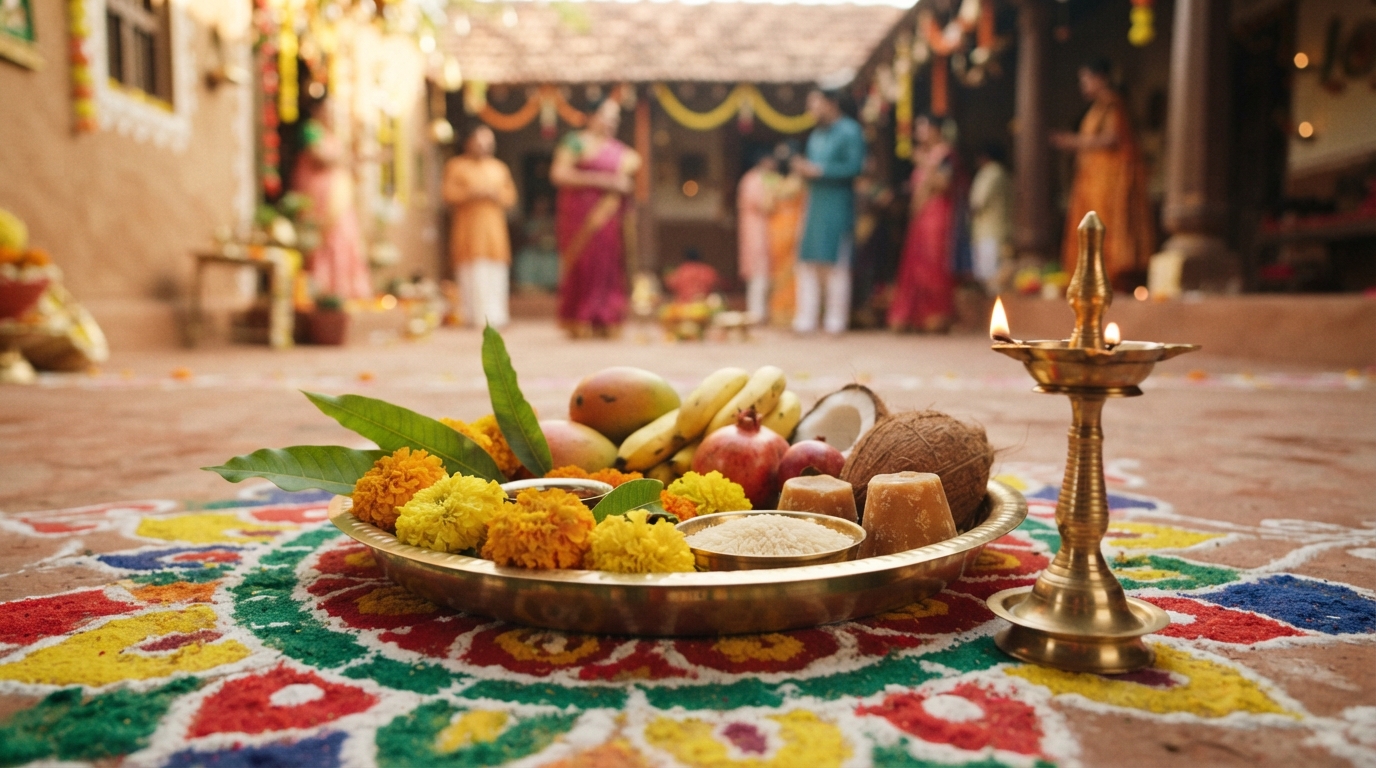
In Tamil Nadu, citizens celebrate April 14 as Puthandu or Varusha Pirappu. Families arrange the Kanni, a tray filled with fruits, betel leaves, gold jewelry, and a mirror, which they view first thing in the morning. They prepare Mangai Pachadi, a traditional dish that mixes sweet, sour, bitter, and spicy flavors to symbolize life's varied experiences.
In Kerala, the day is celebrated as Vishu. Malayali households prepare the Vishukkani, an arrangement of rice, yellow cucumber, betel leaves, and the yellow Kani Konna flower. Elders hand out Vishu Kaineetam, gifting coins to children to bring financial well-being.
Assam celebrates Bohag Bihu (or Rongali Bihu) over seven days starting mid-April. The festival begins with Goru Bihu, honoring livestock, followed by traditional folk dances and community feasts. In West Bengal and Tripura, citizens mark Pohela Boishakh (Bengali New Year). Shopkeepers initiate the Haal Khata, a traditional ceremony for opening new financial ledgers. In Odisha, people celebrate Pana Sankranti by distributing Bela Pana, a cooling sweet drink made from wood apple pulp.
April 14 Indian History Across Cultural and Civil Milestones
April 14 Indian history is the intersection of constitutional milestones, public safety institutions, high-altitude defense victories, and regional solar New Year festivals across the Indian subcontinent. The date unites the 1891 birth of Dr. B.R. Ambedkar, the 1944 Bombay dock explosion, the 1984 Siachen deployment, and harvest festivals across five major linguistic regions.
Readers interested in the flow of spring milestones can review our guide on late April in Indian history. Studying date-based history helps students and researchers understand how political philosophy, emergency response, and national defense connect across Indian history.
Milestones in National Governance and Legal Ethics
The legal and ethical ideas tied to April 14 continue to influence public policy across India. Dr. Ambedkar's focus on constitutional morality guides modern Supreme Court decisions on equality and civil liberties. The principle that state institutions must serve marginalized groups remains central to Indian constitutional law.
At the same time, the regulatory lessons from the 1944 Bombay port disaster shaped modern industrial disaster management. The disaster led to the creation of the National Safety Council and drove the modernization of municipal fire services across the country.
The military lessons learned during Operation Meghdoot in April 1984 redefined Indian high-altitude combat doctrine. The operation pushed the Indian Armed Forces to invest heavily in specialized cold-weather gear, high-altitude aviation, and high-altitude medical research.
Comparing April 14 Historical Milestones
The table below summarizes the key events of April 14 in Indian history, showing the variety of milestones connected to this single day:
| Year | Event / Milestone | Primary Location | Historical Significance |
|---|---|---|---|
| 1891 | Birth of Dr. B.R. Ambedkar | Mhow, Madhya Pradesh | Established the foundation for modern constitutional democracy and civil rights. |
| 1944 | SS Fort Stikine Explosion | Victoria Dock, Bombay | Led to the creation of National Fire Service Day and revamped port safety protocols. |
| 1984 | Operation Meghdoot Launch | Siachen Glacier, Ladakh | Secured the Saltoro Ridge and Siachen Glacier for Indian Armed Forces. |
| Annual | Mesha Sankranti / Regional New Years | Pan-India (TN, KL, AS, WB, OD) | Aligns solar calendar harvest and New Year festivals across multiple states. |
| Annual | National Fire Service Day | Pan-India | Promotes nationwide fire safety, rescue training, and civil defence standards. |
Those learning how to learn Indian history easily through timelines will find that studying single-date milestones makes complex timelines easier to remember. Rather than memorizing isolated dates, grouping related events around specific calendar days reveals how national institutions evolved.
Frequently Asked Questions
Q: Why is April 14 celebrated as Equality Day in India?
April 14 is the birth anniversary of Dr. B.R. Ambedkar, the principal architect of the Indian Constitution and a champion of human rights. State and central bodies observe the day as Equality Day (Samathuva Naal) to promote social justice, anti-discrimination values, and constitutional rights.
Q: What happened during the 1944 Bombay Dock disaster?
On April 14, 1944, the British freighter SS Fort Stikine caught fire and exploded at Victoria Dock while carrying roughly 1,400 tons of explosives and ammunition. The blast killed an estimated 800 to 1,300 people, including 66 firefighters, prompting India to designate April 14 as National Fire Service Day.
Q: Why do several Indian states celebrate their New Year on April 14?
April 14 marks Mesha Sankranti, the astronomical day when the sun enters the sidereal sign of Aries according to the Indian solar calendar. States such as Tamil Nadu (Puthandu), Kerala (Vishu), Assam (Bohag Bihu), and West Bengal (Pohela Boishakh) celebrate their traditional solar New Year on or around this date.
Further Reading
- Annihilation of Caste by Dr. B.R. Ambedkar: A foundational text for understanding Indian constitutional equality, social reform, and caste abolition.
- The Bombay Explosion by John Ennis: A detailed historical account of the 1944 SS Fort Stikine freighter disaster and its impact on wartime Bombay.
- The Crimson Chinar: The Kashmir Conflict: A Politico-Military Perspective by Lt. Gen. M.L. Chibber: Firsthand operational insights into the strategic planning and execution of Operation Meghdoot in 1984.
- India's Constitution: Text and Context: A direct reference for studying Articles 14 to 18, which established constitutional guarantees of equality.
Related Reading
- Milestones in Indian Women's History: A Chronological Guide
- Late April in Indian History: Key Dates, Birthdays, and Milestones
- 1,000 Years of Indian Medical History: A Chronological Guide
- Economic Milestones in Indian History: From 1947 to Present
Sources
- Bhimrao Ramji Ambedkar — Encyclopædia Britannica, 2026. Supports: Dr. B.R. Ambedkar was born on April 14, 1891, and served as the chief architect of the Indian Constitution.
- 740 dead in one afternoon: The 1944 Bombay Explosion that made Mumbai observe Fire Safety Week every April — The Indian Express, 2024. Supports: The 1944 Bombay Dock disaster on April 14 caused mass casualties and led India to observe National Fire Service Day and Fire Safety Week.
- IAF in Operation Meghdoot — Press Information Bureau, Ministry of Defence, Government of India, 2024. Supports: Operation Meghdoot was launched on April 13–14, 1984, deploying troops to secure the strategic heights of the Siachen Glacier.
- April 14 to be marked as Equality Day in memory of BR Ambedkar: Stalin — The New Indian Express, 2022. Supports: The Government of Tamil Nadu codified April 14 as Samathuva Naal (Equality Day) in 2022 to commemorate Dr. Ambedkar's birth anniversary.
- About Dr. B. R. Ambedkar — Ministry of External Affairs, Government of India, 2026. Supports: Dr. Ambedkar's role as independent India's first Law Minister, his academic background, and his campaigns against caste discrimination.