Indo-Iranian Historical Ties: A Timeline of Cultural Exchange
TL;DR
The Indo-Iranian history timeline is a 5,000-year record of shared linguistic roots, continuous trade, and cultural exchange across South Asia and the Iranian plateau. From common Bronze Age ancestors and Achaemenid diplomacy to 600 years of Persian administration in India, this relationship shaped South Asian language, architecture, medicine, and governance across ancient and medieval eras.
Key Takeaways
- Indo-Aryans and Iranians split from a shared ancestral culture around 2000–1500 BCE.
- The 1380 BCE Mitanni treaty provides the earliest recorded names of shared Indo-Iranian deities.
- Persian served as northern India's primary administrative language for more than 600 years.
- Knowledge flowed both ways, carrying Indian medical texts and Persian artistic styles across borders.
- India formally recognized Persian as one of its classical educational languages in 2024.
Over 600 years of official court records across northern and central India were written in Persian before 1837. This linguistic reality surprised many British colonial administrators when they took over Mughal judicial courts. They expected to find regional vernaculars or Sanskrit. Instead, they found a deeply entrenched Persianate bureaucracy.
Mapping the Indo-Iranian history timeline reveals that this was not an isolated phase. The Indian subcontinent and the Iranian plateau share an intertwined past. Ideas, technologies, words, and families crossed the Hindu Kush mountains continuously.
When you check today in Indian history or browse our digital Indian history timeline chart, Persian influences appear everywhere. You find them in everyday administrative words like tehsildar and zamindar. You see them in the dome profiles of medieval mosques and temples. You hear them in classical musical modes.
Understanding these ties requires tracing the story back to its prehistoric roots.
Ancient Roots Define the Early Indo-Iranian History Timeline
The earliest phase of Indo-Iranian contact began in the Bronze Age through trade corridors and shared linguistic roots. Between 2000 BCE and 1500 BCE, Proto-Indo-Iranian speakers split into distinct Indian and Iranian branches, leaving behind striking similarities in the Rigveda and the Avesta.
+-------------------------------------------------------------------------+
|                  BRONZE AGE ANCESTRAL MATRIX                            |
|             (Proto-Indo-Iranian Continuum, c. 2000 BCE)                 |
+------------------------------------+------------------------------------+
                                     |
                  +------------------+------------------+
                  |                                     |
                  v                                     v
       INDO-ARYAN BRANCH                         IRANIAN BRANCH
       - Rigvedic Sanskrit                       - Old Avestan / Old Persian
       - Deities: Mitra, Varuna, Indra           - Ahura Mazda, Mithra
       - Sacred drink: Soma                      - Sacred drink: Haoma
       - Sacred concept: Rta                     - Sacred concept: Asha
Bronze Age Trade and the Shahr-i Sokhta Network
Long before nomadic migrations, urban settlements on the Iranian plateau traded with the Indus Valley Civilization. Archaeological excavations at Shahr-i Sokhta in southeastern Iran prove that extensive trade networks existed by 2600 BCE. Harappan craftsmen exported lapis lazuli beads, shell ornaments, and etched carnelian to proto-Elamite and Helmand settlements.
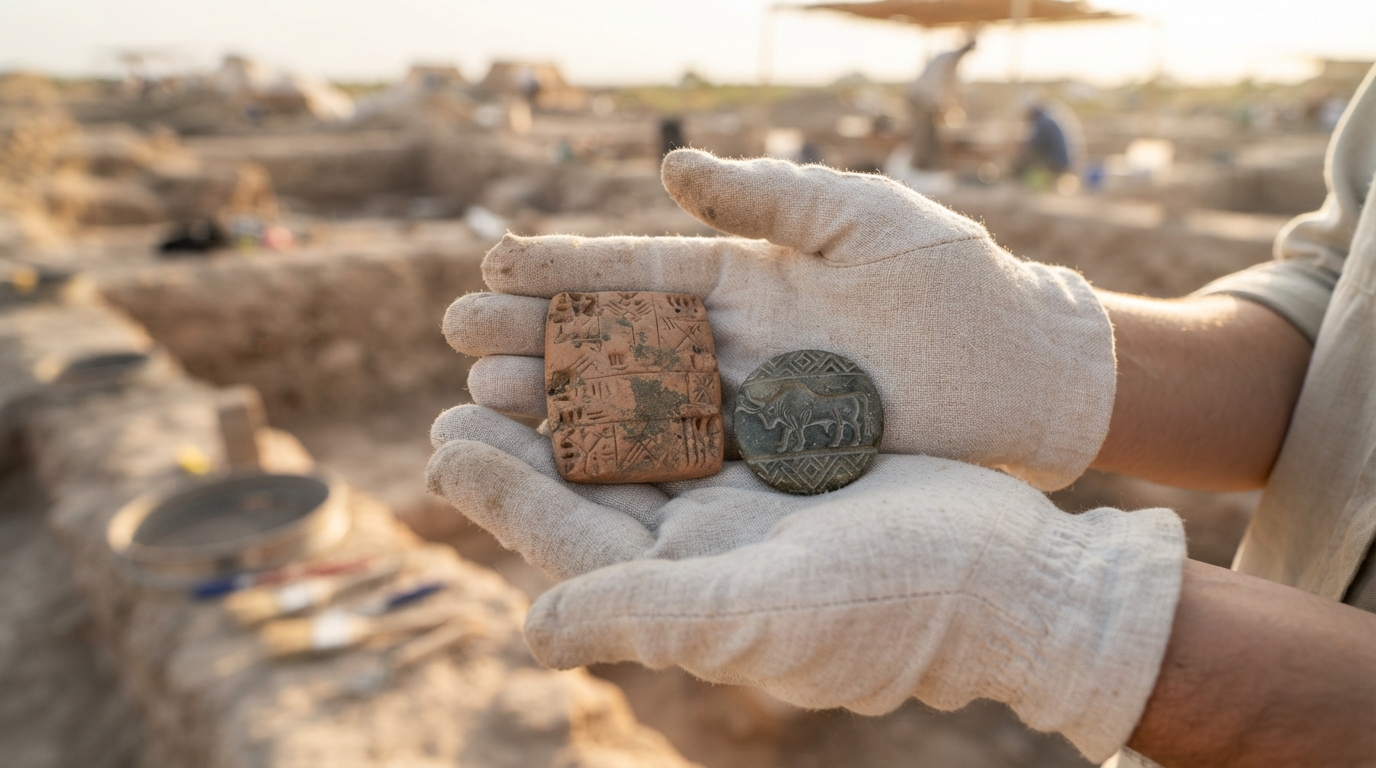
These early interactions were driven by trade rather than language. Merchants moved along overland routes through Balochistan and maritime routes via the Persian Gulf. Indian teak wood, cotton textiles, and spices moved west. Iranian copper, alabaster vessels, and turquoise moved east.
This commerce created permanent transport corridors. Later waves of pastoralists and diplomats used these exact paths to cross the borderlands.
Linguistic Kinship in the Rigveda and the Avesta
Around 2000–1500 BCE, the ancestral Proto-Indo-Iranian linguistic community separated. One group moved east into the northern Punjab plains. The other settled on the Iranian plateau.
Their languages remained nearly identical for centuries. Vedic Sanskrit and Old Avestan share thousands of cognates. As Indologist Asko Parpola noted in 2020, their religious rituals reveal a single cultural root.
| Concept / Element | Vedic Sanskrit Term | Old Avestan (Iranian) Term | Historical Significance |
|---|---|---|---|
| Sacred Ritual Drink | Soma | Haoma | Shared entheogenic ritual plant |
| Cosmic Truth/Order | Rta | Asha | Central moral pillar of both belief systems |
| Divine Beings | Asura / Deva | Ahura / Daeva | Semantic polarity shift between cultures |
| Solar Deity | Mitra | Mithra | Covenant and light divinity in both pantheons |
| Fire Altar Ritual | Yajna (Agni) | Yasna (Atar) | Centralized liturgical fire worship |
The 1380 BCE Mitanni-Hittite peace treaty contains the earliest written evidence of this common culture. Unearthed in modern-day Turkey, this cuneiform tablet records state oaths invoking four deities: Mi-it-ra, U-ru-wa-na, In-da-ra, and Na-sa-at-ti-ya. These correspond directly to the Vedic Mitra, Varuna, Indra, and Nasatya.
Steppe Dispersal and Genetic Findings
Steppe dispersal is the migration process documented by archaeogenetic research in which Bronze Age steppe pastoralist lineages expanded into Central Asia around 2000 BCE. Ancient DNA findings demonstrate that steppe populations integrated with the urban Bactria-Margiana Archaeological Complex (BMAC) before separating into Iranian plateau settlers and Gandhara migrants.
These pastoralist populations interacted with the urban Bactria-Margiana Archaeological Complex (BMAC). The pastoralists did not destroy these oasis towns. Instead, migrating groups absorbed BMAC architectural and agricultural vocabulary before separating.
One branch migrated south toward the Iranian plateau, forming the Medes and Persians. The second branch crossed the northern passes into Gandhara. Both branches preserved their common vocabulary while developing distinct spiritual frameworks.
Classical Empires Forged Diplomatic and Imperial Corridors
Imperial interactions expanded during the first millennium BCE when the Achaemenid Empire incorporated the Indus valley into its administrative network. This contact introduced Aramaic script variants, stone carving techniques, and fiscal structures that influenced the Mauryan Empire and later Gandharan kingdoms.
       518 BCE                   322 BCE                  1st Century CE
+--------------------+   +---------------------+   +--------------------------+
|  ACHAEMENID RULE   |   |   MAURYAN EMPIRE    |   |      KUSHAN EMPIRE       |
| Darius I annexes   |-->| Ashokan edicts use  |-->| Syncretic coinage merges |
| Gandhara & Hindush |   | Kharosthi script    |   | Greek, Iranian, & Indian |
| satrapies          |   | & Persian masonry   |   | deities                  |
+--------------------+   +---------------------+   +--------------------------+
The Achaemenid Satrapies and Darius the Great
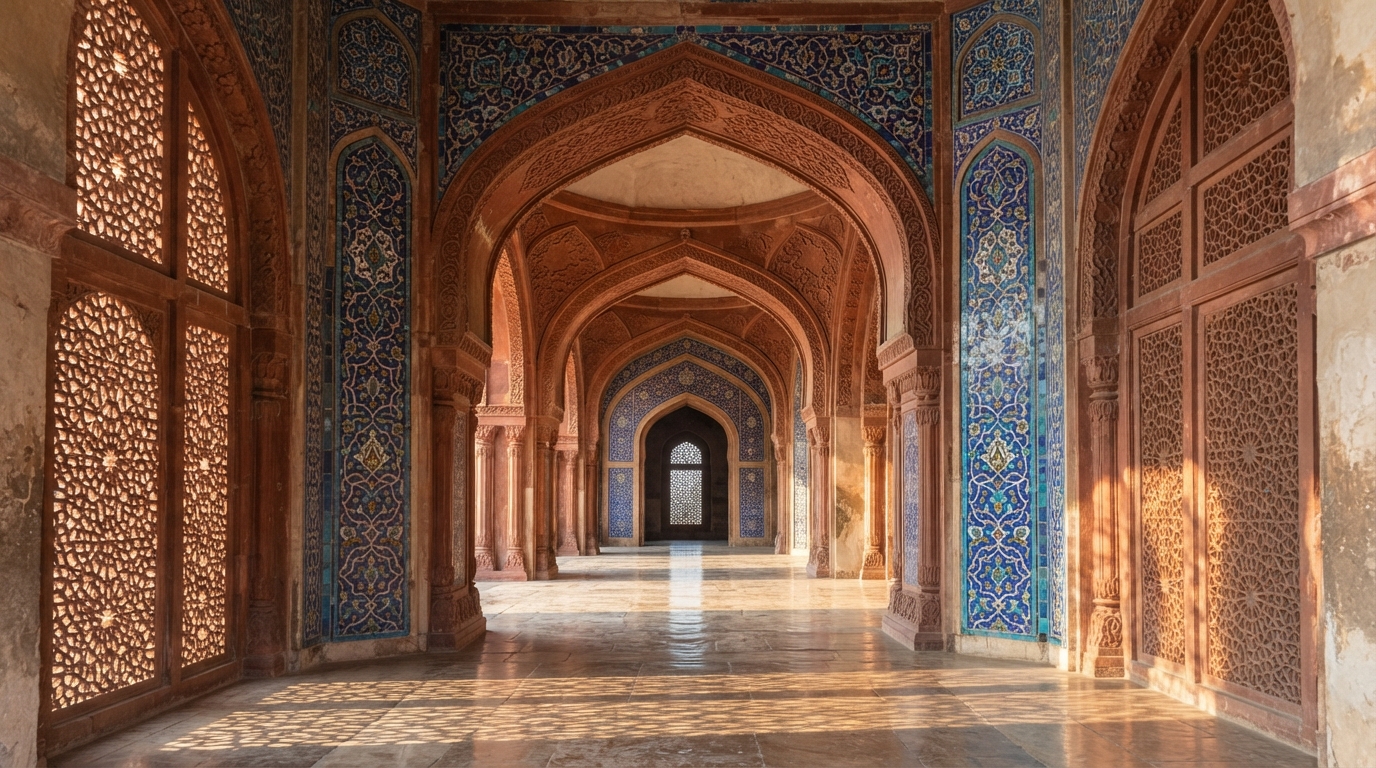
Emperor Darius I expanded Persian borders into the northwestern Indian subcontinent around 518 BCE. Royal inscriptions at Persepolis and Naqsh-e Rustam list Gandara (Gandhara) and Hindush (the Indus basin) as imperial provinces.
Herodotus wrote in his Histories (c. 430 BCE) that Hindush was the twentieth satrapy of the empire. It paid the largest tax tribute: 360 talents of gold dust each year. Indian archers served in Persian armies campaigning against Greek city-states.
Achaemenid Administrative Imperial Sphere (c. 518 BCE)
  └── Province: Hindush (Indus Valley)
  └── Province: Gandara (Peshawar / Rawalpindi Basin)
  └── Province: Sattagydia (Gomal River Valley)
This imperial rule introduced the Aramaic script to northwestern India. Scribes adapted Aramaic into Kharosthi, which Indian kings used for centuries. Achaemenid officials brought sophisticated tax collection methods that influenced Indian political treatises like Kautilya's Arthashastra.
Read our breakdown of Maurya and Gupta empire milestones to see how early Indian dynasties organized their royal administrations.
Stone Craft and Imperial Inscriptions
Stone craft and imperial inscriptions are the architectural and epigraphic techniques that Mauryan emperor Ashoka (reigned c. 268–232 BCE) adapted from Achaemenid Persian royal traditions. Ashoka commissioned polished sandstone pillars and bilingual edicts, utilizing Persian-style lustrous stone polish, bell capitals, and Aramaic scripts across northwestern Indian sites like Kandahar to communicate moral governance.
The pillars of Ashoka feature lustrous polish, bell-shaped capitals, and animal motifs. These artistic elements resemble the column capitals at Persepolis. Emperor Ashoka also wrote northwestern rock edicts in Aramaic and Greek, such as the bilingual Kandahar inscriptions.
Indian stonemasons adapted Persian stonework techniques to local sandstone. Mauryan builders created indigenous Buddhist monuments rather than imperial palaces for foreign kings.
Kushan Synthesis on the Northern Silk Road
The Kushan Empire (c. 30–375 CE) bridged the Iranian world, Central Asia, and northern India. Kushan kings ruled from dual capitals at Purushapura (Peshawar) and Mathura.
They issued gold and copper coins inscribed in the Bactrian language using Greek script. These coins show an eclectic group of deities. Zoroastrian figures like Miiro (Mithra), Nana, and Atsho (fire god) appear alongside the Buddha and the Hindu god Oesho (Shiva).
Kushan sculptors blended these artistic ideas in Gandhara. They dressed Buddhist figures in heavy Greek tunics with Iranian jewellery. Trade flourished during this period along ancient maritime trade routes and northern mountain passes.
Medieval Knowledge Flows Transformed Both Civilizations
Medieval exchanges reversed and diversified the flow of ideas as scholars translated foundational Indian scientific, literary, and philosophical works into Persian. From Sasanian medical missions to Mughal court manuscripts, both civilizations exchanged astronomy, mathematics, games, and administrative traditions across land and sea routes.
                             KNOWLEDGE EXCHANGE (500–1000 CE)

         INDIA                                                   PERSIA
+-----------------------+                               +-----------------------+
|  Panchatantra Fables  | === Borzuya Mission (550 CE) => |  Kalila wa-Dimna      |
|  Chaturanga (Chess)   |                               |  Shatranj             |
|  Ayurvedic Medicine   | === Translation Corpus =======> |  Gondeshapur Academy  |
|  Brahmagupta's Math   | === Baghdad Abbasid Hub ======> |  Zij Astronomical Work|
+-----------------------+                               +-----------------------+
Borzuya's Mission and the Panchatantra
During the 6th century CE, Sasanian King Khosrow I (reigned 531–579 CE) sent his royal physician, Borzuya, on an expedition to India. Borzuya wanted to find medicinal herbs and rare manuscripts.
He returned to the Sasanian capital of Ctesiphon with the Sanskrit fable collection Panchatantra. Borzuya translated the animal allegories into Middle Persian (Pahlavi).
In the 8th century, Ibn al-Muqaffa translated this Pahlavi text into Arabic as Kalila wa-Dimna. This book spread worldwide, shaping European fable collections like The Fables of La Fontaine. Borzuya also brought back the Indian strategy game of Chaturanga. Persians adapted it into Shatranj, which eventually developed into modern chess.
Medical and Mathematical Transfers
Persian and Arab scholars looked to India for medical and mathematical insights. The medical academy at Gondeshapur in southwestern Iran welcomed Indian physicians. They worked alongside Persian and Syrian practitioners.
These Indian scholars translated the Sanskrit medical treatises of Charaka Samhita and Sushruta Samhita into Pahlavi. Later, Islamic scholars translated them into Arabic in Baghdad's House of Wisdom.
Indian mathematicians introduced the decimal place-value system and zero (shunya) to Persian scholars. In the 9th century, Persian mathematician Al-Khwarizmi wrote a treatise on Indian arithmetic (Kitab al-Jam' wa'l-tafriq bi-hisab al-Hind). This text carried the Indian numeral system into the Middle East and Europe.
The Parsi Migration to Gujarat
The collapse of the Sasanian Empire following the 7th-century Arab conquests forced many Zoroastrians to leave Iran. Groups of Zoroastrians migrated by sea to the western coast of Gujarat between the 8th and 10th centuries CE.
Zoroastrian Sea Voyage (Persian Gulf -> Hormuz -> Diu -> Sanjan, Gujarat)
  └── Local Ruler: Jadi Rana (Sanjan Kingdom)
  └── Agreement: Adopt Gujarati language, modify dress, surrender weapons
  └── Establishment: First consecrated Atash Behram (Fire of Victory)
The 16th-century Persian verse text Qissa-i Sanjan describes their arrival. The local Hindu ruler, Jadi Rana, granted them asylum. In return, the refugees agreed to learn Gujarati, adopt local wedding customs, and lay down their weapons.
These migrants, known as Parsis, preserved their Zoroastrian faith and sacred fires. They became prominent traders, shipbuilders, industrial pioneers, and philanthropists in Indian history.
The Indo-Persian Synthesis Shaped Administrative and Visual Arts
Persian became the lingua franca of Indian governance from the 13th century until the British East India Company replaced it in 1837. This six-century era created Indo-Islamic architecture, classical Hindustani musical forms, Persianate bureaucrat training, and massive translation initiatives across North India and the Deccan.
+--------------------------------------------------------------------------+
|                  THE 600-YEAR INDO-PERSIAN SYNTHESIS                     |
+------------------------------------+-------------------------------------+
                                     |
           +-------------------------+-------------------------+
           |                                                   |
           v                                                   v
 NORTHERN IMPERIAL COURTS                             DECCAN SULTANATE CORRIDORS
 - Delhi Sultanate & Mughals                          - Golconda & Bijapur
 - Persian court bureaucracy                          - Direct maritime Safavid trade
 - Monumental dome architecture                       - Shi'a theological networks
 - Imperial translation bureaus                       - Persianate bronze metallurgy
Court Administration and the 600-Year Reign of Farsi
The Delhi Sultanate made Persian its primary administrative language in the early 13th century. Subsequent dynasties, including the Mughals, expanded its use across northern and central India.
For more than 600 years, Persian was the language of law, diplomacy, revenue accounting, and high literature. Elite Hindu communities, such as Kayasthas and Kashmiri Pandits, learned Persian to work as imperial administrators, accountants, and envoys.
Persian Words Absorbed into Indian Regional Languages:
  ├── Kaghaz (Paper)          ──> Used in Hindi, Bengali, Marathi, Punjabi
  ├── Zameen (Land)           ──> Used in revenue and legal documents
  ├── Bazaar (Market)         ──> Universal South Asian commercial term
  ├── Darwaza (Door/Gate)     ──> Standard architectural term
  └── Dastakhat (Signature)   ──> Standard banking and legal term
This linguistic prestige continued until the British East India Act of 1837 replaced Persian with English and regional vernaculars. For more on this period, read our guide to notable events in subcontinent medieval history.
Translation Projects and the Razmnama
Mughal Emperor Akbar (reigned 1556–1605) established an imperial translation bureau called the Maktab Khana at Fatehpur Sikri. He wanted to make Sanskrit epics accessible to Persian-speaking courtiers and bridge religious divisions.
        SANSKRIT ORIGINAL                    PERSIAN COURT TRANSLATION
+-------------------------------+        +-------------------------------+
|          Mahabharata          | ====>  |           Razmnama            |
| (100,000 verses, Vyasa)       |        | (Completed 1584, illustrated) |
+-------------------------------+        +-------------------------------+
|           Ramayana            | ====>  |     Persian Verse Edition     |
| (Valmiki's epic narrative)    |        | (Translated by Badayuni)      |
+-------------------------------+        +-------------------------------+
|         Upanishads            | ====>  |          Sirr-i-Akbar         |
| (Philosophical dialogues)     |        | (Dara Shikoh, 1657 translation)|
+-------------------------------+        +-------------------------------+
Akbar commissioned the Razmnama (Book of War), a Persian translation of the Mahabharata, in 1584. Scribes and scholars like Abdul Qadir Badayuni worked with Hindu pundits to translate the 100,000-verse epic.
Master painters illustrated the manuscripts, blending Persian landscape backgrounds with Indian colors and dynamic movement. Later, in 1657, Prince Dara Shikoh translated 50 Upanishads into Persian as the Sirr-i-Akbar (The Greatest Secret). French scholar Anquetil-Duperron translated this Persian text into Latin in 1801, introducing Indian philosophy to modern Europe.
       1584 CE                                  1657 CE
+---------------------+                  +---------------------+
|      RAZMNAMA       |                  |    SIRR-I-AKBAR     |
| Persian translation |=================>| Dara Shikoh renders |
| of the Mahabharata  |                  | 50 Upanishads into  |
| under Akbar         |                  | Persian             |
+---------------------+                  +---------------------+
                                                    ||
                                                    \/
                                         +---------------------+
                                         | LATIN TRANSLATION   |
                                         | Anquetil-Duperron   |
                                         | introduces text to  |
                                         | Europe (1801 CE)    |
                                         +---------------------+
Deccan Sultanate Maritime Corridors
Most popular histories focus solely on the Mughals in northern India. However, the Deccan Sultanates maintained direct maritime links with Safavid Iran. Kingdoms like Golconda (Qutb Shahi dynasty) and Bijapur (Adil Shahi dynasty) looked across the Arabian Sea for trade and talent.
Persian Gulf Port (Bandar Abbas)
  └── Direct Arabian Sea Maritime Corridor
  └── Deccan Ports: Chaul, Dabhol, Machilipatnam
  └── Sultanates: Golconda, Bijapur, Ahmadnagar
Persian architects, poets, calligraphers, and soldiers arrived regularly at Deccan ports like Dabhol and Machilipatnam. The Qutb Shahis of Golconda were Shi'a Muslims who included the Safavid Shah's name in Friday prayers (khutba) before Mughal expansion halted the practice.
Deccan architecture reflected these ties. Persian engineers designed massive hydraulic water systems, domed tombs, and tile-decorated palaces across Hyderabad and Bijapur.
A Structured Indo-Iranian History Timeline Spans Five Millennia
This chronological breakdown organizes the major turning points in Indo-Iranian relations from early Bronze Age trade to modern policy decisions. It provides a quick reference for students, educators, and researchers studying South Asian and Middle Eastern history.
2500 BCE      518 BCE       550 CE        1000 CE       1584 CE       1837 CE      2024 CE
   |-------------|-------------|-------------|-------------|-------------|------------|
Harappa     Achaemenid     Borzuya        Parsi       Razmnama       Persian     NEP Farsi
 Trade       Satrapy       Mission      Migration    Manuscript     Replaced    Recognition
Chronological Matrix: Key Epochs, Events, and Milestones
The Chronological Matrix is a comprehensive historical framework documenting five millennia of Indo-Iranian cultural, political, and linguistic interactions from 2600 BCE to 2024 CE. This chronological record categorizes key milestones, including Harappan-Iranian trade, Vedic-Avestan linguistic divergence, Achaemenid satrapy governance, Kushan numismatic syncretism, Mughal Persian translations, and 21st-century educational language policies.
| Era / Date | Historical Phase | Major Milestones & Cultural Exchanges |
|---|---|---|
| c. 2600–1900 BCE | Bronze Age Trade | Harappan merchants trade lapis lazuli, shell ornaments, and carnelian with Shahr-i Sokhta and Jiroft settlements. |
| c. 2000–1500 BCE | Linguistic Divergence | Proto-Indo-Iranian language splits into Indo-Aryan (Sanskrit) and Iranian (Avestan) branches in Central Asia. |
| c. 1380 BCE | Mitanni Inscription | Mitanni-Hittite peace treaty invokes shared Vedic-Iranian gods: Mitra, Varuna, Indra, and Nasatya. |
| c. 518 BCE | Achaemenid Expansion | Darius I annexes Hindush and Gandara as imperial satrapies, introducing the Aramaic script and stone masonry. |
| c. 30–375 CE | Kushan Syncretism | Kushan kings issue coins featuring Greek, Indian, and Zoroastrian deities (Miiro, Nana, Oesho). |
| c. 550 CE | Sasanian Medical Mission | Physician Borzuya visits India and translates the Panchatantra and Chaturanga (chess) into Pahlavi. |
| c. 750–950 CE | Parsi Migration | Zoroastrian refugees flee Arab conquests, land on the Gujarat coast, and establish communities at Sanjan. |
| 1206–1526 CE | Delhi Sultanate Era | Persian becomes the official court, administrative, and literary language across northern India. |
| 1584 CE | Mughal Translation Bureau | Akbar commissions the Razmnama, an illustrated Persian translation of the Sanskrit Mahabharata. |
| 1657 CE | Upanishadic Translations | Prince Dara Shikoh completes the Sirr-i-Akbar, translating 50 Upanishads into Persian. |
| 1837 CE | Colonial Administrative Shift | The British East India Company ends 600+ years of official Persian status, replacing it with English and vernaculars. |
| 2024 CE | Classical Recognition | India officially incorporates Persian (Farsi) into its National Education Policy as a classical language. |
Modern Educational Recognition
Modern educational recognition is the formal policy status granted to Persian (Farsi) in January 2024 when External Affairs Minister Dr. S. Jaishankar announced Persian as one of nine classical languages under India's National Education Policy. This policy designation establishes dedicated state funding for university research chairs, archival cataloging, and the preservation of historical Indo-Persian manuscripts.
This educational decision unlocked Indian government funding for manuscript preservation, university chairs, and cataloging efforts. Indian state archives hold millions of Persian documents, royal land grants, and literary works from medieval administrations.
Understanding Indian history from 1200 to 1850 requires historians to work directly with Persian texts. Recognizing Persian's classical historical status ensures that scholars and university students can continue studying these foundational primary sources.
Calendar Archives and Date-Specific Discoveries
Tracking historical dates helps students understand how isolated events connect across centuries. For instance, looking up 22 august in indian history or examining daily entries reveals how central Asian, Persian, and Indian diplomacy intertwined during moments of political transition.
Archival databases allow historians to examine daily court diaries (akhbarat). These records show what Indian emperors, ministers, and foreign ambassadors did on specific calendar days. By studying dates chronologically, researchers can see how cultural exchanges shaped politics, language, and trade over 5,000 years.
Related Reading
- Indian History Timeline Chart: Key Milestones (Digital Reference)
- India at the Olympics: A Timeline of Historic Sporting Milestones
- Indian History Milestones: The Maurya and Gupta Empires
- Milestones in Indian Women's History: A Chronological Guide
FAQ
Q: What happened today in history?
Every calendar day marks significant political, scientific, and cultural milestones across India and the wider world. You can track daily historical events by exploring date-specific archives on India On This Day.
Q: When did Persian stop being the official administrative language of India?
Persian ceased to be India's official court language in 1837 under the British East India Company's Language Act. The colonial administration replaced Persian with English for higher legal courts and regional vernacular languages for lower district courts.
Q: How closely related are Vedic Sanskrit and Old Avestan?
Vedic Sanskrit and Old Avestan are sister languages descended from a single Proto-Indo-Iranian ancestor. A linguist trained in Vedic grammar can read Old Avestan texts with minimal instruction by applying regular sound changes, such as converting the Sanskrit "s" sound to the Iranian "h" sound.
Q: Why did Zoroastrians migrate from Persia to western India?
Zoroastrians migrated to the western coast of Gujarat between the 8th and 10th centuries CE following the collapse of the Sasanian Empire. Seeking to preserve their ancestral religion and cultural traditions, they received refuge from local Hindu rulers in Gujarat and established the Parsi community.
Further Reading
To learn more about the deep cultural and historical exchanges between India and Iran, explore these recommended resources:
- The Indo-Aryans of Ancient South Asia by George Erdosy (1995) — A detailed linguistic and archaeological analysis of how Indo-Iranian language groups split and settled across South Asia.
- India in the Persianate Age: 1000–1765 by Richard M. Eaton (2019) — An essential history showing how Persian became northern India's primary language of governance, literature, and elite identity.
- The Zarathushtrian Saga by Piloo Nanavutty (1977) — A comprehensive study tracing the Parsi migration from Sasanian Iran to western India and their centuries of cultural adaptation.
- The Baburnama: Memoirs of Babur, Prince and Emperor translated by W.M. Thackston (2002) — An annotated primary source illustrating daily cultural and political exchanges across Central Asia, Iran, and North India.
Sources
- India To Include Persian As One Of 9 Classical Languages: S Jaishankar — NDTV, 2024. Supports: India's formal recognition of Persian (Farsi) as a classical language under the National Education Policy in January 2024.
- The Aryan Gods of the Mitanni Treaties — Journal of the American Oriental Society, 1960. Supports: The 1380 BCE Mitanni-Hittite peace treaty invoking the shared Indo-Iranian deities Mitra, Varuna, Indra, and Nasatya.
- Language and the Making of Modern India — Cambridge University Press, 2020. Supports: Act 29 of 1837 abolishing Persian as the official language of colonial Indian law courts and administration in favor of English and regional vernaculars.
- India in the Persianate Age: 1000–1765 — Penguin Books, 2019. Supports: Persian serving as northern India's primary language of court governance, administration, and literature for over 600 years.
- Lithic Technology Behind the Ancient Lapis Lazuli Trade — Penn Museum, 1973. Supports: Bronze Age trade connections between Shahr-i Sokhta in southeastern Iran and the Indus Valley Civilization involving lapis lazuli and carnelian.
- The History of Herodotus: A New English Version — Perseus Digital Library / Tufts University, 1862. Supports: The Achaemenid annexation of the Hindush (Indus) satrapy under Darius I and its annual tribute of 360 talents of gold dust.