Founding Dates and Early Milestones of the Indian National Congress
Bottom Line
The Indian National Congress history timeline is the chronological sequence of political milestones starting on December 28, 1885, when 72 delegates convened at Gokuldas Tejpal Sanskrit College in Bombay. Presided over by Womesh Chandra Bonnerjee, the Indian National Congress united regional political associations into an all-India forum that systematically challenged colonial economic extraction and advocated constitutional self-governance.
Key Takeaways
- The Indian National Congress was founded on December 28, 1885, in Bombay.
- Over 54 percent of the inaugural 72 delegates were practicing legal professionals.
- Badruddin Tyabji became the first Muslim president during the 1887 Madras session.
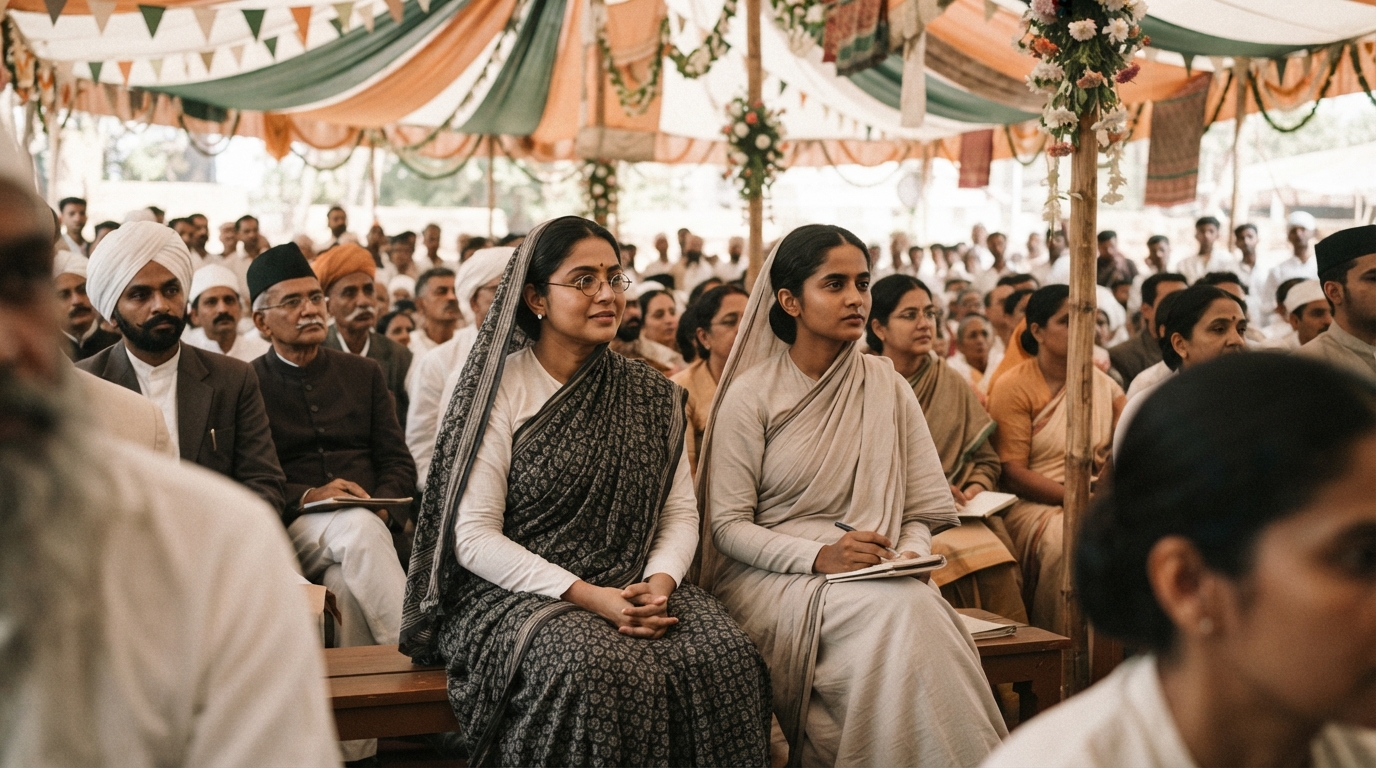
- Ten women delegates participated for the first time at the 1889 session.
- Early resolutions demanded simultaneous civil service examinations and military expenditure reductions.
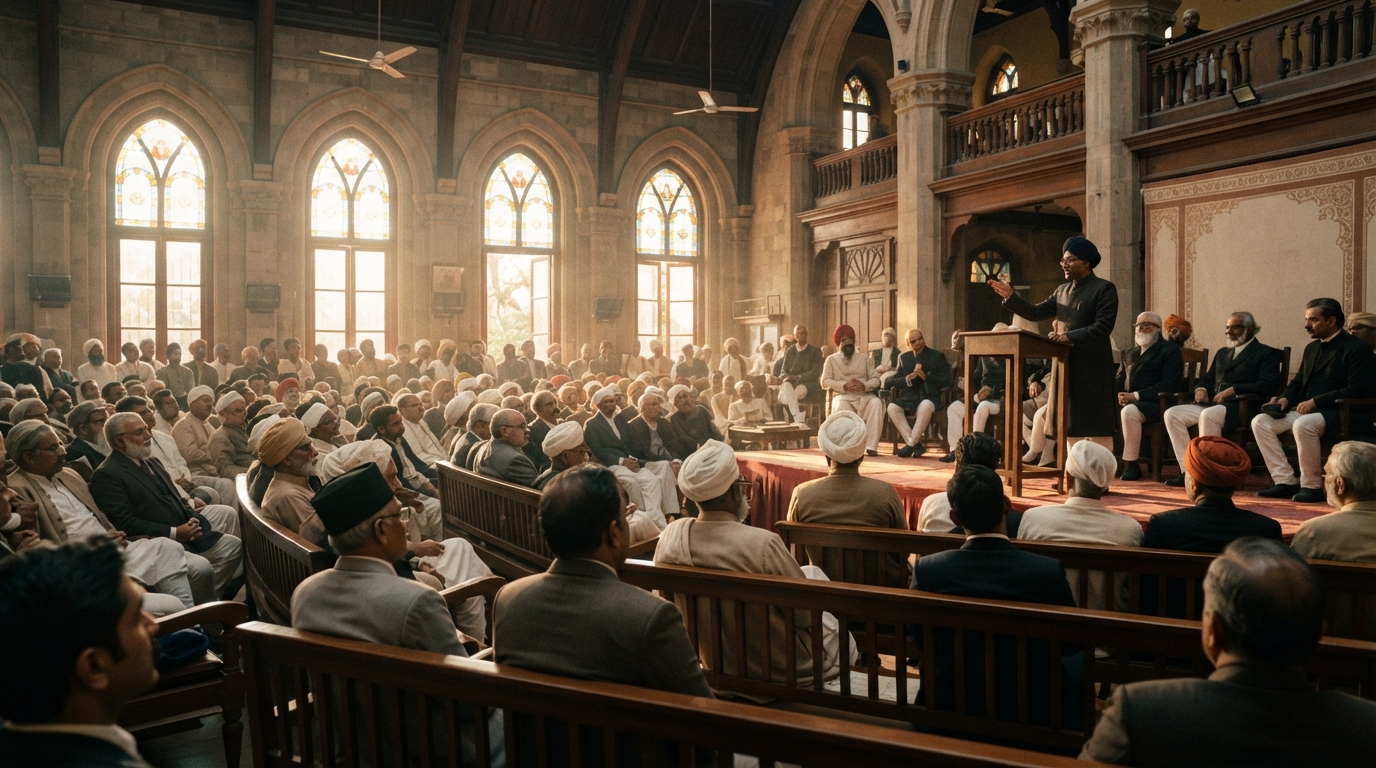
Rows of wooden benches filled the hall of Gokuldas Tejpal Sanskrit College in Bombay on the sunny morning of December 28, 1885. Seventy-two men dressed in frock coats, turbans, and dhotis took their seats to establish the first all-India political assembly. This meeting marked the official start of the Indian National Congress history timeline.
Understanding these foundational dates helps learners appreciate how modern democratic India took shape. For students exploring how to learn Indian history easily, tracing the early Congress milestones offers a clear entry point into modern Indian political thought.
The 1885 Bombay Foundation Established An All-India Political Platform
The first session of the Indian National Congress met in Bombay between December 28 and December 31, 1885. This gathering brought together regional political leaders to build a coordinated national voice. The session laid the groundwork for constitutional advocacy against British colonial rule through nine foundational reform resolutions.
+-------------------------------------------------------------------------+
|                        1885 INAUGURAL SESSION                           |
|  Date: December 28–31, 1885                                             |
|  Venue: Gokuldas Tejpal Sanskrit College, Bombay                        |
|  President: Womesh Chandra Bonnerjee | General Secretary: A.O. Hume     |
|  Attendance: 72 delegates (39 lawyers, 14 journalists, plus academics)  |
|  Key Output: 9 resolutions demanding council reform & fiscal audits    |
+-------------------------------------------------------------------------+
The Emergency Shift From Pune to Gokuldas Tejpal College
Poona was the original city chosen to host the inaugural gathering in late 1885. The Poona Sarvajanik Sabha had offered to provide the facilities and manage local hospitality. A sudden outbreak of cholera in the city forced an emergency change of plans just days before the scheduled start [Prepp, 2026].

Colonial health regulations made holding a large public convention in Poona impossible. Organizers scrambled to locate a safe replacement city with reliable rail links.
Bombay was chosen because it offered established municipal infrastructure and strong transit connections. The management of Gokuldas Tejpal Sanskrit College near Gowalia Tank made their hall and residential quarters available. Delegates arrived by train from Madras, Calcutta, Ahmedabad, and Karachi. They settled into simple campus rooms on December 27, 1885.
The emergency move showed the determination of early organizers to maintain their agreed schedule.
The Demographic Makeup and Professional Profile of the 72 Delegates
The first session brought together 72 registered delegates from across the British presidencies. Professional intellectuals and commercial elites formed the bulk of this inaugural delegation. According to archival analyses, 39 of the 72 delegates, or over 54 percent, were practicing lawyers [Testbook, 2026; Scribd, 2025].
Fourteen delegates worked as journalists or newspaper editors, while the remainder consisted of teachers, landowners, and merchants.
1885 Inaugural Delegate Composition (72 Total Delegates):
===========================================================
Lawyers & Jurists:      [████████████████████] 54.2% (39 delegates)
Journalists & Editors:  [███████             ] 19.4% (14 delegates)
Merchants & Landowners: [████                ] 12.5% (9 delegates)
Academics & Doctors:    [████                ] 13.9% (10 delegates)
Geographic representation reflected the reach of early urban associations. The Bombay Presidency sent 38 delegates, while the Madras Presidency sent 21 representatives. The Bengal Presidency contributed just 3 delegates because regional leaders were attending a concurrent conference in Calcutta.
Two delegates came from the North-Western Provinces and Oudh, and one arrived from the Punjab. Muslim participation was limited to 2 delegates, representing roughly 2.7 percent of the attendance [Modern History Archives, 2026].
The Nine Founding Resolutions Shaping Early Nationalist Demands
The Nine Founding Resolutions are the inaugural policy charter drafted by 72 delegates under President Womesh Chandra Bonnerjee between December 28 and December 31, 1885 [Testbook, 2026]. Passing after four days of structured debate, these nine resolutions established the core constitutional demands of the early nationalist movement, focusing on administrative audits, civil service reforms, and legislative expansion across British India.
- Inquiry Commission: A royal commission to investigate the working of the Indian administration.
- Abolition of the Council of India: Dismantling the advisory council in London that obstructed legislative reforms.
- Expansion of Legislative Councils: Introducing elected members and budget discussion rights into provincial councils.
- Simultaneous Examinations: Holding Indian Civil Service tests concurrently in London and India while raising the maximum candidate age.
- Military Budget Reductions: Lowering imperial military expenditures that consumed domestic tax revenues.
- Reapportioning Imperial Costs: Ensuring Britain paid for military campaigns conducted outside Indian borders.
- Annexation Protest: Opposing the proposed annexation of Upper Burma and its associated fiscal costs.
- Charter Distribution: Transmitting these resolutions to provincial political bodies across the country for local advocacy.
- Next Session Mandate: Convening the second annual session in Calcutta on December 28, 1886.
These nine resolutions avoided radical anti-imperialist rhetoric. Early leaders chose instead to focus on fiscal discipline, civil rights, and administrative transparency. They used standard constitutional mechanisms to argue their case before the British public.
The Safety Valve Debate Contrasts With The Lightning Conductor Strategy
Colonial administrators and Indian nationalists held sharply contrasting views on why the Congress was formed. British officials often portrayed the organisation as a controlled release valve for Indian discontent. Indian nationalist historians argue instead that early leaders tactically used a retired British official to shield their young political organisation from state suppression.
+--------------------------------------------------------------------------+
|                  ORGANIZATIONAL ORIGIN THEORIES                          |
|                                                                          |
|  Safety Valve Theory (W. Wedderburn)                                     |
|  * A.O. Hume created Congress with Lord Dufferin's approval.             |
|  * Designed to preempt violent popular rebellions like 1857.             |
|  * Channel educated elite grievances into polite petitions.              |
|                                                                          |
|  Lightning Conductor Theory (Bipan Chandra)                              |
|  * Indian nationalists consciously used Hume as a political buffer.      |
|  * Prevented colonial authorities from banning indigenous meetings.      |
|  * Capitalized on existing networks built by the Indian Association.     |
+--------------------------------------------------------------------------+
Allan Octavian Hume and Colonial Administrative Intent
Allan Octavian Hume, a retired member of the Imperial Civil Service, served as the primary convenor of the 1885 meeting. Hume had served as a district officer during the 1857 rebellion and later worked as Secretary to the Government of India. In March 1883, he published an open letter to the graduates of Calcutta University. The letter urged educated Indians to form an organised body for national regeneration.
William Wedderburn, Hume's early biographer, popularized the idea that Hume acted to avoid a violent uprising. According to this view, Hume had read seven confidential intelligence reports warning of rural unrest.
He met Viceroy Lord Dufferin in Simla to secure tacit administrative permission for a loyal political safety valve. Dufferin initially saw value in an assembly that could tell the government where policies caused public dissatisfaction.
Bipan Chandra and the Tactical Shield for Early Nationalists
The Lightning Conductor theory is a historical interpretation advanced by historian Bipan Chandra, asserting that early nationalist leaders deliberately used Allan Octavian Hume as a protective buffer [Insights IAS, 2025]. Chandra argued that an all-India political organization launched exclusively by Indians in December 1885 would have faced immediate administrative bans and official state crackdowns from British colonial authorities.
Colonial administrators viewed purely indigenous political bodies with deep suspicion. An organisation headed entirely by Indian leaders in 1885 would have invited swift police bans and administrative boycotts.
Early leader Gopal Krishna Gokhale confirmed this dynamic in his personal writings. Gokhale noted that if any Indian had initiated such an all-India movement in 1885, the government would have found a pretext to suppress the initiative at once [Historical Records / Dialnet, 2025].
By placing Hume at the front as General Secretary, early nationalist leaders gained crucial political protection. This protective cover allowed the Indian National Congress to build root organizations across multiple provinces during the organization's initial vulnerable years.
Precursor Bodies and the Merger of Provincial Conferences
The Indian National Congress did not emerge in an organizational vacuum. Regional political associations had been active across presidency towns for two decades before 1885 [Neptunevines, 2026].
The Poona Sarvajanik Sabha, the Bombay Presidency Association, and the Madras Mahajana Sabha organized urban professionals at local levels. In Bengal, Surendranath Banerjee and Ananda Mohan Bose established the Indian Association in 1876 to unite educated citizens.
Regional Political Associations (1870–1885):
--------------------------------------------------------------------------
• 1870: Poona Sarvajanik Sabha (M.G. Ranade, G.V. Joshi)
• 1876: Indian Association, Calcutta (S.N. Banerjee, A.M. Bose)
• 1884: Madras Mahajana Sabha (M. Veeraraghavachariar, P. Anandacharlu)
• 1885: Bombay Presidency Association (P. Mehta, K.T. Telang, B. Tyabji)
• 1883 & 1885: National Conference, Calcutta (Integrated into Congress 1886)
--------------------------------------------------------------------------
Surendranath Banerjee organized the first All-India National Conference in Calcutta in December 1883. That gathering drew over a hundred delegates from various provinces. The second National Conference met in Calcutta from December 25 to 27, 1885.
Because of this meeting, Banerjee could not travel to Bombay for the first Congress session. Recognizing the wastefulness of parallel forums, the leaders of the National Conference merged their group into the Indian National Congress at Calcutta in 1886.
Early Annual Sessions Expanded Geographic and Social Representation
The early annual sessions of the Indian National Congress are the sequential national conventions held between 1886 and 1889 that transformed the organization from an elite gathering into a representative political assembly. During this period, registered delegate counts expanded sixteen-fold from 72 to 1,889, establishing institutional rules that incorporated regional representatives, religious minorities, and female delegates into national debates.
Delegate Growth Trajectory (1885–1889):
1885 (Bombay):    [72]
1886 (Calcutta):  [████ 434]
1887 (Madras):    [██████ 607]
1888 (Allahabad): [████████████ 1,248]
1889 (Bombay):    [███████████████████ 1,889]
Dadabhai Naoroji and the 1886 Calcutta Session
The 1886 Calcutta Session is the second national assembly of the Indian National Congress, convened from December 27 to 30, 1886, under President Dadabhai Naoroji [INC Records, 2026]. Attended by 434 registered delegates—a sixfold increase from 1885—this convention established Provincial Congress Committees and formally restricted Congress proceedings to nationwide political and administrative questions rather than sectarian social disputes.
Naoroji was an educator, merchant, and political economist who later became the first Indian elected to the British House of Commons. Naoroji used the 1886 platform to introduce clear administrative boundaries for Congress work.
Social reform questions were left to separate regional forums like the National Social Conference. This division protected the political assembly from community-specific disputes.
The Calcutta session also created the first Provincial Congress Committees to manage regional delegate elections throughout the year.
Badruddin Tyabji and Growing Minority Participation at Madras in 1887
The third session convened in Madras in December 1887 under the presidency of Badruddin Tyabji. Tyabji was a distinguished judge of the Bombay High Court and the first Muslim president of the Indian National Congress. Delegate attendance rose to 607 representatives, including 83 Muslim delegates, representing 13.6 percent of total attendees [Modern History Archives, 2026].
Muslim Delegate Expansion (First Four Sessions):
-------------------------------------------------------------------
1885 (Bombay):     2 delegates   ( 2.7% of 72 total)
1886 (Calcutta):  33 delegates   ( 7.6% of 434 total)
1887 (Madras):    83 delegates   (13.6% of 607 total)
1888 (Allahabad): 254 delegates  (20.3% of 1,248 total)
-------------------------------------------------------------------
Data source: Modern History Archives, 2026
Tyabji addressed fears that the Congress represented only majority interests. In his presidential address, he explained that the Congress belonged to all communities inhabiting the subcontinent.
To turn this statement into policy, the Madras session passed an inclusive procedural rule. The rule stated that no subject could be discussed if a majority of Hindu or Muslim delegates formally objected to it [Race IAS, 2025].
By the 1888 Allahabad session, Muslim representation reached 254 out of 1,248 total delegates, or 20.3 percent of the hall.
The 1889 Bombay Session and the First Women Delegates
The fifth annual session met in Bombay in December 1889 under the presidency of William Wedderburn. Total attendance reached 1,889 delegates, matching the calendar year. This session achieved a major historical milestone by welcoming women delegates for the first time [The Indian Express, 2025].
No women had participated during the initial 1885 foundation. In 1889, ten women attended the proceedings as accredited representatives. The delegation included:
- Kadambini Ganguly: One of the first female medical doctors in the British Empire.
- Pandita Ramabai: Sanskrit scholar, educator, and champion of widows' welfare.
- Swarnakumari Devi: Renowned Bengali novelist and social organizer.
- Lady Radhabai Subbarayan: Social worker and advocate for women's suffrage.
Kadambini Ganguly delivered a formal vote of thanks at the conclusion of the 1890 Calcutta session. Her address marked the first time a woman spoke from the Congress podium.
Readers tracking these developments can explore our detailed guide to milestones in Indian women's history for broader context on gender representation in early civic institutions.
The Moderate Phase Built Constitutional Resistance Against Colonial Rule
Between 1885 and 1905, the Indian National Congress operated under what historians term the Moderate Phase. Early leaders believed British institutions were fundamentally fair. They argued that colonial misrule stemmed from administrative ignorance rather than deliberate imperial malice.
+--------------------------------------------------------------------------+
|                  THE THREE PHASES OF THE CONGRESS                        |
|                                                                          |
|  Moderate Phase (1885–1905)                                              |
|  * Leaders: W.C. Bonnerjee, Dadabhai Naoroji, Pherozeshah Mehta          |
|  * Methods: Petitions, Prayers, Protests (Constitutional agitation)      |
|  * Goals: Council expansion, fiscal reforms, ICS exam parity             |
|                                                                          |
|  Assertive / Extremist Phase (1905–1919)                                 |
|  * Leaders: Bal Gangadhar Tilak, Bipin Chandra Pal, Lala Lajpat Rai      |
|  * Methods: Swadeshi, Boycott, National Education, Passive Resistance    |
|  * Goals: Swaraj (Self-Rule) within or outside the empire                |
|                                                                          |
|  Gandhian Phase (1919–1947)                                              |
|  * Leader: Mahatma Gandhi                                                |
|  * Methods: Satyagraha, Non-Cooperation, Civil Disobedience              |
|  * Goals: Purna Swaraj (Complete Independence)                           |
+--------------------------------------------------------------------------+
The Three Ps Method of Petitions, Prayers, and Protests
Moderate leaders relied on a structured method known as the Three Ps: Petitions, Prayers, and Protests [Legacy IAS, 2026]. They organized public meetings, passed formal resolutions, and drafted memorandums for British officials. They believed that educating British public opinion would compel Parliament to enact political reforms.
To reach the British public, the Congress established a British Committee in London in 1889. The committee published an influential journal titled India to circulate factual reports on Indian economic conditions.
Leaders like Pherozeshah Mehta, Dinshaw Wacha, and Gopal Krishna Gokhale gave speeches in municipal halls and legislative chambers. They worked within established legal frameworks to expand basic civil rights and freedom of the press.
Economic Drain Critiques and Legislative Council Reforms
The greatest intellectual achievement of the Moderate phase was its economic critique of British colonialism. Dadabhai Naoroji formulated the Drain of Wealth theory in his landmark work, Poverty and Un-British Rule in India.
Naoroji demonstrated that Britain extracted substantial domestic revenue through home charges, military expenses, and unfunded imperial pensions without giving India equivalent material returns.
Mechanisms of the Drain of Wealth:
-------------------------------------------------------------------
1. Home Charges: Costs of the India Office in London paid by Indian taxpayers.
2. Guaranteed Railway Dividends: 5% guaranteed returns on British investments.
3. Military Charges: Indian revenues funded imperial wars across Asia and Africa.
4. Civil Service Pensions: Remittances sent abroad by retired British officers.
-------------------------------------------------------------------
Romesh Chunder Dutt supported Naoroji's analysis through his classic publication, The Economic History of India. These economic critiques undermined the moral justification of British rule.
Sustained political pressure from the Congress eventually pushed the British Parliament to pass the Indian Councils Act of 1892. This law expanded the size of central and provincial councils and allowed members to discuss the annual budget for the first time.
Early Factional Strains Leading Toward the 1907 Surat Split
By the turn of the century, younger Congress leaders grew frustrated with the slow pace of constitutional appeals. Figures such as Bal Gangadhar Tilak, Lala Lajpat Rai, and Bipin Chandra Pal criticized the Moderate approach as political mendicancy. They demanded direct political action, industrial boycotts, and complete self-rule (Swaraj).
The partition of Bengal by Lord Curzon in October 1905 transformed this internal disagreement into an open split. The Assertive faction demanded extending the Swadeshi and boycott movements nationwide. The Moderates wanted to confine protests to Bengal and stick strictly to constitutional methods.
These disagreements boiled over at the 1907 Surat session, where the Congress split into two distinct factions. The organisation remained divided until the historic Lucknow Pact reunited both wings in December 1916.
For a chronological overview of how this period connects to later events, review our digital reference timeline chart.
Key Milestone Dates Formed The Indian National Congress History Timeline
Tracking annual sessions provides an accurate perspective on how national demands expanded across six decades. The table below outlines the core foundational dates, venues, leadership, and policy shifts that defined the organization's growth.
| Date | Location | President | Key Resolutions & Milestones |
|---|---|---|---|
| Dec 28–31, 1885 | Bombay | W.C. Bonnerjee | First session; 72 delegates pass 9 founding resolutions on governance. |
| Dec 27–30, 1886 | Calcutta | Dadabhai Naoroji | Merger with National Conference; Provincial Committees formed; 434 delegates. |
| Dec 27–30, 1887 | Madras | Badruddin Tyabji | First Muslim president; rule on minority veto passed; 607 delegates. |
| Dec 26–29, 1888 | Allahabad | George Yule | First British president; colonial government bans civil servants from attending. |
| Dec 26–28, 1889 | Bombay | William Wedderburn | First 10 women delegates participate; attendance reaches 1,889. |
| Dec 27–30, 1905 | Benaras | G.K. Gokhale | Formal protest against Bengal Partition; Swadeshi movement endorsed. |
| Dec 26–29, 1906 | Calcutta | Dadabhai Naoroji | Goal of Swaraj (Self-Government) declared for the first time. |
| Dec 26–27, 1907 | Surat | Rashbehari Ghosh | Congress splits into Moderate and Extremist factions; session suspended. |
| Dec 26–30, 1916 | Lucknow | A.C. Majumdar | Lucknow Pact signed with Muslim League; Moderate-Extremist factions reunite. |
| Dec 26–31, 1920 | Nagpur | C. Vijayaraghavachariar | New Congress Constitution adopted; Non-Cooperation Movement launched. |
| Dec 29–31, 1929 | Lahore | Jawaharlal Nehru | Purna Swaraj (Complete Independence) resolution passed; Tricolour hoisted. |
Key Milestone Chronology (1885–1929):
==================================================================================
1885: Founded in Bombay ──► 1887: Minority Rule at Madras ──► 1889: Women Attend
       │                                                                │
       ▼                                                                ▼
1929: Purna Swaraj (Lahore) ◄── 1920: Non-Cooperation ◄── 1907: Surat Split
==================================================================================
Core Historical Cards for Major Pre-Independence Sessions
Students can memorize these major sessions using simple historical index cards. Each card highlights the primary constitutional transition achieved during that session.
+--------------------------------------------------------------------------+
| CARD 1: 1885 BOMBAY SESSION                                              |
| Foundational charter of 9 resolutions focusing on administrative audits, |
| simultaneous civil service examinations, and provincial council reforms. |
+--------------------------------------------------------------------------+
| CARD 2: 1906 CALCUTTA SESSION                                            |
| Dadabhai Naoroji adopted the word "Swaraj" as the official national goal |
| of the Congress, unifying Moderate and Assertive factions temporarily.   |
+--------------------------------------------------------------------------+
| CARD 3: 1929 LAHORE SESSION                                              |
| Passed the historic Purna Swaraj declaration, authorizing Civil          |
| Disobedience and designating January 26, 1930, as Independence Day.      |
+--------------------------------------------------------------------------+
These milestones show how the organisation transformed over time. In 1885, it was an elite assembly seeking modest administrative reforms. By 1929, it had become a mass movement demanding full sovereignty.
How Daily History Archives Track Key Indian Calendar Milestones
Daily history archives help students and researchers organize these historical milestones by calendar date. Tracking specific dates reveals interesting historical patterns across decades.
For instance, December 28 marks the founding of the Congress in 1885. The organisation celebrated its 140th Foundation Day on this date at its Indira Bhawan headquarters in New Delhi [News On AIR, 2025; The Indian Express, 2025].
Calendar indices also show how specific days carried recurring historical importance. Looking at August dates, 19 august in indian history and 20 august in indian history mark key freedom struggle milestones and nationalist birthdays.
Examining today in indian history gives readers a practical way to connect everyday dates with larger political developments across the country.
Frequently Asked Questions
Q: What is the significance of the first Indian National Congress session in 1885?
The 1885 Bombay session established India's first nationwide political forum. It united 72 delegates from diverse regions to draft nine resolutions demanding civil service exams in India, council expansions, and reductions in colonial military spending.
Q: Who were the key founding members of the Indian National Congress?
Allan Octavian Hume convened the initial meeting, while Womesh Chandra Bonnerjee served as the first Congress President. Prominent founding leaders included Dadabhai Naoroji, Dinshaw Wacha, Pherozeshah Mehta, Badruddin Tyabji, and K.T. Telang.
Q: Why was the venue of the first INC session shifted from Pune to Bombay?
The inaugural 1885 session was originally scheduled to take place in Poona under the sponsorship of the Poona Sarvajanik Sabha. A sudden cholera outbreak in Poona forced organizers to move the venue to Gokuldas Tejpal Sanskrit College in Bombay just days before the event.
Q: How does the Indian National Congress history timeline divide its pre-independence phases?
Historians divide early Congress history into three distinct periods: the Moderate Phase (1885–1905), focused on constitutional petitions; the Assertive or Extremist Phase (1905–1919), characterized by Swadeshi protests and direct action; and the Gandhian Phase (1919–1947), which led mass civil disobedience campaigns.
Your Next Move
If you are preparing for competitive civil service exams or teaching modern Indian history, start by memorizing the early presidency locations and key resolutions passed between 1885 and 1907. Create chronological flashcards for the first five sessions, focusing on delegate growth, presidential addresses, and constitutional demands.
Browse our daily calendar archive at 10 Most Searched Dates in Indian History to connect specific calendar dates with landmark national events.
Related Reading
- Indian History Timeline Chart: Key Milestones (Digital Reference)
- Indian History Milestones: The Maurya and Gupta Empires
- Milestones in Indian Women's History: A Chronological Guide
- 1,000 Years of Indian Medical History: A Chronological Guide
Sources
- Indian National Congress and Ideological Dimension: Historical Perspective — Indian National Congress, 2020. Supports: The founding of the Indian National Congress on December 28, 1885, at Gokuldas Tejpal Sanskrit College in Bombay under President Womesh Chandra Bonnerjee.
- Badruddin Tyabji — Indian National Congress, 2023. Supports: Badruddin Tyabji presiding over the 1887 Madras session as the first Muslim president of the Congress.
- The forgotten legacy of Kadambini Ganguly, India's first woman doctor — The Indian Express, 2024. Supports: Kadambini Ganguly and female delegates attending and addressing early Indian National Congress sessions beginning in 1889.
- 140th Foundation day: Congress has not compromised on its core principles: Kharge — The Hindu, 2025. Supports: The Indian National Congress observing its 140th Foundation Day on December 28, 2025, at its Indira Bhawan headquarters in New Delhi.
- Dadabhai Naoroji — Encyclopaedia Britannica, 2026. Supports: Dadabhai Naoroji formulating the Drain of Wealth critique in Poverty and Un-British Rule in India during the Moderate era.
- Indian Councils Act — Encyclopaedia Britannica, 2026. Supports: The British Parliament enacting the Indian Councils Act of 1892 to expand legislative council membership and permit budget discussions.