The Liberation of Goa: A Historical Timeline of the 1961 Operation Vijay
In Short
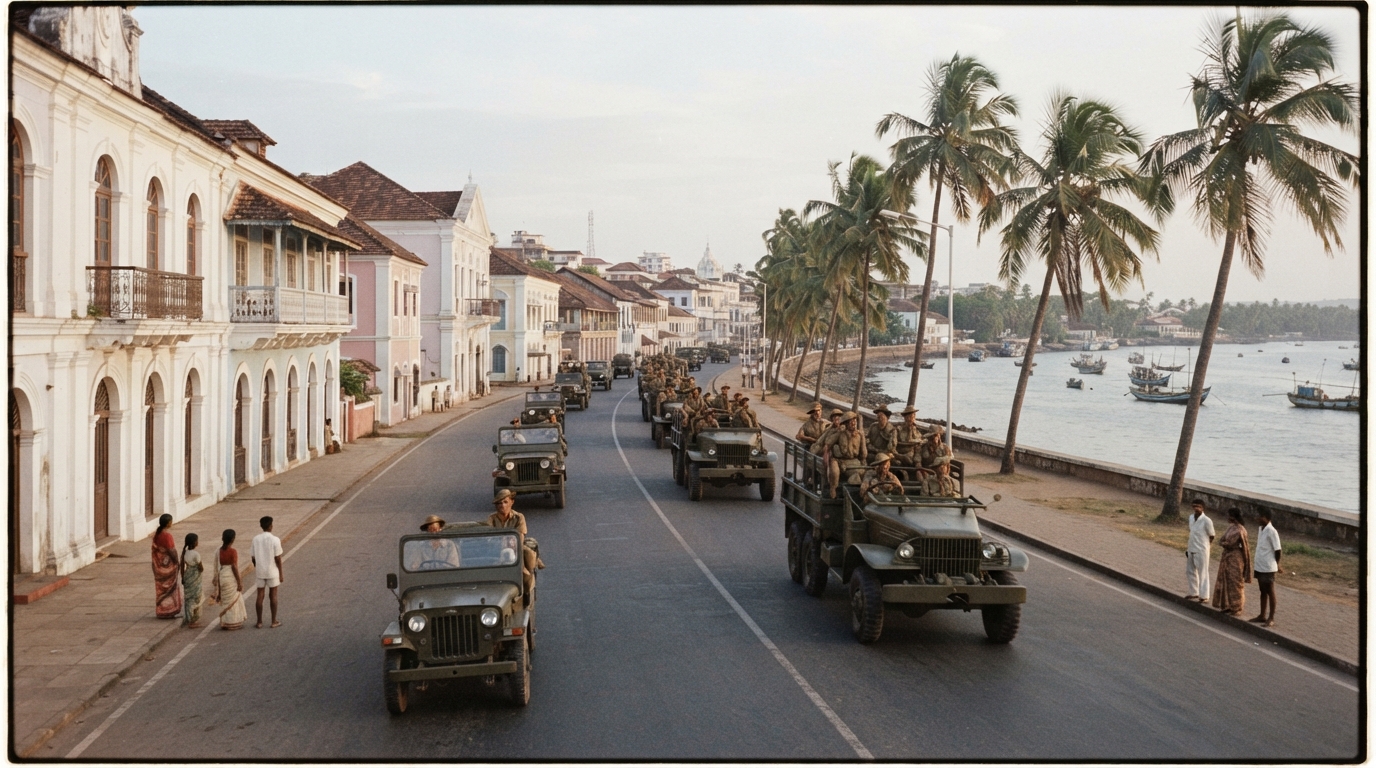
The Goa liberation timeline is the chronological sequence of events culminating on December 19, 1961, when the Indian Armed Forces executed Operation Vijay. This 36-hour tri-service military campaign ended 451 years of Portuguese colonial rule in Goa, Daman, and Diu, successfully capturing 4,668 prisoners of war and integrating these territories into India.
Key Takeaways
- Operation Vijay ended 451 years of Portuguese colonial rule in a swift 36-hour campaign.
- Indian forces integrated Goa, Daman, and Diu 14 years after British colonial withdrawal.
- Portuguese Governor-General Vassalo e Silva defied Lisbon's scorched-earth orders to protect Goan infrastructure.
- Portugal formally recognized Indian sovereignty over Goa in 1974 following the Carnation Revolution.
For 451 years, the Portuguese Crown maintained colonial control over Goa, outlasting the British Raj by 14 full years. When India gained independence on August 15, 1947, Prime Minister Jawaharlal Nehru expected European enclaves to transfer peacefully. France negotiated the phased handover of Puducherry, Chandannagar, Karaikal, Mahe, and Yanam between 1949 and 1954. In contrast, Lisbon’s authoritarian Estado Novo regime under António de Oliveira Salazar refused all diplomatic talks. Salazar claimed Goa was an overseas province of Portugal, not a colony.
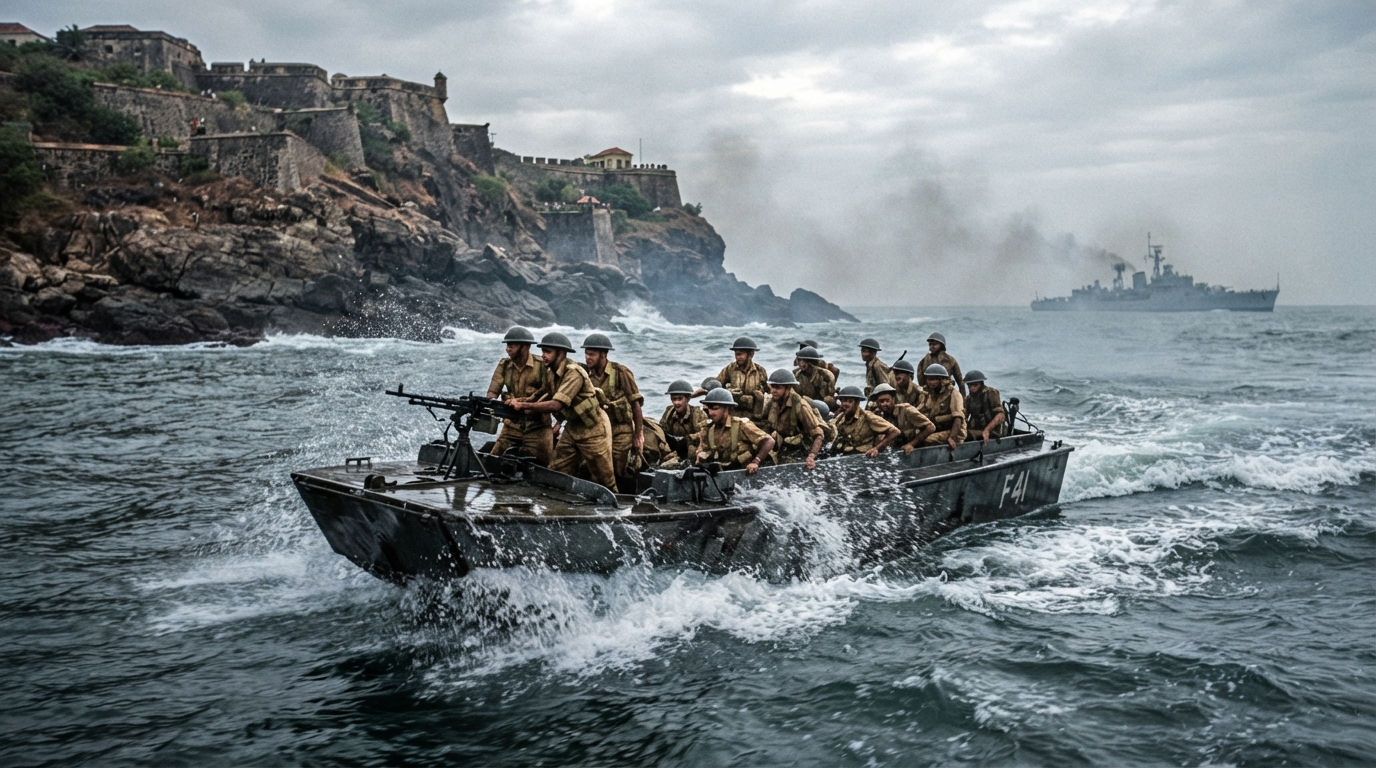
Understanding the complete Goa liberation timeline requires examining years of grassroots civil disobedience alongside decisive military action. Local Goans mounted non-violent protests, established underground resistance networks, and fought cross-border skirmishes long before New Delhi authorized military intervention. When diplomatic channels collapsed and Portuguese troops opened fire on civilian vessels in late 1961, India deployed its armed forces. Operation Vijay remains a definitive chapter in the broader visual history of the Indian independence movement.
The Road to 1961 Rooted in Decades of Resistance
The road to Goan liberation is the multi-decade resistance movement combining civil disobedience, armed guerrilla operations, and international legal challenges between 1928 and 1961. While Prime Minister Jawaharlal Nehru sought peaceful diplomatic transfers, local political organizations mobilized domestic protests against Portuguese authorities, who responded with mass arrests, physical torture, and deportations to penal colonies.
Early Indigenous Resistance and the Goa Congress Committee
Organized modern political resistance began in 1928 when Tristão de Bragança Cunha founded the Goa Congress Committee in Panaji. Cunha, widely revered as the father of Goan nationalism, linked the enclave's liberation directly to the broader Indian national struggle. He published pamphlets exposing administrative censorship and forced cultural assimilation under the Portuguese era in Goa.
Civil disobedience reached a turning point on June 18, 1946. Indian socialist leader Dr. Ram Manohar Lohia visited Goa and addressed a massive public gathering in Margao alongside Dr. Juliao Menezes. Portuguese police arrested Lohia, but the event ignited widespread civil rights protests across the territory. June 18 is celebrated annually as Goa Revolution Day.
+-----------------------------------------------------------------------+
|                 EARLY GOAN FREEDOM STRUGGLE MILESTONES                |
+-----------------------------------------------------------------------+
|  1928: TB Cunha founds Goa Congress Committee in Panaji               |
|  1946: Dr. Ram Manohar Lohia launches civil liberties movement        |
|  1954: Enclaves of Dadra and Nagar Haveli liberated by volunteers    |
|  1955: Portuguese police kill 20-30 unarmed satyagrahis on August 15  |
|  1961: Operation Vijay launches on December 18                        |
+-----------------------------------------------------------------------+
The 1954 Enclaves and the 1955 Satyagraha Massacre
In July and August 1954, local resistance volunteers took control of Portuguese landlocked enclaves north of Mumbai during the liberation of Dadra and Nagar Haveli. Members of the United Front of Goans, the National Liberation Movement Organization, and the Azad Gomantak Dal ousted the Portuguese administration. Portugal took India to the International Court of Justice (ICJ), demanding right of passage for its troops across Indian territory. The ICJ ruled in 1960 that India was within its legal rights to deny Portuguese military access.
Tensions reached an absolute boiling point on August 15, 1955. Over 3,000 unarmed Indian satyagrahis marched across the Goan border at Banda and Castlerock. Portuguese police forces opened live fire without warning, killing between 20 and 30 unarmed demonstrators. The unprovoked massacre sparked outrage across India. Nehru severed all remaining diplomatic relations with Lisbon, imposed an economic blockade, and closed the Indian consulate general in Goa.
Armed Resistance Through the Azad Gomantak Dal
Non-violent protests stalled against Salazar’s police apparatus, prompting younger nationalists to form armed insurgent organizations to liberate the territory by force. The Azad Gomantak Dal (AGD), formed in 1947 by figures such as Vishwanath Lawande, Prabhakar Sinari, and Narayan Hari Naik, waged an active guerrilla campaign.
The AGD carried out targeted raids against Portuguese police outposts, mines, and communications infrastructure throughout the 1950s. Local resistance figures like Bala Raya Mapari and Prabhakar Vaidya sustained intense pressure inside Goa. Their actions proved that local populations actively rejected Portuguese sovereignty, countering Lisbon's claims of a content populace.
The 1961 Escalation Triggered Direct Military Action
The 1961 escalation is the final phase of military and diplomatic conflict that compelled India to launch Operation Vijay on December 18, 1961. Unprovoked Portuguese artillery attacks on civilian vessels, Lisbon's refusal to negotiate decolonization, and Portuguese military reinforcements in the enclaves forced Prime Minister Jawaharlal Nehru to authorize a decisive armed intervention.
The Sabarmati Steamer Incident and Rising Border Friction
The Sabarmati steamer incident is the critical naval confrontation on November 24, 1961, when Portuguese coastal artillery stationed on Anjidiv Island fired upon the civilian Indian passenger vessel SS Sabarmati. The artillery rounds wounded chief engineer B.P. Lobo and killed a passenger, providing the direct casus belli for Indian military mobilization.
Days later, Portuguese troops fired upon an Indian fishing craft off the coast of Karwar, killing another Indian fisherman. These attacks provided the immediate operational catalyst for military action. The Indian government moved active naval patrols toward the Goan coast to protect merchant shipping lines. Public demand for central intervention reached unprecedented levels across India.
Lisbon's Refusal to Negotiate and Diplomatic Deadlocks
Prime Minister Nehru spent fourteen years pursuing peaceful solutions, concerned about international criticism from Western allies. As historian Valmiki Faleiro documented in his 2023 study Goa, 1961, Defense Minister V.K. Krishna Menon and senior military leadership began drafting decisive military intervention plans once diplomatic channels collapsed entirely.
Salazar remained unyielding. He invoked the Anglo-Portuguese Treaty of 1373 and appealed to NATO allies for logistical support. The United Nations General Assembly passed Resolution 1514 in December 1960, asserting that all foreign enclaves must undergo rapid decolonization. Salazar rejected the resolution outright, declaring Goa an indivisible part of European Portugal.
Strategic Planning Behind the Tri-Service Assault
The Indian Armed Forces assigned the operational command of Operation Vijay to Lieutenant General J.N. Chaudhuri of Southern Command. Major General K.P. Candeth directed ground forces as the commander of the 17th Infantry Division. The plan called for a simultaneous, three-pronged land assault supported by carrier-borne naval strikes and tactical air interdiction.
+--------------------------------------------------------------------------+
|                  OPERATION VIJAY COMMAND STRUCTURE                       |
+--------------------------------------------------------------------------+
|  Overall Theater Commander  : Lt. Gen. J.N. Chaudhuri (Southern Command) |
|  Ground Tactical Commander  : Maj. Gen. K.P. Candeth (17th Division)     |
|  Air Component Commander    : Air Vice Marshal Erlic Pinto               |
|  Naval Task Force Leader    : Rear Admiral B.S. Soman                    |
+--------------------------------------------------------------------------+
The objective was speed. Indian planners aimed to neutralize Portuguese defenses within 48 hours to prevent Western powers from forcing a UN ceasefire before the enclaves fell.
The 36-Hour Goa Liberation Timeline of Operation Vijay
The primary military phase of the Goa liberation timeline unfolded between the early hours of December 18 and the evening of December 19, 1961. Indian forces advanced across northern, eastern, and southern axes, overwhelming Portuguese strongholds within 36 hours of combat.
+-----------------------------------------------------------------------+
|             OPERATION VIJAY: 36-HOUR COMBAT TIMELINE                  |
+-----------------------------------------------------------------------+
|  Dec 18, 04:00 IST : Indian troops cross northern Goan border         |
|  Dec 18, 07:00 IST : IAF Canberras neutralize Dabolim Airfield        |
|  Dec 18, 11:00 IST : INS Betwa & Beas engage NRP Afonso de Albuquerque|
|  Dec 18, 14:00 IST : Indian 50th Parachute Brigade captures Ponda     |
|  Dec 19, 08:30 IST : Indian forces enter Panaji without resistance    |
|  Dec 19, 19:30 IST : Formal surrender signed by Vassalo e Silva       |
+-----------------------------------------------------------------------+
December 18: The Three-Pronged Advance and Airfield Strikes
At 04:00 IST on December 18, Indian ground forces crossed into Goa along three separate axes:
- Northern Column: The 50th Parachute Brigade moved rapidly through Dodamarg toward Sanquelim and Bicholim.
- Eastern Column: The 63rd Infantry Brigade advanced from Belgaum through Anmod, targeting Ponda and central transport nodes.
- Southern Column: The 4th Rajput Division advanced from Karwar toward Margao.
Simultaneously, the Indian Air Force launched precision airstrikes. Hawker Hunters and English Electric Canberras bombed the runway at Dabolim Airfield, destroying Portuguese communications and grounding transport planes. Another tactical sortie disabled the Portuguese wireless station at Bambolim.
By midday, Indian armor had bypassed blown bridges and crossed local river channels. Portuguese troops conducted fighting retreats, destroying culverts and roads along their path.
Naval Battle of Mormugao and the Fall of Anjidiv
At sea, the Indian Navy executed decisive strikes to secure coastal perimeters. The Portuguese frigate NRP Afonso de Albuquerque was anchored inside Mormugao Harbour as Lisbon's sole major warship in the theater. Two Indian frigates, INS Betwa and INS Beas, entered the harbour mouth and engaged the Portuguese vessel.
The ships exchanged over 400 rounds of naval gunfire. INS Betwa scored direct hits on the Portuguese frigate’s bridge and boiler rooms. Captain António da Cunha Aragão suffered severe wounds, and the crew ran the burning vessel aground on the beach to prevent its sinking.
Farther south, an Indian landing party from INS Trishul assaulted the fortified garrison on Anjidiv Island. Portuguese defenders raised a white flag but opened fire as Indian sailors approached, killing seven personnel. Indian naval gunfire quickly subdued the garrison, securing the island by late afternoon.
December 19: The Formal Surrender and Capture of Panaji
By the morning of December 19, Indian armored columns reached the outskirts of Panaji. The Portuguese defense collapsed completely as soldiers retreated across the Mandovi River. At 08:30 IST, Indian troops entered the capital city without encountering civilian resistance. Local citizens lined the streets, welcoming the advancing soldiers with Indian flags.
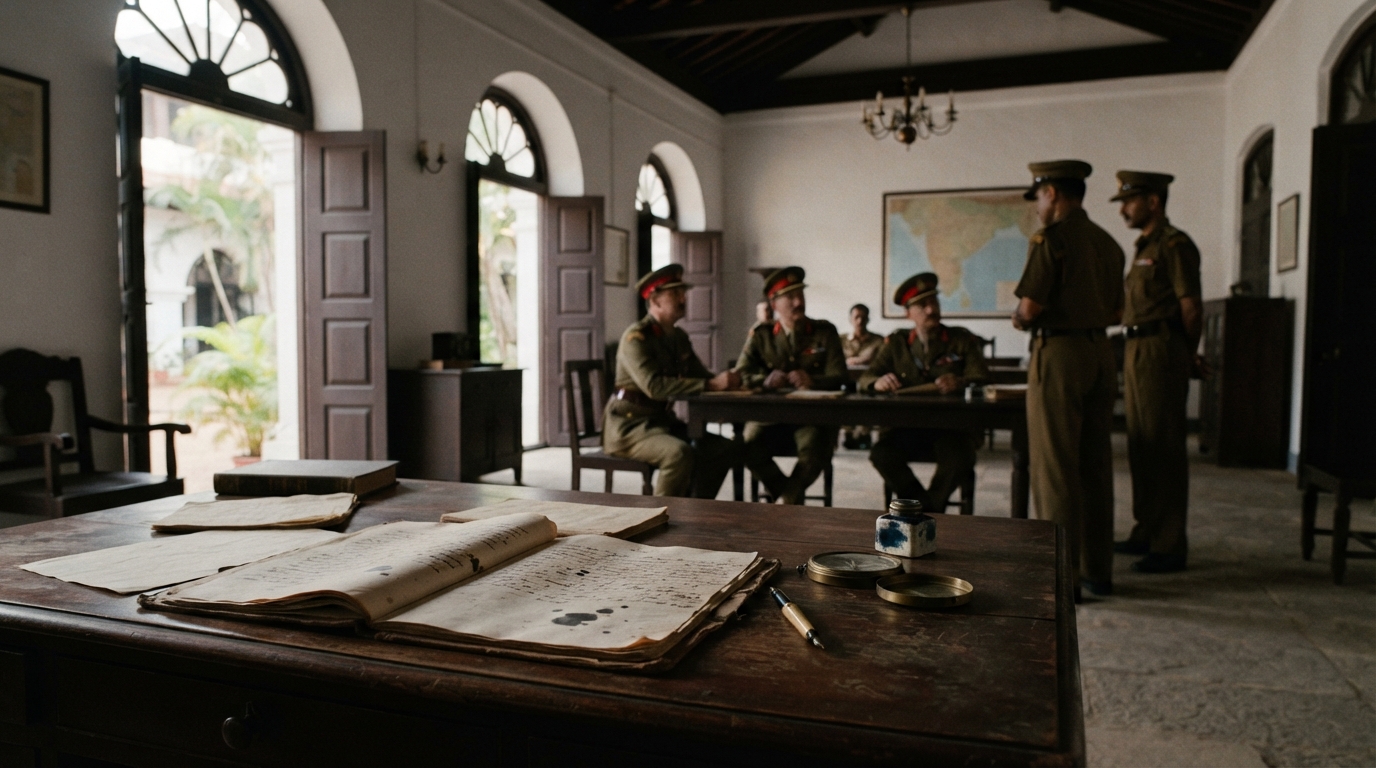
Governor-General Manuel António Vassalo e Silva realized his military situation was hopeless. Indian forces surrounded his remaining headquarters at Vasco da Gama. At 19:30 IST on December 19, 1961, Vassalo e Silva signed the formal instrument of surrender, handing over administrative control to Major General Candeth.
The Military Comparison and Costs Defined the Outcome
The tactical balance of forces during Operation Vijay was heavily weighted in India’s favor, ensuring minimal casualties and preventing prolonged conflict. New Delhi committed disciplined, tri-service elements to end foreign colonial rule permanently, marking a cornerstone entry in the Indian history timeline chart.
| Operational Parameter | Indian Armed Forces | Portuguese Armed Forces |
|---|---|---|
| Total Troop Deployment | ~30,000–45,000 troops | ~3,300–4,000 troops |
| Air Assets Deployed | Canberras, Hunters, Vampires | 2 civilian transport airliners |
| Naval Assets in Theater | Aircraft carrier INS Vikrant, 2 cruisers, 4+ frigates | 1 frigate (NRP Afonso de Albuquerque), 3 patrol boats |
| Combat Casualties | 22 killed, ~225 wounded | 30–31 killed, ~60 wounded |
| Prisoners of War (POWs) | 0 | 4,668 military and civilian personnel |
| Active Combat Duration | 36 hours total | 36 hours total |
Human Costs and Casualties on Both Sides
Operation Vijay concluded with remarkably low loss of life for a military campaign of this size. The Indian Armed Forces suffered 22 personnel killed and roughly 225 wounded, with the highest concentration of losses occurring during the amphibious landing on Anjidiv Island. Portuguese military records confirmed 30 to 31 soldiers killed in combat and 5 naval personnel lost during the battle of Mormugao.
Indian forces interned 4,668 Portuguese personnel as Prisoners of War. These prisoners included 3,300 military troops, naval sailors, and colonial administrators. The Indian government housed the captured personnel at specialized camps in Alparqueiros and Vasco da Gama. They were treated in strict compliance with the Geneva Conventions until their repatriation via Lisbon in May 1962.
+--------------------------------------------------------------------------+
|                  OPERATION VIJAY CASUALTY BREAKDOWN                      |
+--------------------------------------------------------------------------+
|  Indian Armed Forces  : 22 Killed | ~225 Wounded                         |
|  Portuguese Forces    : 31 Killed | ~60 Wounded | 4,668 Captured (POWs)  |
+--------------------------------------------------------------------------+
The Decisive Rejection of Salazar's Scorched Earth Policy
Dictator António de Oliveira Salazar sent explicit orders from Lisbon instructing Governor-General Vassalo e Silva to fight to the last man. Salazar ordered the Portuguese garrison to hold out for at least eight days to allow Western intervention. He demanded the complete demolition of public infrastructure, the destruction of Mormugao port facilities, and the removal of the sacred relics of St. Francis Xavier.
Vassalo e Silva openly defied the dictator's orders. He recognized that blowing up bridges, power plants, and water reservoirs would only slaughter the local civilian population. In his official 1961 record, Vassalo e Silva stated that surrendering to the overwhelming Indian force was an unavoidable moral duty. Salazar dismissed him from service and exiled him upon his return to Portugal.
Global Diplomacy and Constitutional Integration Followed the Action
The conclusion of the Goa liberation timeline is the diplomatic and constitutional transition following Operation Vijay in December 1961 that reshaped Indian foreign policy and finalized the Republic's borders. While Western powers criticized India’s military enforcement, the Non-Aligned Movement and the Soviet Union supported the action, enabling the integration of Goa, Daman, and Diu.
United Nations Security Council Standoff
On December 18, 1961, the United States, Britain, and France introduced a resolution in the United Nations Security Council (UNSC). The draft resolution condemned India’s use of force and demanded an immediate ceasefire and withdrawal to pre-conflict borders. US Ambassador Adlai Stevenson delivered a speech criticizing India for abandoning its non-violent principles.
+-------------------------------------------------------------------------+
|                  UN SECURITY COUNCIL RESOLUTION VETO                    |
+-------------------------------------------------------------------------+
|  Date: December 18-19, 1961                                             |
|  Sponsors: United States, United Kingdom, France, Turkey                |
|  Resolution Text: Ceasefire and immediate Indian military withdrawal    |
|  Veto Cast By: Soviet Union (Platon Morozov, UN Representative)         |
|  Result: Resolution defeated; Indian integration proceeded unhindered   |
+-------------------------------------------------------------------------+
Soviet representative Platon Morozov vetoed the Western resolution. Morozov argued that colonial territories fell outside the charter protections of sovereign states, framing India's action as the eradication of foreign colonial occupation. The Soviet veto blocked all UN intervention, allowing India to consolidate control over the liberated enclaves.
Transition to Indian Statehood and Global Recognition
Following the liberation, Parliament passed the Constitution (Twelfth Amendment) Act in March 1962. This legislation formally integrated Goa, Daman, and Diu into the Indian Union as a centrally administered Union Territory. Major General Candeth served as Military Governor until civilian administrators took charge.
+-----------------------------------------------------------------------+
|             GOA'S PATH FROM UNION TERRITORY TO STATEHOOD              |
+-----------------------------------------------------------------------+
|  1961: Operation Vijay concludes on December 19                       |
|  1962: 12th Constitutional Amendment incorporates Goa as UT          |
|  1967: Historic Goa Opinion Poll rejects merger with Maharashtra      |
|  1974: Treaty of New Delhi: Portugal formally recognizes integration  |
|  1987: Goa granted full statehood as India's 25th state on May 30     |
+-----------------------------------------------------------------------+
In 1967, Goans voted in the historic Goa Opinion Poll, rejecting a proposed merger with neighboring Maharashtra to retain their distinct identity. On May 30, 1987, the central government granted Goa full statehood, making it the 25th state of the Indian Union. Portugal finally recognized Indian sovereignty over Goa, Daman, and Diu in December 1974, following the democratic Carnation Revolution in Lisbon.
Decolonization of Historical Symbols in Modern Goa
Decolonization initiatives continue to evolve in modern Goan administrative culture. The central and state governments have restored national recognition to local freedom fighters who resisted Portuguese rule alongside military personnel.
In December 2025, the Goa Governor officially renamed Goa’s Raj Bhavan to "Lok Bhavan" (Government of Goa Press Release, 2025). This change removed colonial terminology from the former residence of Portuguese Governors-General. Educational curricula and state monuments now honor local heroes like Bala Raya Mapari, celebrating the grassroots resilience that helped liberate the state.
Frequently Asked Questions
Q: Why did it take 14 years after Indian independence for Goa to be liberated?
Prime Minister Jawaharlal Nehru pursued non-violent diplomatic solutions to avoid international criticism and maintain India's non-aligned stance. Direct military intervention was only authorized in December 1961 after Portuguese dictator António de Oliveira Salazar refused all negotiations and Portuguese forces attacked Indian civilian vessels.
Q: How long did Operation Vijay last?
Active combat during Operation Vijay lasted roughly 36 hours, starting in the early hours of December 18, 1961, and ending with the signing of the formal Portuguese surrender on December 19, 1961.
Q: What happened to Portuguese Governor-General Vassalo e Silva after the surrender?
Governor-General Manuel António Vassalo e Silva surrendered to save Goan civilian lives and avoid destroying essential infrastructure, directly defying Salazar's orders. Salazar court-martialed and exiled him from Portugal; his military rank was restored only after the 1974 Carnation Revolution.
Q: When did Portugal officially recognize Indian sovereignty over Goa?
Portugal formally recognized India's sovereignty over Goa, Daman, and Diu on December 31, 1974, by signing a bilateral treaty in New Delhi following the overthrow of the authoritarian Estado Novo regime.
Your next move is to mark December 19 on your historical calendar and explore the primary source archives of the 1961 military dispatches. If you are researching post-independence integration, cross-reference this timeline with records from the 1967 Goa Opinion Poll to understand how democratic referendums shaped India's modern state boundaries.
Related Reading
- India at the Olympics: A Timeline of Historic Sporting Milestones
- December 1984: A Historical Timeline of the Bhopal Gas Tragedy
- Portuguese Era in Goa: Key Dates and Architectural Milestones
- Indian History Timeline Chart: Key Milestones (Digital Reference)
Sources
- Foreign Relations of the United States, 1961–1963, Volume XIX, South Asia — Office of the Historian, U.S. Department of State, 1961. Supports: The December 18–19, 1961 UN Security Council meeting, Western draft resolution S/5033, and the Soviet veto [PerQueryResult(index="1.4.1")].
- Right of Passage over Indian Territory (Portugal v. India) — International Court of Justice, 1960. Supports: The ICJ's 1960 ruling that India was legally entitled to deny Portuguese armed forces transit to Dadra and Nagar Haveli [PerQueryResult(2.1.1)].
- The Constitution (Twelfth Amendment) Act, 1962 — Legislative Department, Ministry of Law and Justice, Government of India, 1962. Supports: The formal constitutional incorporation of Goa, Daman, and Diu as a Union Territory of India with retrospective effect from December 20, 1961 [PerQueryResult(2.2.1)].
- Goa, 1961: The Complete Story of Nationalism and Integration — Penguin Random House India, 2023. Supports: Valmiki Faleiro's historical documentation of Operation Vijay, the 36-hour military campaign, and internal Goan resistance movements [PerQueryResult(1.2.1)].
- Explained: A Passage to Portugal — The Indian Express, 2016. Supports: Portugal's formal bilateral treaty recognition of Indian sovereignty over Goa signed on December 31, 1974 [PerQueryResult(index="1.3.2")].