TL;DR
Indian maritime history is the record of more than 4,000 years of seaborne trade between India and the Middle East. Harappan ports such as Lothal shipped goods to Oman, Bahrain and Mesopotamia through the Strait of Hormuz. Later, monsoon voyages carried pepper, ivory and nard from India to Red Sea ports for Rome. Inscriptions, a temple statue and ancient DNA show that Indian sailors took part directly in this trade, not just as suppliers waiting at home.
Key Takeaways
- Indian sailors left 193 readable inscriptions in a cave on Socotra.
- Harappan traders reached Oman and Bahrain directly, not only via Mesopotamia.
- One 2nd-century CE cargo record shows pepper made up 67% of its value.
- Experts still debate Lothal's dockyard and whether Pattanam is ancient Muziris.
- INSV Kaundinya sailed a rebuilt ancient-style ship from Porbandar to Muscat in 18 days.
A Greek papyrus from the 2nd century CE values three-quarters of one ship's Indian cargo at 6,911,852 drachmas. That figure comes after a 25% tax, according to the Oxford Research Encyclopedia's summary of the so-called Muziris papyrus. The ship was the Hermapollon. Its hold was full of goods loaded on India's southwest coast. One document, one ship, and a sum large enough to equip an army.
That papyrus is a single card in a much longer story. Indian maritime history with the Middle East stretches from Harappan beads in Mesopotamia to stitched-plank ships crossing the Arabian Sea in 2025. Most textbooks tell it through Roman and Greek eyes. The evidence below gives equal weight to what Indian sailors left behind themselves.
Here's the timeline at a glance, card by card:
| Era | Main ports | Middle East link | Key evidence |
|---|---|---|---|
| c. 2500–1900 BCE | Lothal, Dholavira region | Oman (Magan), Bahrain (Dilmun), Mesopotamia | Harappan pottery at Ra's al-Jinz, Indus weights in Bahrain |
| c. 1st century BCE–6th century CE | Barygaza (Bharuch), Muziris | Socotra, Red Sea ports | Hoq cave inscriptions, Periplus |
| 1st–3rd century CE | Muziris, Arikamedu, Pattanam | Berenike (Egypt), Roman trade | Muziris papyrus, Roman amphorae, Berenike Buddha |
| 2025–2026 | Porbandar | Muscat (Oman) | INSV Kaundinya voyage |
What does Indian maritime history reveal about early trade with the Middle East?
The earliest chapter of Indian maritime history belongs to the Harappan civilisation, around 2500 to 1900 BCE. Indus traders shipped goods from Gujarat's coast to Oman, Bahrain and southern Mesopotamia. Mesopotamian texts called the Indus homeland Meluhha. Shared weights, Harappan pottery in Oman and a likely dockyard at Lothal all point to regular sea contact between the Indus region and the Gulf.
Lothal and the dockyard debate
Lothal is a Harappan site in Gujarat, close to the Gulf of Khambhat. Archaeologist S. R. Rao excavated Lothal between 1955 and 1960. Rao identified a large brick-lined basin as a dockyard, and the label stuck. Critics argued the basin could just as easily be a water reservoir. A 2024 IIT Gandhinagar study backs the dockyard reading. The study points to inlet and outlet channels and a 240-metre mudbrick cargo platform (reported by La Brújula Verde and Archaeology Magazine, 2024).
The IIT Gandhinagar study strengthens the case, but it doesn't end the argument. Popular articles routinely call Lothal "the world's oldest port" as if the matter were settled. We'd label Lothal a likely dockyard on a timeline card. That wording is accurate, and it teaches students that archaeology is about weighing evidence.
Meluhha in Mesopotamian records
Meluhha is the name Mesopotamian records used for a distant trading land that most scholars identify as the Indus region. Around 2300 BCE, Sargon of Akkad boasted that ships from Meluhha, Magan and Dilmun docked at his capital. That boast makes Mesopotamia, not India, the source of the clearest written link between the Indus civilisation and the Middle East.
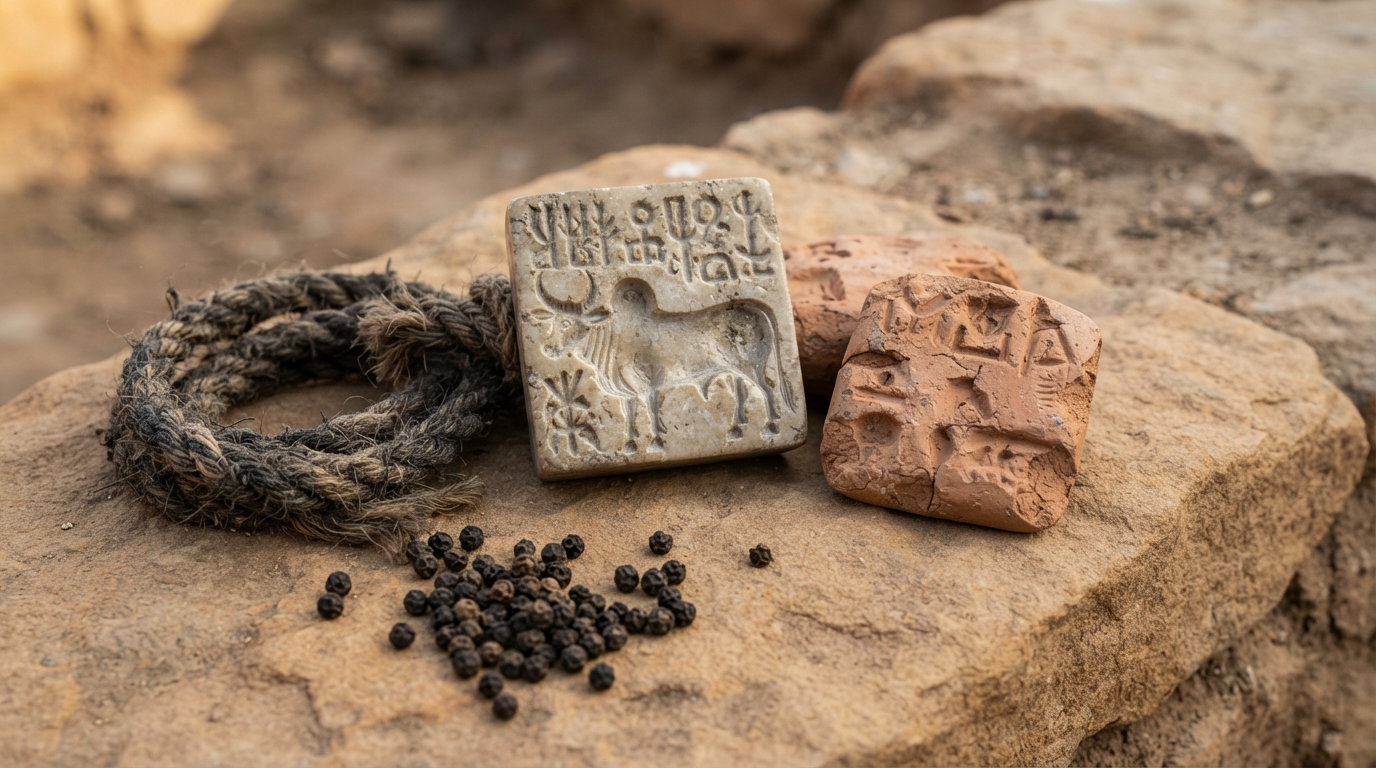
Magan is generally placed in Oman, and Dilmun in Bahrain. The physical finds match the texts. Etched carnelian beads in an Indus style turned up in the royal graves at Ur. The carnelian beads needed skilled drilling and heat treatment. Carnelian drilling and heat treatment was a Harappan speciality, so the beads at Ur are a strong trade marker. Reliable counts of Indus seals found in Mesopotamia are hard to pin down, so treat any exact number you see online with caution.
Oman and Bahrain as direct partners
Oman and Bahrain were direct trading partners of the Harappan civilisation, not just stops on a route to Mesopotamia. Harappan jar fragments found at Ra's al-Jinz in Oman point to direct Indus–Oman contact (harappa.com). Oman was also a likely copper source for Indus cities (Dayalan, 2018). Summaries that route all Harappan trade through Mesopotamia miss this evidence.
Bahrain tells a similar story. Indus-style cubical weights appear at Qal'at al-Bahrain, and Dilmun adopted a matching weight standard. Shared measures show deep, repeated trade, because merchants only standardise with partners they meet regularly. The Indus weights found in Bahrain belong alongside other early scientific milestones in Indian history.
Geography explains the split between Oman and Bahrain. Ra's al-Jinz sits on Oman's eastern tip, outside the Gulf. Bahrain and Ur lie inside the Gulf. Any ship heading for Dilmun or Mesopotamia had to pass the Strait of Hormuz.
How did ancient ships cross the Arabian Sea and the Strait of Hormuz?
Ancient ships used two main approaches. Harappan-era boats mostly hugged the coast, following the Makran shore west to Oman and then through the Strait of Hormuz into the Persian Gulf. By the 1st century CE, sailors also crossed the open Arabian Sea using seasonal monsoon winds, heading for Arabia and Red Sea ports.
The coastal route into the Persian Gulf
The coastal route was slower but safer. Boats could land each night, take on water and wait out bad weather. From Gujarat, ships followed the coast of what is now southern Pakistan and Iran. They reached the Strait of Hormuz, a narrow channel between Iran and Oman's Musandam peninsula. Past it lay Dilmun and the river mouths of Mesopotamia.
That chokepoint still shapes trade planning. An Atlantic Council report (2025) estimated that an expanded India–Middle East–Europe Economic Corridor could replace about 60% of container traffic through the Strait of Hormuz. The corridor is only planned for now. Still, the same stretch of water mattered 4,000 years ago, and it matters to shipping planners today.
Riding the monsoon winds
The monsoon changed the pace of trade. The southwest monsoon blows from roughly June to September, and the northeast monsoon returns in winter. A ship could sail out on one season's wind and come home on the next. The Periplus of the Erythraean Sea, a Greek merchant's guide from the mid-1st century CE, describes these crossings. It names Indian ports such as Barygaza (modern Bharuch) and Muziris.
The Periplus credits a Greek pilot named Hippalus with "discovering" the monsoon route. Treat that claim carefully. Indian and Arabian sailors almost certainly used these winds long before any Greek writer recorded them. Greek texts survived better, so Greek names got the credit.
Stitched-plank ships
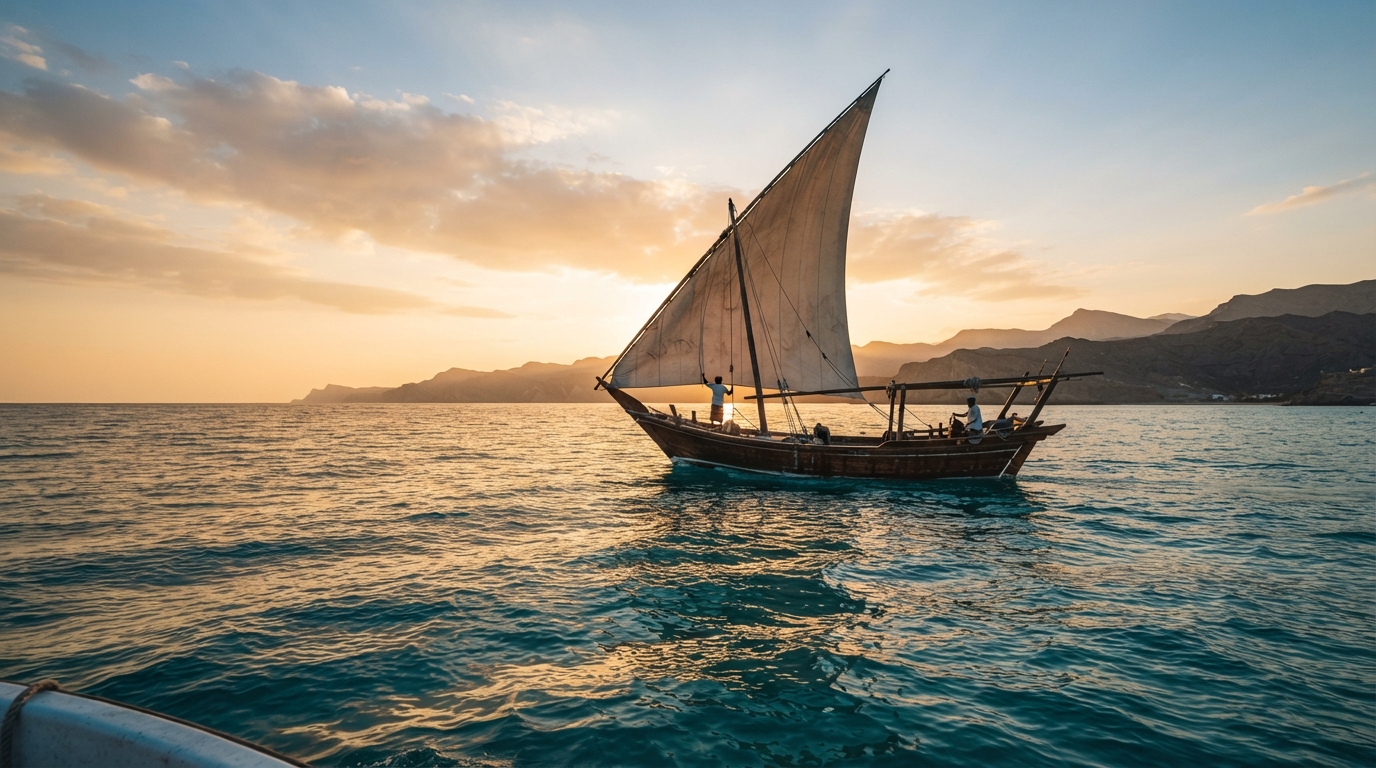
Many ships on these routes had no nails at all. Builders sewed hull planks together with coir rope made from coconut fibre. The stitched hull flexed in heavy seas instead of cracking. It also used local materials found on both Indian and Arabian coasts. The Indian Navy's 2025 reconstruction, INSV Kaundinya, uses this same stitched-plank method.
| Route | Main era | Typical stops | Key trade goods |
|---|---|---|---|
| Coastal Gulf route | c. 2500–1900 BCE | Lothal, Makran coast, Ra's al-Jinz, Dilmun, Ur | Carnelian beads, copper, timber |
| Monsoon Red Sea route | 1st–3rd century CE | Muziris, Socotra, Berenike | Pepper, ivory, nard |
| Southern Arabia route | 1st century BCE–6th century CE | Barygaza, Socotra, Arabian ports | Spices, textiles, incense |
What did India trade with Rome and the Middle East 2,000 years ago?
Pepper dominated India's westward sea trade around 2,000 years ago. Ships from Kerala's coast also carried ivory, nard, textiles and gemstones to Red Sea ports such as Berenike. From there, goods moved overland to the Nile and on to Rome. Roman coins, amphorae and wine travelled back to Indian ports like Muziris and Arikamedu.
The Muziris papyrus
This papyrus is the closest thing to an ancient cargo manifest. It values three-quarters of the Hermapollon's Indian cargo at 6,911,852 drachmas after a 25% tax (Oxford Research Encyclopedia). The best-preserved item, probably pepper, accounts for 67% of that value. Ivory makes up 7% and nard 4%.
One reconstruction puts the cargo at about 20,500 talents by weight, with roughly 87% of it black pepper. That's a single scholar's estimate, and others dispute it. The value figures are firmer than the weight figures. A useful rule: quote the 67% value share, and flag the 87% weight share as an estimate.
Berenike's pepper stores
Berenike was an Egyptian port on the Red Sea. Excavations there found about 60 cultivated plant species, according to a Springer study of trade at the site. Black pepper turned up "in considerable quantities," the first find of its kind. In 2022, digs at the town's Isis temple found more Indian produce. Pots held thousands of peppercorns, alongside Indian rice, coconut and tamarind.
These finds matter because written sources can exaggerate. Seeds and peppercorns don't. They show that Indian food reached the Red Sea in bulk, not as a rare luxury.
Pattanam, Arikamedu and the Muziris question
Muziris was the most famous Indian port in Roman sources. Its exact location is still debated. Excavations at Pattanam in Kerala found Roman amphorae and material from more than three dozen sites around the Indian Ocean, Red Sea and Mediterranean (NYRB, 2023; PMC, 2023). Many researchers link Pattanam to Muziris. Historian Pius Malekandathil (2015) is among those who question that identification.
Arikamedu, near Puducherry on the east coast, also yielded Roman amphorae. Both sites show India was part of a wide trade network. This period overlaps with the centuries after the Mauryas and before the height of the Guptas. For political context, our guide to the Maurya and Gupta empires is a good companion.
Did Indian sailors actually travel to the Middle East?
Yes, Indian sailors travelled west themselves and left written proof. A cave on Socotra holds 193 readable inscriptions, most in Indian languages, dated between the 1st century BCE and the 6th century CE. A 2nd-century CE Buddha statue in an Egyptian temple at Berenike and ancient DNA from Pattanam in Kerala add evidence of people moving in both directions.
The Hoq cave inscriptions on Socotra
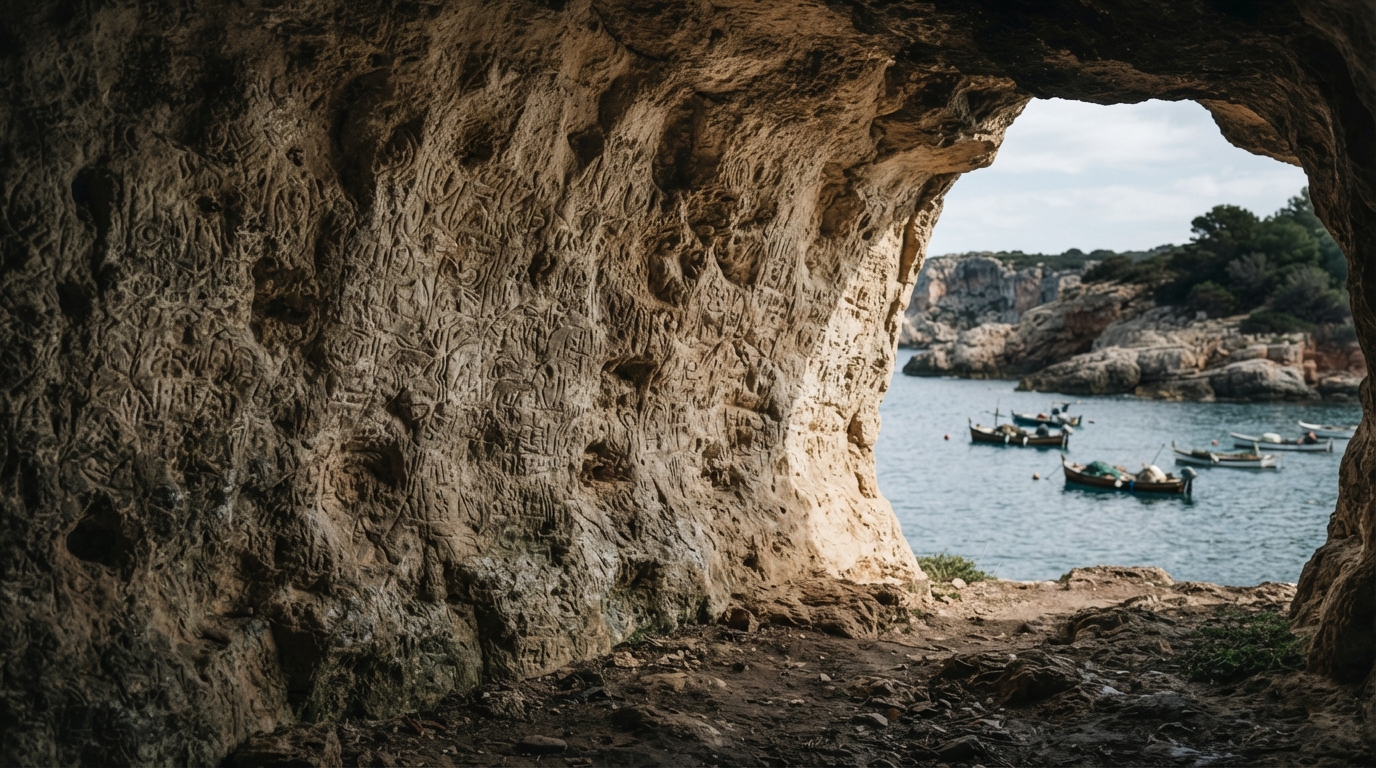
Socotra is an island off Yemen, near the mouth of the Gulf of Aden. Inside Socotra's Hoq cave, sailors scratched names, prayers and drawings onto the walls. Ingo Strauch of the University of Lausanne edited these texts in Foreign Sailors on Socotra. Of the 193 readable inscriptions, most are in Indian languages and scripts. The Hoq cave inscriptions span roughly seven centuries, from the 1st century BCE to the 6th century CE.
The Hoq cave evidence changes how the story should be told. Strauch's work shows Indian sailors were active participants in Indo-Roman trade. Indian sailors were not just suppliers waiting at home ports. Most popular accounts skip Socotra entirely, which leaves out the one place where Indian sailors wrote their own record.
A Buddha in an Egyptian temple
In 2022, a team led by Steven Sidebotham of the University of Delaware and Mariusz Gwiazda of the Polish Centre of Mediterranean Archaeology made an unusual find. At Berenike's Isis temple, the team uncovered a 71 cm marble Buddha dated to the 2nd century CE (The Past, 2023). The Berenike Buddha is evidence of Indian religious presence in Roman Egypt.
A temple statue like the Berenike Buddha implies a community, not a passing trader. Someone paid for the statue and placed it in a temple. The dedication suggests Indian merchants lived at Berenike long enough to practise their faith there.
DNA evidence from Pattanam
The Pattanam DNA evidence is a 2023 mitochondrial DNA study, published in the journal Genes, that found West Eurasian lineages among ancient remains at Pattanam on the Kerala coast. Genetics adds a newer line of evidence to the archaeological record. Mitochondrial DNA passes down the maternal line. The Pattanam result points to people from the west living, and probably settling, on the Kerala coast. Sample sizes in ancient DNA studies like the Pattanam analysis are small, so the Pattanam findings work best as support for other evidence.
Why does ancient Indian maritime history still matter today?
Ancient Indian maritime history matters because it explains why India's western coast faces outward. Modern projects draw on it directly. INSV Kaundinya, a stitched-plank ship modelled on a 5th-century Ajanta painting, sailed from Porbandar to Muscat in 2025–26. A large heritage complex is also being built at Lothal to present this past.
INSV Kaundinya's voyage to Muscat
The Indian Navy built INSV Kaundinya using stitched-plank methods. Its design comes from a 5th-century CE painting at Ajanta. The ship was launched in Goa in February 2025 and commissioned on 21 May 2025. It left Porbandar on 29 December 2025 and reached Muscat after 18 days (The Week, January 2026).
Sanjeev Sanyal of the Prime Minister's Economic Advisory Council sailed as part of the crew. He said the voyage aimed to revive cultural memory of India's ancient seafaring (Tribune/ANI, January 2026). The route itself, Gujarat to Oman, mirrors the Harappan link seen at Ra's al-Jinz. Dates like these make good entries for a "today in Indian history" card.
The National Maritime Heritage Complex at Lothal
The government is building a National Maritime Heritage Complex at Lothal. It covers about 400 acres and is estimated at around ₹4,500 crore (The Week, 2026; PIB). Phase 1A alone costs ₹774.23 crore. That phase was first due in 2025. The ports minister has since set a July 2026 deadline (The Week, May 2026).
Big projects often slip, so check official updates before planning a visit. The original site and the Archaeological Survey of India museum at Lothal are open now. For students, standing beside the brick basin explains the dockyard debate better than any diagram.
How to study these routes date by date
The easiest way to remember this history is to tie it to dates and places. Chronological cards help because each card holds one fact, one place and one source. Our guide on learning Indian history through timelines explains the method. A future guide to ancient ports of India will map each port in this article.
Many readers search for "ancient India achievements" and find lists with no sources. Maritime trade is a better topic than most for real learning. It has papyri, inscriptions, seeds and DNA. Each one can be checked.
Related Reading
- Milestones in Indian Women's History: A Chronological Guide
- 1,000 Years of Indian Medical History: A Chronological Guide
- Economic Milestones in Indian History: From 1947 to Present
- What Are the Major Events in Indian History? (FAQ Archive)
FAQ
Q: What was Meluhha? Meluhha is the name Mesopotamian texts used for a distant trading land, which most scholars identify with the Indus region. Around 2300 BCE, Sargon of Akkad recorded ships from Meluhha docking at his capital. Indus-style carnelian beads found at Ur support this link.
Q: Which ancient Indian ports traded with the Middle East? Lothal served the Harappan trade with Oman, Bahrain and Mesopotamia. Later, Barygaza (Bharuch), Muziris, Pattanam and Arikamedu handled trade with Arabia, the Red Sea and Rome. The Periplus of the Erythraean Sea names several of these ports.
Q: Was Lothal really a dockyard? Most evidence points that way, but it isn't settled. A 2024 IIT Gandhinagar study found inlet and outlet channels and a 240-metre cargo platform. Some scholars still argue the basin worked as a reservoir.
Q: What was the INSV Kaundinya voyage? INSV Kaundinya is an Indian Navy stitched-plank ship based on a 5th-century CE Ajanta painting. It left Porbandar on 29 December 2025 and reached Muscat, Oman, after 18 days. The voyage retraced an ancient India–Oman sea route.
Further reading
Pick one site from the timeline above, such as Socotra or Berenike, and read one primary source on it this week. Then add its key date to your own study cards. These five sources are a strong place to start:
- Lionel Casson, The Periplus Maris Erythraei (Princeton University Press, 1989): The standard English translation of the 1st-century trade guide, with notes on every port.
- Ingo Strauch (ed.), Foreign Sailors on Socotra (2012): The full edition of the Hoq cave inscriptions left by Indian sailors.
- Steven E. Sidebotham, Berenike and the Ancient Maritime Spice Route (University of California Press, 2011): A readable account of the Red Sea port where Indian pepper landed.
- Federico De Romanis, The Indo-Roman Pepper Trade and the Muziris Papyrus (Oxford University Press, 2020): A detailed study of the Hermapollon cargo and its numbers.
- harappa.com: A free, image-rich site covering Indus sites, including the Ra's al-Jinz finds in Oman.
Sources
- Muziris papyrus — Oxford Research Encyclopedia of Classics, n.d. Supports: After the levy, three-quarters of the Hermapollon's Indian cargo was valued at 6,911,852 drachmas, and the possible pepper made up 67% of that value.
- Foreign Sailors on Socotra: The inscriptions and drawings from the cave Hoq — Heidelberg University Library repository (Ingo Strauch, ed.), 2012. Supports: The Hoq cave on Socotra holds inscriptions left by foreign sailors, most of them in Indian languages.
- Trade and Subsistence at the Roman Port of Berenike, Red Sea Coast, Egypt — Springer, n.d. Supports: Black pepper was found at Berenike "in considerable quantities," the first find of its kind.
- IIT Gandhinagar's Breakthrough in Reevaluating the Lothal Dockyard Theory — Press Information Bureau, Government of India, 2024. Supports: A 2024 IIT Gandhinagar study backs the theory that Lothal had a dockyard.
- A network of corridors is the only reliable hedge against Middle East chokepoint disruptions — Atlantic Council, 2025. Supports: An expanded IMEC corridor could replace roughly 60% of the container traffic that passes through the Strait of Hormuz.
- INSV Kaundinya's maiden voyage to Muscat "has been a dream": Sanjeev Sanyal on 18-day expedition — The Tribune / ANI, 2026. Supports: INSV Kaundinya sailed from Porbandar to Muscat in 18 days with Sanjeev Sanyal in the crew.
- India to get world's biggest maritime museum in 2026? Here is what we know — The Week, 2026. Supports: Phase 1A of the National Maritime Heritage Complex at Lothal now has a July 2026 target.
- Berenike's Buddha — The Past, 2023. Supports: A Buddha statue was found at Berenike's Isis temple during 2022 excavations led by Steven Sidebotham.