The Quick Read
The history of education in India runs for more than 2,500 years. It began with Vedic gurukuls and centres like Takshashila and Nalanda. British policy from 1835 brought English-medium schooling, and the first universities opened in 1857. After 1947, India widened access, made schooling a legal right in 2010, and adopted NEP 2020, which now allows foreign campuses.
Key Takeaways
- Nearly every child is now enrolled, but reading and maths skills lag behind.
- Nalanda and Takshashila were real centres of learning that mostly served elite students.
- Macaulay's 1835 Minute made English the core of colonial education policy.
- The RTE Act made schooling a fundamental right for ages 6–14 from 2010.
- Government schools' share of enrolment fell from 71% in 2005 to about 49%.
India had no organised schooling until the British arrived. That belief is common, and it is wrong. In 1822, Thomas Munro, the Governor of Madras, ordered a district-by-district survey of village schools. His collectors reported thousands of local schools teaching reading, writing and arithmetic. Earlier still, Buddhist monasteries such as Nalanda drew scholars from China and Korea. The real story is not "nothing, then British schools." It is a long chain of systems. Each one reached some people and left others out. The cards below follow that chain in date order, the way we organise every page on IndiaOnThisDay.
How did education work in ancient India?
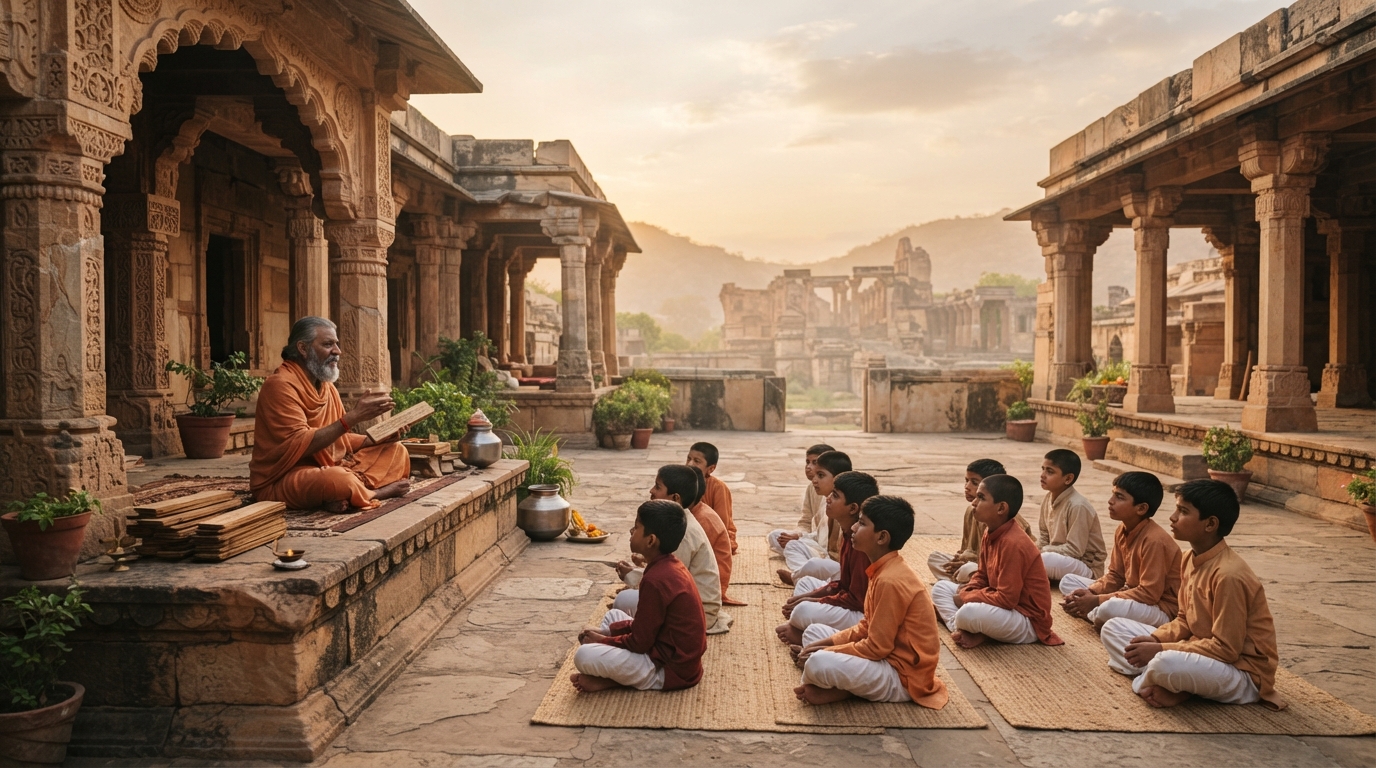
Education in ancient India was a two-track system. Vedic gurukuls taught small groups of students at a teacher's home through memory and recitation. Large Buddhist monasteries such as Nalanda and Vikramashila taught hundreds of residents at once. Both were serious centres of learning, but both served a narrow slice of society, mostly upper-caste or monastic males.
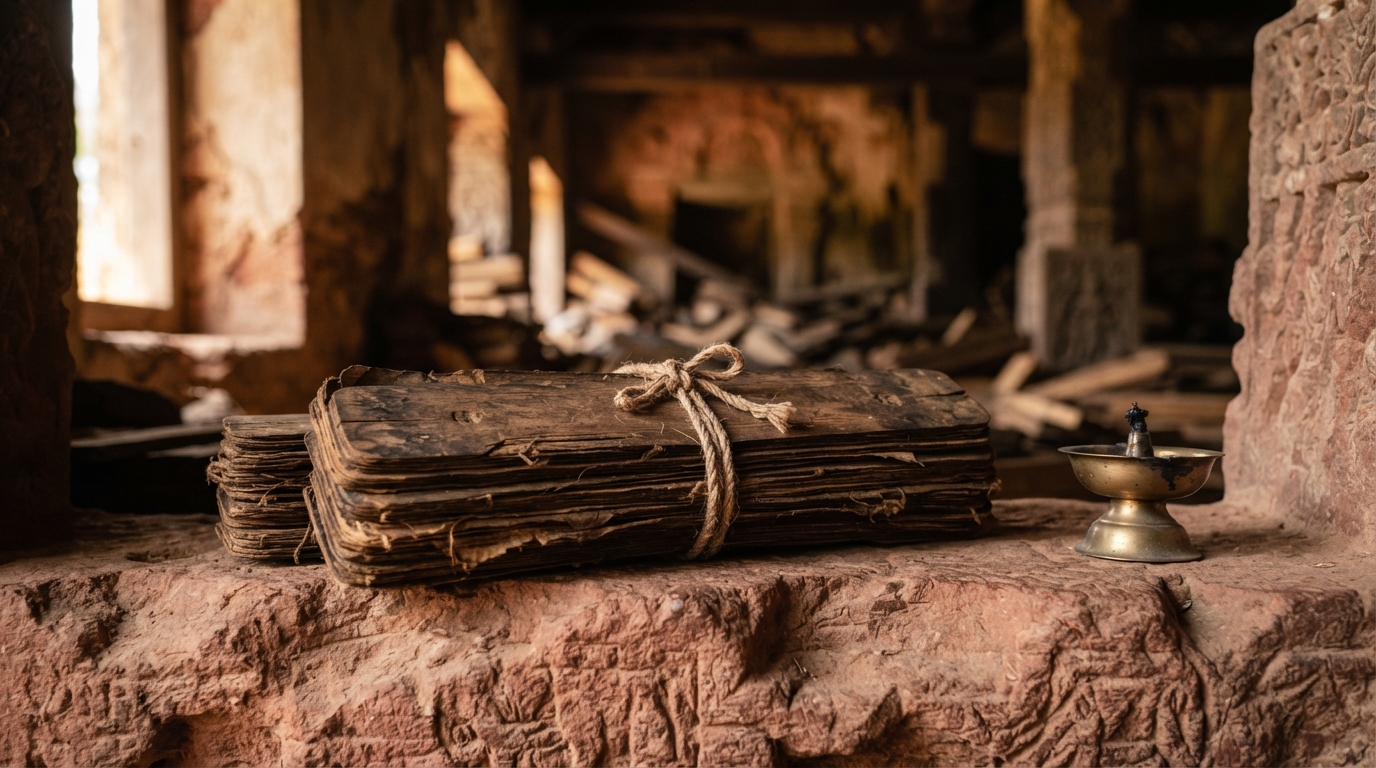
The gurukul track relied on oral teaching, because the Vedas were passed on by recitation rather than writing, and students learned grammar, phonetics, ritual, astronomy and logic through repetition and debate. The monastic track operated at a much larger scale. Nalanda, often credited to the Gupta ruler Kumaragupta I around 427 CE, is called one of the world's first residential universities and hosted the Chinese monk Xuanzang in the 7th century. Access to both tracks was limited. Vedic study began with the upanayana ceremony, which texts reserved for the upper three varnas, and Buddhist monasteries mainly trained monks. Ancient Indian education produced excellent scholarship, but it was not mass education.
Gurukuls and the guru-shishya method
The gurukul was a home, not a building with classrooms. A student lived with the teacher's family for years and did household work in return for teaching. Lessons were oral because the Vedas were passed on by recitation, not writing. Students learned grammar, phonetics, ritual, astronomy and logic through repetition and debate. The model has never fully disappeared. The Arya Kanya Gurukul in Porbandar, founded in 1936, still runs as a girls' boarding school from kindergarten to Class 12 with Vedic values at its core.
Takshashila and Nalanda
Takshashila, in present-day Pakistan, was a major learning centre by around the 5th century BCE. Tradition links it with the grammarian Panini and the political thinker Chanakya. It was a cluster of teachers rather than a formal campus. Nalanda was different. It is often credited to the Gupta ruler Kumaragupta I around 427 CE and is called one of the world's first residential universities. The Chinese monk Xuanzang studied there in the 7th century. Nalanda lasted about 800 years until it was destroyed in the late 12th century. A new Nalanda University campus opened at Rajgir, Bihar, on 19 June 2024, near the old ruins (PIB, 2024). For the political setting that supported these centres, see our guide to the Maurya and Gupta empires.
Who was left out
Most popular accounts describe gurukuls as "holistic" and stop there. That framing skips a hard fact. Vedic study began with the upanayana ceremony, which texts reserved for the upper three varnas. Shudras and most women were shut out of formal Vedic learning. The Upanishads name women scholars such as Gargi and Maitreyi, but they were exceptions. Buddhist monasteries were more open across caste lines, yet they still mainly trained monks. Ancient India had excellent scholarship. It did not have mass education.
What did schooling look like in India before British rule?
Before British policy took hold in the 1830s, India had a wide network of local schools. Hindu pathshalas, Sanskrit tols and Muslim maktabs and madrasas taught in local languages and were paid for by villages, temples, mosques or patrons. Colonial surveys from the 1820s and 1830s recorded these schools in large numbers.
The Munro survey of 1822
Thomas Munro's survey is the best-known piece of evidence. Collectors in each Madras district counted schools, students and their castes. The returns showed that village schools were common and that many students came from outside the Brahmin community. William Adam produced similar reports on Bengal between 1835 and 1838. Historian Dharampal gathered these records in The Beautiful Tree (1983). The title comes from Gandhi's 1931 remark in London that the British had uprooted a "beautiful tree" of Indian learning.
Pathshalas, madrasas and tols
Pathshalas, tols, maktabs and madrasas were the main types of local school in pre-colonial India, the kinds of institution that Thomas Munro's 1822 Madras survey and William Adam's 1835–1838 Bengal reports recorded. Each type of school had its own focus and its own students. Pathshalas taught reading, writing and arithmetic for trade and village accounts. Tols taught Sanskrit grammar, logic and law to older students. Maktabs taught basic literacy and the Quran, while madrasas offered higher study in Persian and Arabic. Persian was the language of Mughal courts, so madrasa graduates often found work in administration. The mix of pathshalas, tols, maktabs and madrasas gave India several learning traditions running side by side.
The limits of this evidence
The limits of the pre-colonial school evidence are real, and anyone using the Munro survey of 1822 or William Adam's Bengal reports of 1835–1838 should know them. Girls barely appear in the school counts. Most girls who learned to read did so at home. Some district collectors counted carefully while others estimated. The survey numbers also capture only a few years in a few regions, mainly Madras and Bengal. Dharampal's The Beautiful Tree (1983) shows that local schooling was widespread. The Beautiful Tree cannot tell us what national literacy looked like in 1800.
How did British rule change the history of education in India?
British rule shifted the history of education in India toward English, Western subjects and a small, exam-focused elite. The key steps were the Charter Act of 1813, Macaulay's Minute in 1835, Wood's Despatch in 1854 and the founding of three universities in 1857. Indian reformers then built their own schools to fill the gaps.
Macaulay's Minute and the 1835 turn
Macaulay's Minute is the memo by Thomas Babington Macaulay, dated 2 February 1835, that settled a two-decade debate over colonial education funding in favour of English. Governor-General William Bentinck approved Macaulay's Minute on 7 March 1835. The debate began with the Charter Act of 1813, which set aside one lakh rupees a year for education in British India. Officials then argued for two decades over how to spend the money. One camp backed Sanskrit and Persian learning. The other backed English. Macaulay's Minute became the basis of British education policy in India. The goal of the policy was a class of English-educated Indians to serve the colonial state.
Wood's Despatch and the 1857 universities
Wood's Despatch is the 1854 policy document by Charles Wood that built the frame of the colonial education system in India. Wood's Despatch set up education departments in each province and backed grants-in-aid for private schools. The Despatch also called for universities modelled on the University of London. Three opened in 1857:
- University of Calcutta, 24 January 1857
- University of Bombay, 18 July 1857
- University of Madras, 5 September 1857
The universities of Calcutta, Bombay and Madras mainly set exams and granted degrees. Teaching happened in affiliated colleges. The exam-first design of these three 1857 universities still shapes Indian higher education today.
Indian reformers who built their own schools
Indians did not wait for the colonial state to educate everyone. Savitribai and Jyotirao Phule opened a girls' school in Pune on 1 January 1848. Syed Ahmad Khan founded the Muhammadan Anglo-Oriental College at Aligarh in 1875, which became Aligarh Muslim University in 1920. Madan Mohan Malaviya founded Banaras Hindu University in 1916. Rabindranath Tagore started a school at Santiniketan in 1901 that grew into Visva-Bharati in 1921. Our chronology of Indian women's history milestones covers the Phules' work in more detail.
What changed in Indian education after independence?
After 1947, India set out to turn a small, elite system into a mass one. Literacy was just 18.33% in the 1951 Census (PIB data via India TV, 2025). National policies in 1968 and 1986, the Right to Education Act in 2009 and the National Education Policy in 2020 marked the main stages of that shift.
From the 1950s to the 1986 policy
Maulana Abul Kalam Azad served as India's first education minister. His birthday, 11 November, has been marked as National Education Day since 2008. The 1950s brought the first IIT at Kharagpur in 1951 and the University Grants Commission in 1953. The Kothari Commission (1964–66) shaped the first National Policy on Education in 1968. It pushed for a common school structure and wider use of Indian languages. The 1986 policy followed with a focus on access, including Operation Blackboard in 1987, which aimed to give every primary school basic facilities.
The Right to Education Act
The 86th Constitutional Amendment of 2002 added Article 21A, which makes education a right for children aged 6 to 14. The Right of Children to Free and Compulsory Education Act, 2009 put that right into practice. It took effect on 1 April 2010. One clause had a large impact on private schooling. Private unaided schools must keep 25% of entry-level seats for children from economically weaker groups (CARE India). By 2024, only 1.6% of rural children aged 6–14 were out of school, the lowest since the RTE Act (ASER 2024, Pratham, 2025).
NEP 2020 and the new school structure
The Union Cabinet approved the National Education Policy on 29 July 2020. It replaced the old 10+2 model with a 5+3+3+4 structure that starts at age 3. It also stresses early reading and maths, mother-tongue teaching in early grades and flexible degrees. States are adopting it at different speeds. Maharashtra began bringing it in at school level in stages from 2025–26 (Shiksha, 2025). In October 2025, NITI Aayog published its first national review of how far states had gone in putting NEP 2020 into practice.
Where does Indian schooling stand today?
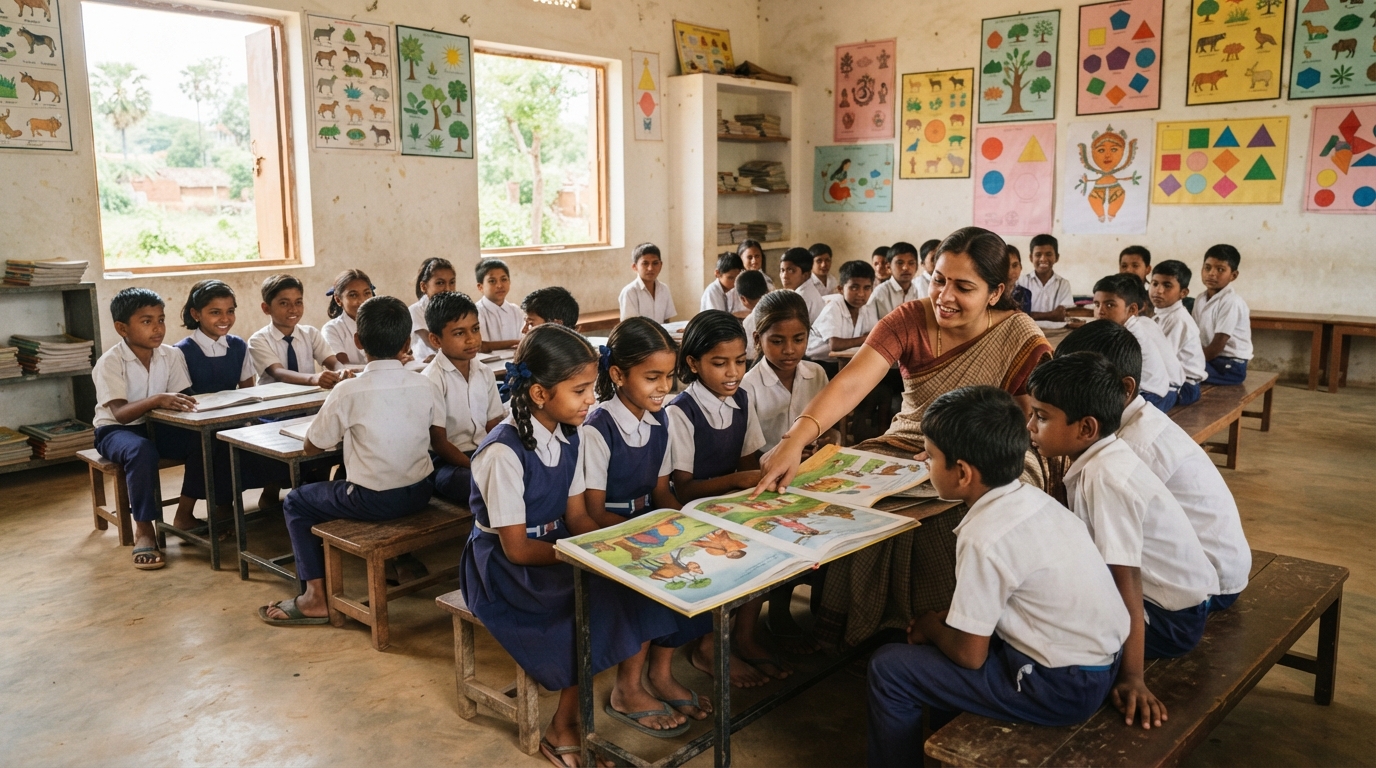
Indian schooling today is vast, mostly enrolled and increasingly private. India has 1.47 million schools holding 24.69 crore students from pre-primary to higher secondary (UDISE+ 2024–25). The main challenge has moved from getting children into school to making sure they learn once there.
Enrolment is high, learning is catching up
Access is no longer the main gap. Learning is. Fewer than 30% of Grade 6 students are competent with fractions (NITI Aayog, 2025). Early reading is improving. In government schools, 23.4% of Class 3 children could read a Class 2 text in 2024, up from 16.3% in 2022 (ASER 2024). The ASER Centre notes that early-grade reading has recovered past pre-COVID levels, with government schools leading those gains. Literacy tells a similar story of steady progress. It rose to 74% in the 2011 Census and to 80.9% for people aged 7 and over in PLFS 2023–24.
The shift to private schools
Government schools still make up about 1.01 million of India's 1.47 million schools (UDISE+ 2024–25). Their share of students has dropped sharply, though. It fell from 71% in 2005 to 49.24% in 2024–25 (NITI Aayog, via Drishti IAS, 2025). Much of that shift went to low-fee private schools. Total enrolment is also changing. Classes 1–12 enrolment fell to 23.29 crore in 2024–25, the lowest since 2017–18. Education statistician Prof. Arun C. Mehta links this to fewer births, students moving back to private schools after COVID and the removal of duplicate records (2026). He warns the decline still puts NEP's goal of universal schooling at risk.
International curricula and foreign campuses
India's school boards now sit side by side with global ones. CBSE, reconstituted in 1962, and CISCE, set up in 1958, run national exams. Many urban private schools also offer International Baccalaureate and Cambridge programmes. Higher education is opening up too. The University of Southampton opened its Gurugram campus in 2025, the first full foreign-university campus under NEP (Outlook; ScooNews, 2025). Higher education overall now has 4.5 crore students, up from 3.42 crore in 2014–15 (AISHE 2023–24). The gross enrolment ratio stands at 30%. For women, it is higher at 31.2%. That reverses centuries in which formal higher learning was almost entirely male.
Which dates in the history of education in India should students remember?
A short list of dated milestones makes the history of education in India much easier to recall. The table below covers the turning points most exams and classrooms return to. Some ancient dates are approximate. Every colonial and modern date has a firm record.
A date card for each milestone
| Date | Milestone | Why it matters |
|---|---|---|
| c. 427 CE | Nalanda founded (attributed to Kumaragupta I) | Early residential university |
| 1822 | Munro survey of Madras schools | Evidence of pre-colonial village schooling |
| 1 Jan 1848 | Phules open girls' school in Pune | Early push for girls' education |
| 2 Feb 1835 | Macaulay's Minute | English becomes the policy medium |
| 1854 | Wood's Despatch | Provincial education departments created |
| 24 Jan 1857 | University of Calcutta founded | First of three colonial universities |
| 1 Apr 2010 | RTE Act takes effect | Schooling becomes a legal right |
| 29 Jul 2020 | NEP 2020 approved | New 5+3+3+4 structure |
| 19 Jun 2024 | New Nalanda campus opens | Revival near the ancient site |
How to use these dates when you study
Dates work best when you tie each one to a cause and a result. For Macaulay's Minute, the cause was the 1813 funding debate. The result was English-medium colleges. Try linking each card to the one before it. You can also check each date on our daily pages. National Education Day falls on 11 November, and Children's Day falls on 14 November, so mid-November pages on India's special days carry several education milestones. For a broader method, read our guide to learning Indian history through chronological timelines. We've also planned a deeper card on Maulana Azad and National Education Day.
Related Reading
- India at the Olympics: A Timeline of Historic Sporting Milestones
- Milestones in Indian Women's History: A Chronological Guide
- 1,000 Years of Indian Medical History: A Chronological Guide
- Economic Milestones in Indian History: From 1947 to Present
FAQ
Q: When did the history of education in India begin? Organised learning in India goes back to the Vedic period, when knowledge passed orally from teacher to student in gurukuls. Takshashila was a known centre of learning by around the 5th century BCE. Exact start dates are uncertain because early teaching was oral and left few written records.
Q: Who founded Nalanda University, and is it still open? The ancient Nalanda Mahavihara is often credited to the Gupta ruler Kumaragupta I around 427 CE. It was destroyed in the late 12th century. A new Nalanda University campus opened at Rajgir, Bihar, on 19 June 2024, near the original ruins.
Q: What was Macaulay's Minute on Education? It was a policy note by Thomas Babington Macaulay, dated 2 February 1835. It argued that British funds should support English-language education rather than Sanskrit or Persian learning. Governor-General Bentinck approved it on 7 March 1835.
Q: What does the RTE Act guarantee? The Right to Education Act, which took effect on 1 April 2010, makes free and compulsory education a fundamental right for children aged 6 to 14. It also requires private unaided schools to reserve 25% of entry-level seats for children from economically weaker groups.
Q: How many students are in Indian schools today? UDISE+ 2024–25 reports 24.69 crore students from pre-primary to higher secondary across 1.47 million schools. Enrolment in Classes 1–12 alone was 23.29 crore, the lowest since 2017–18.
Further Reading
Pick one milestone from the date table today. Find the cause that led to it and the change it produced, then write both on a single card. Do this for a week and you'll have the full arc of Indian education in your own words. These sources will take you deeper:
- Dharampal, The Beautiful Tree (1983): Reprints the Munro and Adam survey records, the best primary evidence on pre-colonial village schools.
- Syed Nurullah and J.P. Naik, A History of Education in India: A classic, detailed account of education policy across the British period.
- ASER 2024 report (Pratham): The clearest annual data on what rural children can actually read and calculate.
- National Education Policy 2020 (Ministry of Education): The full policy text, useful for checking claims made about NEP.
- Historic Dates in Modern India: Places post-1947 education reforms alongside other national milestones.
Sources
- PM inaugurates Nalanda University Campus in Rajgir, Bihar — Press Information Bureau, 2024. Supports: The new Nalanda University campus at Rajgir, Bihar, opened on 19 June 2024.
- Minute by Mr. Macaulay (2 February, 1835) — Wikisource (primary text), 1835. Supports: Macaulay's Minute was dated 2 February 1835 and argued that the education grant should go to English rather than Sanskrit or Persian learning.
- Lord Macaulay: The Man Who Started It All, And His Minute — M.S. Thirumalai, George Mason University archive. Supports: Bentinck approved the Minute on 7 March 1835, and it became the basis of British education policy in India.
- UDISE+ 2024–25 Report (Booklet) — Ministry of Education, Government of India, 2025. Supports: 24.69 crore students are enrolled from pre-primary to higher secondary across India's schools.
- Status of School Education in India: An Analysis Based on UDISE+ 2021-22 to 2024-25 — Prof. Arun C. Mehta, Education for All in India, 2026. Supports: Enrolment in Classes 1–12 fell to 23.29 crore in 2024–25, the lowest since 2017–18.
- School Education System in India — NITI Aayog, 2025. Supports: Enrolment has shifted from government schools to private schools, and government schools' share fell from 71% in 2005 to 49.24% in 2024–25.
- India's Higher Education Enrolment Reaches 4.5 Crore; AISHE 2023-24 Report Shows Record Growth In GER & Female Participation — Free Press Journal, 2025. Supports: Higher education enrolment has reached 4.5 crore and the gross enrolment ratio is 30 (AISHE 2023–24).
- University of Southampton opens India's first foreign varsity campus — Business Standard, 2025. Supports: The University of Southampton's Gurugram campus opened in 2025 as the first foreign university campus to begin operating under the new rules.