The Withdrawal of the Raj: A Timeline of British Decolonization
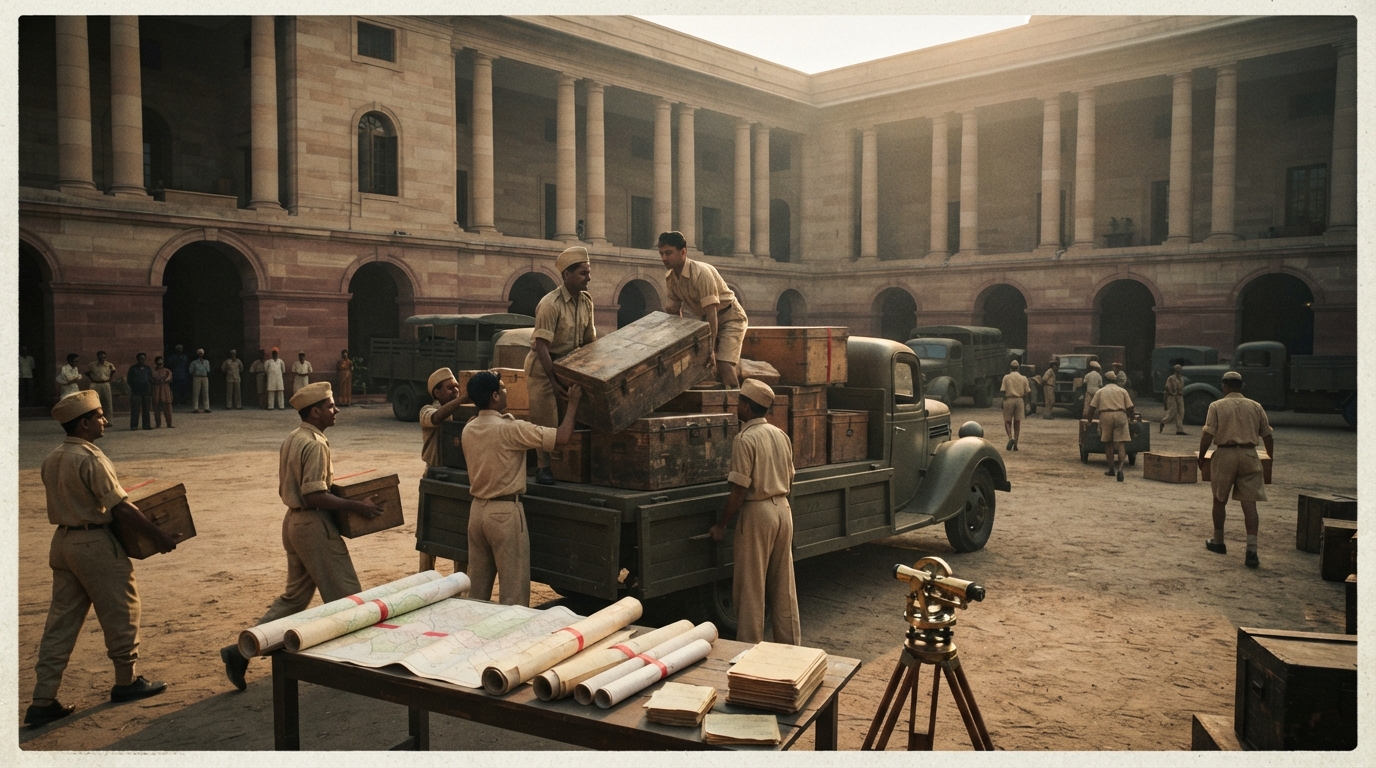
What Is the Bottom Line of the British Decolonization of India Timeline?
The British decolonization of India timeline is the sequence of diplomatic, military, and administrative events between 1945 and 1948 that dismantled the British Raj. Facing severe post-war debt and civil unrest, the British government advanced its departure deadline by ten months, leading Viceroy Louis Mountbatten to partition British India into independent dominions on August 15, 1947 [History Guild, 2025].
Key Takeaways
- Britain advanced the independence deadline by ten months, causing deep administrative disruption.
- Sir Cyril Radcliffe had only 36 days to draw over 4,000 miles of borders.
- The 1946 Royal Indian Navy revolt convinced London that colonial forces were no longer dependable.
- British troops completed their final physical withdrawal from India on February 28, 1948.
- Rulers of 565 Princely States had to choose accession before imperial paramountcy lapsed.
On the afternoon of June 3, 1947, Lord Louis Mountbatten sat inside the Viceroy's Executive Council room in New Delhi. He handed a single mimeographed document to seven Indian political leaders, giving them less than twenty-four hours to accept the partition plan. That tense meeting ended two centuries of imperial governance and locked the British decolonization of India timeline into an accelerated deadline.

The end of the British Empire in South Asia was not a slow, orderly handover. It was a rushed liquidation driven by post-war exhaustion, domestic political pressure in London, and escalating communal friction on the subcontinent. The decisions made during those final twenty-four months reshaped the global map, displaced millions of people, and left behind contested borders that influence international diplomacy today. A close examination of this period reveals the structural crises that forced Britain's exit and the political milestones that established the modern nations of India and Pakistan. You can explore earlier milestones in our visual timeline of the independence movement.
Why Did British Imperial Authority Collapse After 1945?
The collapse of British imperial authority after 1945 is the rapid breakdown of colonial governance across South Asia caused by economic exhaustion, military mutinies, and administrative shortages. As documented by researchers at the Geneva Graduate Institute (2024), Great Britain shifted from an imperial creditor to a massive debtor within six years, making the financial maintenance of an overseas colonial army unsustainable. Concurrently, the February 1946 Royal Indian Navy revolt—involving 20,000 ratings across 78 naval vessels—demonstrated to Whitehall that colonial armed services would no longer enforce imperial directives against civilian populations [History Guild, 2025]. Furthermore, the Indian Civil Service experienced severe operational strain, with fewer than 1,000 active officers left governing nearly 400 million citizens amidst rising communal riots. These converging structural crises eliminated Britain's capacity to maintain direct administrative control over the subcontinent, compelling London to negotiate an immediate transfer of power.
The Economic Toll of World War II
World War II bankrupted Great Britain. By mid-1945, the British Treasury owed billions of pounds to international creditors, including significant sterling debts to India for wartime goods, food supplies, and military services. The British public voted Winston Churchill out of office in July 1945, electing Clement Attlee's Labour government with a clear mandate to build a domestic welfare state.
Funding an overseas colonial army was no longer economically viable. London could not spare British troops for policing duties across the subcontinent when domestic reconstruction required every available worker. Research by the Geneva Graduate Institute (2024) shows that Britain shifted from an imperial creditor to a massive debtor in under six years. This financial reversal removed the economic logic of retaining direct administrative control over South Asia.
The 1946 Royal Indian Navy Revolt
On February 18, 1946, Indian naval ratings on the training ship HMIS Talwar in Bombay went on strike over substandard food and racial discrimination. Within forty-eight hours, the protest spread to 78 ships, 20 shore establishments, and over 20,000 sailors across Karachi, Bombay, Calcutta, and Madras [History Guild, 2025].
The naval strike exposed the vulnerability of British rule. For decades, imperial authority rested on the loyalty of the Royal Indian Navy, the Indian Army, and the local police. When civilian workers and Royal Indian Air Force units joined the naval ratings in sympathy strikes, British commanders realized their enforcement tools were broken. The mutiny showed Whitehall that colonial troops would not follow orders to suppress an organized national uprising.
Royal Indian Navy Revolt (Feb 1946)
       │
       ▼
20,000 Ratings Strike across 78 Ships
       │
       ▼
Whitehall Dispatch: Cabinet Mission Sent (March 1946)
The Breakdown of the Indian Civil Service
The Indian Civil Service (ICS) formed the administrative backbone of British governance. During the war, recruitment from Britain stopped completely, leaving district officers overworked and isolated. By early 1946, the ICS suffered from critical staffing deficits, with fewer than 1,000 active officers governing a population of nearly 400 million people.
Dr. Sandip Hazareesingh of the Open University notes that colonial administrative structures, such as separate electorates created decades earlier, had already deepened institutional divisions [History Guild, 2025]. Local administrative staff began aligning along communal lines as political uncertainty grew. British district magistrates could no longer manage routine municipal governance, collect taxes reliably, or stop communal riots in major cities. Direct imperial authority had reached its functional limit.
What Was the British Decolonization of India Timeline from 1945 to 1947?
The British decolonization of India timeline from 1945 to 1947 is the diplomatic progression from failed constitutional power-sharing negotiations to the rapid partition of the subcontinent. As recorded in official British parliamentary records, discussions moved from the 1945 Simla Conference through the 1946 Cabinet Mission Plan before culminating in the 3rd June Plan that created India and Pakistan.
Tracing the British decolonization of India timeline reveals how rapidly British strategy shifted from preserving a unified federal state to executing an immediate partition. Each diplomatic round eroded trust among the Indian National Congress, the All-India Muslim League, and the British administration.
1945: The Simla Conference and Post-War Realities
In June 1945, Viceroy Lord Wavell convened the Simla Conference to reconstruct the Viceroy’s Executive Council with Indian political leaders. The goal was to establish an interim government while maintaining imperial defence and foreign policy control.
The conference collapsed over representation. The Muslim League, led by Muhammad Ali Jinnah, demanded the exclusive right to nominate all Muslim members to the council. The Indian National Congress, led by Maulana Abul Kalam Azad and Jawaharlal Nehru, rejected this demand because it denied Congress's status as a secular, representative body. Wavell adjourned the conference on July 14 without an agreement, signaling that British mediation was failing.
1946: The Cabinet Mission and Direct Action Day
In March 1946, the British government dispatched three cabinet ministers—Lord Pethick-Lawrence, Sir Stafford Cripps, and A.V. Alexander—to negotiate a constitutional framework. The Cabinet Mission proposed a three-tiered federal system:
- A weak central union managing foreign affairs, defence, and communications.
- Grouped autonomous provinces based on regional religious majorities.
- Individual provincial governments managing local legislation.
You can read more about these constitutional proposals in our guide to the Cabinet Mission Plan of 1946. While both parties initially showed interest, divergent interpretations of the grouping clauses destroyed the consensus.
On August 16, 1946, the Muslim League launched Direct Action Day to demand a separate sovereign Pakistan. Severe communal violence erupted in Calcutta, leaving an estimated 4,000 people dead in seventy-two hours. The unrest spread across Noakhali, Bihar, and the Punjab, proving that an unpartitioned federal compromise was no longer workable.
What Was the 1947 Mountbatten Plan and Partition?
The 3rd June Plan of 1947 is the partition framework formulated by Viceroy Lord Louis Mountbatten that divided British India into the independent dominions of India and Pakistan. According to British parliamentary records, Mountbatten advanced the independence deadline by ten months, leading to the passage of the Indian Independence Act on July 18, 1947 [History Guild, 2025].
On February 20, 1947, Prime Minister Clement Attlee announced that Britain would transfer power to responsible Indian hands no later than June 1948. Prime Minister Attlee appointed Rear Admiral Lord Louis Mountbatten as the final Viceroy to oversee the transition. Upon arriving in March 1947, Mountbatten decided that a unified transfer was impossible. Mountbatten drafted the 3rd June Plan (also known as the Mountbatten Plan), which formally accepted the partition of British India. Crucially, Mountbatten advanced the departure deadline by roughly ten months, setting the transfer for August 15, 1947 [History Guild, 2025]. The British Parliament passed the Indian Independence Act on July 18, 1947, creating the dominions of India and Pakistan and ending British paramountcy over the subcontinent.
| Date | Major Event | Key Participants | Strategic Outcome |
|---|---|---|---|
| June 25 – July 14, 1945 | Simla Conference | Lord Wavell, Jawaharlal Nehru, Muhammad Ali Jinnah | Ended in deadlock over communal representation in the Executive Council. |
| Feb 18 – 23, 1946 | Royal Indian Navy Revolt | RIN ratings, British naval command | Shattered British confidence in the loyalty of colonial armed forces. |
| March 24 – June 29, 1946 | Cabinet Mission Plan | Cripps, Pethick-Lawrence, Alexander, Congress, League | Failed three-tier federation plan; led to breakdown in constitutional talks. |
| August 16, 1946 | Direct Action Day | All-India Muslim League, local populations | Triggered the "Great Calcutta Killings" and widespread communal rioting. |
| February 20, 1947 | Attlee's Declaration | Clement Attlee (House of Commons) | Set an original exit deadline of June 1948; appointed Mountbatten as Viceroy. |
| June 3, 1947 | The 3rd June Plan | Lord Mountbatten, Indian political leadership | Partition accepted; exit date advanced ten months to August 15, 1947. |
| July 18, 1947 | Indian Independence Act | British Parliament, King George VI | Formally created the independent Dominions of India and Pakistan. |
| August 15, 1947 | Independence Day | Jawaharlal Nehru, Liaquat Ali Khan, Lord Mountbatten | Political transfer of power executed across the subcontinent. |
How Was the Radcliffe Line Drawn in Five Weeks?
The Radcliffe Line was demarcated in five weeks by two boundary commissions led by Sir Cyril Radcliffe, a British lawyer with no prior background in Indian affairs. Working with obsolete maps and conflicting census data, Radcliffe split the provinces of Punjab and Bengal, creating boundaries that triggered massive cross-border migrations and border disputes.
A central flashpoint in the British decolonization of India timeline was the demarcation of borders separating communities that had lived together for centuries. The speed of the process created deep operational failure.
Five Weeks to Split Punjab and Bengal
Sir Cyril Radcliffe arrived in India on July 8, 1947. He received 36 days to draw over 4,000 miles of international borders across the provinces of Punjab and Bengal [The National Archives UK, 2024]. Radcliffe chaired two separate commissions, each containing four local high court judges—two nominated by the Congress and two by the Muslim League.
The judges deadlocked on nearly every district boundary. Radcliffe had to make unilateral decisions using outdated 1941 census maps, irregular canal-water grids, and contested railway networks. He worked through the peak of the summer heat in New Delhi, cutting through villages, private farms, and irrigation systems. The resulting boundary displaced an estimated 15 million people and caused between 500,000 and 2 million deaths during the subsequent migration [Britannica, 2026].
Boundary Commissions Established (July 8, 1947)
       │
       ▼
36 Days of Deliberation (Punjab & Bengal)
       │
       ▼
Award Finalized: August 12, 1947 (Kept Secret)
       │
       ▼
Award Published: August 17, 1947 (2 Days Post-Independence)
The Strategic Delay of the Boundary Announcement
Radcliffe finalized the boundary awards on August 12, 1947, three days before formal independence. Lord Mountbatten chose to withhold the maps until August 17, two full days after the independence ceremonies concluded in Karachi and New Delhi [The National Archives UK, 2024].
Mountbatten delayed the release to ensure that Britain avoided immediate operational blame for any violence that erupted on Independence Day. Because the borders remained secret, district officers, police units, and local citizens celebrated August 15 without knowing which country their towns belonged to. Flags were raised in places like Lahore, Gurdaspur, and Malda that had to be lowered days later when the official awards were published. The delayed maps left local administrators unprepared to protect migrating populations.
The Integration of 565 Princely States
British India contained 565 Princely States governed by hereditary rulers under British treaties. When the Indian Independence Act passed, the British Crown terminated its treaties, causing imperial paramountcy to lapse. These states were technically free to declare independence or join either dominion.
Viceroy Mountbatten, working alongside Sardar Vallabhbhai Patel and V.P. Menon, pressured the rulers to sign the Instrument of Accession before August 15. Patel offered rulers privy purses and retained titles in exchange for surrendering defense, external affairs, and communications.
Most states integrated quickly. However, several holdouts created prolonged diplomatic crises:
- Junagadh: Acceded to Pakistan despite a majority Hindu population; joined India after a plebiscite in late 1947.
- Hyderabad: The Nizam attempted to remain an independent sovereign monarchy; integrated into India following "Operation Polo" in September 1948.
- Jammu and Kashmir: Signed the Instrument of Accession to India in October 1947 following an invasion of tribal militias, leading directly to the first Indo-Pakistani war.
For an overview of how these early territorial integrations influenced modern Indian governance, see our summary of historic dates in modern India.
What Was the Military and Economic Withdrawal Through 1948?
The military and economic withdrawal through 1948 is the operational phase of British decolonization that continued past the August 15, 1947 political transfer of power. According to the National Army Museum (2024), British military units completed Operation Exit on February 28, 1948, while shared currency arrangements under the Reserve Bank of India operated until June 30, 1948.
Understanding the complete British decolonization of India timeline requires looking beyond August 1947. The administrative machinery took an additional year to fully disentangle the two new states from imperial institutions.
Phased Military Evacuation: Operation Exit
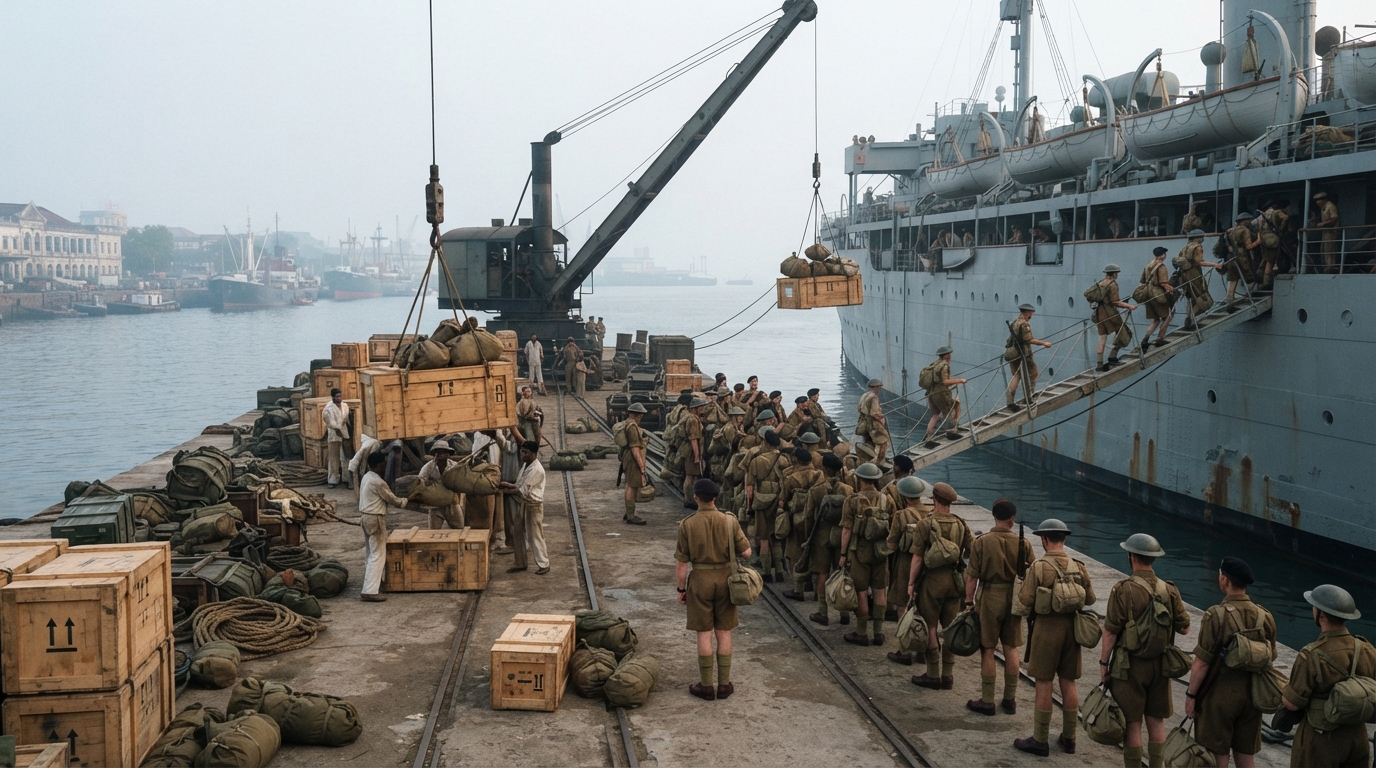
Popular accounts often assume that all British personnel left India on August 15, 1947. In reality, thousands of British soldiers remained in camps and garrisons across the subcontinent under a phased evacuation plan called Operation Exit [National Army Museum, 2024].
The British government ordered its troops not to intervene in the communal violence that accompanied partition. British units stayed inside their cantonments to protect European civilians and await transport ships. The final British military unit, the 1st Battalion, Somerset Light Infantry, marched through the Gateway of India in Bombay on February 28, 1948. They boarded the troopship Empress of Australia, concluding 174 years of formal British military presence on the subcontinent.
Aug 15, 1947: Political Independence Handover
       │
       ▼
Aug 1947 – Jan 1948: Phased Cantonment Evacuations
       │
       ▼
Feb 28, 1948: Somerset Light Infantry Departs Bombay (Military Exit Complete)
       │
       ▼
June 30, 1948: Reserve Bank of India Ends Dual-Currency Operations
Partitioning the Reserve Bank and Sterling Assets
The economic decolonization was just as complex as the territorial division. Atiya Hussain of the Geneva Graduate Institute (2024) points out that political independence outpaced financial planning, stranding industrial supply lines and currency reserves across hastily constructed sovereign borders.
The Reserve Bank of India (RBI) served as the central bank and currency authority for both India and Pakistan until June 30, 1948. Pakistan operated with Indian rupee notes overstamped with "Government of Pakistan" until it could establish the State Bank of Pakistan in July 1948.
The partition of physical assets required dividing everything:
- 82.5% of central assets went to India, and 17.5% went to Pakistan.
- Military equipment, railway carriages, office furniture, and official records were split along the same ratio.
- Pakistan’s initial share of sterling cash balances (750 million rupees) became an immediate flashpoint, with India briefly withholding the final 550 million rupees during the 1947 Kashmir conflict until Mahatma Gandhi went on a hunger strike to enforce payment.
Human and Institutional Legacies of the 1947 Exit
The abrupt nature of the British exit left structural scars on South Asia. Decades of colonial reliance on separate electorates and administrative divide-and-rule strategies left the newly formed dominions with institutionalized communal divisions.
Recent research in the History Education Research Journal (2025) emphasizes that the administrative haste of the 1947 withdrawal stripped local institutions of the resources needed to manage cross-border refugee flows. The hastily drawn borders fractured established trade corridors, divided irrigation canal headworks from downstream farms, and established long-term regional tensions. The territorial disputes born during the 1947 exit shaped later conflicts, including the events detailed in our archive of the 1971 India-Pakistan War key dates.
Frequently Asked Questions
Q: Why was the date of Indian independence moved from June 1948 to August 1947?
Viceroy Lord Mountbatten advanced the date because he believed British administrative control was collapsing rapidly under escalating communal riots and economic instability. He concluded that waiting until June 1948 would result in complete civil war and make an orderly evacuation impossible.
Q: Did British soldiers fight to stop the violence during Partition?
British military units received strict orders from London not to engage in policing duties or halt communal violence during Partition. They were confined to their cantonments and transit camps, tasked solely with protecting British installations and European nationals awaiting transport ships home.
Q: When did the last British official leave India?
Lord Mountbatten stepped down as the first Governor-General of independent India in June 1948, succeeded by C. Rajagopalachari. The final British military unit, the 1st Battalion of the Somerset Light Infantry, departed from Bombay on February 28, 1948.
Q: What happened to the Indian Army during the withdrawal?
The British Indian Army was divided roughly along religious and geographic lines, with roughly two-thirds of the personnel and equipment assigned to India and one-third to Pakistan. British officers temporarily remained in senior advisory and command roles in both armies through early 1948 to assist with the administrative reorganization.
Your next move is to examine the specific boundary commission files and constitutional acts from 1947. Review the declassified Radcliffe maps and the Indian Independence Act text to evaluate how specific district border decisions shaped modern South Asian administrative boundaries.
Related Reading
- India at the Olympics: A Timeline of Historic Sporting Milestones
- The 1971 India-Pakistan War: Key Dates and Historical Summary
- Timeline of Mahatma Gandhi's Nonviolent Movements in India
- December 1984: A Historical Timeline of the Bhopal Gas Tragedy
Sources
- Independence and Partition, 1947 — National Army Museum, 2024. Supports: The phased military withdrawal under Operation Exit and the embarkation of the final British unit, the 1st Battalion, Somerset Light Infantry, from Bombay on February 28, 1948.
- Indian Independence Act 1947 — UK Legislation (The National Archives), 1947. Supports: The British Parliament's passage of the Act dividing British India into the independent dominions of India and Pakistan and terminating imperial paramountcy over the Princely States.
- Partition of British India — The National Archives UK, 2022. Supports: The establishment and timeline of the Boundary Commissions chaired by Sir Cyril Radcliffe to divide the provinces of Bengal and Punjab.
- Brief History — Reserve Bank of India, 2024. Supports: The Reserve Bank of India continuing to serve as the central monetary and currency authority for Pakistan until June 1948.
- Partition of India — Encyclopaedia Britannica, 2026. Supports: The human displacement of roughly 15 million people and estimated death toll of between 200,000 and 2 million following the partition of India.