The 1857 Siege of Lucknow: A Date-by-Date Historical Archive
In Short
The Siege of Lucknow is a major 1857 confrontation in which Indian rebel forces besieged the British Residency in Awadh from June 30 to November 27, 1857, before final British recapture on March 21, 1858. This date-by-date Siege of Lucknow 1857 timeline details the major clashes, underground mining warfare, two relief efforts, and the final citywide clearance.
Key Takeaways
- The siege spanned two defensive phases and one final offensive across eight months.
- Exactly 1,729 troops and civilians defended the Residency compound during the initial siege.
- Begum Hazrat Mahal ran a parallel rebel government in support of her son.
- British soldiers earned 24 Victoria Crosses in one day at Sikandar Bagh.
- Sapper units fought a subterranean mine war beneath the Residency walls.
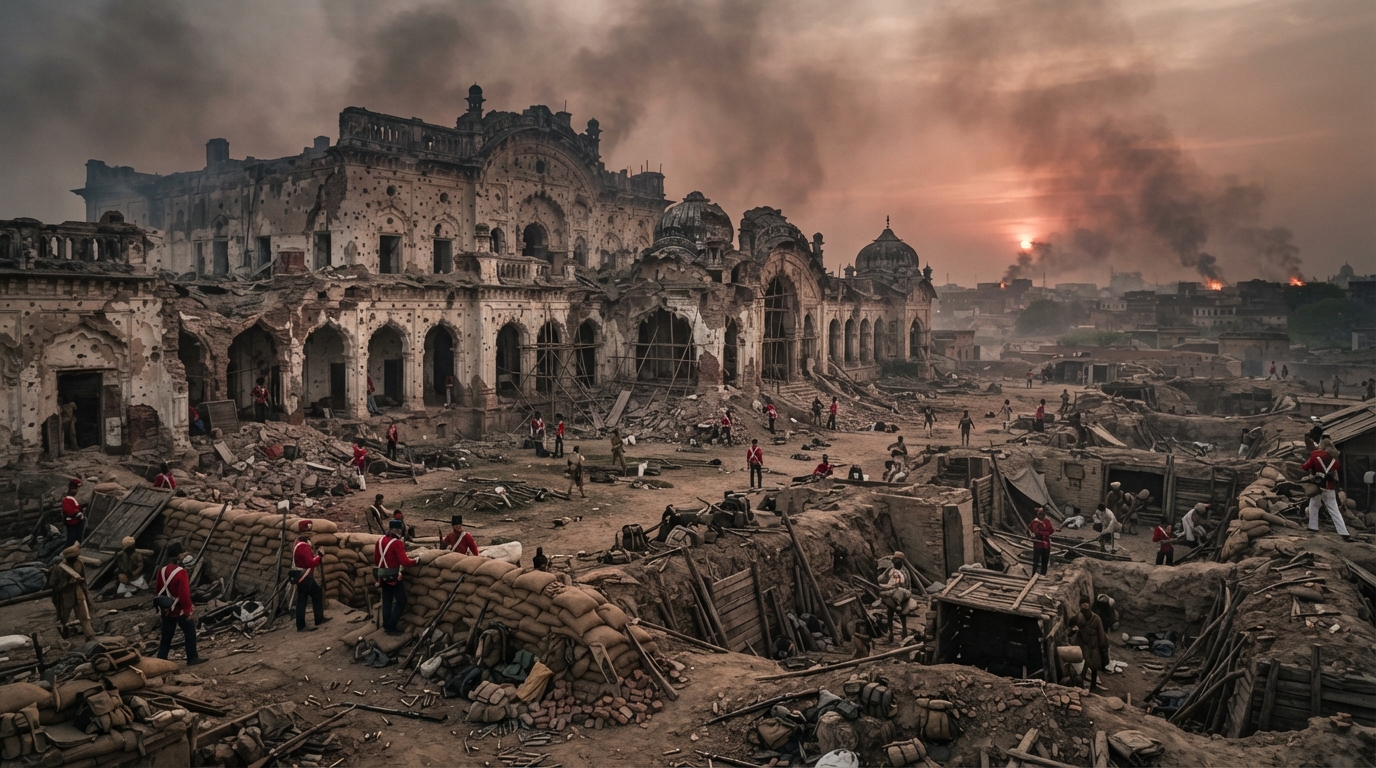
Exactly 1,729 soldiers and civilians retreated behind the mud banks of the Lucknow Residency on June 30, 1857. This retreat followed a crushing defeat against rebel forces at the Battle of Chinhat earlier that morning. For the next eighty-seven days, this small group held out against relentless artillery fire and infantry charges. Understanding the Siege of Lucknow 1857 timeline gives vital context to the major events in Indian history that reshaped colonial rule across the subcontinent.
The conflict in Lucknow was not an isolated mutiny. It transformed into a massive regional revolution across the kingdom of Awadh. Royal soldiers, talukdars, and city residents joined hands against the British East India Company. The events in Lucknow produced some of the fiercest urban combat of the nineteenth century.
What Sparked the Initial Defense of the Lucknow Residency?
The initial defense of the Lucknow Residency is a military fortification and entrenchment operation initiated in May 1857 by Sir Henry Lawrence, the British Chief Commissioner of Awadh, to protect British personnel and loyal Indian troops against regional uprisings. Tensions escalated after the British East India Company annexed the kingdom of Awadh under the Doctrine of Lapse in February 1856, deposing Nawab Wajid Ali Shah and sparking widespread civilian and military discontent across northern India. When Indian rebel soldiers under Barkat Ahmad decisively routed Sir Henry Lawrence’s British expeditionary column at the Battle of Chinhat on June 30, 1857, the surviving British forces, European civilians, and loyal sepoys retreated behind the fortified walls of the 33-acre Residency compound. According to historical records from the National Army Museum, this rapid withdrawal marked the formal start of the siege, transforming the unfortified administrative complex into a besieged garrison under continuous rebel bombardment.
The 1856 Annexation of Awadh and Growing Rebellion
The roots of the siege trace back to February 1856. The East India Company deposed Nawab Wajid Ali Shah and seized Awadh under the Doctrine of Lapse. This move stripped local talukdars of land rights and disbanded thousands of royal troops. As historian Dr. Rosie Llewellyn-Jones notes in her 2025 study, India’s Historic Battles: Lucknow, 1857 (HarperCollins India), the revolt was an organized regional revolution driven by the annexation of Awadh in 1856 rather than a simple military mutiny.
When the sepoy mutiny erupted at Meerut in May 1857, Awadh erupted as well. Sir Henry Lawrence, the Chief Commissioner of Awadh, recognized the danger early. Sir Henry Lawrence began storing grain, ammunition, and medical supplies inside the 33-acre Residency complex on the banks of the Gomti River.
The Disaster at the Battle of Chinhat (June 30, 1857)
The Battle of Chinhat is a military engagement fought on June 30, 1857, in which nearly 6,000 Indian rebel soldiers routed a British force led by Sir Henry Lawrence eight miles northeast of Lucknow. According to British military records, on June 29, 1857, Sir Henry Lawrence received intelligence that rebel forces were gathering at Chinhat. Lawrence marched out the next morning with roughly 700 soldiers and 10 artillery guns to scatter the rebel force.
The engagement resulted in a fatal British defeat. The rebel army numbered nearly 6,000 experienced soldiers led by Barkat Ahmad, whose artillery outmatched the British guns. Indian gunners fighting for the East India Company switched sides during the battle, turning their cannons directly onto British lines. Sir Henry Lawrence ordered a chaotic retreat back to Lucknow, and rebel forces pursued the retreating British troops to the gates of the Residency, sealing the compound and beginning the siege.
Garrison Strength and the Defensive Perimeter
The garrison inside the Residency was small and vulnerable. According to records from the National Army Museum (2017), the initial defense force numbered 1,729 combatants:
- 1,050 British officers, soldiers, and civilian volunteers
- 712 loyal Indian sepoys from the 13th, 48th, and 71st Native Infantry
- Roughly 1,280 non-combatants, including British women, children, and Indian servants
The compound was not a purpose-built fortress. It consisted of several brick residences, banqueting halls, a church, and administrative offices. Defenders connected these buildings with hasty earthworks, trenches, and wooden palisades. A contingent of staff and schoolboys from La Martinière College joined the defense, helping man artillery batteries and patrol the Baillie Guard Gate.
What Happened During the First Siege from June to September 1857?
The First Siege of Lucknow lasted 87 days, running from June 30 to September 25, 1857. Rebel artillery pounded the compound constantly, killing Sir Henry Lawrence on July 4. The defenders faced intense heat, starvation, disease, and close-quarters infantry assaults while waiting for a relief column to arrive.
+-----------------------------------------------------------------------+
|                 PHASE 1: THE FIRST SIEGE (87 DAYS)                   |
|                    June 30, 1857 – Sept 25, 1857                      |
|                                                                       |
|  • 1,729 defenders held a 33-acre compound against constant fire      |
|  • July 4: Death of Sir Henry Lawrence from shell wounds              |
|  • Intense underground mine warfare (37 rebel vs 25 British mines)    |
|  • Parallel rebel government founded under Regent Begum Hazrat Mahal  |
+-----------------------------------------------------------------------+
Death of Sir Henry Lawrence and Early Bombardments
Rebel artillery took up positions in surrounding city palaces and houses. Snipers fired into open courtyards from high vantage points like the Clock Tower and Johannes House.
On July 2, an artillery shell burst inside Lawrence’s room on the second floor of the Residency. The explosion shattered his thigh. Lawrence died two days later on July 4, 1857, after passing military command to Major John Inglis of the 32nd Regiment.
Inglis faced terrible conditions inside the walls. Dead bodies could not always be buried promptly. Flies, cholera, and dysentery caused more deaths each week than enemy gunfire. Clean water supplies dropped rapidly, and daily food rations shrank to basic flour and salt beef.
Subterranean Mine Warfare by Royal Engineers and Sepoys
As direct infantry assaults failed to break the perimeter, rebel forces turned to underground warfare. Sepoys who had served in Company engineer units began digging tunnels toward British defensive posts.
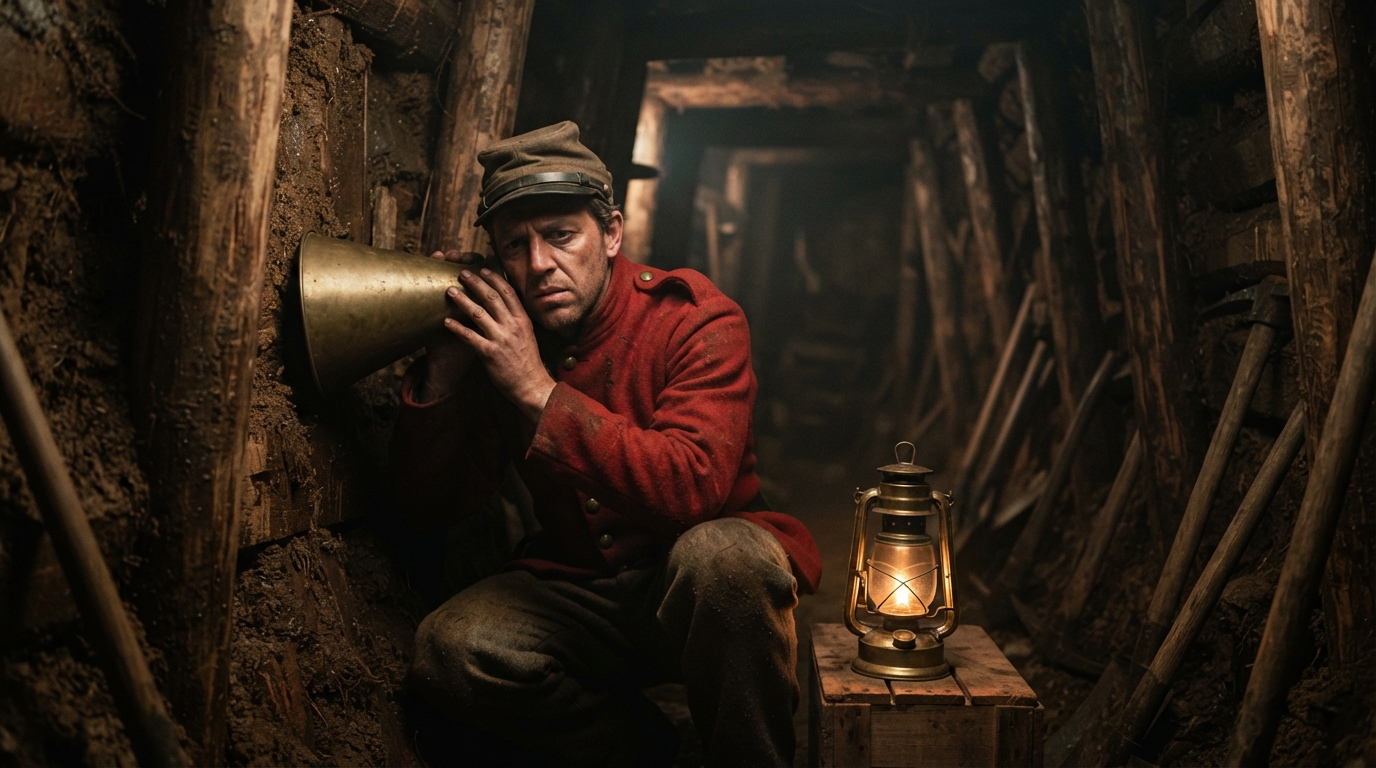
The Royal Engineers and Madras Sappers inside the compound set up listening posts in the tahkhanas (underground cellars). Whenever they heard picks striking rock, they dug countermines. Over three months, rebel miners dug 37 separate shafts toward the Residency. British and Indian sappers intercepted and blew up 25 of those tunnels before they could be detonated under key outposts like Sago’s House and the Redan Battery.
Rebel Governance Under Begum Hazrat Mahal and Birjis Qadr
Rebel governance under Begum Hazrat Mahal and Birjis Qadr is the parallel administrative authority established in Awadh during the 1857 uprising to coordinate military operations and civilian rule against the British East India Company. Begum Hazrat Mahal, the junior wife of the exiled Nawab, rallied the talukdars and sepoys. On July 5, 1857, Begum Hazrat Mahal crowned her 11-year-old son, Birjis Qadr, as the new Nawab of Awadh.
Contemporary court records (akhbarat) show that Begum Hazrat Mahal established administrative departments to manage food supplies, tax collection, and troop salaries. Begum Hazrat Mahal issued royal proclamations calling on Hindus and Muslims to unite against British rule. The rebel administration coordinated military operations around the Residency and dispatched troops to block British relief forces advancing from Kanpur.
How Did the Havelock and Outram Relief Column Fight Its Way In?
The Havelock and Outram relief operation is the first British military effort to breach the rebel encirclement of the Lucknow Residency, culminating on September 25, 1857, under the joint command of Major General Henry Havelock and Major General Sir James Outram. According to historical records from the National Army Museum, the combined British and Indian force numbered approximately 3,179 troops who fought their way through heavily fortified streets, palace complexes, and bridge barricades across Lucknow. Although roughly 2,700 surviving soldiers succeeded in reaching the besieged garrison, the relief column sustained 535 casualties during intense urban street fighting. Because Major General Havelock and Sir James Outram lacked sufficient transport animals, litters, and combat strength to safely evacuate hundreds of wounded soldiers, women, and children back to Kanpur, the expedition served as a military reinforcement that doubled the number of defenders rather than executing a full evacuation.
The Costly Urban Advance (September 23–25, 1857)
Major General Henry Havelock spent months fighting his way across Uttar Pradesh. Joined by Major General Sir James Outram, Havelock crossed the Ganges into Awadh in late September with roughly 3,179 soldiers.
The column reached the outskirts of Lucknow on September 23, capturing the walled garden of the Alambagh. On September 25, Havelock ordered a direct push into the city. Rebel fighters turned every street into a kill zone. Soldiers fired from rooftops, loopholed garden walls, and palace balconies. The 78th Highlanders and the Sikhs of Ferozepore suffered heavy losses at the Charbagh Bridge before fighting their way into the Residency compound late that evening.
Why the "First Relief" Became a Reinforcement
The arrival of Havelock and Outram boosted garrison morale, but it created a new tactical problem. As military historian Saul David pointed out for the National Army Museum (2017), Havelock’s force lacked the transport animals, litters, and combat strength to escort hundreds of women, children, and wounded men through miles of fortified urban streets.
The relief force had become trapped alongside the original defenders. The operation was not a true relief. It was a reinforcement that doubled the number of mouths to feed while compound rations were already nearly exhausted.
The Second Siege: Living Under Blockade (September to November 1857)
The Second Siege lasted 61 days, running from September 25 to November 22, 1857. Outram took overall command of the expanded force. He quickly ordered sorties to capture adjacent palace complexes along the Gomti River, including the Farhat Baksh and Chattar Manzil palaces.
These captures gave the garrison more physical breathing room. Yet the food crisis grew worse. Hospital staff treated hundreds of newly wounded soldiers without chloroform or clean bandages. Rebel countermines continued to threaten the perimeter, requiring round-the-clock listening watches by sapper teams.
What Is the Complete Siege of Lucknow 1857 Timeline of Key Dates?
This Siege of Lucknow 1857 timeline details every critical milestone from the initial May 1857 uprisings to the final British recapture in March 1858. The table below lists the chronological progression of clashes, reliefs, and political developments. You can cross-reference these dates with our broader Indian history timeline chart for a full national view.
| Date | Phase / Event | Key Leaders Involved | Tactical Outcome |
|---|---|---|---|
| May 30, 1857 | Lucknow Cantonment Uprising | Sir Henry Lawrence | Rebel sepoys mutiny; British forces consolidate inside the city. |
| June 30, 1857 | Battle of Chinhat | Sir Henry Lawrence, Barkat Ahmad | Lawrence is routed; the 87-day First Siege begins. |
| July 2–4, 1857 | Mortar Strike & Lawrence's Death | Sir Henry Lawrence, Major John Inglis | Lawrence is killed; Major Inglis assumes military command. |
| July 5, 1857 | Coronation of Birjis Qadr | Begum Hazrat Mahal, Birjis Qadr | Rebel provisional government established in Lucknow. |
| August 10, 1857 | First Major Rebel Assault | Major John Inglis | British and loyal sepoys repel massive attacks across the perimeter. |
| Sept 25, 1857 | The "First Relief" Breakthrough | Generals Havelock and Outram | Relief force fights into the Residency; becomes trapped inside. |
| Nov 16, 1857 | Storming of Sikandar Bagh | Sir Colin Campbell | British take Sikandar Bagh; 24 Victoria Crosses awarded. |
| Nov 22–27, 1857 | Residency Evacuation | Sir Colin Campbell, Begum Hazrat Mahal | Civilians and garrison evacuated to Kanpur; Residency abandoned. |
| March 21, 1858 | Final Recapture of Lucknow | Sir Colin Campbell, Begum Hazrat Mahal | British capture the city; rebel forces retreat to the Nepal border. |
The Storming of Sikandar Bagh (November 16, 1857)
The decisive break came in November 1857. Sir Colin Campbell, the new Commander-in-Chief in India, marched on Lucknow with a fresh army of 4,500 men. Campbell avoided Havelock’s narrow urban route. He circled east through open parks and fortified enclosures to reach the Residency.
On November 16, 1857, Campbell attacked Sikandar Bagh, a high-walled garden held by over 2,000 rebel soldiers. British artillery blew a small hole in the masonry wall. The 93rd Sutherland Highlanders and the 4th Punjab Infantry charged through the narrow gap under heavy fire.
+-----------------------------------------------------------------------+
|                 NOVEMBER 16, 1857: SIKANDAR BAGH                      |
|                                                                       |
|  • Attackers: 93rd Highlanders and 4th Punjab Infantry                |
|  • Breach: A narrow 2-foot hole blown in the garden wall              |
|  • Casualties: Over 2,000 rebel defenders killed in close combat       |
|  • Medals: 24 Victoria Crosses awarded in a single day                |
+-----------------------------------------------------------------------+
The fighting inside the garden was brutal. According to British Library Archives and National Army Museum data (2017), over 2,000 rebel soldiers were killed inside the enclosure. That day, British authorities awarded 24 Victoria Crosses for bravery at Sikandar Bagh. As recorded by Tornos India and the National Army Museum (2021), this remains the highest number of Victoria Crosses awarded in a single day in British military history.
The Final Recapture and Pacification (March 1858)
Campbell linked up with Outram and Havelock on November 17. Recognizing that Lucknow was still held by tens of thousands of armed rebels, Campbell chose not to hold the city. Between November 22 and November 27, he evacuated all 500 women and children, along with 1,000 wounded soldiers, sending them back to Kanpur. General Havelock died of dysentery at the Dilkusha Palace during the retreat on November 24.
Campbell left Outram with a holding force at the Alambagh and returned four months later. In March 1858, Campbell advanced with a massive army of over 30,000 regular troops, supported by 9,000 Gurkha soldiers under Jung Bahadur Rana of Nepal.
British forces captured the city palace by palace. They took the Begum Kothi, the Kaiserbagh, and the Musa Bagh in heavy fighting. On March 21, 1858, British troops secured the final rebel positions, marking the official end of the Lucknow campaign according to Oxford Reference (2021). Begum Hazrat Mahal refused to surrender, escaping across the border into Nepal with her loyal supporters.
How Do Modern Historians and Conservators View the Lucknow Siege Today?
Modern historians view the Siege of Lucknow as a complex popular uprising rather than a simple military rebellion. Ongoing conservation efforts protect the battered physical structures of the Residency, while researchers study indigenous archives to understand rebel administrative strategy.
+-----------------------------------------------------------------------+
|                   HISTORICAL PERSPECTIVE SHIFTS                       |
|                                                                       |
|  COLONIAL VIEW (1857–1947):                                           |
|  • Focused exclusively on British martyrdom and heroic endurance.     |
|  • Ignored local political grievances and the annexation of Awadh.    |
|                                                                       |
|  MODERN HISTORIOGRAPHY (2020s):                                       |
|  • Examines Begum Hazrat Mahal's coalition and court records.         |
|  • Analyzes urban warfare geography and sapper engineering.          |
|  • Recognizes the contribution of 712 loyal Indian garrison sepoys.   |
+-----------------------------------------------------------------------+
Subterranean Conservation at the Residency (2025–2026)
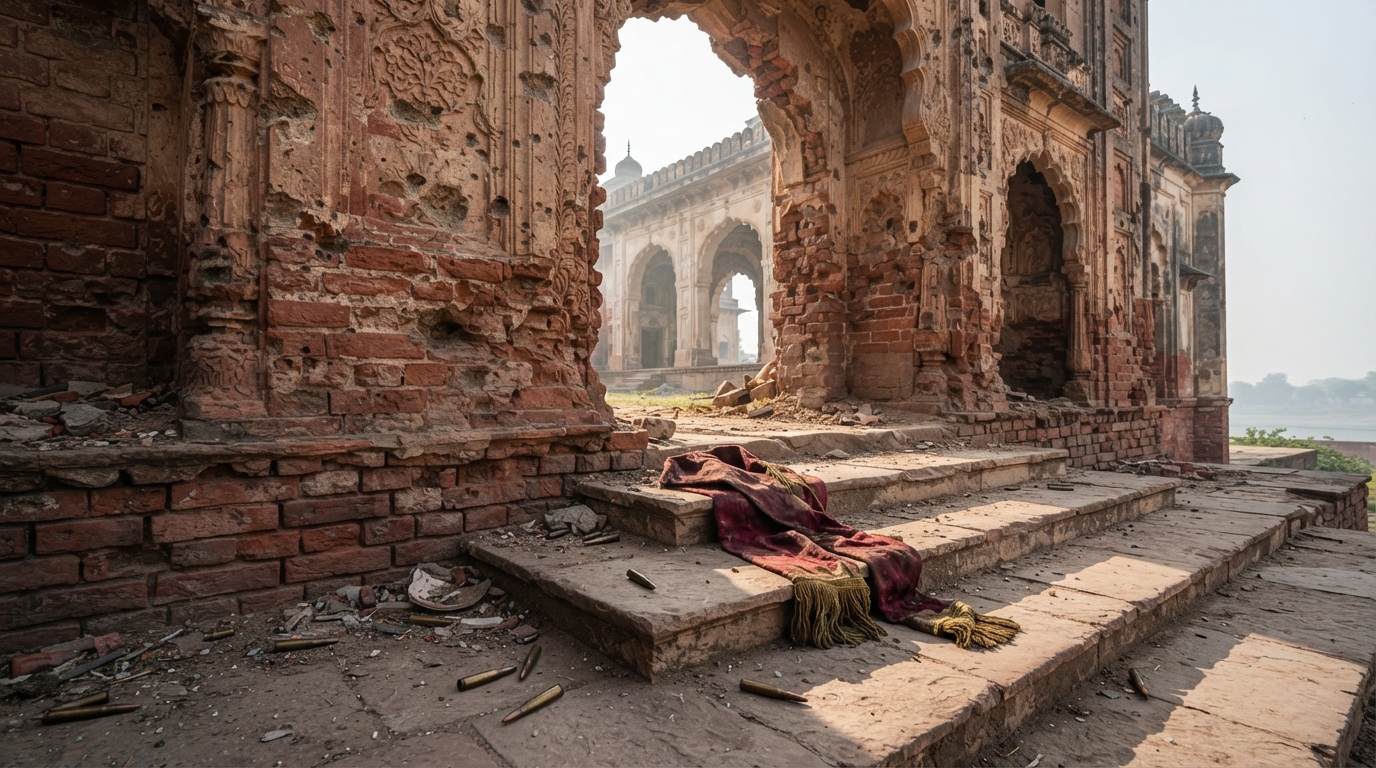
The Lucknow Residency stands today as a preserved ruin under the care of the Archaeological Survey of India (ASI). Visitors can still see cannonball impacts on the Baillie Guard Gate and the roofless shell of the main banquet hall.
Between 2025 and 2026, the ASI Lucknow Circle initiated digital documentation and structural conservation projects across the site. Engineers focused on the underground tahkhanas and drainage channels. These areas had begun to deteriorate due to monsoon water pooling. Laser scanning and mortar stabilization now protect the fragile brick masonry, preserving the original battlefield topography for future study.
Decolonizing the Archive: Voices of Awadh's Defenders
For over a century, colonial accounts dominated the history of 1857. Popular books focused on British diarists and Victorian heroics. Recent work places the resistance of Awadh back at the center of the story.
Scholars now examine rebel letters, poetry, and court minutes to reconstruct the defense from the Indian perspective. Begum Hazrat Mahal is widely recognized as one of the most effective military leaders of the 1857 uprising. Her ability to hold a fragile coalition together under siege conditions remains an important chapter in the visual history of the Indian independence movement.
The 712 Indian sepoys who defended the Residency compound also represent a unique historical study. These men stood by their regiments despite intense social and religious pressure from rebel forces outside the walls. Their actions reveal the complex loyalties and divided choices that defined the 1857 conflict.
Frequently Asked Questions
Q: How long did the Siege of Lucknow last?
The Siege of Lucknow lasted 148 days across two distinct phases between June 30 and November 27, 1857. The First Siege lasted 87 days until Havelock’s arrival, followed by a 61-day Second Siege until Campbell evacuated the site. The British army recaptured the entire city on March 21, 1858.
Q: Why was the Siege of Lucknow significant in the 1857 Rebellion?
Lucknow served as the political and military focal point of the 1857 Rebellion in northern India. The long defense tied down thousands of rebel troops who could have reinforced Delhi or Kanpur. The eventual British recapture of Lucknow broke the back of organized royal resistance in Awadh.
Q: Who was Begum Hazrat Mahal and what was her role during the siege?
Begum Hazrat Mahal was the wife of the deposed Nawab of Awadh who led the provisional rebel government in Lucknow. She crowned her young son Birjis Qadr as ruler and organized tax, food, and military commands across the city. She directed the siege operations against the Residency until March 1858.
Q: How many Victoria Crosses were awarded at Lucknow?
British soldiers received over 120 Victoria Crosses throughout the various operations around Lucknow in 1857 and 1858. Exactly 24 of those medals were awarded for actions on a single day during the storming of Sikandar Bagh on November 16, 1857.
Review the dates in this historical record against primary archives or museum exhibits on your next study session to build a clear, evidence-based understanding of the 1857 uprising.
Related Reading
- India at the Olympics: A Timeline of Historic Sporting Milestones
- December 1984: A Historical Timeline of the Bhopal Gas Tragedy
- Indian History Timeline Chart: Key Milestones (Digital Reference)
- The Dandi March Day-by-Day: A Timeline of the 1930 Salt Satyagraha
Sources
- Siege of Lucknow — Oxford Reference, 2021. Supports: The timeline of the siege, the relief efforts by Havelock and Campbell, and the final British recapture of the city on March 21, 1858.
- India's Historic Battles: Lucknow, 1857 — HarperCollins India, 2025. Supports: Dr. Rosie Llewellyn-Jones's analysis of the conflict as a regional revolution following the 1856 annexation of Awadh rather than an isolated sepoy mutiny.
- Decisive events of the Indian Rebellion — National Army Museum, 2017. Supports: The major operational phases and strategic centers of the 1857 uprising across northern India.
- In Their Own Words: Captain George Fulton — National Army Museum, 2025. Supports: Subterranean countermining warfare conducted by British and Indian sappers against rebel mining operations during the siege.
- 93rd (Sutherland Highlanders) Regiment of Foot — National Army Museum, 2017. Supports: The storming of Sikandar Bagh on November 16, 1857, led by the 93rd Highlanders under Sir Colin Campbell.
- Siege of Lucknow (1857) — Encyclopaedia Britannica, 2026. Supports: The overall chronology of the siege, the initial defense of the Residency, and the multi-month blockade by rebel forces.