Technological Milestones in Indian History: A Chronological Guide
TL;DR
India's technological evolution spans from ancient metallurgy and colonial-era science institutes to the post-independence space program and modern digital infrastructure. Tracking these Indian technology history dates reveals a steady progression from foundational scientific discoveries to the global software and digital payment revolutions defining the nation today.
Key Takeaways
- Ancient Indian metallurgy and mathematics laid the groundwork for complex technological problem-solving.
- Colonial-era science institutes provided the necessary infrastructure for indigenous research and development.
- Post-1947 policies focused heavily on establishing elite engineering colleges and atomic research facilities.
- The 1990s IT boom transformed the national economy into a global software services hub.
- Modern digital public infrastructure like UPI represents the current peak of domestic technological innovation.
Many assume the timeline of India's technological prowess begins abruptly with the software boom of the late 1990s. The reality is that the foundation of the country's engineering and scientific capability stretches back centuries, long before the first lines of code were exported from Bangalore. Understanding this trajectory requires looking at specific milestones that mark shifts in industrial capacity, institutional focus, and digital infrastructure. You see a clear line connecting the creation of early colonial science academies to the launch of modern digital payment systems. We track these historical milestones to show exactly how the nation built its technical capacity generation by generation.
The Foundations of Ancient and Medieval Innovation
This section outlines the early technological achievements in metallurgy and astronomy that defined pre-colonial Indian science. You will see how ancient craftsmen and medieval astronomers developed sophisticated techniques and instruments that set a high standard for practical engineering long before modern research institutions existed.
Metallurgical Marvels of Antiquity
The mastery of metals stands as one of the earliest verifiable technological achievements on the subcontinent. By 300 BCE, Indian metallurgists had developed the crucible steel production process, creating what became globally known as Wootz steel. This high-carbon steel was exported heavily to the Middle East, where it was forged into the famous Damascus blades. The process involved heating wrought iron with carbonaceous materials in sealed clay crucibles, a sophisticated chemical engineering feat for the ancient world. This early industrial export demonstrates that Indian manufacturing held a premium position in global trade networks long before the modern era.

Another defining milestone in metallurgical engineering is the Iron Pillar of Delhi, erected around 400 CE during the Gupta Empire. Standing over seven meters tall, this massive iron structure is famous for its remarkable resistance to corrosion over more than a millennium and a half. Metallurgical analysts attribute this rust resistance to a high phosphorus content and an even layer of crystalline iron hydrogen phosphate hydrate that protects the metal from the elements. The creation of such a massive, durable structure indicates a deep, practical understanding of forge welding and material science. You can trace the lineage of these early physical sciences directly into later periods of medical and chemical innovation, much like the progression seen in the 1,000 Years of Indian Medical History: A Chronological Guide.
Astronomical and Mathematical Instruments
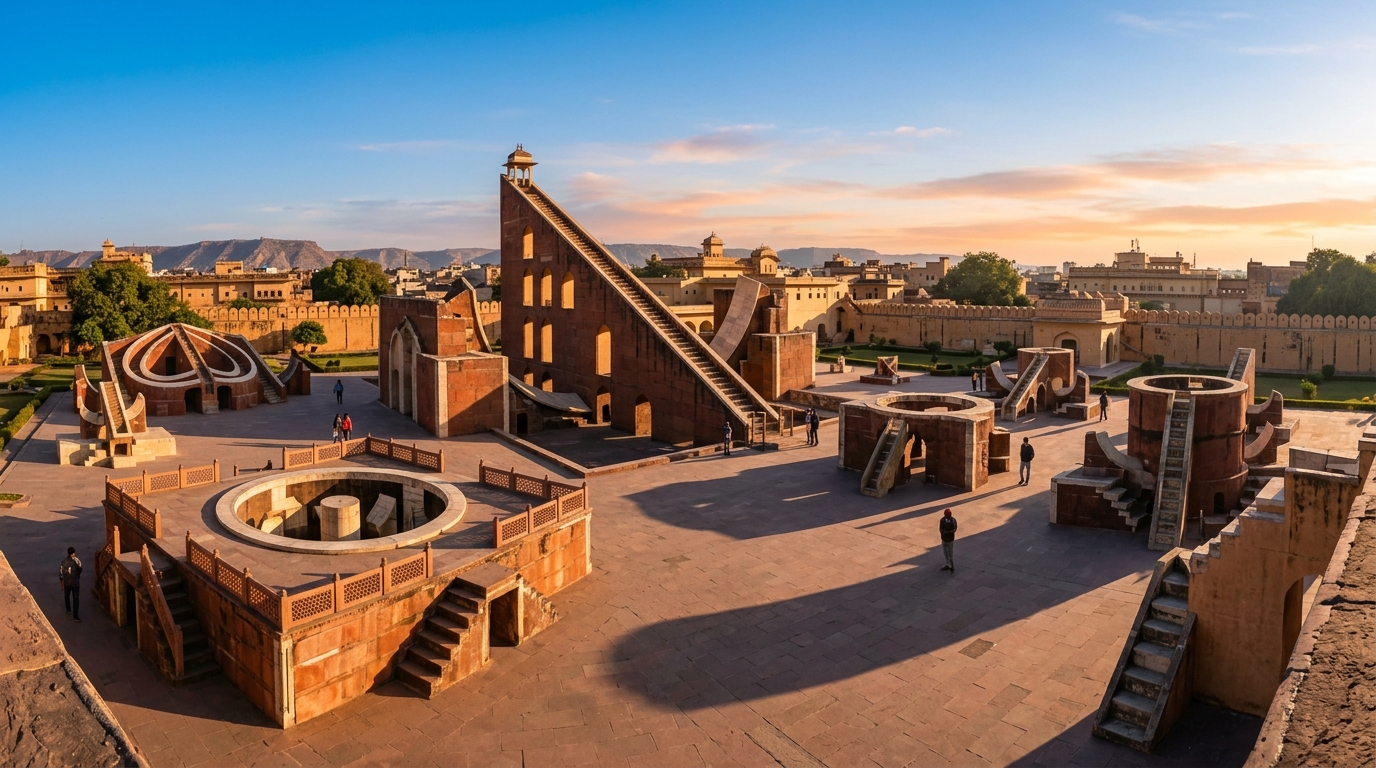
Long before the invention of optical telescopes, Indian astronomers built massive masonry instruments to track celestial bodies and calculate time with high precision. The most prominent examples are the Jantar Mantar observatories constructed by Maharaja Sawai Jai Singh II between 1724 and 1730. Located in cities like New Delhi and Jaipur, these complexes feature enormous structural instruments designed to measure the azimuth and declination of celestial objects. The Samrat Yantra in Jaipur, an immense sundial standing 27 meters tall, can measure time to an accuracy of about two seconds.
These observatories represent a unique intersection of architecture, mathematics, and astronomy. They were built to revise the calendar and astronomical tables, providing accurate data for agricultural planning and religious observances. The scale and precision of these instruments required advanced geometric calculations and an understanding of structural engineering that rivaled any contemporary scientific facility in the world. They stand as physical evidence of a scientific culture that prioritized observation, measurement, and mathematical modeling.
How Did Colonial India Build Its Early Science Institutes?
This section examines the late 19th and early 20th centuries when Indian scientists established formal research institutions under British rule. These specific Indian technology history dates highlight the shift from individual scientific pursuit to organized, institutional research aimed at cultivating indigenous talent and capability.
The Establishment of the Indian Association for the Cultivation of Science
In the late 19th century, scientific research in India was largely monopolized by the British colonial administration, with few opportunities for native Indians to conduct independent studies. To counter this, Dr. Mahendra Lal Sircar founded the Indian Association for the Cultivation of Science (IACS) in Calcutta in 1876. This marked the birth of the first national science association in India designed explicitly to enable Indians to pursue fundamental research. Sircar believed that true national progress required intellectual independence, which could only be achieved through scientific literacy and domestic research facilities.
The IACS quickly became the epicenter of scientific thought in the country, hosting lectures and providing laboratory space for aspiring scientists. It was within the laboratories of the IACS that Sir C.V. Raman conducted his groundbreaking research on the scattering of light. In 1928, Raman discovered the phenomenon now known as the Raman Effect, an achievement that earned him the Nobel Prize in Physics in 1930. The establishment of the IACS proved that with the right institutional support, Indian scientists could produce research of the highest global standard.
The Birth of the Indian Institute of Science
The push for institutional scientific training gained massive momentum at the turn of the 20th century, driven by industrialist Jamsetji Nusserwanji Tata. Tata recognized that the future of Indian industry depended on a steady supply of highly trained engineers and scientists. In 1898, he pledged a substantial portion of his personal wealth to establish a world-class research university. After years of negotiation with the British government and the princely state of Mysore, the Indian Institute of Science (IISc) was finally established in Bangalore in 1909.
The strategic placement of IISc in Bangalore had profound historical consequences for the region. The Maharaja of Mysore donated over 370 acres of land and provided a significant annual subsidy to ensure the institute's success. IISc began with just two departments—General and Applied Chemistry, and Electrical Technology—but it laid the foundational infrastructure for India's future aerospace, computing, and defense research. The presence of this elite institution is a primary reason Bangalore eventually evolved into the technology capital of the nation.
Post-Independence Nation Building Through Technology
This section covers the decades immediately following 1947, focusing on state-led investments in heavy industry, engineering education, and strategic research. The timeline highlights the creation of the Indian Institutes of Technology and the founding of the national space and nuclear programs as critical pillars of modernization.
The Genesis of the IIT Network
Following independence in 1947, the new government faced the massive challenge of rebuilding an economy drained by colonial rule. Policymakers understood that rapid industrialization required thousands of highly skilled engineers. Based on the recommendations of the 1946 Sarkar Committee, the government decided to establish elite technical institutes modeled after the Massachusetts Institute of Technology. The first Indian Institute of Technology (IIT) was inaugurated in 1951 in Kharagpur, West Bengal. Notably, it was established on the site of the former Hijli Detention Camp, physically transforming a symbol of colonial imprisonment into a center of national progress.
The success of IIT Kharagpur led to the rapid expansion of the network. Throughout the late 1950s and early 1960s, additional IITs were established in Bombay, Madras, Kanpur, and Delhi, often with technical assistance from foreign governments and international organizations. These institutes introduced rigorous academic standards and competitive entrance examinations that cultivated some of the finest engineering talent in the world. The graduates of these early IITs became the driving force behind the Economic Milestones in Indian History: From 1947 to Present, leading domestic industrial projects and eventually seeding the global technology sector.
The Dawn of the Space and Nuclear Programs
Simultaneous to the expansion of engineering education, the government initiated highly classified and strategic research programs. In 1954, the Department of Atomic Energy (DAE) was established under the leadership of physicist Homi J. Bhabha. Bhabha formulated a unique three-stage nuclear power program utilizing India's vast thorium reserves, aiming to secure long-term energy independence. This early investment in nuclear physics required the development of sophisticated domestic capabilities in heavy engineering, materials science, and computational physics.
In parallel, the seeds of the space program were planted. In 1962, the Indian National Committee for Space Research (INCOSPAR) was formed under the vision of Dr. Vikram Sarabhai. This committee eventually evolved into the Indian Space Research Organisation (ISRO) in 1969. The space program started with humble beginnings, launching sounding rockets from a church in the fishing village of Thumba. However, it rapidly accelerated, leading to the launch of India's first satellite, Aryabhata, in 1975. These programs demonstrated the state's commitment to mastering complex, high-stakes technologies despite severe economic constraints.
| Year | Technological Milestone | Key Figures / Institutions involved |
|---|---|---|
| 1951 | Establishment of IIT Kharagpur | Government of India, Sarkar Committee |
| 1954 | Creation of Dept. of Atomic Energy | Dr. Homi J. Bhabha |
| 1969 | Formation of ISRO | Dr. Vikram Sarabhai |
| 1974 | First peaceful nuclear explosion (Smiling Buddha) | DAE, BARC |
| 1975 | Launch of Aryabhata Satellite | ISRO, Soviet Union (launch vehicle) |
When Did the Information Technology Revolution Actually Begin?
This section tracks the origins of the computing and software services industry, tracing it back to early mainframe development in the 1950s. We follow these specific Indian technology history dates through the restrictive policies of the 1970s up to the transformative economic reforms that sparked the 1990s software export boom.
Early Computing and the TIFRAC
The origins of computing in India predate the commercial IT industry by several decades. The first analog computer was installed at the Indian Statistical Institute (ISI) in Calcutta in 1953, followed by the first digital computer, the HEC-2M, in 1955. However, the true milestone for indigenous computing occurred in 1960 at the Tata Institute of Fundamental Research (TIFR) in Mumbai. Researchers there designed and built the TIFR Automatic Computer (TIFRAC), the first computer developed entirely in India. TIFRAC featured a massive assembly of vacuum tubes and a core memory system, proving that Indian scientists could engineer complex computational hardware from scratch.
Despite this early promise, the 1970s presented significant challenges due to restrictive trade policies and high tariffs on imported electronics. In 1977, the government mandated that foreign companies dilute their equity stakes, leading IBM to exit the Indian market entirely. While this caused a temporary technological vacuum, it forced domestic companies to step up. Firms like Wipro and HCL pivoted from their original businesses to manufacture microcomputers and develop software solutions, laying the commercial groundwork for the indigenous IT sector.
The 1990s Software Export Boom
The trajectory of Indian technology shifted permanently in 1991. Facing a severe balance of payments crisis, the government initiated sweeping economic reforms that dismantled the complex licensing system known as the License Raj. A crucial piece of this puzzle was the establishment of the Software Technology Parks of India (STPI) in 1991. The STPI scheme provided IT companies with tax incentives, duty-free import of hardware, and most importantly, reliable high-speed satellite data links. This infrastructure allowed Indian programmers to write code in Bangalore, Pune, or Hyderabad and transmit it directly to clients in the United States and Europe.
This combination of economic liberalization, dedicated infrastructure, and a massive pool of English-speaking engineering graduates ignited the software export boom. Companies like Tata Consultancy Services, Infosys, and Wipro scaled rapidly, pioneering the global delivery model for IT services. By the late 1990s, India was firmly established as the back office of the world. The Y2K bug provided another massive catalyst, as foreign corporations outsourced the tedious work of updating legacy code to Indian firms, permanently cementing the country's reputation for reliable, cost-effective software engineering.
The Modern Era of Digital Public Infrastructure
This section details the 21st-century shift toward population-scale digital platforms, primarily focusing on biometric identification and real-time payment systems. These recent Indian technology history dates demonstrate a move away from purely exporting IT services toward building domestic digital utilities that serve hundreds of millions of citizens.
The Launch of Aadhaar and Biometric Identity
In 2009, the government launched the Unique Identification Authority of India (UIDAI) to solve a fundamental problem: millions of citizens lacked verifiable identification, excluding them from banking, government subsidies, and formal employment. Under the leadership of tech entrepreneur Nandan Nilekani, the UIDAI developed Aadhaar, a 12-digit unique identity number linked to a citizen's biometric data (fingerprints and iris scans). The first Aadhaar number was issued in September 2010 in the rural district of Nandurbar, Maharashtra.
Building Aadhaar required solving unprecedented technological challenges regarding database architecture, biometric deduplication, and data security at a scale of over one billion people. The system moved the country from a fractured, paper-based identity system to a centralized, digitally verifiable framework. Aadhaar became the foundational layer for what is now widely recognized as the-evolution-of-india-stack, a set of open APIs allowing governments and businesses to build services around identity, data, and payments.
The Rise of the Unified Payments Interface (UPI)
If Aadhaar solved the identity problem, the Unified Payments Interface (UPI) revolutionized the movement of money. Launched in April 2016 by the National Payments Corporation of India (NPCI), UPI is an instant real-time payment system that facilitates inter-bank peer-to-peer and person-to-merchant transactions. Unlike mobile wallets that require users to load money into a third-party app, UPI links directly to the user's bank account, allowing seamless transfers using a simple virtual payment address or QR code.
The adoption of UPI exploded following the 2016 demonetization exercise and accelerated further during the COVID-19 pandemic. It democratized digital payments, allowing street vendors, small merchants, and everyday citizens to transact without cash or expensive point-of-sale hardware. By processing billions of transactions monthly, UPI has made India the global leader in real-time digital payments. This shift represents a maturation of the Indian tech ecosystem—moving from servicing foreign corporations to building world-class digital public goods that drive domestic economic inclusion. You can see this trajectory continuing as you look at the 25 Historic Indian Events from 2000 to 2025: A Timeline.
Your next move is to look at the digital services you use daily and trace their origins back through this timeline. If you are building a historical lesson plan or researching a specific era of industrial growth, use the dates associated with the IITs or the STPI scheme to anchor your research. Understanding exactly when and why these institutions were funded gives you the clearest picture of how national technological capacity is actually built.
Related Reading
- 10 Most Searched Dates in Indian History and Why They Matter
- Milestones in Indian Women's History: A Chronological Guide
- Online Indian History Study Materials: Important Dates Index
- 1,000 Years of Indian Medical History: A Chronological Guide
FAQ
Q: What is the most significant early milestone in Indian technology history dates?
The creation of Wootz steel around 300 BCE is widely considered one of the most significant early milestones. It demonstrated advanced knowledge of metallurgy and chemical engineering, establishing an early standard for high-quality industrial exports.
Q: When was the first computer built in India?
The first computer developed entirely in India was the TIFRAC (TIFR Automatic Computer). It was commissioned in 1960 at the Tata Institute of Fundamental Research in Mumbai, marking the beginning of indigenous hardware engineering.
Q: How did the 1991 economic reforms affect the Indian tech industry?
The 1991 reforms dismantled restrictive trade licensing and established the Software Technology Parks of India (STPI). This provided the necessary tax incentives and high-speed data infrastructure that allowed the IT export sector to scale globally.
Q: Who was responsible for founding the Indian space program?
Dr. Vikram Sarabhai is recognized as the father of the Indian space program. He established the Indian National Committee for Space Research (INCOSPAR) in 1962, which later became the Indian Space Research Organisation (ISRO) in 1969.
Q: What makes UPI different from other digital payment apps?
UPI (Unified Payments Interface) is an underlying public infrastructure, not a private digital wallet. It allows users to transfer money instantly and directly between bank accounts using mobile numbers or QR codes without needing to park funds in a third-party application.