The Quick Read
Indian marathon history milestones are the landmark races and records that run from Phadeppa Chaugule's start at the 1920 Antwerp Olympics, per Olympedia, to Sawan Barwal's 2:11:37 national record at the 2026 Asian Games, per Olympics.com (2026). Key dates include Chhota Singh's 1951 Asian Games gold, Shivnath Singh's 2:12:00 in 1978, Asha Agarwal's 1985 Asian title, and OP Jaisha's 2:34:43 women's record from 2015.
Key Takeaways
- Shivnath Singh's 1978 men's record of 2:12:00 stood for about 48 years.
- Sawan Barwal broke that record twice in 2026, ending at 2:11:37.
- OP Jaisha's 2:34:43 women's record, set in Beijing in 2015, still stands.
- Record crowds at Indian city marathons have not yet produced faster elite times.
- Asian Championship golds came in 1985, 2017 and 2024, years apart.
In 2026, Sawan Barwal stood on the start line in Rotterdam for his first full marathon. He finished in 2:11:58. That beat by two seconds the national record Shivnath Singh had set in Jalandhar in 1978, running barefoot, as he did throughout his career. The gap between those two runs holds the central puzzle of Indian marathon history milestones. India built some of Asia's biggest road races in that time, yet its fastest marathon time barely moved for nearly half a century. This archive lays out the key dates in order so you can see where the progress happened and where it stalled.
Where Did Indian Marathon Running Begin?
Indian marathon running began at the 1920 Antwerp Olympics, when Phadeppa Chaugule ran the race for a small Indian team. The next major milestone came in 1951, when Chhota Singh won the first Asian Games marathon in New Delhi. Shivnath Singh then set the 2:12:00 national record in 1978.
1920: The first Olympic marathon start
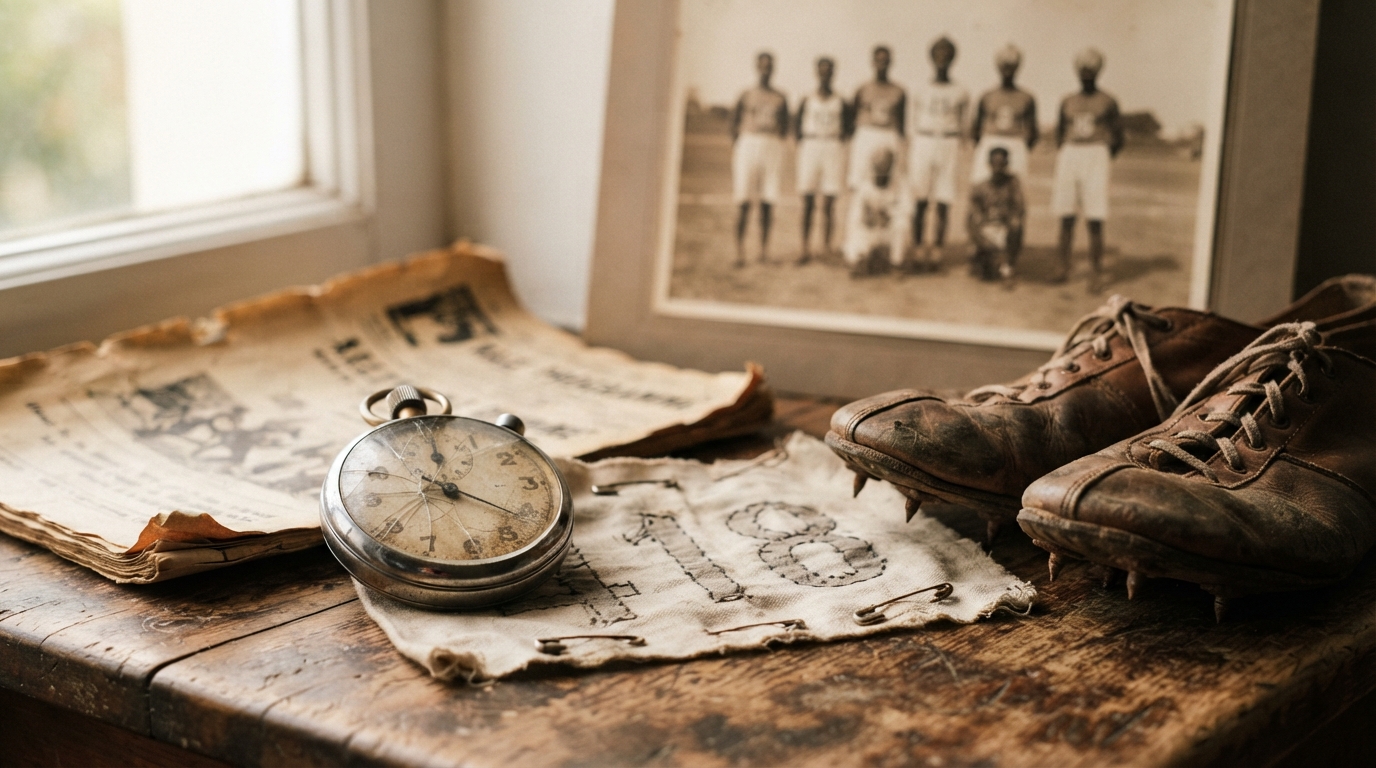
India's first Olympic team in 1920 was tiny and largely self-funded. Phadeppa Chaugule ran the marathon in Antwerp and finished 19th, according to Olympedia's results database. That placing matters because it came long before India had a national athletics federation. There were no structured training camps and no coaching pathway. Runners like Chaugule came through local races and trials, not through a system. For a student building a timeline, 1920 is the right starting point for Indian distance running on the world stage.
1951: Chhota Singh wins Asian Games gold
The first Asian Games were held in New Delhi in March 1951. Chhota Singh won the marathon there, as recorded by Olympedia. This was India's first major international marathon title. It also came just four years after independence, at a home Games meant to show the new nation's place in Asia. The win gets far less attention than India's hockey golds, which is a real gap in most sports histories. If you are teaching post-1947 milestones, this one belongs on the list.
1978: Shivnath Singh's barefoot record
Shivnath Singh ran 2:12:00 in Jalandhar in 1978, per Wikipedia's record entry. He had already finished 11th in the marathon at the 1976 Montreal Olympics. He ran barefoot for his whole career, which makes the time even more striking. His record outlasted every Indian runner for roughly 48 years. For context on his era's other track and sprint marks, see our guide to Indian athletics records on the track.
The Long Wait: Indian Marathon History Milestones From 1978 to 2026
The men's marathon record sat at 2:12:00 from 1978 until 2026. In between, India sent a record five marathoners to Rio 2016, sent none to Tokyo 2020, and won two Asian Marathon Championship golds. Sawan Barwal finally broke the record in Rotterdam and lowered it again at the 2026 Asian Games.
A timeline of the key men's dates
The table below lists the men's milestones that most often appear in date-based searches. Each row links a year to a single achievement you can verify.
| Year | Athlete | Milestone | Source |
|---|---|---|---|
| 1920 | Phadeppa Chaugule | First Indian Olympic marathon start, Antwerp | Olympedia |
| 1951 | Chhota Singh | Asian Games marathon gold, New Delhi | Olympedia |
| 1978 | Shivnath Singh | National record of 2:12:00, Jalandhar | Wikipedia |
| 2016 | Gopi, Kheta Ram, Rawat | Part of India's largest Olympic marathon team (five) | The Bridge |
| 2017 | Gopi Thonakal | Asian Marathon Championship gold | Public records |
| 2024 | Man Singh | Second Indian man to win Asian Marathon title | Abhipedia, 2024 |
| 2026 | Sawan Barwal | 2:11:58 in Rotterdam, then 2:11:37 at Asian Games | Olympics.com, 2026 |
Rio 2016 and the Tokyo gap
The Rio 2016 Olympic marathon is the high point for India's squad size. India sent five marathoners to Rio: Thonakal Gopi, Kheta Ram and Nitendra Singh Rawat among the men, plus OP Jaisha and Kavita Raut, as The Bridge reported. That five-runner team was the largest Indian marathon squad at any Games.
Tokyo 2020 is the low point that followed. Five years after Rio, the picture flipped: The Bridge noted in 2021 that no Indian would race the marathon at Tokyo 2020. The swing from five Olympic marathoners to zero shows how fragile Indian depth was in the event. One cycle of qualified runners did not produce a pipeline for the next.
Barwal's double break in 2026
Barwal's Rotterdam run of 2:11:58 came in his marathon debut, according to Asianet (2026). Five months later, he ran 2:11:37 at the Asian Games in Aichi-Nagoya, Japan, per Olympics.com (2026). That run earned silver behind Japan's Ichitaka Yamashita, who won in 2:10:49. ETV Bharat and Olympics.com both reported that the medal ended India's 44-year wait for an Asian Games marathon podium. Barwal trains under the Reliance Foundation's long-distance programme. Different outlets name different coaches, so check primary reports before citing one.
What Have Indian Women Achieved Over 42.195 km?
Indian women hold two major marathon milestones. Asha Agarwal won the women's marathon at the 1985 Asian Championships, and OP Jaisha set the national record of 2:34:43 at the 2015 World Championships in Beijing. That record is now more than 11 years old, and no Indian woman met the 2026 Asian Games qualifying mark.
1985: Asha Agarwal's Asian title
Asha Agarwal won the women's marathon gold at the 1985 Asian Championships, as recorded by GKToday. The women's marathon was still a young event at the time. It only joined the Olympic programme in 1984 in Los Angeles. Agarwal's win placed India among the early Asian leaders in women's distance running. Her name rarely appears in general history quizzes, which makes it a strong addition to any date-based study list. Our chronological guide to Indian women's history covers more firsts like this one.
2015: OP Jaisha's national record
OP Jaisha ran 2:34:43 at the 2015 World Championships in Beijing, per Olympics.com (2026). That time remains the Indian women's record. Jaisha also raced the marathon at Rio 2016 alongside Kavita Raut. Raut built her name on the track first, winning a 10,000 m bronze at the 2010 Commonwealth Games in Delhi. Both women moved up to the marathon in their peak years. Their path shows a common pattern in Indian distance running, where track runners convert to the road later on.
The 2026 qualifying gap
The women's side has not kept pace with the men's recent gains. In 2026, no Indian woman beat the Asian Games qualifying mark of 2:31:52, according to Olympics.com (2026). That standard sits more than two and a half minutes inside Jaisha's record. A national record that old usually signals a thin pool of athletes at the top level. The men's 1978 record showed the same pattern for decades. For anyone tracking women's sport, this is the date gap to watch over the next few seasons.
Mass Participation Grew Faster Than Elite Times
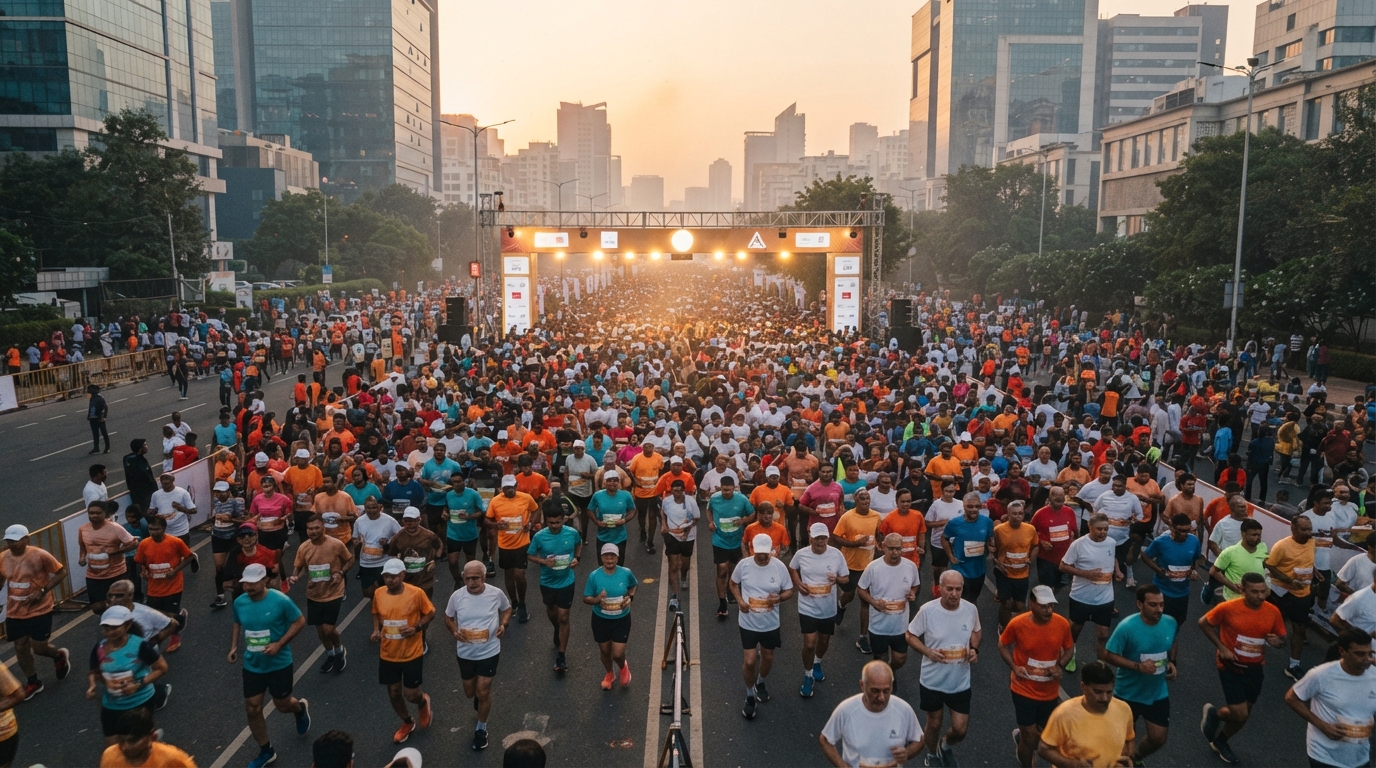
India's road-running boom started with the first Mumbai Marathon in 2004 and has since grown into thousands of timed events. Mumbai drew a record 69,100 participants in 2026. Yet the top Indian finisher in Mumbai's elite race that year ran 2:19:55, well outside the national record.
2004 to 2026: the Mumbai Marathon's growth
Procam International launched the first Mumbai Marathon in 2004. That first race drew about 22,000 participants and raised ₹1.44 crore for charity, according to a Mumbai fan wiki; check Procam's own archives before quoting that figure. By 2026, the Tata Mumbai Marathon had grown to 69,100 participants, per The Tribune/ANI (2026). The same report counted a record 14,059 runners in the full marathon. Procam also reported that India hosted about 1,700 timed running events in 2019. For wider context on this period, see our timeline of Indian events from 2000 to 2025.
Beyond the metros
India's running boom beyond the metros is the spread of timed road races from Mumbai to cities such as Hyderabad and towns such as Dehradun. The NMDC Hyderabad Marathon grew from 1,250 runners at its 2011 debut to 28,300 in 2025, according to InBody India (2025), a more than twentyfold rise in 14 years.
Smaller races show the same trend. ThePrint reported that the Dehradun Ultra Run grew from 150 runners in 2024 to 500 in 2025. Venkatraman Pichumani, founder of the timing firm YouTooCanRun, told ThePrint in 2024 that India now has "more running events than I can remember." Pichumani added that he could track every Indian running event as recently as 2014.
Fauja Singh and the age-group story
Fauja Singh is the best-known face of mass running in India: a runner who took up marathons in his late 80s and kept racing into his 100s. Olympics.com reported in 2025 that Fauja Singh died in a road accident in Punjab at a reported age of 114, ending one of Indian running's most widely followed age-group stories.
Fauja Singh's claimed age was never ratified by record keepers, because he had no birth certificate. The Fauja Singh story still matters to Indian running history. His career shows that participation records and performance records measure very different things.
Why crowds have not meant faster times
The gap between big crowds and fast times is a gap between two different systems. Indian city marathons reward entry numbers, charity totals and finisher counts. Elite marathon times need full-time training, altitude camps, pacers and racing abroad, which mass events do not provide.
The 2026 results show the gap clearly. Kartik Karkera won the Indian elite race at the Tata Mumbai Marathon 2026 in 2:19:55, per Olympics.com (2026). Karkera's winning time was about eight minutes off Sawan Barwal's 2:11:37 national record.
The Indian Army and the Reliance Foundation still do much of the elite development work in Indian marathon running, not the mass-participation events.
How Can You Track Indian Marathon History Milestones by Date?
The easiest way to track Indian marathon history milestones is to tie each achievement to a calendar date, then check it against a primary source. Daily history archives like India On This Day group events by date, which helps students and teachers build timelines and spot gaps quickly.
Using today in Indian history pages
A date-based archive works best for sports history because races happen on fixed days. If you search "today in history India" on 30 August, you might find Jaisha's 2015 Beijing run. Our daily cards are built for this kind of quick lookup on a phone. Each card gives one event, one date and one short summary. That format suits revision before a quiz or a class discussion. For a method you can reuse across subjects, see our guide to learning Indian history through chronological timelines.
Checking sources before you cite
Marathon facts go out of date fast, and many sites lag behind. A common example is Gopi Thonakal's 2017 Asian title. Some sources still call him the only Indian man to win it. That stopped being true in 2024, when Man Singh became the second, per Abhipedia (2024). Use this checklist before you cite any running milestone:
- Confirm the time and date on Olympedia, World Athletics or Olympics.com.
- Check whether a newer result has replaced the record.
- Note the race location, since course records differ from national records.
- Cross-check coach and team names across at least two reports.
Where date-based archives fall short
Date cards have limits that are worth knowing. They show what happened, not why a record lasted 48 years. They can also miss events where the exact day is unclear, such as early 1920s trials. For deeper context, pair the daily card with a longer article or an Olympedia profile. A related guide on India's Olympic history by date would also help fill this gap.
Related Reading
- Indian History Milestones: The Maurya and Gupta Empires
- Milestones in Indian Women's History: A Chronological Guide
- Economic Milestones in Indian History: From 1947 to Present
- Today in Indian History: March Events, Birthdays, and Milestones
FAQ
Q: Who holds the Indian men's marathon record? Sawan Barwal holds it with 2:11:37, set at the 2026 Asian Games in Aichi-Nagoya, Japan, per Olympics.com (2026). He had already broken Shivnath Singh's 1978 mark of 2:12:00 earlier that year in Rotterdam.
Q: What is the Indian women's marathon record? OP Jaisha holds it with 2:34:43, set at the 2015 World Championships in Beijing. No Indian woman met the 2026 Asian Games qualifying mark of 2:31:52, according to Olympics.com (2026).
Q: Who was India's first Asian Games marathon champion? Chhota Singh won the marathon at the 1951 Asian Games in New Delhi, as recorded by Olympedia. It was the first edition of the Games and India's first major international marathon title.
Q: What are the most important Indian marathon history milestones for students? Start with 1920 (Chaugule's Olympic start), 1951 (Chhota Singh's gold), 1978 (Shivnath Singh's record) and 1985 (Asha Agarwal's Asian title). Then add 2015 (Jaisha's record), 2016 (Rio's five-runner team) and 2026 (Barwal's record and Asian Games silver).
Q: Why did India have no marathoners at Tokyo 2020? No Indian runner met the qualifying standards in that cycle, as The Bridge reported in 2021. It came just five years after India sent a record five marathoners to Rio 2016.
Your next move: Pick the seven dates in the FAQ answer above and add them to your own timeline or class notes. For each one, check a single primary source, such as Olympedia or Olympics.com. If a fact appears on only one site, mark it as unverified until a second source confirms it.
Sources
- Asian Games 2026: Sawan Barwal wins silver medal in men's marathon event — ETV Bharat, 2026. Supports: Barwal ran a national record of 2:11:37 for silver at the 2026 Asian Games behind Ichitaka Yamashita (2:10:49), ending India's 44-year wait for a marathon medal at the Games.
- Sawan Barwal smashes national record to win historic Asian Games silver, ends India's 44-year marathon wait — The Statesman, 2026. Supports: Barwal's 2:11:37 in Nagoya beat the 2:11:58 national record he set in Rotterdam in April 2026.
- Sawan Barwal Shatters Longest Standing Record In Indian Athletics On Marathon Debut — Reliance Foundation, 2026. Supports: Barwal ran 2:11:58 in Rotterdam in his marathon debut, breaking the 2:12:00 record Shivnath Singh set in Jalandhar in 1978.
- O. P. Jaisha — Wikipedia. Supports: OP Jaisha holds the Indian women's marathon record of 2:34:43, set at the 2015 World Championships in Beijing.
- Chhota Singh – Athlete Profile — Olympedia. Supports: Chhota Singh won the marathon at the 1951 Asian Games in New Delhi.
- 0 marathon runner from India at the Tokyo Olympics — What went wrong? — The Bridge, 2021. Supports: India sent its largest Olympic marathon team, five runners (Gopi, Kheta Ram, Rawat, Jaisha, Raut), to Rio 2016 and had no marathoners at Tokyo 2020.
- Asian Marathon Championships 2024: Man Singh emerges winner in men's race — Olympics.com, 2024. Supports: Man Singh won the 2024 Asian Marathon Championships and became the second Indian winner, after T Gopi in 2017.
- Over 69,000 runners confirm participation for Tata Mumbai Marathon 2026 — The Tribune, 2026. Supports: The Tata Mumbai Marathon 2026 drew a record 69,100 participants.
- Mumbai Marathon 2026: Ethiopia's Tadu Abate, Yeshi Chekole clinch elite titles — Olympics.com, 2026. Supports: Kartik Karkera won the Indian elite men's race at Mumbai 2026 in 2:19:55.
- Marathon legend Fauja Singh dies in road accident at 114 — Olympics.com, 2025. Supports: Fauja Singh died in a road accident in Punjab at a reported age of 114.
- Record 28,300 runners participate in NMDC Hyderabad Marathon 2025 — Telangana Today, 2025. Supports: The 2025 NMDC Hyderabad Marathon drew a record 28,300 runners.
- Marathons are no longer reserved for elite. Small-town, middle-class India wants in — ThePrint, 2024. Supports: Venkatraman Pichumani of YouTooCanRun said India now has "more running events than I can remember," compared with 2014.