Woven in Time: A Timeline of India's Ancient Textile Heritage
The Quick Read
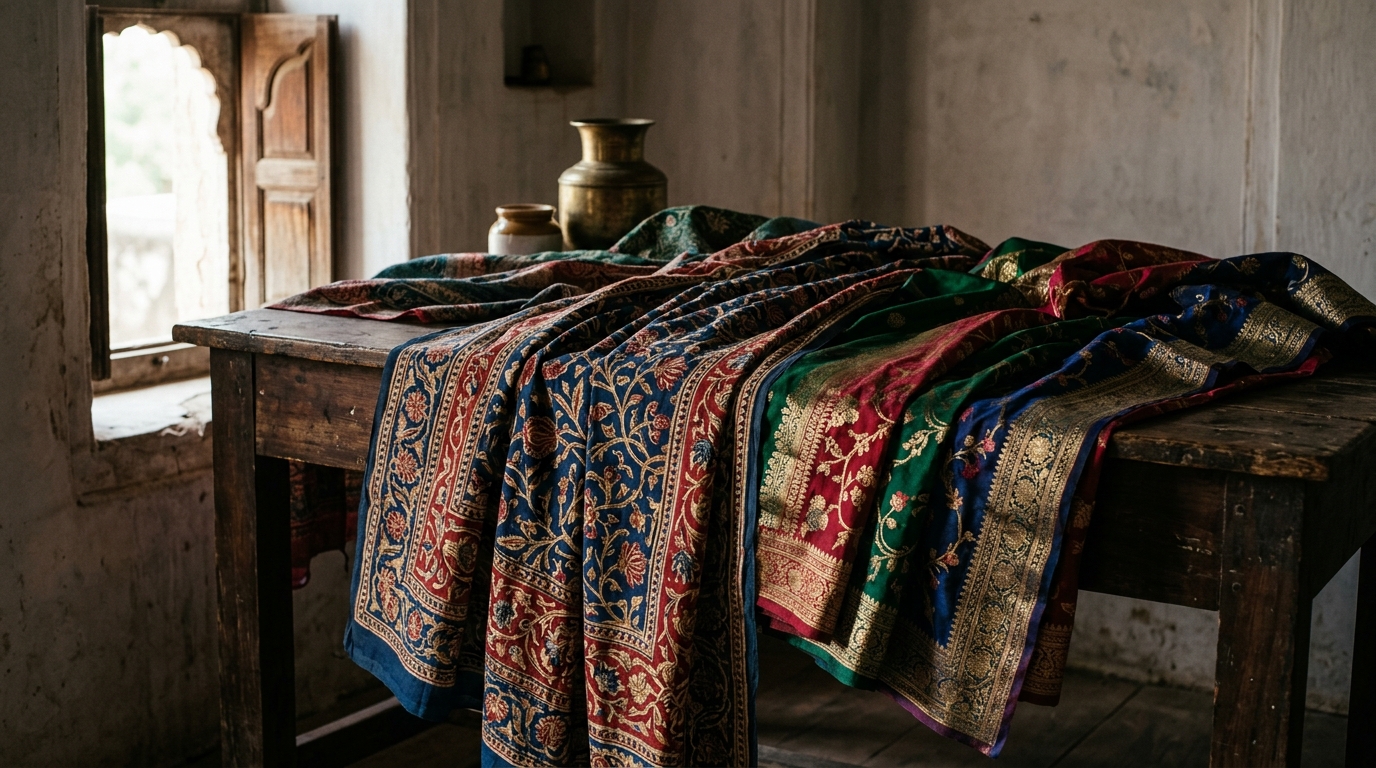
India's ancient textile heritage spans over 5,000 years, beginning with the cultivation of cotton in the Indus Valley around 3000 BCE. The subcontinent mastered complex dyeing, weaving, and spinning techniques early on, establishing legendary trade routes that supplied Rome, Egypt, and Southeast Asia with prized muslin, silk, and chintz fabrics.
Key Takeaways
- Indus Valley civilizations domesticated and spun indigenous cotton varieties as early as 3000 BCE.
- Ancient Roman historians documented the massive wealth drained from their empire to buy Indian textiles.
- Medieval weaver guilds standardized production and established distinct regional fabric specialties across the subcontinent.
- Mughal imperial patronage refined ancient weaving techniques into luxury global exports like jamdani and chintz.
- Early mastery of chemical mordants gave Indian artisans a global monopoly on colorfast dyed fabrics.
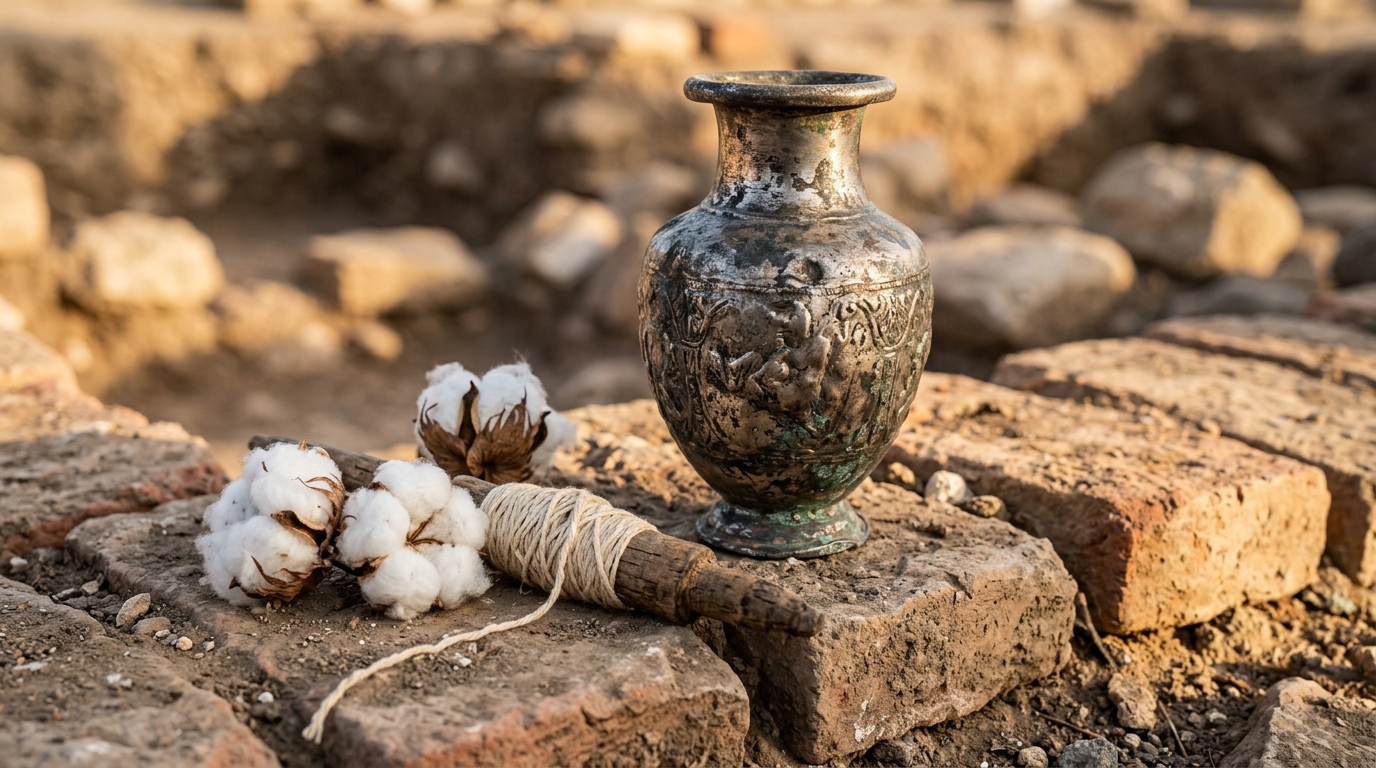
Exactly 5,000 years ago, artisans in the Indus Valley successfully spun the world's first documented cotton threads, fundamentally altering human industry. Archaeologists uncovered these microscopic fibers preserved inside a silver vase at Mohenjo-Daro, proving the subcontinent mastered fabric production millennia before Europe. This single discovery reshaped our understanding of early civilization, showing that clothing had moved beyond basic survival gear into a sophisticated manufacturing sector. Tracing Indian textile history dates reveals a continuous timeline of technical innovation that defined global trade long before the modern era. The fabrics produced across the subcontinent did not just clothe local populations; they served as primary currency for spices and drove the expansion of maritime networks. Understanding this timeline requires looking at archaeological evidence, ancient trade manifests, and the evolution of loom technology. Readers exploring the 10 Most Searched Dates in Indian History and Why They Matter often find that economic milestones are deeply tied to these early manufacturing triumphs. Tracking the chronological development of India's textile mastery shows exactly how ancient river valleys built an enduring global trade monopoly.
The Harappan Civilization Pioneered Early Cotton Cultivation
The Indus Valley civilization established the foundational Indian textile history dates by domesticating cotton and inventing early spinning tools around 3000 BCE. Archaeological digs reveal standardized terracotta spindle whorls in nearly every excavated household, proving that fabric production operated as a massive, decentralized industry rather than an isolated craft.
Evidence of the First Woven Threads
Excavations at Mohenjo-Daro yielded the earliest surviving cotton threads in the world, preserved by a rare chemical accident. The threads survived because they were wrapped around a silver handle; the metallic salts from the degrading silver stabilized the fragile cellulose fibers over thousands of years. Microscopic analysis of these fibers confirms they belong to the Gossypium arboreum species, a hardy cotton plant native to the Indian subcontinent. The threads show advanced spinning techniques, indicating that the people of the Indus Valley had already moved past primitive fiber twisting. They used specialized terracotta and bone spindle whorls to create consistent, fine yarns suitable for weaving on rudimentary looms. This level of standardization suggests a mature industry rather than a recent invention, pointing to centuries of prior experimentation. The widespread distribution of these spinning tools across different excavation sites proves that yarn production was a daily domestic activity for most Harappan families. These early milestones mark the definitive moment when clothing transitioned from animal skins to cultivated plant fibers.
Dyeing Techniques of the Indus Valley
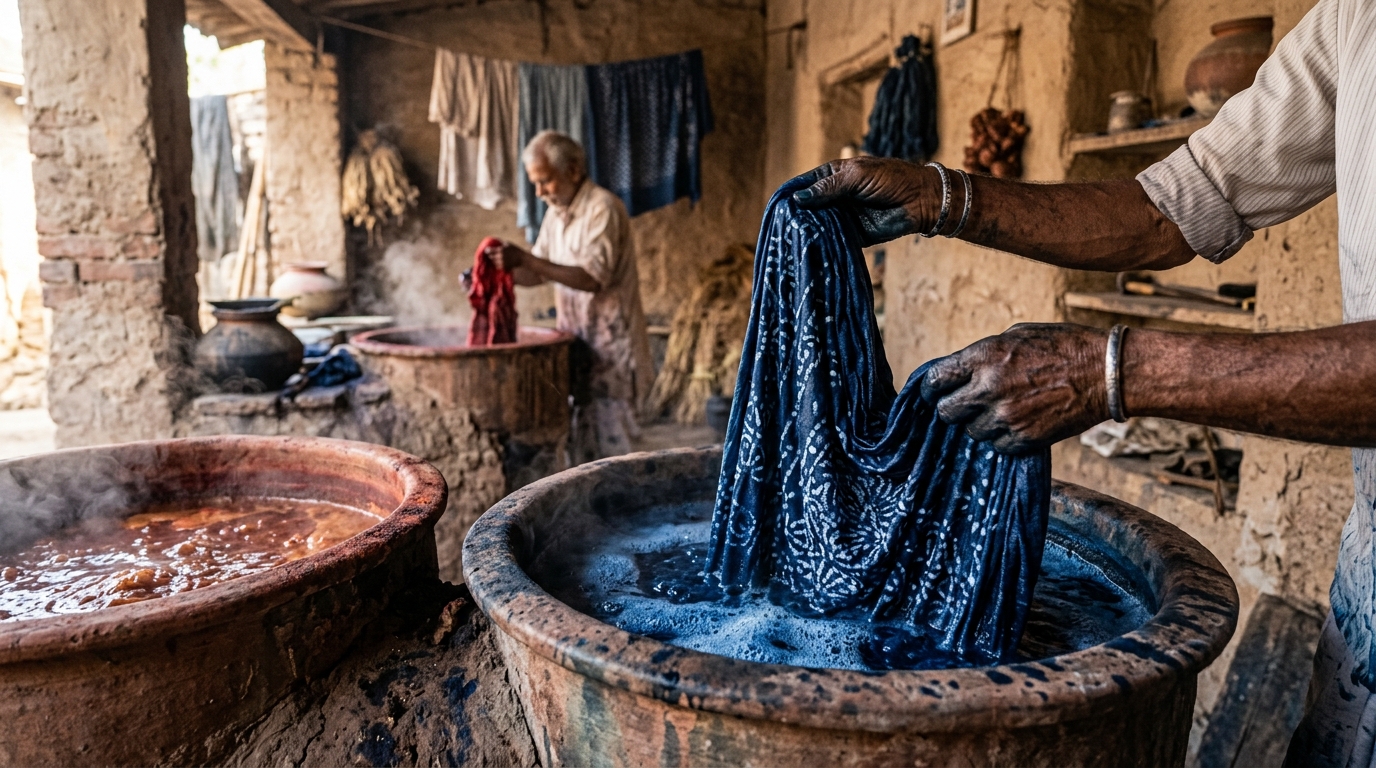
Harappan artisans did not just weave plain cloth; they mastered the complex chemistry of natural dyes. Evidence from the archaeological port site at Lothal includes specialized brick dyeing vats and traces of madder, a plant root used to produce deep red colors. Creating colorfast dyed cotton is chemically difficult because cellulose fibers do not naturally absorb pigments well. The Harappans solved this by developing early mordanting techniques, using metallic salts like alum to bind the dye to the fabric permanently. This chemical breakthrough gave Indian fabrics a massive competitive advantage in early trade networks. Buyers in Mesopotamia and Egypt highly valued these bright, washable colors that refused to fade under the harsh desert sun. The mastery of indigo extraction also began during this era, setting the stage for India's eventual global monopoly on blue dyes. These ancient innovations in color chemistry established a technical foundation that regional artisans would build upon for the next three millennia.
Vedic and Epic Periods Established Textile Specialization
Between 1500 BCE and 500 BCE, Indian weavers developed highly specialized techniques for different fibers, including wool, silk, and bast. Ancient texts from this era meticulously categorize fabrics by their geographic origin, weaving style, and intended social use, showing a highly organized and stratified textile economy.
References in Ancient Texts
The Rig Veda, composed around 1500 BCE, contains numerous detailed references to weaving, frequently using the loom as a metaphor for the creation of the universe. These texts mention specific garments like the vasas (lower garment) and adhivasa (overgarment), indicating that standardized clothing styles had become culturally significant. Later texts, such as the Arthashastra written by the scholar Chanakya around 300 BCE, provide a granular look at the textile administration under the Mauryan Empire. Chanakya outlines strict state regulations for spinners and weavers, detailing wage structures based strictly on the quality and fineness of the yarn produced. The text explicitly names regions like Kashi (Varanasi) and Madurai as recognized centers of excellence for specific types of luxury cloth. This documentation proves that the state actively managed and taxed textile production to fill its treasuries and fund military expansion. Establishing definitive Indian textile history dates during this period relies heavily on these administrative records, which treat fabric production as a critical pillar of national wealth. If you look at Economic Milestones in Indian History: From 1947 to Present, you see the modern echoes of this ancient state-level economic planning.
The Birth of Regional Weaving Centers
As the population expanded across the Gangetic plain and the southern peninsula, distinct regional weaving identities began to form based on local resources. Climate, local water mineral content, and indigenous plant varieties dictated what type of fabric a specific region could produce best. Bengal leveraged its humid climate and abundant river water to spin ultra-fine cotton, eventually leading to the creation of legendary sheer muslin. Gujarat focused on heavy cotton and intricate block-printing techniques, utilizing the arid conditions favorable for drying heavily dyed cloths. Down south, the Coromandel Coast developed highly complex painted cottons known as Kalamkari, using local iron-rich water that naturally enhanced the vibrancy of vegetable dyes. These regional specialties created a vibrant internal trade network across the subcontinent. Merchants moved raw materials and finished goods along established caravan routes, connecting northern silk weavers with southern cotton dyers. This geographic specialization ensured that Indian textiles could meet diverse demands, from durable sailcloth for merchant ships to sheer luxury garments for royalty.
The Silk Routes Expanded India's Global Fabric Trade
By the first century CE, Indian textiles dominated the maritime and overland Silk Routes, acting as a primary exchange currency for Roman gold and Southeast Asian spices. Tracking Indian textile history dates through foreign trade manifests shows exactly how dependent the ancient world became on subcontinent fabrics.
Roman Demand for Indian Muslin
The Roman Empire developed an insatiable appetite for fine Indian cottons, particularly the sheer muslins produced in Bengal and the Coromandel Coast. Roman elite women favored these translucent fabrics, which they called ventus textilis or "woven wind," often layering them with heavier local wools. The Roman historian Pliny the Elder famously complained in 79 CE that India was draining Rome of its gold reserves, estimating an annual trade deficit of 50 million sesterces. Archaeological evidence strongly supports this text; massive hoards of Roman gold and silver coins have been unearthed at ancient Indian port cities like Arikamedu and Muziris. The Periplus of the Erythraean Sea, a Greek navigation manual from the first century CE, explicitly lists Indian ports and the specific textiles available at each one. It details how merchants timed their voyages with the monsoon winds to load up on dyed cottons, wild silks, and malabathrum. This intense export demand forced Indian weavers to scale their production and refine their maritime logistics. Explicitly defining entities like Pliny the Elder and the Periplus in historical documentation helps modern researchers map the exact scale of this ancient global supply chain.
Maritime Trade with Southeast Asia
While Rome bought luxury muslins, Southeast Asia demanded heavy, brightly patterned cottons for both daily wear and ceremonial use. Indian merchants traded these robust fabrics in the Indonesian archipelago directly for cloves, nutmeg, and mace. The local populations in places like Bali and Sumatra integrated these Indian textiles into their own cultural and religious ceremonies, treating them as sacred heirlooms. Certain Indian patterns became so deeply embedded in Southeast Asian culture that local weavers eventually began copying the motifs using their own indigenous ikat techniques. The trade was highly specific; Indian merchants carried detailed pattern books to ensure they wove the exact geometric shapes and colors preferred by different island communities. This localized export strategy highlights the sophisticated market research Indian textile guilds conducted centuries before modern trade theory. They did not just export surplus goods; they engineered specific fabrics for specific foreign buyers. This maritime dominance laid the groundwork for the later European spice trade, which also relied heavily on Indian cotton as a primary trade currency.
Medieval Guilds Formalized Industrial Production
During the medieval period, organized weaver guilds called shrenis standardized production techniques, negotiated trade terms, and protected the intellectual property of specific weaving communities. These powerful organizations transformed textile production from a family craft into a highly regulated industrial enterprise.
The Role of Weaver Guilds (Shrenis)
Weaver guilds operated as powerful corporate entities within medieval Indian society, wielding immense economic and political influence. They functioned independently of the state, maintaining their own strict codes of conduct, quality standards, and pricing models. A guild could dictate the exact thread count for a specific type of fabric and punish members who produced substandard goods. These organizations also acted as banks, lending money to weavers during lean seasons and financing large bulk orders for foreign export. Inscriptions found in temples across South India detail how these guilds made massive donations of gold and land, proving their immense accumulated wealth. By controlling the supply chain from raw cotton procurement to final dyeing, guilds protected weavers from exploitation by middlemen. They also facilitated the transfer of complex skills across generations, ensuring that proprietary dyeing and weaving techniques remained closely guarded secrets. Understanding the rise of these guilds is crucial for mapping Indian textile history dates, as they represent the definitive shift toward organized industrial manufacturing.
Technological Shifts in Looms
The medieval period saw significant upgrades in loom technology, heavily influenced by trade interactions with Central Asian and Islamic cultures. The introduction of the drawloom allowed weavers to produce highly complex, repeating geometric and floral patterns with much greater speed than traditional backstrap looms. This technology required two people to operate: a master weaver to manage the shuttle and a "draw boy" to lift specific warp threads according to a coded pattern. This innovation led to the mass production of intricate brocades and patterned silks that became highly sought after in Middle Eastern markets. The spinning wheel, or charkha, also gained widespread adoption during this era, exponentially increasing the speed at which raw cotton could be turned into yarn. Prior to this, all spinning was done using a weighted hand spindle, which was a massive bottleneck in the production pipeline. The adoption of the spinning wheel democratized yarn production, allowing agricultural families to supplement their income by spinning during the off-season. These mechanical advancements allowed India to meet the exploding global demand for its textiles without sacrificing quality.
Mughal Era Patronage Elevated Fabric Craftsmanship
The Mughal Empire, beginning in the 16th century, merged Persian aesthetic sensibilities with indigenous Indian weaving techniques to create unprecedented luxury fabrics. The most significant Indian textile history dates from this era involve the establishment of imperial workshops that funded master artisans to push the absolute boundaries of their craft.
Imperial Karkhanas and Fine Silks
Emperor Akbar established state-sponsored workshops, known as karkhanas, inside the royal palace complexes at Lahore, Agra, and Fatehpur Sikri. These workshops brought together the best weavers, dyers, and embroiderers from across the subcontinent and Persia into a single collaborative environment. Removed from the pressures of commercial markets, these artisans had unlimited access to the finest raw materials, including pure gold and silver threads known as zari. They spent months, sometimes years, producing single garments or ceremonial tents for the royal court. The Mughals introduced new motifs, shifting away from traditional geometric patterns toward highly naturalistic floral designs like the poppy, tulip, and iris. This era saw the perfection of Jamdani weaving in Bengal, where artisans wove intricate cotton motifs directly into sheer muslin on the loom. The resulting fabrics were so fine they were often described poetically in court documents as "running water" or "evening dew." Readers studying 1,000 Years of Indian Medical History: A Chronological Guide will note that similar state patronage drove major advancements in ancient sciences during this same broad historical window. The karkhana system ensured that technical mastery reached its absolute peak under imperial funding.
The Global Obsession with Chintz
During the 17th century, the Mughal empire oversaw the explosion of the global chintz trade, forever altering European fashion and home decor. Chintz, derived from the Hindi word chhint meaning "spotted" or "variegated," refers to cotton fabric painted or printed with bright, colorfast floral designs. European East India Companies initially purchased chintz to trade for spices in Indonesia, but they soon realized the massive potential for these fabrics back in London and Paris. European consumers, accustomed to heavy, dull wools and linens, went completely mad for the lightweight, brightly colored, and easily washable Indian cottons. The demand reached such extreme levels that it actively threatened local European textile industries with bankruptcy. In response, countries like England and France passed strict Calico Acts in 1700 and 1721, outright banning the import and wearing of Indian chintz. Despite these harsh legal bans, smuggling operations thrived, proving the unmatched superiority of Indian dyeing technology. The global obsession with chintz forced European manufacturers to eventually mechanize their own textile industries to compete, directly sparking the early stages of the Industrial Revolution. You can explore similar sweeping historical changes in our guide to historic Indian trade routes and their impact.
The Colonial Impact on Traditional Weaving Timelines
The arrival of European colonial powers marked a drastic turning point in Indian textile history dates, shifting the subcontinent from the world's premier fabric exporter to a captive market for foreign manufactured goods. The British East India Company systematically dismantled the traditional guild structures to monopolize the trade.
The Shift from Export to Import
In the late 18th century, the British East India Company began using political power to dictate terms to Indian weavers, entirely bypassing the traditional guild protections. They employed agents known as gomasthas to force weavers into exclusive, low-paying contracts, effectively turning independent artisans into bonded laborers. Simultaneously, the British government imposed massive tariffs on Indian textiles entering England while allowing British machine-made goods to flood the Indian market tax-free. This unequal tariff structure devastated the domestic handloom industry, forcing millions of weavers to abandon their looms and return to agriculture. The thriving textile centers of Bengal and the Coromandel Coast experienced severe economic depression as the export market collapsed. The meticulous records from this era show a stark reversal of trade flows; India was now exporting raw cotton to Manchester and importing finished cloth. This deliberate deindustrialization is a critical chapter for anyone studying the economic history of the subcontinent.
The Survival of Handloom Traditions
Despite the aggressive policies of the colonial government, India's handloom traditions did not entirely disappear. Rural communities continued to weave coarse cottons for local consumption, keeping the basic mechanics of the craft alive in the villages. Specialized luxury weaves, such as Kanjeevaram silks and Banarasi brocades, survived because they were deeply tied to religious ceremonies and weddings where machine-made substitutes were deemed unacceptable. The early 20th century saw a massive political revival of these traditional fabrics through the Swadeshi movement. Leaders championed the spinning wheel and hand-woven khadi cloth as potent symbols of economic independence and resistance against British rule. This political reframing saved many dying weaving techniques by injecting them with profound nationalistic value. Today, the survival of these ancient techniques provides a direct, tangible link to the earliest days of the Indus Valley civilization.
Related Reading
- 10 Most Searched Dates in Indian History and Why They Matter
- Milestones in Indian Women's History: A Chronological Guide
- Online Indian History Study Materials: Important Dates Index
- 1,000 Years of Indian Medical History: A Chronological Guide
FAQ
Q: What is the absolute oldest evidence of cotton in India? Archaeologists found woven cotton threads preserved inside a silver vase at the Mohenjo-Daro excavation site. These threads date back to approximately 3000 BCE, making them the oldest surviving cotton textiles in the world.
Q: Why were Indian textiles so highly valued in ancient Rome? Indian artisans mastered the use of mordants, which allowed them to create bright, colorfast dyes that did not wash out or fade. Roman elites highly prized these vibrant fabrics, as well as the sheer, lightweight muslins that were impossible to produce in Europe.
Q: What role did weaver guilds play in ancient India? Weaver guilds, or shrenis, functioned as powerful corporate entities that standardized production quality, managed supply chains, and negotiated trade terms. They protected the intellectual property of weaving communities and acted as financial safety nets for their members.
Q: How did the spinning wheel change Indian textile history dates? The widespread adoption of the spinning wheel (charkha) during the medieval period exponentially increased yarn production speed compared to the traditional hand spindle. This technological leap allowed India to scale its fabric manufacturing to meet massive global demand.
Q: What was chintz and why was it banned in Europe? Chintz was a brightly colored, printed or painted Indian cotton fabric that became wildly popular in 17th-century Europe. Governments banned it because its immense popularity threatened to bankrupt local wool and linen manufacturers who could not compete with its quality.
Look at the labels on the clothes in your closet right now and note the fabrics and manufacturing origins. Compare those modern supply chains to the ancient trade routes detailed above to see how global textile dominance has shifted. Use this historical context to make more informed choices about supporting traditional handloom artisans the next time you purchase a heritage garment.