What is Martyrs' Day in India: A Historical Timeline of Mahatma Gandhi's Final Days?
Martyrs' Day in India: A Historical Timeline of Mahatma Gandhi's Final Days is a chronological record of January 30, 1948. At 5:10 PM, 78-year-old Mahatma Gandhi leaned on grandnieces Abha and Manu at Birla House in New Delhi. Nathuram Godse waited in the crowd with a Beretta M1934 pistol.
What is the TL;DR of the Mahatma Gandhi Martyrs' Day Timeline?
The TL;DR of the Mahatma Gandhi Martyrs' Day timeline is a summary tracking the final weeks of India's independence leader, culminating in Mahatma Gandhi's assassination on January 30, 1948, at 5:17 PM. Mahatma Gandhi undertook a final fast for communal peace before Nathuram Godse killed Mahatma Gandhi at Birla House.
Key Takeaways
- Gandhi survived at least five documented assassination attempts before the fatal shooting in 1948.
- He began his final fast on January 13 to force peace between feuding communal factions.
- Nathuram Godse used a Beretta M1934 pistol to fire three fatal shots at exactly 5:17 PM.
- American diplomat Herbert Reiner Jr. physically apprehended the assassin moments after the gunfire.
- The shocking loss temporarily halted communal violence across India, forcing factions to reflect.
The Political Context Behind the Mahatma Gandhi Martyrs' Day Timeline
The weeks leading up to January 30, 1948, were defined by the violent aftermath of the 1947 Partition. Widespread communal riots displaced millions across the new borders of India and Pakistan. A severe ideological rift between Jawaharlal Nehru and Vallabhbhai Patel threatened the stability of the new Indian government.
Partition Violence and Gandhi's Depression
India achieved independence in August 1947. The resulting partition created two new nations and triggered one of the largest mass migrations in human history. Millions of Hindus, Muslims, and Sikhs crossed the newly drawn borders. Intense communal violence erupted along these migration routes. Gandhi refused to celebrate independence. He instead traveled to riot-torn areas like Noakhali and Calcutta to appeal for peace.
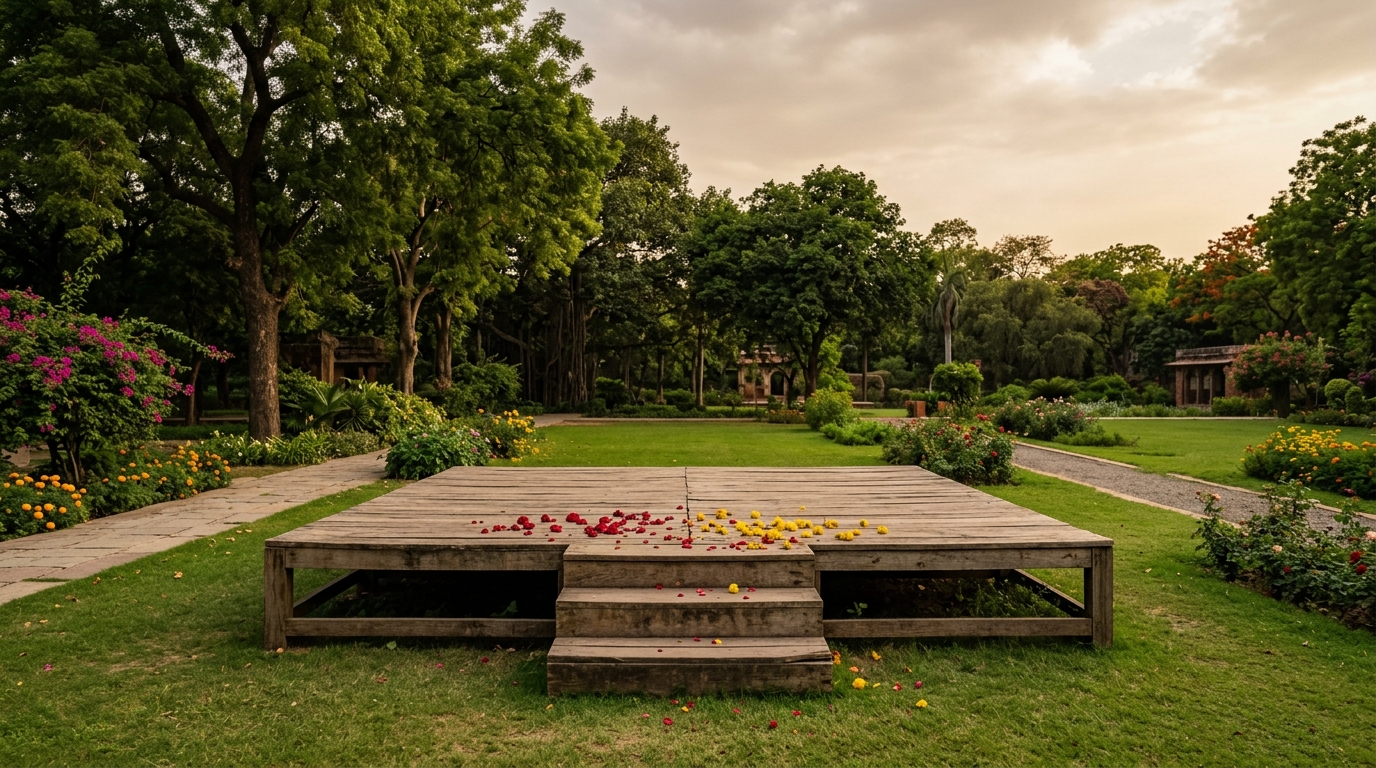
By late 1947, Gandhi relocated to New Delhi. He spent his final 144 days living at Birla House, a large mansion in the capital. The violence weighed heavily on him. British historian Alex von Tunzelmann noted that Gandhi's final days were clouded by deep depression over the violence of Partition. He viewed the bloodshed as a personal failure of his lifelong commitment to nonviolence. You can trace the origins of this commitment in our Timeline of Mahatma Gandhi's Nonviolent Movements in India.
The Rift Between Nehru and Patel
External violence was not the only crisis facing the new nation. A deep political fracture developed inside the Indian cabinet. Prime Minister Jawaharlal Nehru and Deputy Prime Minister Vallabhbhai Patel held sharply different views on how to manage the new state. Nehru favored a secular, accommodating approach toward minorities and neighboring Pakistan. Patel preferred a hardline administrative stance to restore order.
Gandhi acted as the primary mediator between his two closest political allies. The friction between Nehru and Patel distressed him deeply. He believed a public split between the two leaders would fracture the fragile nation. Gandhi scheduled a critical meeting with both men for the evening of January 30. He intended to force a reconciliation. That meeting was interrupted by his assassination.
Why Did Gandhi Undertake His Final Fast?
Gandhi initiated his final fast unto death on January 13, 1948, to force a halt to the relentless communal violence in Delhi. He refused to eat until Hindu, Muslim, and Sikh leaders signed a binding pledge to protect minorities and restore peace across the fractured capital.
January 13: The Fast Begins
The violence in Delhi displaced tens of thousands of Muslims, who took refuge in crowded camps like the Purana Qila. Angry Hindu and Sikh refugees, arriving from Pakistan, demanded the eviction of Muslims from the capital. Gandhi announced he would fast until the violence stopped. He was 78 years old. His health deteriorated rapidly within the first 48 hours.
His demands were highly specific. He required local leaders to guarantee the safety of Muslims in Delhi. He insisted that occupied mosques be returned to Muslim control. He demanded the Indian government release 550 million rupees owed to Pakistan under the partition agreement. The Indian cabinet had withheld these funds due to the ongoing war in Kashmir. Gandhi viewed withholding the money as a breach of national honor.
January 18: A Fragile Peace Pact
The fast placed immense public pressure on political and religious leaders. No faction wanted the responsibility for the Mahatma's death. On January 18, a coalition of over 100 leaders gathered at Birla House. They included representatives from the Hindu Mahasabha and the Rashtriya Swayamsevak Sangh.
These leaders signed a seven-point peace pledge. They promised to protect the life and property of Muslims in Delhi. The Indian government also agreed to release the withheld funds to Pakistan. Satisfied with these guarantees, Gandhi broke his fast by accepting a glass of orange juice from Maulana Abul Kalam Azad. The fast succeeded in calming the city, but it enraged radical Hindu nationalists. They viewed Gandhi's actions as appeasement of Pakistan.
What Was the Shadow of Prior Assassination Attempts?
The shadow of prior assassination attempts is the historical context showing Nathuram Godse's fatal attack was not an isolated incident. Mahatma Gandhi survived five documented assassination attempts dating back to 1934. The five threats highlight the sustained hostility Mahatma Gandhi faced from radical Hindu factions opposing Hindu-Muslim unity efforts.
Five Documented Threats Since 1934
The Mahatma Gandhi Martyrs' Day timeline must account for the decades of danger he navigated. Long before the 1948 shooting, radical groups targeted Gandhi for his inclusive political philosophy. His insistence on eradicating untouchability and treating minorities as equals drew violent opposition.
| Year | Location | Method | Outcome |
|---|---|---|---|
| 1934 | Pune | Bomb thrown at car | Missed target; injured others |
| 1944 | Panchgani | Dagger attack | Thwarted by supporters |
| 1944 | Wardha | Dagger attack | Police intercepted attacker |
| 1946 | Karjat | Train derailment attempt | Train stopped in time |
| Jan 20, 1948 | New Delhi | Bomb detonated at prayer meeting | Detonated far from Gandhi; attacker arrested |
The 1934 attack in Pune marked the first serious attempt on his life. An unidentified assailant threw a bomb at a car believed to be carrying Gandhi. The explosion injured several people, but Gandhi was in a different vehicle. Similar attacks followed in 1944 when a young Nathuram Godse rushed Gandhi with a dagger in Panchgani. Supporters overpowered Godse before he could strike.
The January 20 Bombing at Birla House
The most direct precursor to the assassination occurred just ten days before the fatal shooting. On January 20, 1948, a group of conspirators attempted to kill Gandhi during his evening prayer meeting at Birla House. The group included Nathuram Godse, Narayan Apte, and a Punjabi refugee named Madanlal Pahwa.
Their plan involved throwing a grenade into the crowd to create panic, followed by a direct shooting. Pahwa detonated a gun-cotton slab near the boundary wall. The explosion disrupted the meeting, but the other conspirators lost their nerve and fled. Police arrested Pahwa at the scene. Gandhi remained calm and continued his prayers. The police failed to track down the fleeing conspirators, leaving Godse free to return ten days later.
How Did the Events of January 30, 1948 Unfold?
The final day of the Mahatma Gandhi Martyrs' Day timeline began at 3:30 AM with morning prayers. It ended at exactly 5:17 PM when Nathuram Godse stepped out of the crowd at Birla House, bowed to Gandhi, and fired three point-blank shots into his chest and stomach.
What Was Gandhi's Final Routine from 3:30 AM to 4:00 PM?
Gandhi's final routine from 3:30 AM to 4:00 PM is the sequence of activities on January 30, 1948. Mahatma Gandhi woke at 3:30 AM, drafting a constitution to convert the Indian National Congress into a rural social service organization. Mahatma Gandhi then ate goat's milk and cooked vegetables.
At 4:00 PM, Deputy Prime Minister Vallabhbhai Patel arrived for a scheduled meeting. Mahatma Gandhi and Vallabhbhai Patel spoke privately for one hour. Mahatma Gandhi and Vallabhbhai Patel discussed the mounting friction with Prime Minister Jawaharlal Nehru. Mahatma Gandhi insisted Vallabhbhai Patel and Jawaharlal Nehru must work together for India's survival. Mahatma Gandhi planned to meet with Jawaharlal Nehru later that evening to finalize the reconciliation. The meeting with Vallabhbhai Patel ran long, causing Mahatma Gandhi to be late for the 5:00 PM prayer meeting.
5:17 PM: The Three Fatal Shots
At 5:10 PM, Gandhi left his room and walked toward the prayer grounds at Birla House. He leaned on the shoulders of his grandnieces, Abha and Manu. A crowd of several hundred people waited for him. As Gandhi approached the raised wooden platform, the crowd parted to let him through.
Nathuram Godse stepped forward from the crowd. He greeted Gandhi with folded hands. Manu asked Godse not to delay the Mahatma, as he was already late. Godse pushed Manu aside. He drew a Beretta M1934 semi-automatic pistol from his pocket. At exactly 5:17 PM, Godse fired three shots at point-blank range. The bullets struck Gandhi in the chest and abdomen. Gandhi collapsed to the ground, allegedly uttering the words "Hey Ram." He was carried back into Birla House, where doctors pronounced him dead shortly after.
The Capture of Nathuram Godse
Chaos erupted on the lawns of Birla House immediately after the shooting. Godse did not attempt to flee. He stood his ground and called for the police. The crowd initially froze in shock.
Herbert Reiner Jr., an American vice-consul attending the prayer meeting, was the first person to react. Reiner stepped forward and grabbed Godse by the shoulders. He shoved the assassin toward the military guards standing nearby. The guards and the enraged crowd then swarmed Godse. Police officers eventually secured Godse and transported him to the local station. The swift apprehension prevented the assassin from escaping, ensuring he would face trial for the murder.
The Immediate National and Global Response
The news of Gandhi's assassination sent an immediate shockwave across the globe. National radio broadcast the tragedy within hours, prompting swift international tributes and temporarily halting the communal violence that had plagued India since Partition.
Nehru's Broadcast to the Nation
Prime Minister Jawaharlal Nehru arrived at Birla House shortly after the shooting. He found a massive, grieving crowd gathering outside the gates. Later that evening, Nehru delivered a live radio broadcast to the nation via All India Radio. His speech remains one of the most defining moments in modern Indian history.
Nehru spoke without a prepared script. He told the nation, "The light has gone out of our lives, and there is darkness everywhere." He urged the country to remain calm and to honor Gandhi's legacy by rejecting violence. He confirmed the funeral would take place the following day. This broadcast unified a fractured nation in a moment of profound collective grief. You can explore other defining moments of this era in our guide to the 10 Most Searched Dates in Indian History and Why They Matter.
What Were the Global Shockwaves and Tributes?
The global shockwaves and tributes are the immediate international reactions to Mahatma Gandhi's assassination. The assassination dominated international news headlines on January 30, 1948. American General Douglas MacArthur praised Mahatma Gandhi's commitment to peace, while Pakistan founder Muhammad Ali Jinnah called Mahatma Gandhi a great man.
The United Nations lowered the United Nations flag to half-mast. Pope Pius XII expressed deep sorrow over the assassination. The global response highlighted Mahatma Gandhi's unique position as a moral authority whose influence extended far beyond the borders of India.
The Legacy of January 30
The assassination fundamentally altered the trajectory of Indian politics. Author and contemporary observer Horace Alexander noted that the assassination ironically provided the shock the country needed. The sudden loss of the Mahatma forced angry factions to see the tragic consequences of their violence. Communal riots across India ceased almost immediately.
The Indian government moved quickly to ban radical organizations implicated in the assassination plot. Police arrested thousands of individuals connected to extremist groups. Godse and his co-conspirator Narayan Apte were tried, convicted, and executed by hanging in November 1949. The government transformed Birla House into a national memorial, preserving the exact spot where Gandhi fell. Today, January 30 is officially observed as Martyrs' Day across India.
How Is the Mahatma Gandhi Martyrs' Day Timeline Commemorated Today?
Modern observances of January 30 focus on national reflection and public commitments to nonviolence. The Indian government organizes official ceremonies at Rajghat, the site of Gandhi's cremation, while schools and civic groups host educational programs detailing the events of 1948.
The 78th Anniversary in 2026
January 30, 2026, marked the 78th anniversary of his martyrdom. The government used this milestone to connect Gandhi's historical teachings to contemporary national goals. During the 78th anniversary commemorations in January 2026, Prime Minister Narendra Modi publicly emphasized Gandhi's concept of 'swadeshi' (self-reliance) as the fundamental pillar for modern India's development.
Digital outreach played a major role in the 2026 events. The Ministry of External Affairs hosted a global online broadcast featuring renowned Gandhian scholar Shobhana Radhakrishnan. The program, titled "Mahatma Gandhi's Message of Compassion and Peace: Guiding Humanity in Turbulent Times," reached audiences across fifty countries. These digital initiatives ensure the Mahatma Gandhi Martyrs' Day timeline remains relevant to younger, globally connected generations.
Official Ceremonies at Rajghat
The core of the national observance takes place in New Delhi. Official 2026 Martyrs' Day ceremonies included a Sarva-Dharma Prarthana (multi-faith prayer) at Rajghat. President Droupadi Murmu and Vice President C.P. Radhakrishnan attended the morning service. They laid floral wreaths at the black marble platform marking Gandhi's cremation site.
At exactly 11:00 AM on January 30, a two-minute silence is observed nationwide. Sirens sound across major cities to signal the start and end of the silence. Government offices, schools, and public institutions pause all work to honor Gandhi and other martyrs who died for the nation. For a deeper look at the significance of this memorial site, read our History of Rajghat Memorial.
Related Reading
- Timeline of Mahatma Gandhi's Nonviolent Movements in India
- The Dandi March Day-by-Day: A Timeline of the 1930 Salt Satyagraha
- India at the Olympics: A Timeline of Historic Sporting Milestones
- December 1984: A Historical Timeline of the Bhopal Gas Tragedy
FAQ
Q: When is Martyrs' Day observed in India?
Martyrs' Day (Shaheed Diwas) is observed annually on January 30. This date marks the anniversary of Mahatma Gandhi's assassination in 1948.
Q: Who assassinated Mahatma Gandhi?
Nathuram Godse, a radical Hindu nationalist, assassinated Gandhi. He believed Gandhi's policies overly favored Muslims and appeased the newly formed state of Pakistan.
Q: What weapon was used in the assassination?
Godse used a Beretta M1934 semi-automatic pistol. He fired three shots at point-blank range into Gandhi's chest and abdomen.
Q: Where was Gandhi assassinated?
The assassination took place on the grounds of Birla House in New Delhi. The mansion has since been converted into a museum called Gandhi Smriti.
Q: Why was Gandhi fasting before his death?
Gandhi began his final fast on January 13, 1948, to protest the ongoing communal violence in Delhi. He broke the fast on January 18 after local leaders signed a pledge guaranteeing the safety of minorities.
Listen to the original All India Radio broadcast of Jawaharlal Nehru's "The light has gone out" speech to fully grasp the immediate emotional impact of January 30, 1948.
Sources
- Assassination of Mahatma Gandhi — Wikipedia, 2024. Supports: Mahatma Gandhi was assassinated on January 30, 1948, at 5:17 PM at Birla House.
- Beretta M1934 — Wikipedia, 2024. Supports: Nathuram Godse used a Beretta M1934 pistol to fire the fatal shots.
- Herbert Reiner Jr. — Wikipedia, 2024. Supports: American diplomat Herbert Reiner Jr. physically apprehended the assassin moments after the gunfire.
- Gandhi's Last Fast is a Lesson for India's Present — The Wire, 2025. Supports: Gandhi initiated his final fast on January 13, 1948, to halt communal violence and demand the release of 550 million rupees owed to Pakistan.
- Assassination of Mahatma Gandhi — Wikipedia, 2024. Supports: Madanlal Pahwa detonated a bomb near the boundary wall at Birla House on January 20, 1948, as part of a prior assassination attempt.