The History of Print Media in India: Historic Dates in Early Journalism
TL;DR
The history of print media in India began in 1780 with James Augustus Hicky’s Bengal Gazette. It quickly evolved from a tool for British expatriates into a powerful platform for Indian social reform and political independence. Regional language newspapers later mobilized the masses against colonial rule.
Key Takeaways
- The Bengal Gazette launched in 1780 as India's first printed newspaper.
- Raja Ram Mohan Roy pioneered regional journalism to drive social reform.
- Early censorship laws forced Indian publishers to develop creative legal workarounds.
- Nationalist leaders used daily newspapers to unify citizens during the independence struggle.
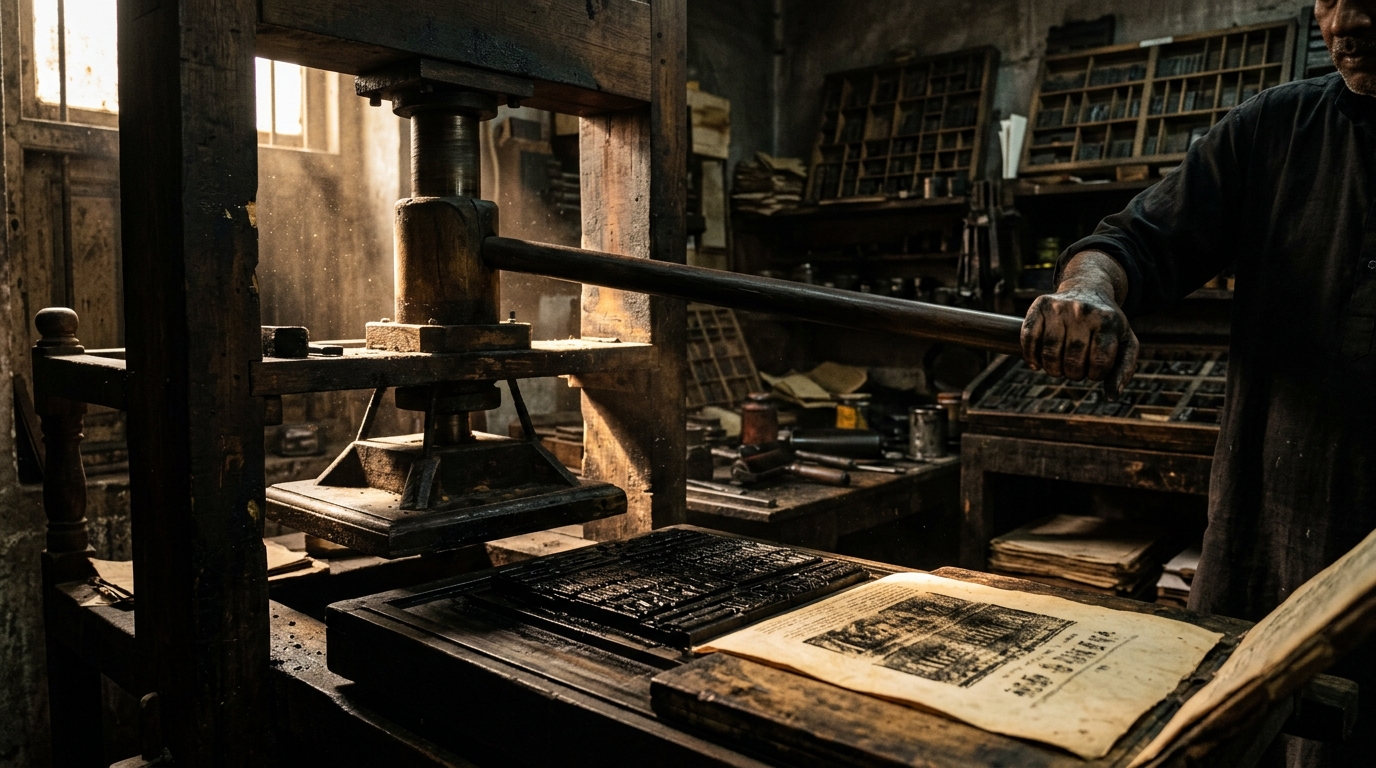
Walk into the quiet archives of the Asiatic Society in Kolkata, and you smell the distinct scent of decaying paper and old ink. Behind glass cases sit the fragile, yellowed broadsheets of the late 18th century. These dense columns of text, printed on hand-cranked wooden presses, sparked a communication revolution. When you view digital scans of these early papers—often tagged in modern archives with detailed image descriptions to aid visual search—you see the raw beginnings of mass communication. The history of print media in India starts right here, in these quiet rooms, with rebellious editors who dared to challenge the East India Company.
How did the history of print media in India actually begin?
The history of print media in India began when the British East India Company brought printing presses to the subcontinent. While initially used strictly for official documents, independent printers soon realized the potential for public news. This led to the creation of the country's first commercial newspaper in 1780.
The Arrival of the Printing Press
Printing technology arrived in India long before the first newspaper. Portuguese missionaries brought the first printing press to Goa in 1556. They printed religious texts and catechisms to spread Christianity. You can read more about this era in our guide to the Portuguese Era in Goa: Key Dates and Architectural Milestones.
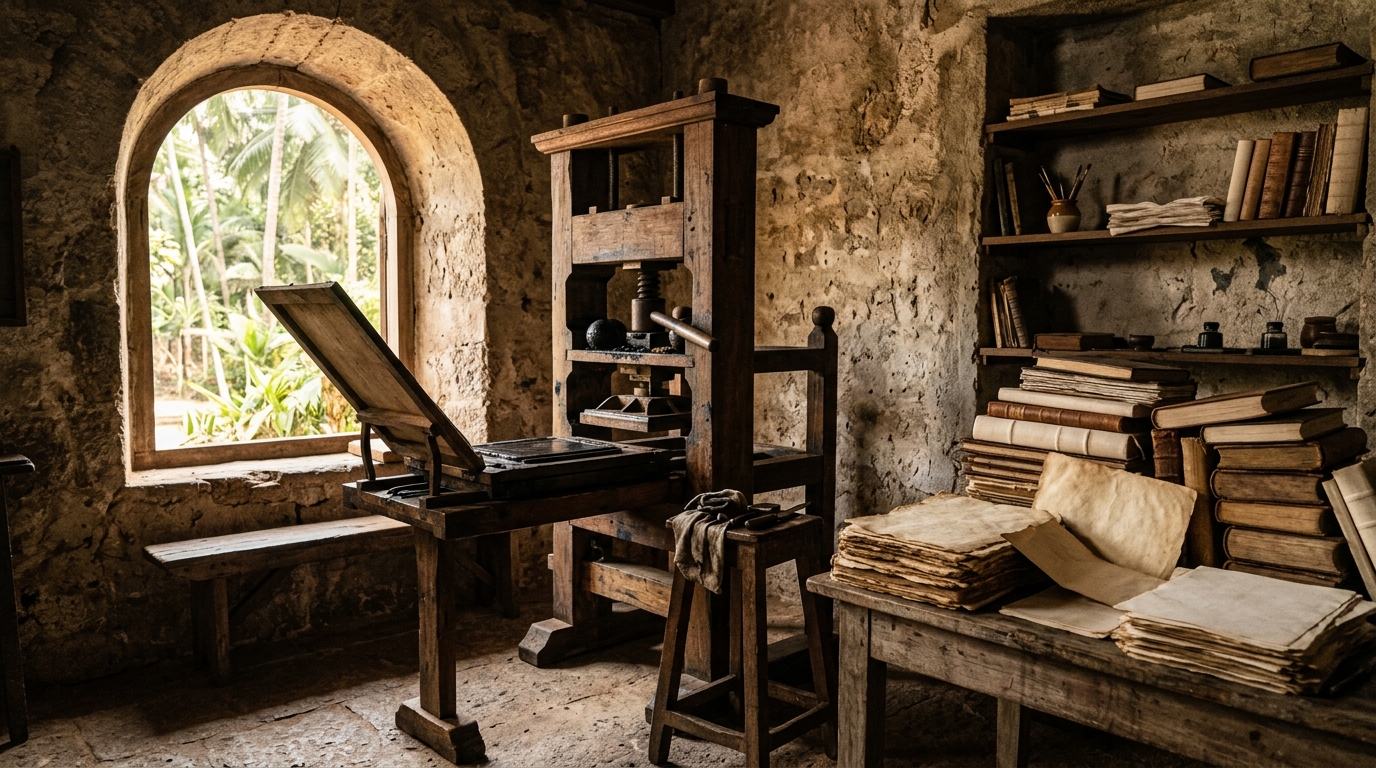
Over a century later, the East India Company set up its own press in Bombay in 1684. For nearly a hundred years, these machines only produced government decrees, military orders, and religious tracts. No one printed news. The ruling authorities had no interest in sharing information with the public. They actively discouraged independent printing to maintain tight control over the flow of information.
James Augustus Hicky and the Bengal Gazette
On January 29, 1780, an eccentric Irishman named James Augustus Hicky changed the landscape of Indian communication. He launched Hicky's Bengal Gazette, also known as the Original Calcutta General Advertiser. It was a two-page weekly paper. Hicky filled it with local gossip, advertisements, and sharp criticism of Governor-General Warren Hastings.
Hicky operated his press with a fierce sense of independence. He famously declared that he printed the paper to purchase freedom for his mind and soul. His relentless attacks on the East India Company's corruption infuriated the colonial administration. The paper lasted only two years before the government seized his press and threw him in jail. Still, Hicky proved that independent journalism could exist in India. He set a precedent of defiance that future publishers would follow.
The Immediate Aftermath and New Publications
Hicky's dramatic exit did not stop the momentum. Other British expatriates quickly filled the void. The Calcutta Gazette launched in 1784, followed by the Bengal Journal in 1785 and the Madras Courier in 1785. These early papers catered exclusively to the British community. They published news from Europe, shipping schedules, and parliamentary debates. They rarely covered Indian society. Yet, the physical infrastructure of printing was now firmly established on Indian soil.
Why was the rise of regional language newspapers so crucial?
English newspapers only reached a tiny fraction of the population. Regional language journalism translated complex political and social issues into the daily languages of the Indian public. This shift transformed the press from an elite British hobby into a mass movement for Indian self-awareness.
Raja Ram Mohan Roy and the Bengali Press
Raja Ram Mohan Roy stands as a foundational figure in Indian history. He recognized that true social change required communicating directly with the people. In 1821, he launched Sambad Kaumudi, a Bengali weekly newspaper. He used this platform to campaign against the practice of Sati and advocate for scientific education.
Roy did not stop at Bengali. In 1822, he started Mirat-ul-Akbar in Persian, which was the language of the educated elite across many parts of India. These publications set a new standard. They proved that newspapers could do more than report shipping news. They could actively campaign for the betterment of society.
The Expansion into Hindi and Urdu
The push for regional journalism quickly spread beyond Bengal. In 1822, Fardunjee Marzban launched the Bombay Samachar in Gujarati. It focused heavily on commercial news for the merchant community. Remarkably, it is the oldest continuously published newspaper in India today.
Hindi journalism found its start a few years later. Jugal Kishore Shukla published Udant Martand in 1826 from Calcutta. It was the first Hindi newspaper. Shukla faced immense challenges. He had to pay high postal rates to send the paper to Hindi-speaking regions, which eventually forced the publication to close. Meanwhile, the Urdu press flourished with papers like Jam-i-Jahan-Numa, which also launched in 1822.
Reaching the Masses Beyond English
Regional papers changed the entire dynamic of public discourse. When people read news in their own language, they engage differently. They debate the issues in local tea shops and town squares. Regional papers discussed local grievances, oppressive taxation, and social inequalities. This created a shared consciousness among ordinary citizens. It laid the groundwork for a unified national identity that would become vital in the decades to follow.
How did early censorship shape the history of print media in India?
Censorship forced Indian journalists to become highly strategic and resilient. Every time the colonial government passed a new gagging law, publishers found creative legal workarounds to keep printing. This constant friction built a strong tradition of press freedom.
The East India Company's Gagging Acts
The colonial government viewed the press with deep suspicion. In 1799, Lord Wellesley enacted the Censorship of Press Act. He feared that the French might use local newspapers to track British troop movements. This act required all newspapers to submit their content to a government secretary for approval before printing.
The rules tightened again in 1823. John Adams introduced the Licensing Regulations. These rules made it a criminal offense to start or operate a printing press without a government license. Raja Ram Mohan Roy fiercely protested this law. He argued that a free state required a free press. When his petitions failed, he shut down Mirat-ul-Akbar in protest rather than submit to the licensing regime.
The Metcalfe Act and Temporary Relief
The strict rules of 1823 did not last forever. In 1835, Charles Metcalfe took over as acting Governor-General. He believed that suppressing information caused more harm than good. Metcalfe repealed the licensing regulations and passed the Press Act of 1835. This act simply required printers to declare the location of their presses.
This period of relative freedom caused a massive boom in publishing. Hundreds of new regional and English papers launched. Metcalfe earned the title "Liberator of the Indian Press." However, this golden era ended abruptly when the 1857 rebellion forced the British government to clamp down on all forms of communication.
The Vernacular Press Act of 1878
The most infamous censorship law arrived in 1878. Lord Lytton introduced the Vernacular Press Act specifically to target regional language newspapers. The government was spending heavily on the Second Afghan War, and regional papers were loudly criticizing the expense while Indians faced famine.
The act allowed district magistrates to confiscate printing presses without a court order if a paper published "seditious" material. It applied only to non-English papers. The Amrita Bazar Patrika, a fierce Bengali nationalist paper, executed a brilliant workaround. To avoid the law, the publishers bought English type and converted the paper into an English-language daily overnight. The government eventually repealed the act in 1881, but the anger it generated helped fuel the growing nationalist movement.
What role did the press play during the Indian independence movement?
The press served as the primary organizing tool for the Indian independence movement. Leaders used newspapers to expose colonial exploitation, announce protests, and build a unified national identity. Print media turned isolated regional protests into a coordinated national campaign against British rule.
Journalism as a Tool for Reform
By the late 19th century, journalism and political activism were inseparable. Almost every major leader of the independence movement worked as an editor or publisher. Bal Gangadhar Tilak launched two highly influential papers in 1881: Kesari in Marathi and Mahratta in English. Tilak used these papers to demand absolute self-rule. His fiery editorials frequently landed him in prison for sedition, but his arrests only increased his paper's circulation.
Other legendary publications emerged during this time. The Hindu started as a weekly in 1878 in Madras to protest the discriminatory policies of the local administration. It became a daily in 1889. These papers provided detailed analyses of British economic exploitation, giving local activists the data they needed to argue for independence.
Mahatma Gandhi's Print Campaigns
Mahatma Gandhi understood the power of the press better than almost anyone. He relied heavily on print to communicate his philosophy of nonviolence. He edited several influential journals, including Young India, Navajivan, and Harijan. You can explore the timeline of his efforts in our guide to Mahatma Gandhi's Nonviolent Movements in India.
Gandhi did not accept advertisements in his papers. He believed commercial interests would compromise his editorial independence. He used his columns to explain the rationale behind his boycotts and fasts. When he planned major actions, he used the press to coordinate the masses. During the 1930 Salt Satyagraha, newspapers tracked his daily progress, turning a local march into a global news event. Read more about this specific event in our Dandi March Day-by-Day Timeline.
Unifying a Fractured Nation
India is a vast geography with dozens of major languages and distinct regional cultures. The British often exploited these divisions to maintain control. The nationalist press actively worked to bridge these gaps. Editors translated articles from other regions. They reported on protests happening thousands of miles away. If a strike happened in Bombay, readers in Calcutta knew about it within days. This shared information ecosystem convinced ordinary citizens that they were part of a single, massive movement.
How did printing technology evolve during the early days of Indian journalism?
Early Indian journalism relied on slow, manual wooden presses that limited circulation. As demand for news grew, publishers imported cast-iron presses and eventually steam-powered machines. This technological shift dramatically lowered printing costs and allowed daily newspapers to reach thousands of readers.
From Wooden Hand Presses to Iron
James Augustus Hicky printed the Bengal Gazette on a wooden hand press. These machines required immense physical labor. Two men working together could only print about 200 sheets an hour. The type was set by hand, letter by letter. This slow process meant early newspapers were expensive and had very small circulations.
By the 1830s, Indian printers began importing cast-iron presses like the Stanhope and the Columbian. These metal presses could apply more even pressure, resulting in clearer text. They were also faster and more durable. As the technology improved, the cost of printing dropped. This allowed publishers to drop the price of their newspapers, bringing them within reach of the middle class.
The Introduction of Lithography
Typesetting worked well for English and regional languages with distinct, separate characters. It did not work well for Urdu. The flowing, cursive script of Urdu calligraphy (Nastaliq) was nearly impossible to recreate with movable metal type.
The introduction of lithography solved this problem. Lithography involves writing directly onto a smooth limestone block with oil-based ink. The stone is treated with chemicals, inked, and pressed onto paper. This allowed Urdu publishers to hire skilled calligraphers to write out the newspaper by hand, and then print thousands of copies. This technological leap spurred a massive expansion of the Urdu press in cities like Delhi and Lucknow. You can learn more about how these technical shifts shaped early media in our suggested guide to early Indian printing technologies.
The Shift to Daily Circulation
As the 19th century progressed, steam-powered rotary presses arrived in India's major port cities. These machines fed continuous rolls of paper through spinning cylinders, printing thousands of copies per hour. Combined with the expansion of the railway and the telegraph network, this technology allowed newspapers to become daily operations. Publishers could receive news via telegraph in the evening, print it overnight on steam presses, and put it on trains by morning.
What are the most significant dates in early Indian journalism?
The timeline of early Indian journalism is marked by firsts: the first English paper, the first regional publications, and the first major censorship laws. Tracking these specific dates reveals how quickly the press evolved from local newsletters to national institutions.
1780 to 1826: The Foundational Years
The first few decades established the basic formats and proven demand for news across different languages.
| Year | Milestone Event | Historical Significance |
|---|---|---|
| 1780 | Launch of Bengal Gazette | James Augustus Hicky prints India's first newspaper. |
| 1821 | Launch of Sambad Kaumudi | Raja Ram Mohan Roy starts the first reformist Bengali paper. |
| 1822 | Launch of Bombay Samachar | Fardunjee Marzban starts what becomes India's oldest continuously operating paper. |
| 1826 | Launch of Udant Martand | Jugal Kishore Shukla publishes the first Hindi language newspaper. |
1857 to 1878: Rebellion and Regulation
The middle of the 19th century saw intense conflict between the press and the colonial government. You can see how these years rank in historical interest in our post on the 10 Most Searched Dates in Indian History and Why They Matter.
| Year | Milestone Event | Historical Significance |
|---|---|---|
| 1857 | The Gagging Act passed | Government severely restricts press freedom during the 1857 rebellion. |
| 1868 | Launch of Amrita Bazar Patrika | Sisir Kumar Ghosh and Motilal Ghosh launch a fierce nationalist paper. |
| 1878 | Launch of The Hindu | Started in Madras to counter pro-British local reporting. |
| 1878 | Vernacular Press Act passed | Lord Lytton attempts to crush regional language journalism. |
1881 and Beyond: The Nationalist Voice Solidifies
As the 20th century approached, the press became fully integrated with the political struggle for independence.
| Year | Milestone Event | Historical Significance |
|---|---|---|
| 1881 | Launch of Kesari | Bal Gangadhar Tilak starts his Marathi paper to demand self-rule. |
| 1881 | Repeal of Vernacular Press Act | Public pressure forces the government to restore regional press freedom. |
| 1889 | The Hindu becomes a daily | Marks the maturation of the nationalist daily press. |
Related Reading
- India at the Olympics: A Timeline of Historic Sporting Milestones
- Milestones in Indian Women's History: A Chronological Guide
- 1,000 Years of Indian Medical History: A Chronological Guide
- Economic Milestones in Indian History: From 1947 to Present
FAQ
Q: What was the first newspaper published in India? James Augustus Hicky launched Hicky's Bengal Gazette on January 29, 1780. It was a two-page English weekly published in Calcutta that heavily criticized the East India Company.
Q: Who is considered the pioneer of Indian language journalism? Raja Ram Mohan Roy is widely considered the pioneer. He launched the Bengali newspaper Sambad Kaumudi in 1821 and the Persian newspaper Mirat-ul-Akbar in 1822 to drive social reform.
Q: Why did the British introduce the Vernacular Press Act in 1878? The colonial government introduced the act to silence regional language newspapers that were criticizing British economic policies. It allowed authorities to confiscate printing presses without a court order.
Q: Is the Bombay Samachar still being published today? Yes. Launched in 1822 by Fardunjee Marzban as a Gujarati weekly, Bombay Samachar (now Mumbai Samachar) is the oldest continuously published newspaper in India.
Search your local library's digital archives today for a scanned copy of an early Indian newspaper like the Bengal Gazette or Amrita Bazar Patrika. Read the letters to the editor and the advertisements to see exactly what daily life and political tension looked like a century ago.