The First Votes: A Historical Timeline of India's 1951 General Election
The Quick Read
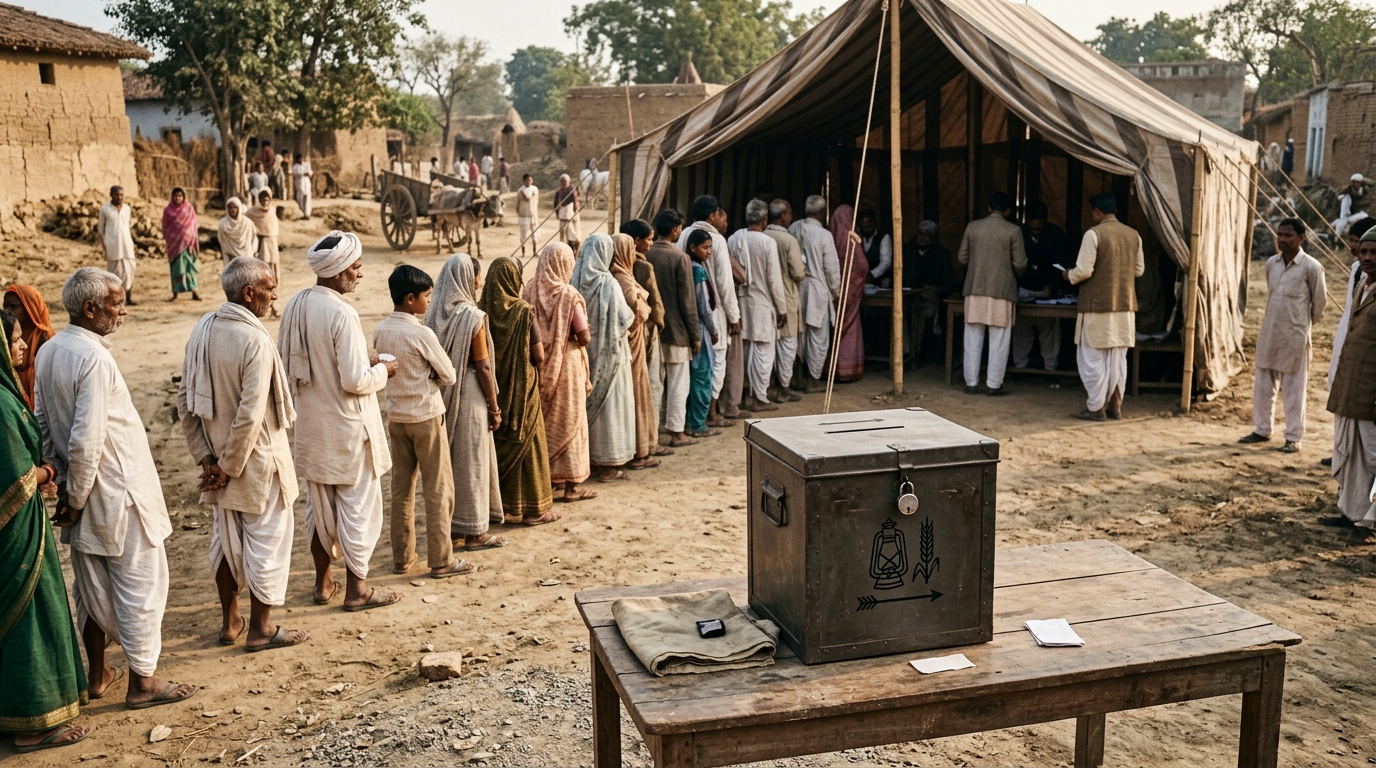
India first general election history spans from October 1951 to February 1952, marking the largest democratic exercise ever attempted at the time. The Election Commission registered 173 million voters, built 196,000 polling booths, and used pictorial symbols on ballot boxes to help a largely illiterate population vote successfully.
Key Takeaways
- The 1951–1952 election enfranchised 173 million citizens under universal adult suffrage.
- Chief Election Commissioner Sukumar Sen engineered the massive, unprecedented logistical rollout.
- Pictorial ballot boxes solved the challenge of an 84 percent illiterate electorate.
- Voting took four months due to extreme geography, weather, and infrastructure limits.
- The Indian National Congress won a sweeping mandate, securing 364 parliamentary seats.
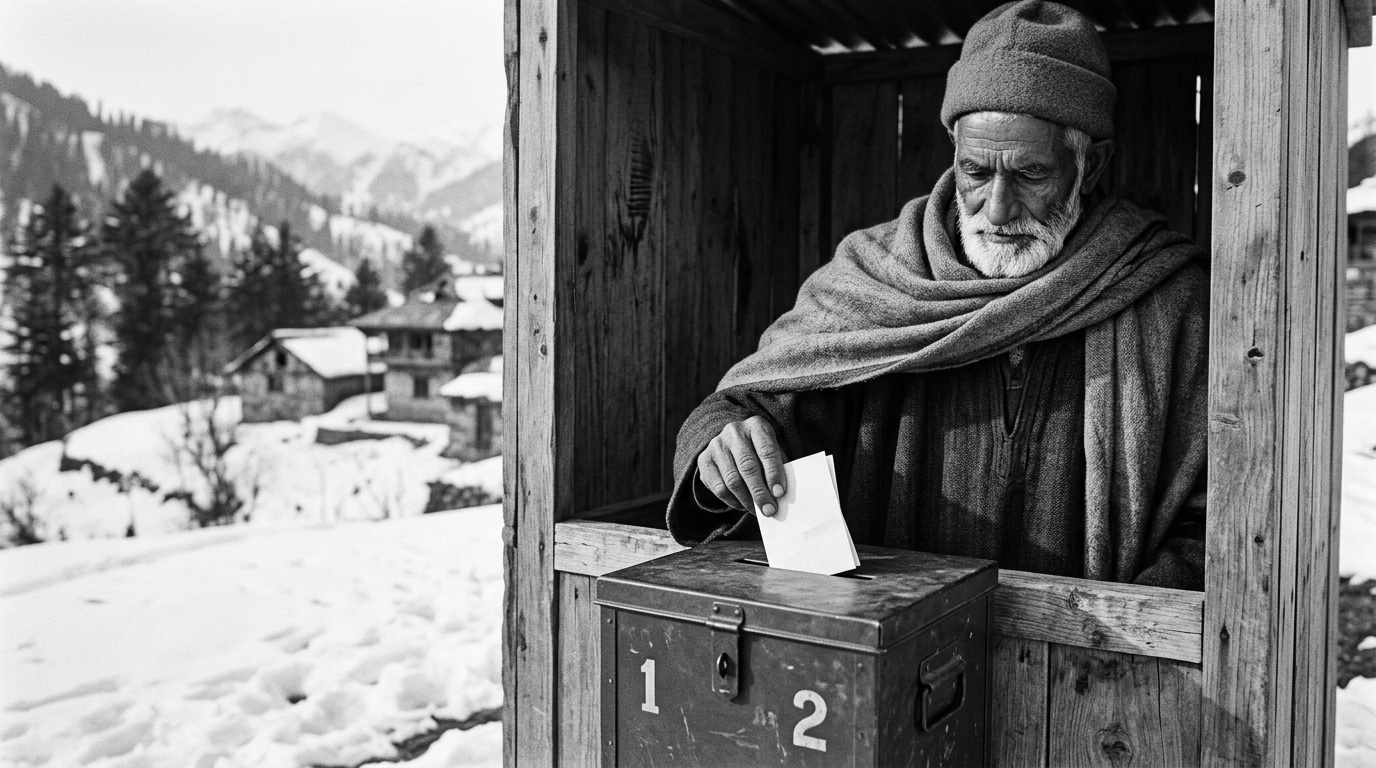
In the freezing hills of Chini, Himachal Pradesh, Shyam Saran Negi stepped into a makeshift polling booth on October 25, 1951. He dropped his blank ballot slip into a steel box marked with a pair of bullocks. With that simple motion, Negi cast the very first vote in a newly independent republic.
Western observers doubted the new nation could pull this off. India was massive, impoverished, and divided by language and geography. Literacy hovered around 16 percent. Many critics expected the democratic experiment to collapse before the votes were even counted. Understanding India first general election history requires looking past the political speeches and focusing on the sheer mechanics of the event.
The Election Commission had to build a system from scratch. They mapped constituencies across newly integrated princely states. They trained a million poll workers. They figured out how to let voters choose candidates without reading names on a ballot. The resulting system laid a foundation that still supports the world's largest democracy today.
Setting the Stage for Universal Suffrage
Preparing for the election required building a democratic infrastructure completely from scratch. The newly formed Election Commission mapped constituencies, printed millions of ballots, and registered a massive, diverse population across newly integrated states and rugged geographic territories.
The Role of Sukumar Sen
Sukumar Sen served as India's first Chief Election Commissioner. He took office in March 1950 and faced an impossible deadline. Politicians wanted elections immediately. Sen insisted on waiting until the administrative machinery was ready. He understood that a rushed election would fail, and a failed first election would doom the republic.
Sen managed a staff that had to identify and register 173 million adults aged 21 and older. This process revealed deep social challenges. In many regions, women refused to give their proper names to enumerators. They registered as "A's mother" or "B's wife." Sen struck 2.8 million of these entries from the rolls. He ordered officials to register women only by their actual names. This controversial move forced a massive cultural shift toward recognizing women as individual citizens.
Mapping the Electorate
Drawing electoral boundaries was another massive hurdle. The Delimitation Commission had to divide the country into 401 parliamentary constituencies and 3,283 state assembly constituencies. They based these lines on the 1951 census data.
The geography of India complicated everything. Teams surveyed dense forests in Assam, vast deserts in Rajasthan, and remote islands in the Indian Ocean. They had to ensure every citizen lived within a reasonable walking distance of a polling booth. The commission ultimately set up 196,084 polling stations. This network ensured that even isolated communities had a voice in the new government.
How Did They Count Votes in 1951?
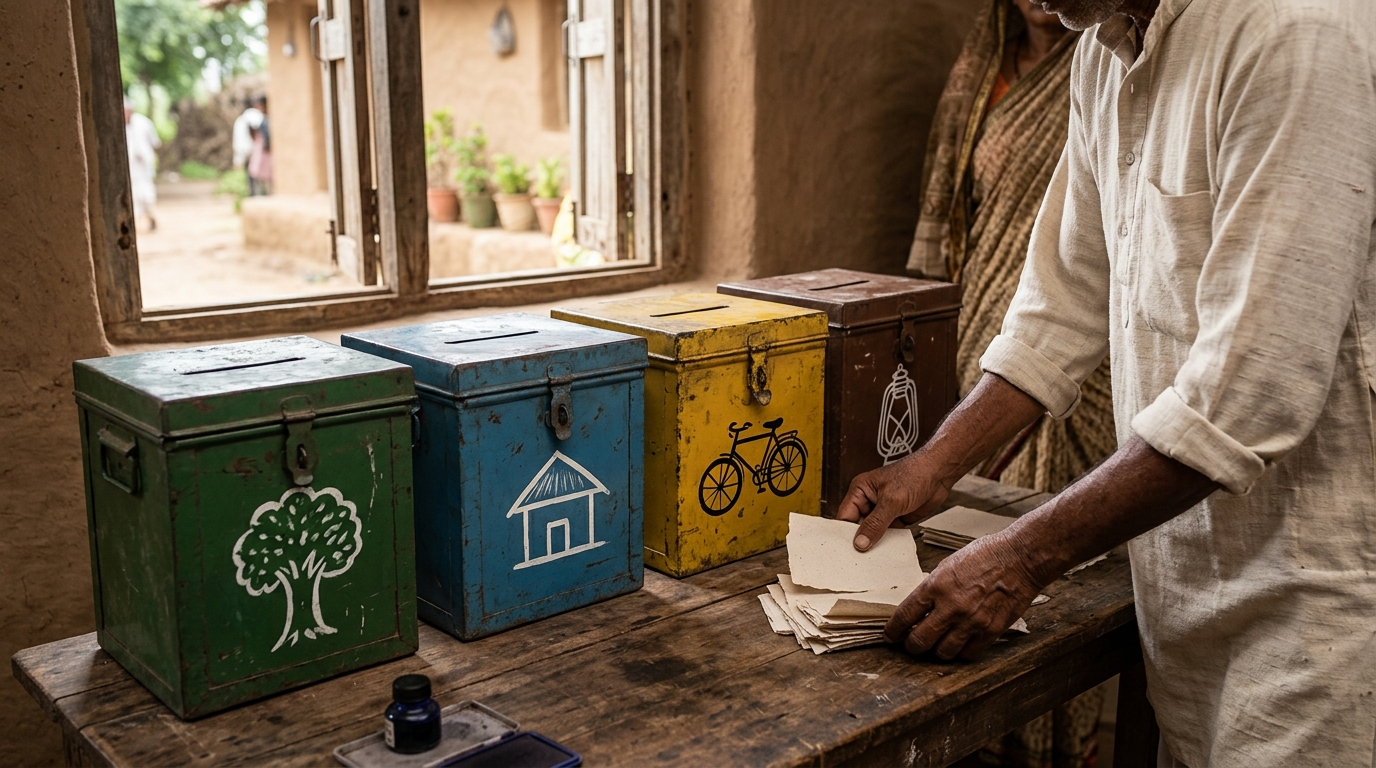
The Election Commission used a unique system of colored boxes with party symbols painted on them instead of printed ballots with candidate names. This simple visual system allowed illiterate voters to drop a blank slip into the box corresponding to their chosen party.
The Pictorial Symbol System
A major chapter in India first general election history involves the logistical solution to high illiteracy. You cannot hand a written ballot to a voter who cannot read. The Election Commission assigned distinct, easily recognizable symbols to each political party.
The Indian National Congress received the symbol of two bullocks with a yoke. The Communist Party of India used ears of corn and a sickle. The All India Forward Bloc used a lion. Inside the voting booth, voters found a row of steel boxes. Each box bore a different symbol. The voter simply took a uniform blank pink paper slip and dropped it into the box of their preferred candidate. This system protected voter secrecy and eliminated the need for reading skills.
Manufacturing Millions of Ballot Boxes
The symbol system required a separate ballot box for every candidate at every polling station. The Election Commission ordered over two million steel boxes. The Godrej company manufactured the bulk of these boxes in their Mumbai factories.
Workers produced 15,000 boxes a day at the peak of production. The boxes featured a tamper-proof locking mechanism. Once a ballot dropped inside, the box could not be opened without breaking a visible paper seal.
To prevent people from voting multiple times, scientists at the Council of Scientific and Industrial Research (CSIR) developed an indelible ink. Poll workers painted a stripe of this silver nitrate-based ink on the voter's left index finger. The ink stained the skin and nail for weeks. The Election Commission used 389,816 phials of this ink during the first election.
The Timeline of India First General Election History
The voting process stretched across four months, beginning in October 1951 in remote mountainous regions before winter blocked the passes. The rest of the country voted in staggered phases through January and February 1952.
October 1951: The First Votes Cast
The Election Commission started the process in the upper reaches of Himachal Pradesh. Heavy snow blocks these mountain passes by late November. If the commission waited for the rest of the country, these northern villages would miss their chance to vote.
Polling opened in the Chini and Pangi tehsils on October 25, 1951. Turnout was high despite the freezing temperatures. Poll workers trekked for days on foot and horseback to deliver the steel boxes and pink slips to these remote outposts. This early start tested the protocols that would soon roll out across the subcontinent.
January to February 1952: The Nationwide Rollout
The bulk of the country voted between December 1951 and February 1952. The logistics required moving mountains of supplies. Elephants carried ballot boxes through the jungles of Northeast India. Camels transported poll workers across the Thar Desert. Boats navigated the backwaters of Kerala.
The timeline of India first general election history shows a carefully choreographed dance of resources. Security forces and poll workers moved from state to state as voting wrapped up in one region and began in another. The sheer scale makes it one of the 10 Most Searched Dates in Indian History and Why They Matter.
Key Election Dates and Phases
| Date Range | Region / Milestone | Significance |
|---|---|---|
| Oct 25, 1951 | Himachal Pradesh (Chini/Pangi) | First votes cast before winter snow blocked mountain passes. |
| Dec 10, 1951 | Travancore-Cochin | First major southern state begins its polling phases. |
| Jan 1952 | Central and Northern Plains | Peak voting period for the majority of the Indian population. |
| Feb 21, 1952 | Nationwide | Final polling stations close across the country. |
| April 1952 | New Delhi | The first democratically elected Lok Sabha officially convenes. |
What Were the Major Political Forces?
The Indian National Congress dominated the political landscape, but several opposition parties actively contested the elections. These included the Communist Party of India, the Socialist Party, and regional coalitions that tested the new democratic waters.
The Dominance of Congress
The Indian National Congress entered the election with massive momentum. They were the party of independence. Prime Minister Jawaharlal Nehru served as their star campaigner. He covered nearly 40,000 kilometers by plane, train, and automobile. He addressed an estimated 20 million people during his campaign rallies.
The party capitalized on the legacy detailed in the Timeline of Mahatma Gandhi's Nonviolent Movements in India. Voters recognized the Congress leaders as the architects of their freedom. The party fielded candidates in almost every constituency, leveraging a deep grassroots network that no other political group could match.
The Rise of the Opposition
Despite Congress's dominance, a vibrant opposition emerged. Fifty-three political parties contested the national elections. Fourteen of these received recognition as national parties.
The Communist Party of India (CPI) ran a strong campaign in southern and eastern states. They focused on land reform and workers' rights. Meanwhile, the Socialist Party, led by figures like Jayaprakash Narayan, offered a democratic alternative to Congress's centrist policies.
Dr. B.R. Ambedkar revived the Scheduled Castes Federation to fight for Dalit representation. You can trace his political strategy during this period in Dr. B.R. Ambedkar's Life: A Chronological Timeline of Legacy. Syama Prasad Mookerjee launched the Bharatiya Jana Sangh, laying the early groundwork for right-wing politics in India. These opposition groups won few seats, but they established the multi-party framework that defines Indian politics today.
The Results and Democratic Legacy
The final results cemented India first general election history as a massive success. The turnout exceeded 45 percent, proving a massive, impoverished nation could execute democratic elections and stabilize its political future for decades.
Counting the Ballots
Counting millions of paper slips took weeks. Poll workers opened the sealed steel boxes under the watchful eyes of party agents. They counted the slips manually.
The Indian National Congress won a landslide victory. They secured 364 of the 489 Lok Sabha seats and 45 percent of the total vote. The Communist Party of India emerged as the largest opposition group, winning 16 seats. The Socialist Party won 12 seats.
Several prominent leaders faced surprising defeats. Dr. B.R. Ambedkar lost his constituency in Bombay. Acharya Kripalani, a former Congress president who formed his own party, also lost. The voters showed they were willing to reject established figures, proving the democratic process was functioning independently of mere hero worship. Historian Ramachandra Guha notes in his work India After Gandhi that the election was a leap in the dark that landed safely.
A Blueprint for the Future
The 1951 election created a template for the future. The Election Commission retained the symbol system, the indelible ink, and the phased voting schedule.
When studying India first general election history, the administrative triumph stands out as much as the political outcome. Sukumar Sen and his team proved that poverty and illiteracy do not disqualify a population from self-governance. They established the Election Commission as a fiercely independent body.
This success inspired other post-colonial nations. It demonstrated that universal adult franchise could work outside the wealthy, industrialized West. For a deeper look at how this foundation shaped subsequent growth, you can review the Economic Milestones in Indian History: From 1947 to Present. The political stability achieved in 1952 allowed the government to launch its first Five-Year Plan and begin modernizing the economy.
Related Reading
- India at the Olympics: A Timeline of Historic Sporting Milestones
- Milestones in Indian Women's History: A Chronological Guide
- 1,000 Years of Indian Medical History: A Chronological Guide
- Economic Milestones in Indian History: From 1947 to Present
FAQ
Q: How many people voted in India's first election? The Election Commission registered approximately 173 million eligible voters. Around 105.9 million people actually cast their ballots, resulting in a voter turnout of 45.7 percent.
Q: Who was the first person to vote in independent India? Shyam Saran Negi, a school teacher from Kalpa in Himachal Pradesh, cast the first vote on October 25, 1951. His region voted early because heavy winter snow would soon block access to his village.
Q: Why did the first election take four months? The massive scale, difficult terrain, and limited infrastructure required a phased approach. Poll workers and security forces had to travel physically between regions to manage the 196,000 polling stations.
Q: How did illiterate citizens vote in 1951? The Election Commission assigned visual symbols to each political party. Voters simply dropped a blank paper slip into a steel ballot box painted with the symbol of their chosen candidate.
Read through the current roster of your local political representatives and identify the specific visual symbols their parties use on the ballot today.