In Short
The history of international schools in India begins in 1854, when Woodstock School opened in Mussoorie for missionary families. Hill-station schools in Ooty and Kodaikanal followed by 1901. Schools for diplomats' children came in the 1950s. After the 1991 reforms, international schools spread to cities. India had 972 of them by 2025, according to ISC Research.
Key Takeaways
- India's oldest international-style boarding school, Woodstock, opened in Mussoorie in 1854.
- Before the 1990s, India's international schools were found only in hill stations.
- Kodaikanal International School became India's first IB school in the mid-1970s.
- Student bodies shifted from missionary children to diplomats' children to Indian families.
- Several founding dates conflict across sources, so check primary records before citing.
Many people believe international schools in India began with the city campuses of the 1990s and 2000s. That belief is wrong. The oldest one opened in 1854, which is 137 years before economic liberalisation. It sat in a Himalayan hill town, and it served the children of missionaries. The full story runs across three centuries and three very different groups of students. This guide lays out that story date by date, the same way our daily cards do. If you're new to studying history this way, our guide on learning Indian history through chronological timelines explains the method.
The history of international schools in India starts in the hill stations
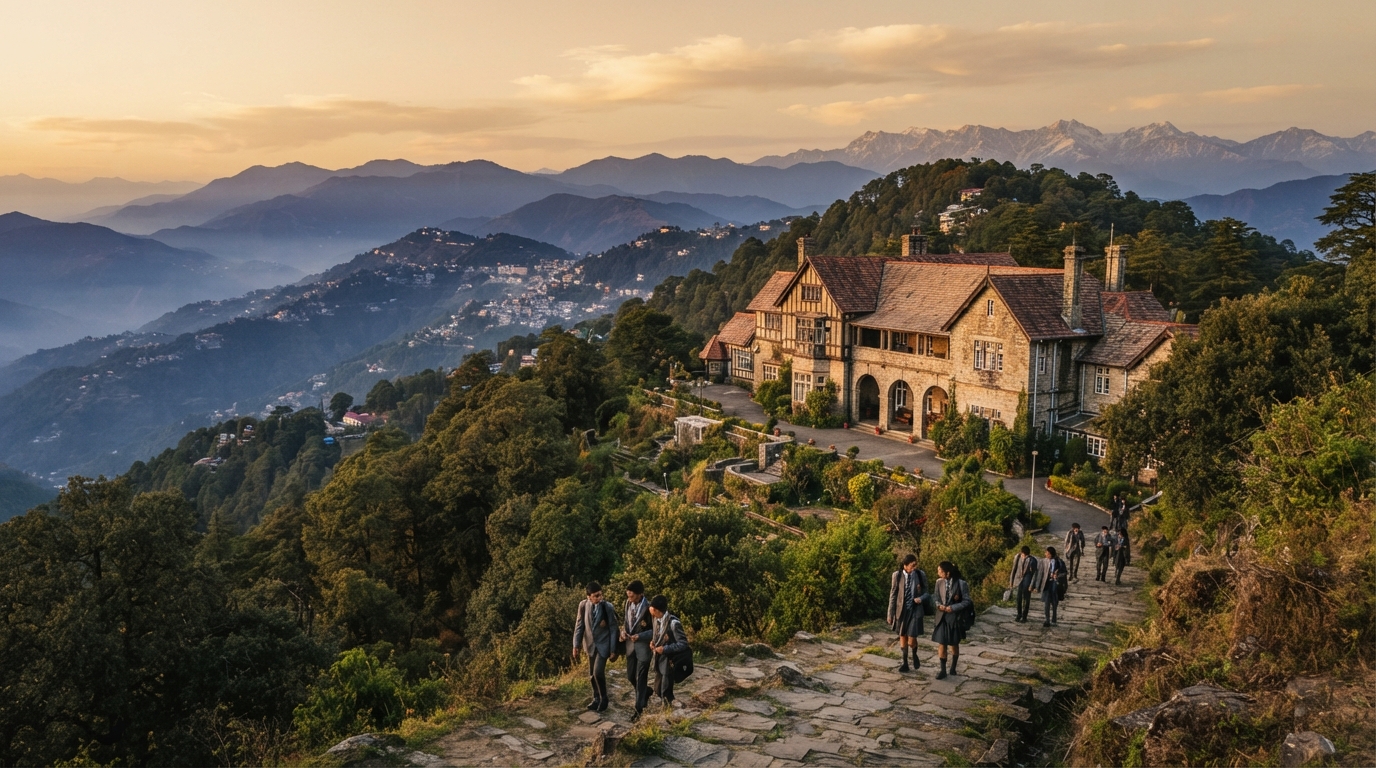
The history of international schools in India starts in three cool, high-altitude towns: Mussoorie, Ooty and Kodaikanal. Between 1854 and 1901, schools opened there for the children of foreign missionaries working across India. Their location, curriculum and student body set the pattern for the next 90 years.
Woodstock School, Mussoorie (1854)
Woodstock School is a school in Mussoorie, in the Himalayan foothills of present-day Uttarakhand, that opened in 1854. Woodstock School began as a place for missionary families to educate their children in India without sending them back to Europe or North America. School directories describe Woodstock as the first international boarding school in India and in all of Asia.
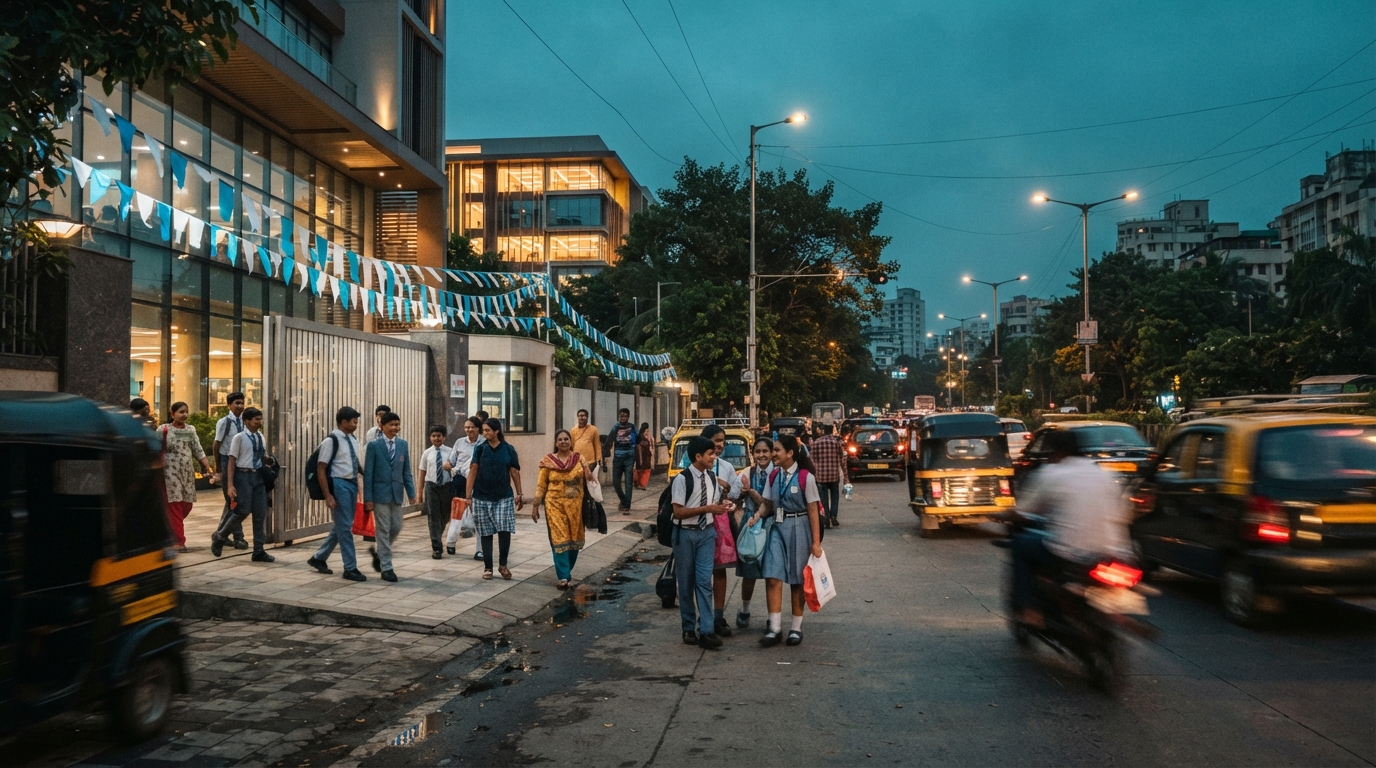
Over the following 170 years, Woodstock School grew into one of India's best-known international schools. The "first in India and Asia" claim deserves care, however. The claim comes from directory listings, not a primary archive. The term "international school" also meant something very different in 1854 than it does today, so the label should be read as a modern description of an early missionary school.
Hebron School, Ooty (1899)
Hebron School is a school in Ooty, in the Nilgiri Hills of present-day Tamil Nadu, that traces its roots to 1899. The Hebron School that operates today took shape much later, in 1974/5, when Lushington Boys' School and Hebron Girls' School merged. Hebron School therefore has two valid start dates: 1899 and 1974/5.
This detail matters for anyone building a timeline of early international schools. A single school can have two valid "start" dates: the year the school's oldest part opened and the year the school took its current form. In Hebron's case, 1899 marks the origin and 1974/5 marks the merger. Good timelines record both dates and label each one clearly.
Kodaikanal International School (1901)
Kodaikanal International School, known as KIS, was founded by Margaret Eddy. It was set up as an English-medium school for South India's missionary community. Under its early name, "Highclerc School," it opened to students on 1 July 1901. Kodaikanal sits in the Palani Hills, another cool hill retreat in Tamil Nadu. KIS later became India's first IB school. In 2025–26, it marked 50 years of IB in India alongside its own 125th anniversary, as reported by India Education Diary in 2026.
The purpose of these schools changed three times
International schools in India served three distinct groups over 150 years. Missionary children came first, from the 1850s to the early 1900s. Diplomats' and expatriates' children followed after Independence in 1947. From the 1990s, Indian families became the main audience. Each shift changed where schools were built and who paid for them.
Missionary children, 1850s to 1900s
The first wave existed for one practical reason. Missionary parents worked in the plains, often far from any English-medium school. Sending a child home by sea meant years of separation. Hill-station boarding schools offered a closer option with a cooler climate. A 2012 paper on ResearchGate notes that all international schools in India before the 1990s were in hill stations such as Dehradun, Ooty, Kodaikanal and Panchgani. That geography came straight from the missionary model.
Diplomats and expatriates, 1950s
The American Embassy School in New Delhi is the clearest example of the second wave of international schools in India. The American Embassy School opened in 1952, after the U.S. Embassy asked the Indian government for a school for American expatriate children. Its students were the children of embassy officials, not missionaries, and the campus sat in the capital.
The second wave followed India's new diplomatic ties after Independence in 1947. The American Embassy School marked a clear break from the hill-station pattern of Mussoorie, Ooty and Kodaikanal, because the American Embassy School sat in New Delhi rather than in the hills. The school also served a new purpose: educating the children of foreign officials posted to India. For the wider context of this period, see our timeline of historic dates in modern India.
Indian families, from the 1990s
The third wave changed everything. Indian parents, not foreign residents, became the main source of demand. ISC Research, reported by ICEF Monitor in February 2026, says growth in India now comes from local demand. In the past, that demand came from a country's expatriate community. The table below shows how each era compares.
| Era | Main students | Typical location | Example and date |
|---|---|---|---|
| 1850s–1900s | Missionary children | Hill stations | Woodstock School, 1854 |
| 1950s | Diplomats' and expatriates' children | Capital city | American Embassy School, 1952 |
| 1990s onward | Indian families | Major cities | UWC Mahindra College, 1997 |
The IB reached India through a hill-station school
The International Baccalaureate entered India through Kodaikanal International School in the mid-1970s. For about two decades, the IB stayed a rare option. Today, India has 276 IB schools, according to The Federal (2025). The programme's growth closely tracks the wider rise of international education in Indian cities.
Kodaikanal's IB start date
KIS is widely recorded as India's first IB school. The exact year depends on your source, though. Wikipedia gives 1975. The school directory doris.school gives 1976. Both may be "right" in a narrow sense. One date could mark the school's authorisation and the other its first teaching year. Without the IB's own records, you can't settle it from secondary sources alone. Write "1975–76" or name the source next to the year.
From one school to 276
The IB's recent growth is fast and well documented. IB schools in India rose from 192 in 2020 to 276 in 2025, according to The Federal (2025). That makes IB schools 28% of India's international school market. The Cambridge curriculum has grown even faster in raw numbers. Cambridge International reported in 2025 that its schools in South Asia grew from 894 in 2023-24 to 1034 in 2024-25. India contributed over 81% of those new additions and now has more than 800 Cambridge schools. A programme that once ran in one hill town is now offered across the country.
Economic reform moved international schools from hills to cities
The 1991 economic reforms explain why international schools left the hill stations. Liberalisation, a growing private sector and pressure on public education all opened space for new private schools in cities. Between the late 1990s and early 2000s, international campuses began appearing near India's growing urban centres.
The 1991 turning point
The 1991 turning point is the start of the economic reforms that moved international schools in India from hill stations to cities. During the 1990s, strain on public education, fast-growing private institutions and a policy turn toward liberalisation together created city-based families who could pay private fees and wanted globally recognised qualifications.
These three changes arrived at once. The public education system was under strain, private institutions were growing quickly, and economic policy turned toward liberalisation. The hill-station boarding model of Mussoorie, Ooty and Kodaikanal no longer fit these new urban families. Urban parents wanted day schools close to home, not boarding schools a long journey away in the hills. Our guide to economic milestones in Indian history covers the 1991 reforms in more detail.
UWC Mahindra College, 28 November 1997
UWC Mahindra College near Pune is a key date in this shift. Nelson Mandela and Queen Noor of Jordan inaugurated it on 28 November 1997. The college is part of the United World Colleges movement and teaches the IB Diploma. Its opening showed that international education in India now had a new base in the western part of the country. Pune is close to Panchgani, an older hill-station school town. But UWC Mahindra was built for a wider, global student intake.
Schools that changed their audience
DSB International School in Mumbai is a clear example of an international school that changed its audience. DSB International School was set up for German families in Mumbai. When fewer Germans came to India in the early 2000s, DSB International School added an international section offering Cambridge IGCSE and the IB.
Some international schools in India adapted in this way as their original students left. DSB's international section opened the school to families beyond Mumbai's German community. The same pattern repeats across India's history: when an expatriate audience shrinks, international schools turn to Indian families to stay open.
Founding dates in the history of international schools in India often conflict
Founding dates in the history of international schools in India don't always match across sources. School websites, Wikipedia and directories sometimes give different years for the same event. The gaps are usually small, often one year. But they matter for students, teachers and anyone building an accurate timeline.
Where the sources disagree
Two schools show the problem clearly. The table below lists the conflicts we found while checking dates for this guide.
| School | Event | Source A | Source B |
|---|---|---|---|
| Kodaikanal International School | Founding conference | 1 June 1900 (school's own site) | 1 June 1901 (Wikipedia) |
| Kodaikanal International School | IB start | 1975 (Wikipedia) | 1976 (doris.school) |
| Woodstock School | "First in India and Asia" | Directory claim | No primary source found |
| Hebron School | Founding | 1899 (roots) | 1974/5 (merger into current form) |
Notice that KIS's opening to students is firm: 1 July 1901. The disagreement is about the conference that came before it. That's a common pattern. A school's planning date and its opening date often get blurred together in later retellings.
How to check a founding date
Use this order when you verify any school's founding date:
- Start with the school's own archive or official history page.
- Compare it against an independent source, such as a curriculum body's records.
- Check what the date marks: a conference, a first class or an official authorisation.
- Look for period sources like old reports, mission records or newspaper notices.
- When sources still disagree, give both dates and name each source.
A step that's often skipped is step three. Many "conflicts" disappear once you see that two sources describe different events. One limit to keep in mind: no verified count exists for how many international schools India had in 1990 or 2000. One 2012 paper suggests fewer than 20 in the 1990s. Its text survives only in a damaged form, so the figure shouldn't be cited without the original.
Access remains the open question
International schools now form a large part of Indian education, but access is still limited. Most are private and charge high fees. Critics call the system elitist, and even the IB admits that perception exists. A few public-sector schools now offer international curricula, and they point to another possible direction.
The numbers today
The scale is now very large. ISC Research reports that India grew from 884 international schools in 2019 to 972 in 2025. That ranks India second in the world by number of schools. Another 26 are planned to open in the coming years, according to ISC Research (2025). Growth has slowed somewhat. ISC Research reported 2% year-on-year growth in India in 2026, as covered by ICEF Monitor. ISC Research also says, "International schools are no longer positioned at the margins of national education systems." Its view is that these schools are now becoming part of those systems.
The elitism debate
Who gets access is the hardest question in this history. Adrien Kearney, Director of IB World Schools, admits the IB is seen as elitist in India. He links this to the dominance of private schools. "We would like to see a stronger balance in India between the public system and the private system," he told The Federal in 2026. The roots of the issue go back to the beginning. The first schools served a small, closed community of missionary families. The audience grew after 1991, but fees still limit who can attend.
A public-sector exception
One Mumbai school offers a different model. The Brihanmumbai Municipal Corporation runs the Vile Parle International School, according to ThePrint (2026). It's the only IB school in Mumbai's western suburbs run by a municipal body. It's still a single case, not a trend. It does show that an international curriculum can run inside public education. For a related story about who gained access to schooling over time, see our chronological guide to Indian women's history.
Related Reading
- India at the Olympics: A Timeline of Historic Sporting Milestones
- Milestones in Indian Women's History: A Chronological Guide
- 1,000 Years of Indian Medical History: A Chronological Guide
- Economic Milestones in Indian History: From 1947 to Present
FAQ
Q: What happened on 19 November for India? Rani Lakshmibai of Jhansi is widely recorded as born on 19 November 1828 in Varanasi. Indira Gandhi, India's first woman Prime Minister, was born on 19 November 1917 in Allahabad, now Prayagraj. Both births make 19 November one of the most searched dates in Indian history.
Q: What is on 19 November in India? India observes National Integration Day on 19 November, Indira Gandhi's birth anniversary. The date also begins Quami Ekta Week, which runs from 19 to 25 November. You can find these and other events on the 19 November card in our Browse Dates archive.
Q: Which is the oldest international school in India? Woodstock School in Mussoorie, founded in 1854, is usually named as the oldest. Directories also call it the first international boarding school in Asia. That wider claim hasn't been confirmed by a primary source.
Q: When did the IB start in India? Kodaikanal International School introduced the IB in the mid-1970s. Wikipedia gives 1975, while doris.school gives 1976. India had 276 IB schools by 2025, according to The Federal.
Your next move: pick one school from this guide and check its founding date against its own archive page before you cite it. If the school's date matches an independent source, use it as written. If it doesn't, write both years and name each source. Then compare it with the matching date card in our archive to see what else happened in India that day.
Sources
- The International Schools Market in 2025 — ISC Research, 2025. Supports: India has 972 international schools, with another 26 planned to open in the coming years.
- India Becomes Second-Largest Hub for International Schools: ISC Research 2025 — Insights on India, 2025. Supports: India grew from 884 international schools in 2019 to 972 in 2025 and now ranks second in the world.
- Continuing expansion of K-12 international school sector driven more by growing local demand — ICEF Monitor, 2026. Supports: ISC Research reported 2% growth in India, and growth now comes from local demand instead of from expatriate communities.
- IB schools surge in India as parents seek global education standards — The Federal, 2025. Supports: IB schools in India rose from 192 in 2020 to 276 in 2025.
- Cambridge reaches 1000 schools in South Asia — Cambridge International, 2025. Supports: Cambridge schools in South Asia grew from 894 in 2023-24 to 1034 in 2024-25, and India contributed over 81% of the new additions.
- Kodaikanal International School Marks 50 Years of IB in India and 125 Years of Pioneering Education — India Education Diary, 2026. Supports: KIS brought the IB Diploma to India and marked 50 years of IB alongside its 125th anniversary.
- Mumbai's BMC is running schools offering free Cambridge and IB education, and parents are lining up — ThePrint, 2026. Supports: Vile Parle International School is the only IB school in Mumbai's western suburbs run by a municipal body.
- The American Embassy School, New Delhi — U.S. Department of State, c.1997–2001. Supports: The American Embassy School in New Delhi was founded in 1952.
- UWC – Our History and Educational Philosophy — United World Colleges. Supports: UWC Mahindra College opened in Pune, India, in 1997.
- 1854 to today: The mountain school where history meets global education — Business Today, 2026. Supports: Woodstock School was founded in 1854 as a school for missionary families and became one of India's best-known international schools.