The Chipko Movement: A Timeline of India's Forest Defenders
TL;DR
The Chipko movement timeline runs from the 1970 Alaknanda flood to the April 1973 stand at Mandal, the March 1974 action by Gaura Devi and the women of Reni, and the 1980 15-year ban on green felling in Himalayan forests. Chipko was a non-violent protest by villagers in the Garhwal Himalayas, now part of Uttarakhand.
Key Takeaways
- Chipko's biggest policy win was a 15-year ban on green felling in 1980.
- Gaura Devi and the women of Reni made the 1974 tree-hugging stand famous.
- Sources disagree on the exact Reni date and on how many women took part.
- The movement grew out of the 1970 Alaknanda flood and anger over forest contracts.
- Britannica dates Chipko from 1973 to about 2004, which includes the Tehri Dam fight.
About a hundred villagers turned back a team of loggers at Mandal on 24 April 1973. Wikipedia, citing UN sources, records that they used only drums and slogans. Nobody was hurt. The contractors and their lumbermen simply retreated. That small event in a Himalayan village became the first confrontation of the Chipko movement, one of the best-known chapters in Indian environmental history. The dates below follow Chipko from its roots to its legacy. They also flag the places where sources still disagree, which matters if you're citing them in an essay or exam answer.
The Chipko movement timeline begins with a flood
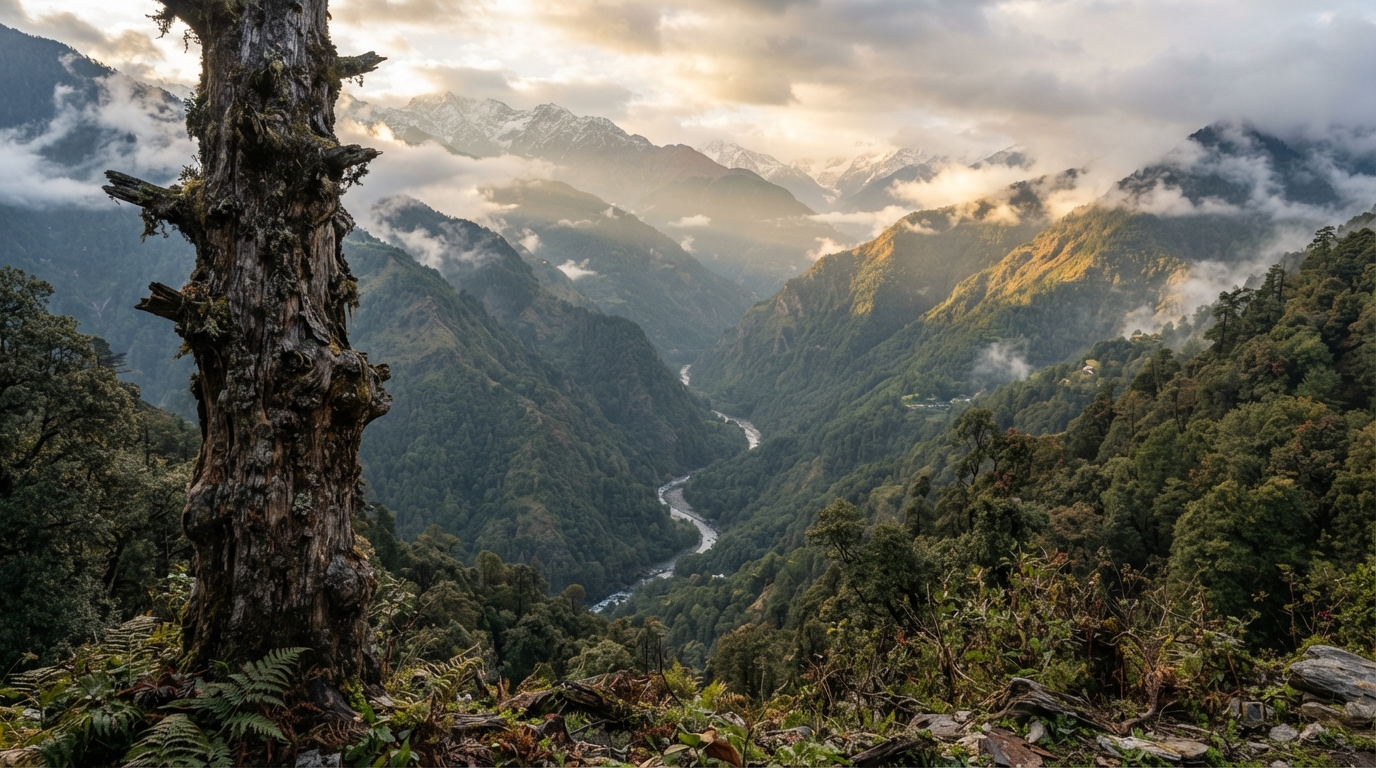
The Chipko movement was a non-violent forest protest in the Garhwal Himalayas, and its roots lie in the 1970 Alaknanda flood and years of local frustration over who controlled Himalayan forests. Villagers in Chamoli district depended on these forests for fuel, fodder and small timber, yet outside contractors received the felling rights instead.
Chipko did not start with a tree hug. That gap between local need and outside control set the stage for 1973.
The 1970 Alaknanda flood
The 1970 Alaknanda flood was a flood on the Alaknanda river that caused heavy damage across the Garhwal hills and changed how villagers saw the forests above them. Many hill residents linked the flood damage to the loss of tree cover on the slopes, so forest protection became a matter of physical safety, not just livelihood.
Few short timelines mention the 1970 flood, yet the disaster shaped how Garhwal villagers understood their forests. Forests held soil in place and slowed runoff. When the forests thinned, landslides and floods seemed to follow. For people living in the Alaknanda valleys, the safety concern now sat alongside the older livelihood concern over fuel and fodder.
A local cooperative and the forest contracts
The Dasholi Gram Swarajya Sangh (DGSS, later known as DGSM) was a cooperative based in Gopeshwar, in Chamoli district. Chandi Prasad Bhatt led it. The group ran small workshops that made farm tools from local wood. In the early 1970s, it struggled to get even a few ash trees from the forest department. Around the same time, the department allotted ash trees at Mandal to Symonds Co. of Allahabad, which wanted them to make sports goods, according to Down To Earth. To the villagers, this looked deeply unfair. A distant company got the trees that the local cooperative could not.
Mandal and Reni turned a local dispute into a movement (1973–1974)
Mandal and Reni are the two Himalayan villages where the Chipko movement took shape between 1973 and 1974. At Mandal on 24 April 1973, about a hundred villagers and DGSS workers drove away loggers from Symonds Co. At Reni in March 1974, women led by Gaura Devi did the same.
The two stands, less than a year apart, gave the Chipko movement its method and its most lasting image.

April 1973: the ash trees at Mandal
Sanctuary Asia reports that the word "Chipko" was first heard on 27 March 1973 from an agitated Chandi Prasad Bhatt. In Hindi, chipko means "to cling" or "to stick to." The idea was simple. Villagers would hug the trees so loggers could not cut them without harming people. On 24 April 1973, about a hundred villagers and DGSS workers met the Symonds team at Mandal. They beat drums and shouted slogans until the contractors left, as Wikipedia's account notes. The method drew on Gandhian non-violence, which explains why many historians place Chipko alongside Mahatma Gandhi's nonviolent movements.
March 1974: Gaura Devi and the women of Reni
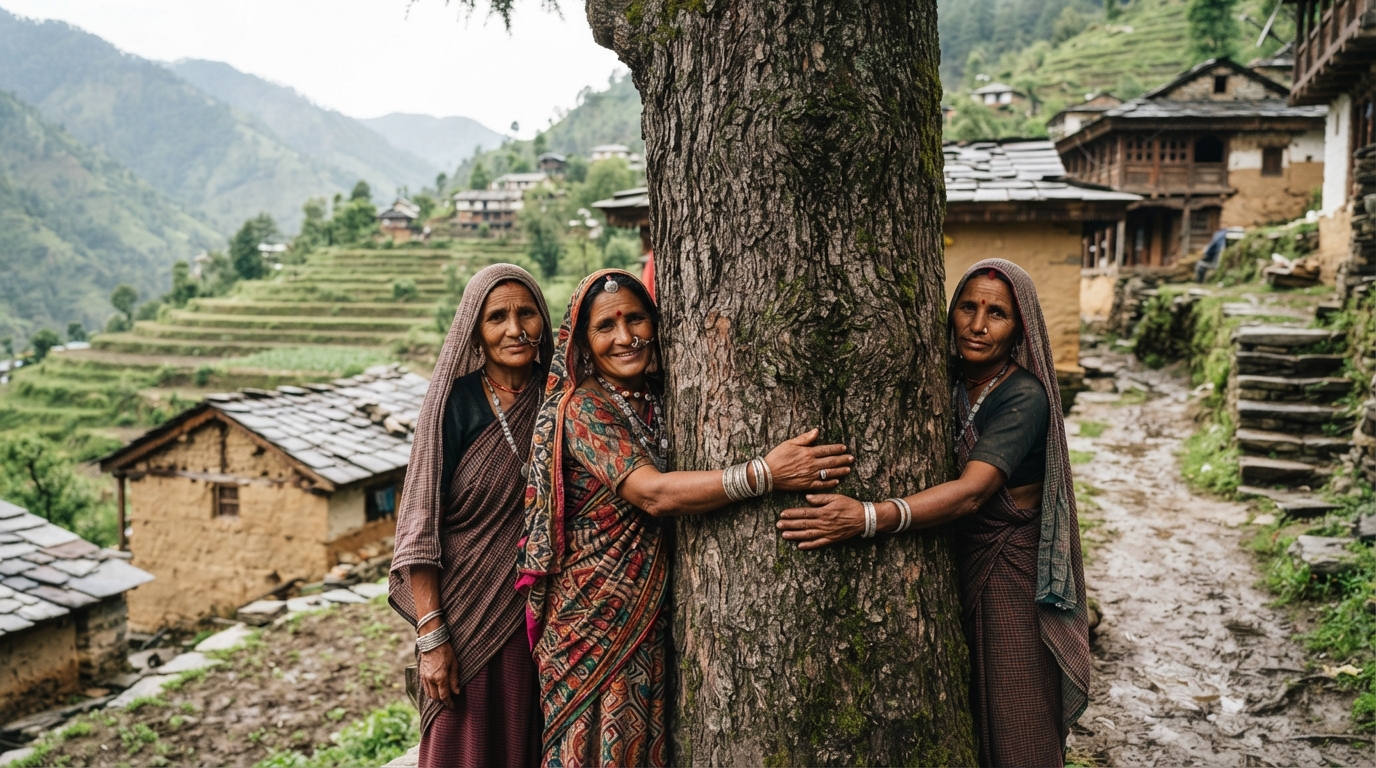
Reni is a small village near the Rishiganga river in Chamoli district. In March 1974, loggers arrived while many of the village men were away. Gaura Devi, who headed the local women's group, gathered other women and blocked the forest path. They refused to move. The loggers eventually left without cutting the trees. Chandi Prasad Bhatt later told Outlook that women outnumbering the loggers is what made Chipko unique. This stand is the source of the "eco-feminist" reading of Chipko that appears in many textbooks.
Why the Reni date is disputed
Sources give both 25 and 26 March 1974 for the Reni stand. According to ThePrint, 26 March has come to be accepted as the anniversary. One reason is that a Google Doodle marking Chipko's 45th anniversary appeared on that date in 2018. The number of women is also contested. Wikipedia says Gaura Devi and 27 other women faced the loggers. ThePrint (2024) says it was Gaura Devi and 24 women from her hamlet. Neither figure is clearly wrong. If you cite one, name the source next to it.
The 1980 ban gave the movement its biggest policy win
Chipko's most concrete result came in 1980. That year, Prime Minister Indira Gandhi enacted a 15-year ban on green felling in the Himalayan forests, according to the Right Livelihood Foundation. After the ban, the movement spread through long marches, a southern offshoot and international recognition.
Bahuguna's 5,000-kilometre march
Sunderlal Bahuguna became Chipko's best-known public voice. Between 1981 and 1983, he walked about 5,000 kilometres across the Himalayas, according to Wikipedia. The march carried Chipko's message to villages far beyond Garhwal. Bahuguna also coined the slogan "Ecology is permanent economy." The phrase captured the movement's core argument in four words. Forests kept hill economies alive over the long term, while felling gave only short-term income.
Appiko and the spread south (1983)
Appiko is the Karnataka offshoot of Chipko, which began in 1983 when villagers from Salkani village in Uttara Kannada hugged trees to stop felling. The name Appiko is a Kannada word with a meaning close to "hug," and the Appiko movement showed that Chipko's tree-hugging method could work outside the Himalayas.
The Appiko protests came about a decade after the first Chipko stand at Mandal in April 1973. Like Chipko, Appiko needed no money or weapons. The method needed only enough people willing to stand in front of the trees.
Recognition in 1987
The Dasholi Gram Swarajya Mandal received the Right Livelihood Award in 1987. The citation praised the group "for its dedication to the conservation, restoration and ecologically-sound use of India's natural resources." That same year, Chipko inspired a group of Swedish activists. In 2008, it inspired Japanese citizens too. By then, a protest from a few Himalayan villages had become an example studied around the world.
Three leaders shaped how Chipko worked
Chipko had no single founder. Chandi Prasad Bhatt organised it, Sunderlal Bahuguna spread its message, and Gaura Devi gave it its most famous moment. Each played a different role. Seeing those roles side by side helps students avoid the common mistake of crediting one person for everything.
| Leader | Main role | Key date or work |
|---|---|---|
| Chandi Prasad Bhatt | Organiser and DGSS leader | First use of "Chipko," 27 March 1973 (Sanctuary Asia) |
| Gaura Devi | Led the women of Reni | Reni stand, March 1974 |
| Sunderlal Bahuguna | Campaigner and public voice | 5,000-km march, 1981–83 (Wikipedia) |
Chandi Prasad Bhatt
Bhatt built Chipko from a local cooperative. His work focused on village control of forests and small, local industries. Historian Ramachandra Guha has called him a "secular saint" and said meeting him changed his life (The Telegraph, 2024). In a later interview with Outlook, Bhatt said felling for highways and dams has slowed but not stopped. That view frames Chipko as unfinished work rather than a closed chapter.
Sunderlal Bahuguna
Bahuguna linked Chipko to a wider ecological message. His marches, fasts and writing made the movement known across India and abroad. He later became central to the long protest against the Tehri Dam. Bahuguna died on 21 May 2021. A full timeline of Sunderlal Bahuguna's life would trace how his focus moved from trees to rivers.
Gaura Devi and the women of Chipko
Gaura Devi's stand at Reni made women the public face of Chipko. Hill women gathered fuel, fodder and water. They felt forest loss first and most directly. Their action at Reni showed that protest did not need formal leaders or outside support. In 2025, Gaura Devi was listed among the Uttarakhand Gaurav Samman honorees, according to Wikipedia.
The Chipko movement timeline did not end in the 1970s
Most exam guides stop at 1980. A fuller account runs much longer. Britannica dates the movement from 1973 to about 2004, which ties it to the Tehri Dam protests. The story also continues in Reni itself, in forest data and in national honours awarded as recently as 2025.
Tehri Dam and the c. 2004 end date
Britannica's end date of about 2004 reflects the long fight over the Tehri Dam on the Bhagirathi river. Bahuguna led much of that opposition. The dam's reservoir filled in the mid-2000s, and the campaign lost its main goal. Including Tehri changes how Chipko reads. It becomes a three-decade story about forests, rivers and who decides how hill land gets used.
Reni after 2021
Reni returned to the headlines decades later. In 2019, villagers filed a public interest litigation against the Rishiganga Power project, CNN reported in 2021. On 7 February 2021, the Rishiganga flood struck the village. According to The Tribune (2021), parts of Reni were washed away and five locals lost their lives. The village where Chipko's most famous stand took place faced the kind of disaster its residents had long warned about. Like the Bhopal gas tragedy of December 1984, it is a reminder that environmental history is also human history.
Forests and honours in the 2020s
Forest data shows how much work remains. Factly, citing the India State of Forest Report (ISFR) 2023, reports that Uttarakhand had 45% of its area under forest. That falls below the National Forest Policy target of two-thirds for hill states. The state also saw reductions in forest cover over the past decade. On the policy side, the INSEE Journal (2024) notes that the 2023 Forest Conservation Amendment has been widely criticised for the forest loss it may cause through diversion of forest land. Recognition has continued too. Chipko-era Gandhian Radha Bhatt received the Padma Shri in 2025, according to Wikipedia citing PIB.
Reading a Chipko timeline well means checking the sources
Chipko is easy to summarise and easy to get wrong. Dates shift between sources, counts differ, and some popular claims have no solid figures behind them. For students and teachers, the safest approach is to cite a source for every date and number. Doing that protects your work from small but common errors.
Where the numbers disagree
Three points trip up most readers of any Chipko movement timeline:
- The Reni date. Sources split between 25 and 26 March 1974. ThePrint explains why 26 March became the accepted anniversary.
- The number of Reni women. Wikipedia gives 27 women plus Gaura Devi. ThePrint (2024) gives 24 women plus Gaura Devi.
- The end date. Many guides treat 1980 as the finish. Britannica extends the movement to about 2004.
What we deliberately leave out
No reliable figure exists for how many trees Chipko saved in total. Some websites quote large round numbers, but we could not trace them to a primary source. A good timeline admits these gaps instead of filling them. The same caution applies to recent tree-felling disputes. In July 2026, Down To Earth reported protests over plans to fell 4,369 trees at Saat Mod for a highway expansion near Rishikesh. ETV Bharat put the number placed on hold at 3,000. Even current coverage needs cross-checking.
Placing Chipko in the wider story
The Chipko movement is a bridge between two eras of Indian history: it borrowed non-violent methods from Mahatma Gandhi's freedom struggle and pointed ahead to modern environmental debates. The key Chipko stands at Mandal in April 1973 and Reni in March 1974 belong among India's post-Independence milestones.
Our overview of historic dates in modern India shows where 1973 and 1974 fit among other post-Independence milestones. Reading Chipko in that context makes the Chipko movement more than a single protest. Chipko becomes part of how independent India argued about development.
Related Reading
- India at the Olympics: A Timeline of Historic Sporting Milestones
- December 1984: A Historical Timeline of the Bhopal Gas Tragedy
- Indian History Timeline Chart: Key Milestones (Digital Reference)
- The Dandi March Day-by-Day: A Timeline of the 1930 Salt Satyagraha
FAQ
Q: When did the Chipko movement start? The first major confrontation took place at Mandal on 24 April 1973. Sanctuary Asia reports that the word "Chipko" was first used by Chandi Prasad Bhatt on 27 March 1973. The 1970 Alaknanda flood is often seen as its background cause.
Q: Why is 26 March linked to the Chipko movement? On 26 March 1974, Gaura Devi and the women of Reni blocked loggers from entering their forest. Some sources give 25 March instead. According to ThePrint, 26 March became the accepted anniversary partly because a 2018 Google Doodle marked the 45th anniversary on that date.
Q: What did the Chipko movement achieve? Its biggest policy result was a 15-year ban on green felling in Himalayan forests in 1980, according to the Right Livelihood Foundation. It also inspired the 1983 Appiko movement in Karnataka. In 1987, the Dasholi Gram Swarajya Mandal received the Right Livelihood Award.
Q: Who were the main leaders of Chipko? Chandi Prasad Bhatt organised the movement through his cooperative in Gopeshwar. Sunderlal Bahuguna spread its message through marches, including a 5,000-km Himalayan walk in 1981–83. Gaura Devi led the famous 1974 stand at Reni.
Q: When did the Chipko movement end? There is no single end date. Many guides stop at the 1980 ban. Britannica dates the movement from 1973 to about 2004, which includes the Tehri Dam protests.
Further reading
Pick one disputed detail from this timeline today, such as the Reni date or the number of women, and check it against two sources before you use it in your notes. That habit will strengthen any history answer you write. These works make good next steps:
- Ramachandra Guha, The Unquiet Woods (1989): A detailed history of forest conflict in the Himalayas that places Chipko in its colonial and post-Independence context.
- Shekhar Pathak, The Chipko Movement: A People's History: A Uttarakhand historian's account, based on village voices and local records.
- Vandana Shiva, Staying Alive (1988): The key text behind the eco-feminist reading of Chipko and the role of hill women.
- Forest Survey of India, India State of Forest Report 2023: The official source for current forest cover data in Uttarakhand and other hill states.
- Right Livelihood Foundation's laureate page for DGSM: A short, reliable summary of the 1987 award and the 1980 green-felling ban.
Sources
- The Chipko Movement — Right Livelihood Foundation, n.d. Supports: Indira Gandhi brought in a 15-year ban on green felling in the Himalayan forests in 1980.
- Chipko movement — Encyclopaedia Britannica, n.d. Supports: Britannica dates the Chipko movement from 1973 to about 2004.
- Google Doodle doesn't tell full story of Chipko Movement. It began well before Gaura Devi — ThePrint, 2024. Supports: 26 March 1974 became the accepted anniversary because of a 2018 Google Doodle marking the 45th anniversary, and Gaura Devi led 24 women from Reni.
- Fifty Years of the Chipko Andolan — Sanctuary Nature Foundation (Sanctuary Asia), 2023. Supports: Chandi Prasad Bhatt first said the word "Chipko" on 27 March 1973, and the first Chipko action happened at Mandal on 24 April.
- Chipko: an unfinished mission — Down To Earth, n.d. Supports: Villagers at Mandal, led by Bhatt and the DGSM, stopped Symonds, a sports goods company from Allahabad, from cutting down ash trees on 24 April 1973.
- Reni, Chipko & disaster — The Tribune, 2021. Supports: Parts of Reni were washed away and five locals died in the flood of 7 February 2021.
- Village at center of India glacier collapse warned of impending disaster for decades — CNN, 2021. Supports: In 2019, Reni villagers filed a public interest litigation against the Rishiganga Power project.
- Data: 'State of Forest Report 2023' Indicates a Marginal Increase in Forest Cover Compared to 2021 — Factly, 2025. Supports: Uttarakhand had 45% of its area under forest in 2023, below the National Forest Policy target of two-thirds, and its forest cover shrank over the past decade.