The Ancient Spice Route: Key Dates in India's Historic Spice Trade
Bottom Line
The Indian spice trade history spans over two millennia, beginning with ancient medicinal exports to Rome and evolving into a global economic catalyst. Key dates include the 2nd-century Muziris Papyrus, Vasco da Gama’s 1498 arrival, and modern export milestones that continue to shape India's economic landscape today.
Key Takeaways
- Black pepper historically accounted for roughly 34% of the global spice trade volume.
- Early trade routes focused heavily on botanical medicines rather than culinary flavorings.
- Rome spent up to 100 million sesterces annually on Eastern imports through Indian ports.
- Modern Indian spice exports reached $1.6 billion in the first four months of FY26.
- Recent underwater discoveries off Kenya provide new dates for early Portuguese navigation.
Many people believe the ancient spice trade was driven purely by European chefs seeking to flavor bland meat. The reality is that early global demand centered on complex botanical-medical knowledge, where spices were traded primarily as medicines, preservatives, and ritual unguents. Tracking the Indian spice trade history reveals a timeline of economic milestones, geopolitical shifts, and cultural exchanges. These historical events defined global borders and established maritime routes that are still studied today.
How Did Botanical Medicine Drive Early Indian Spice Trade History?
Early Indian spice trade history was built on the export of medicinal plants and unguents. Ancient texts encoded botanical properties through mythology, making herbs essential for global medical practices. This demand drove merchants across the Arabian Sea, establishing the first major maritime trade networks connecting the subcontinent to the Mediterranean.
The Medical Origins of Spice
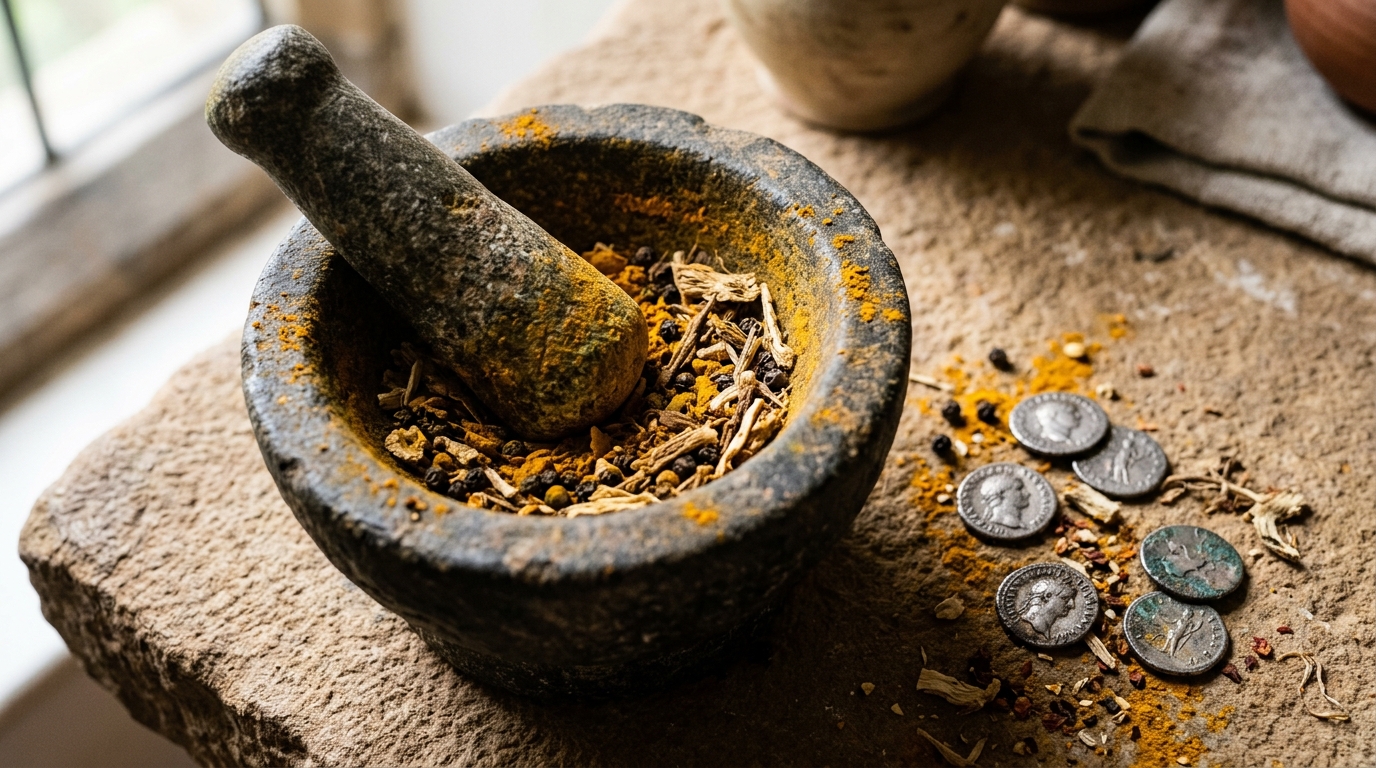
Spices held immense medical value long before they became common kitchen staples. Ancient practitioners relied on these botanical exports to treat ailments, preserve bodies, and conduct religious rituals. Heinrich Zimmer noted via historical translation that ancient lore encoded the properties of spices and herbs through mythology [Google Arts & Culture, 2026]. This mythology associated the power of medicinal plants with divine beings and centuries of observational use.
Merchants traded ginger, cardamom, and turmeric specifically for their healing properties. These botanical exports formed the foundation of early international commerce. The demand for these medical goods drove the expansion of shipping routes across the Indian Ocean. You can trace this evolution in our 1,000 Years of Indian Medical History: A Chronological Guide. Medical necessity created the economic incentive for merchants to risk months at sea.
The Muziris Papyrus and Roman Demand
Roman demand for Eastern goods created an unprecedented flow of wealth into the Indian subcontinent. Roman author Pliny the Elder noted that Rome spent 50 to 100 million sesterces annually on Eastern imports, much of it flowing through the Indian port of Muziris [WION, 2025]. This massive spending drained Roman silver reserves and enriched Indian port cities.
The Muziris Papyrus provides concrete proof of this financial scale. This surviving 2nd-century CE loan document details a massive cargo shipment from Muziris to Alexandria [Google Arts & Culture, 2026]. The cargo included Gangetic nard, ivory, and textiles. Gangetic nard was a highly prized aromatic plant used in perfumes and medicines. The papyrus outlines specific weights, values, and taxation rates. It shows that ancient trade was highly formalized and heavily taxed.
Excavations at Pattanam
Modern archaeologists have spent decades searching for the exact location of Muziris. Digs near modern-day Kochi have unearthed Roman amphorae, a seal from Thebes, and Mediterranean glassware [WION, 2025]. These findings confirm the village of Pattanam as the likely site of the legendary lost port.
Artifacts found at Pattanam date back over two thousand years. They show a continuous history of international habitation and commerce. The presence of Mediterranean glassware indicates that trade was reciprocal. Indian merchants exported spices and imported luxury manufactured goods. These excavations provide physical anchor points for dates previously only known through ancient texts.
Key Milestones in the Medieval and Colonial Indian Spice Trade History
The medieval and colonial eras transformed local spice networks into militarized global monopolies. Key milestones include the Arab dominance of the Indian Ocean, the 1498 Portuguese arrival in Calicut, and the subsequent establishment of the Dutch and British East India Companies.
Arab and Venetian Monopolies
Arab merchants controlled the Indian Ocean trade routes for centuries. They mastered the monsoon winds to navigate between the Malabar Coast and the Arabian Peninsula. These merchants bought spices in India and transported them to ports in the Red Sea and Persian Gulf. From there, goods traveled overland to the Mediterranean.
Venetian merchants then bought these spices and sold them across Europe at massive markups. This dual monopoly made spices incredibly expensive for European buyers. The high prices created intense pressure to find a direct sea route to India. European monarchs realized that bypassing the Arab and Venetian middlemen would bring immense wealth to their own kingdoms.
Vasco da Gama and the Portuguese Arrival
Portuguese explorer Vasco da Gama reached Calicut on May 20, 1498. This arrival marked a violent shift in global trade dynamics. The Portuguese did not want to participate in the existing trade network. They wanted to control it entirely. They used superior naval artillery to force local rulers into exclusive trade agreements.
This period initiated centuries of European colonial influence on the subcontinent. The Portuguese established fortified trading posts along the western coast. You can explore the architectural legacy of this era in our guide to the Portuguese Era in Goa: Key Dates and Architectural Milestones. They enforced a pass system called the cartaz. Any ship sailing the Indian Ocean without a Portuguese pass was subject to attack and confiscation.
The Rise of the East India Companies
The immense profits generated by the Portuguese eventually attracted other European powers. The English established the East India Company in 1600. The Dutch followed with the creation of the Dutch East India Company in 1602. These organizations were the world's first multinational corporations. They possessed the power to mint money, command armies, and wage war.
The Dutch focused heavily on the spice islands of modern-day Indonesia. The British slowly built their presence on the Indian subcontinent. They established key trading posts in Surat, Madras, and Calcutta. Over the next two centuries, the British East India Company transitioned from a trading enterprise into a territorial power. They used military force and strategic alliances to secure control over spice-producing regions.
What Role Did Black Pepper Play in the Global Economy?
Black pepper acted as a foundational currency that dictated international trade policies. It accounted for roughly 34% of the global spice trade, driving European powers to fund massive maritime expeditions to bypass middlemen and secure direct access to the Malabar Coast.
Black Gold as Currency
Black pepper was the most important commodity in the ancient and medieval world. Historically, black pepper accounted for approximately 34% of the global spice trade [Scribd, 2025]. It was durable, lightweight, and universally desired. These traits made it function almost like a physical currency.
Landlords in medieval Europe frequently accepted rent payments in peppercorns. Dock workers in London had their pockets sewn shut to prevent them from stealing individual peppercorns. The sheer volume of pepper moving through Indian ports dictated the economic health of entire regions. Rulers on the Malabar Coast built massive fortunes by taxing the pepper trade.
The Shift in European Power Dynamics
The desire to control the pepper trade reshaped the map of Europe. The center of global wealth shifted based on who controlled the sea routes to India. Venice held the power in the 14th century. Lisbon took control in the 16th century following da Gama's voyage. Amsterdam and London claimed dominance in the 17th and 18th centuries.
| Spice Commodity | Primary Ancient Use | Key Historical Trade Destination | Modern Economic Status |
|---|---|---|---|
| Black Pepper | Currency, Preservative | Roman Empire, Medieval Europe | High volume global export |
| Cardamom | Medicine, Rituals | Middle East, Scandinavia | Premium culinary export |
| Gangetic Nard | Perfume, Unguents | Alexandria, Rome | Niche botanical market |
| Turmeric | Dye, Anti-inflammatory | Southeast Asia, Middle East | Rapidly growing health export |
This constant shifting of power led to numerous naval wars. Nations bankrupted themselves building fleets to protect their spice shipments. The economic foundations of modern banking and stock markets were built to finance these risky voyages. The Indian spice trade history is directly responsible for the financial infrastructure of the modern world.
Modern Economic Realities of the Indian Spice Trade History
Today's spice trade involves massive export volumes, shifting international buyers, and strict quality standards. India continues to dominate the market, but modern farmers must adapt to new agricultural practices to meet the demands of global partners and overcome recent contamination hurdles.
Export Growth and Shifting Markets
India remains the undisputed leader in global spice production. Spice exports from India grew by 88% in volume and 97% in value between FY14 and FY25 [Harvestia, 2026]. This growth reflects both increased global demand and improved agricultural yields. In just the first four months of FY26 (April–July 2025), India shipped $1.6 billion worth of spices [Harvestia, 2026].
The primary destinations for these exports are changing. In fiscal year 2026, the United States surpassed China to become the largest importer of Indian spices [Dividend Earnings Report, 2026]. This shift occurred due to a sharp decline in Chinese imports driven by their own higher domestic production. Tracking these shifts provides insight into broader economic trends, as detailed in our timeline of Economic Milestones in Indian History: From 1947 to Present.
Quality Challenges and the Organic Shift
High export volumes come with strict international scrutiny. Several countries recently rejected shipments of Indian spices due to ethylene oxide contamination. Ethylene oxide is a sterilizing agent used to prevent microbial growth. International food safety regulators classify it as a health risk. These rejections caused significant financial losses for exporters.
Indian farmers and exporters are now shifting toward organic farming and alternative sterilization methods. Steam sterilization is replacing chemical treatments. Farmers are adopting strict tracking systems to trace spices from the field to the shipping container. This transition requires significant capital investment. The common advice to simply "grow more" breaks down when international borders close due to quality control failures.
Heritage Tourism and the Muziris Network
The historical weight of the spice trade now drives a new economic sector: heritage tourism. Kerala is actively repositioning its ancient maritime history through the Muziris Network [Daily Pioneer, 2026]. This landscape-level heritage project connects recent archaeological finds at Pattanam to modern tourism infrastructure.
Visitors can explore excavated port sites, historic spice warehouses, and ancient trade routes. The project aims to educate the public while generating local revenue. It transforms abstract historical dates into physical locations people can experience. This approach ensures that the ancient spice trade continues to benefit the local economy in the 21st century.
How Do We Track Historic Spice Trade Dates Today?
Historians track spice trade dates by analyzing shipwreck artifacts, translating ancient loan documents, and mapping archaeological digs. These methods allow researchers to build exact chronologies of maritime routes, proving the immense scale and specific timelines of India's historical global commerce.
Archaeological Discoveries
Shipwrecks act as submerged time capsules for historians. In late 2024, underwater archaeologists off the coast of Kenya identified a shipwreck believed to be the São Jorge [Daily Express, 2024]. This lost galleon belonged to Vasco da Gama’s 1524 voyage to India. The discovery sheds new light on early Portuguese spice routes and ship construction techniques.
Underwater archaeology expert Caesar Bita stated that the artifacts linked to Vasco da Gama's voyages are vital not for colonial nationalism, but for understanding the complex environment and people that successfully executed the 1497 sea route to India [Daily Express, 2024].
Experts use specific processes to date these maritime finds:
- They analyze the wood using dendrochronology to determine when the ship was built.
- They examine the cargo for coins bearing specific minting dates.
- They study the pottery styles to match them with known manufacturing periods.
- They cross-reference the ship's location with historical naval logs and storm records.
Preserving the Chronological Record
Written records remain crucial for establishing exact dates. Historians rely on port ledgers, tax documents, and diplomatic treaties to build timelines. The archives of the Dutch East India Company contain millions of pages detailing daily trade volumes and prices. These documents allow economists to track inflation and market crashes from hundreds of years ago.
Translating ancient texts like the Muziris Papyrus requires collaboration between linguists and historians. These texts often use outdated measurement systems and localized terminology. We compile the most significant of these translated events in our archive. You can see how these specific events shaped the nation in our guide to the 10 Most Searched Dates in Indian History and Why They Matter. Accurate dating prevents historical myths from replacing actual facts.
Related Reading
- Milestones in Indian Women's History: A Chronological Guide
- 1,000 Years of Indian Medical History: A Chronological Guide
- Economic Milestones in Indian History: From 1947 to Present
- What Are the Major Events in Indian History? (FAQ Archive)
FAQ
Q: What was the most valuable spice in ancient India? Black pepper held the highest consistent value and accounted for roughly 34% of the global spice trade. It was highly durable, making it easy to transport and use as a physical currency across Europe and the Middle East.
Q: Did ancient Rome really trade directly with India? Yes. Historical records show Rome spent 50 to 100 million sesterces annually on Eastern imports. Archaeological digs at Pattanam have uncovered Roman amphorae and Mediterranean glassware, confirming direct trade links.
Q: How did the Portuguese change the Indian spice trade? The Portuguese introduced militarized monopolies to the Indian Ocean in 1498. They bypassed traditional Arab and Venetian middlemen and used naval artillery to enforce exclusive trade agreements with local rulers.
Q: Why are modern Indian spice exports facing quality challenges? Recent international rejections occurred due to ethylene oxide contamination, a chemical used for sterilization. Exporters are now investing heavily in steam sterilization and organic farming practices to meet strict global food safety standards.
Understanding the timeline of India's spice exports gives you a clearer view of modern global economics. Look at the labels on the spices in your kitchen today to see which regions still dominate the agricultural export market.
Further reading
- Historic Milestones in Indian Agriculture — A chronological look at farming practices from ancient times to the Green Revolution.
- [The Book of Spices by John O'Connell] — A detailed encyclopedia covering the culinary and medical history of global spices.
- Maritime Trade Routes of the Indian Ocean — An interactive timeline mapping the shift from Arab monopolies to European shipping lanes.
Sources
- Where did Muziris go? Facts you didn't know about India's forgotten ancient port city — WION, 2025. Supports: Rome spent 50 to 100 million sesterces annually on Eastern imports through Indian ports.
- Where did Muziris go? Facts you didn't know about India's forgotten ancient port city — WION, 2025. Supports: Excavations at Pattanam unearthed Roman amphorae, a seal from Thebes, and Mediterranean glassware, confirming it as the likely site of Muziris.
- A Buried Ancient Egyptian Port Reveals the Hidden Connections Between Distant Civilizations — Smithsonian Magazine, 2024. Supports: The Muziris Papyrus is a 2nd-century document detailing a cargo shipment including nard and ivory.
- Da Gama reaches Calicut, India — Oxford University Press, 2012. Supports: Vasco da Gama reached Calicut on May 20, 1498.
- East India Company — Britannica, 2026. Supports: The English established the East India Company in 1600.
- Dutch East India Company — Britannica, 2026. Supports: The Dutch East India Company was created in 1602.