The 1965 Indo-Pakistani War: A Day-by-Day Historical Timeline
TL;DR
The 1965 Indo-Pakistani war was a 17-day military conflict sparked by Pakistan's covert infiltration into Jammu and Kashmir. The confrontation rapidly escalated into a full-scale war across the international border, featuring massive armored battles and intense aerial combat. It concluded with a UN-mandated ceasefire and the Soviet-brokered Tashkent Agreement.
Key Takeaways
- Pakistan's Operation Gibraltar triggered the war by infiltrating armed forces into Kashmir.
- Indian troops crossed the international border on September 6 to relieve pressure on the Akhnoor sector.
- The Battle of Asal Uttar decimated Pakistan's technologically superior Patton tank regiments.
- The United Nations Security Council intervened to enforce a strict ceasefire on September 23.
- The Tashkent Agreement restored pre-war borders but was overshadowed by Prime Minister Shastri's death.
Exactly 1,280 kilometers of border territory became an active combat zone during the late summer of 1965. This brief but intense conflict featured the largest tank engagements the world had seen since the end of World War II. To understand the modern geopolitical borders and military doctrines of South Asia, you must examine the specific tactical decisions made during this period. Our 1965 Indo-Pakistani war timeline breaks down the military maneuvers, diplomatic interventions, and daily realities of the conflict.
The Indian Armed Forces faced a technologically superior adversary equipped with modern American hardware. Despite this disadvantage, Indian troops managed to halt the enemy offensive, capture strategic mountain passes, and threaten major urban centers. The Ministry of Defence's Official History of the 1965 War meticulously documents how these engagements played out on the ground. We have synthesized these historical records into a clear chronological guide. Like the 10 Most Searched Dates in Indian History and Why They Matter, the dates of this war remain crucial for understanding India's post-independence resilience.
The Prelude to Conflict Centers on the Rann of Kutch
Border tensions simmered for months before the main war began, specifically in the disputed Rann of Kutch region in Gujarat. Pakistan tested India's military readiness through localized skirmishes early in the year. This early confrontation set the stage for the larger infiltration strategy in Kashmir later that summer.
April to June 1965: Testing the Waters in Gujarat
The geography of the Rann of Kutch made it an ideal testing ground for early hostilities. The marshy terrain favored the Pakistani logistical supply lines, which sat much closer to the border outposts than India's military bases. In April 1965, Pakistani forces launched probing attacks against Indian border police posts in this sector. The Indian Army deployed the 50th Parachute Brigade to stabilize the line, but the flooded marshland severely restricted heavy vehicle movement.

British Prime Minister Harold Wilson eventually intervened to broker a ceasefire on June 30. The agreement established an international tribunal to resolve the boundary dispute peacefully. This temporary de-escalation gave Pakistani leadership false confidence in their ability to force a localized military solution without triggering a wider war. They assumed India's cautious response in the Rann of Kutch would translate to a similarly restrained response in Kashmir.
August 5, 1965: Operation Gibraltar Begins
Pakistan launched Operation Gibraltar with the specific goal of inciting a local rebellion in Jammu and Kashmir. Thousands of soldiers from the Azad Kashmir Regular Force disguised themselves as local tribesmen and crossed the Ceasefire Line. The Pakistani military high command believed the local Kashmiri population would rise up and support the infiltrators against Indian administration.
This core assumption failed almost immediately. Local Kashmiris did not support the insurgency and instead reported the presence of the infiltrators to the Indian authorities. The Indian Army quickly mobilized to seal off the border passes and hunt down the covert units. By late August, Indian forces launched counter-offensives to capture the strategic Haji Pir Pass, effectively cutting off the primary logistical route for the infiltrators. This aggressive counter-measure forced Pakistan to rethink its covert strategy and deploy conventional military units.
The 1965 Indo-Pakistani War Timeline Reaches Full-Scale Escalation
The conflict transitioned from covert infiltration to conventional warfare when Pakistani forces launched a massive armored assault in the Chhamb sector. India responded by crossing the international border in Punjab to force Pakistan to divert its troops. This strategic expansion turned a localized dispute into a full theater war.
September 1: Operation Grand Slam Targets Chhamb
Pakistan initiated Operation Grand Slam to capture the vital town of Akhnoor in Jammu. Taking Akhnoor would sever the primary logistical supply line connecting the Indian Army in Kashmir to the rest of the country. Pakistani forces attacked the Chhamb sector with overwhelming artillery fire and two armored regiments equipped with M48 Patton tanks. The defending Indian 191 Infantry Brigade faced massive numerical and technological disadvantages.
The Indian Air Force deployed de Havilland Vampire fighters to slow the armored advance. The Pakistani Air Force responded with F-86 Sabres, shooting down four Vampires in the initial engagement. Despite taking heavy casualties, the Indian ground forces conducted a fighting retreat to the Manawar Tawi river. This desperate defense bought the Indian high command enough time to execute a massive strategic diversion.
September 6: India Opens the Punjab Front
Prime Minister Lal Bahadur Shastri authorized the Indian Army to cross the international border toward Lahore. This critical decision forms the turning point of the 1965 Indo-Pakistani war timeline. By opening a new front in Punjab, India forced the Pakistani military to abandon its offensive in Akhnoor and rush troops south to defend its own territory.
The Indian XI Corps advanced rapidly across the border, catching the Pakistani defenders off guard. Indian troops reached the Ichhogil Canal (BRB Canal), a major defensive waterway situated just outside Lahore. Fierce urban and trench warfare erupted along the canal banks as Pakistani forces blew up bridges to halt the Indian advance. The bold offensive successfully relieved the pressure on Kashmir and dictated the terms of the war for the remaining weeks.
September 8–10: The Decisive Battle of Asal Uttar
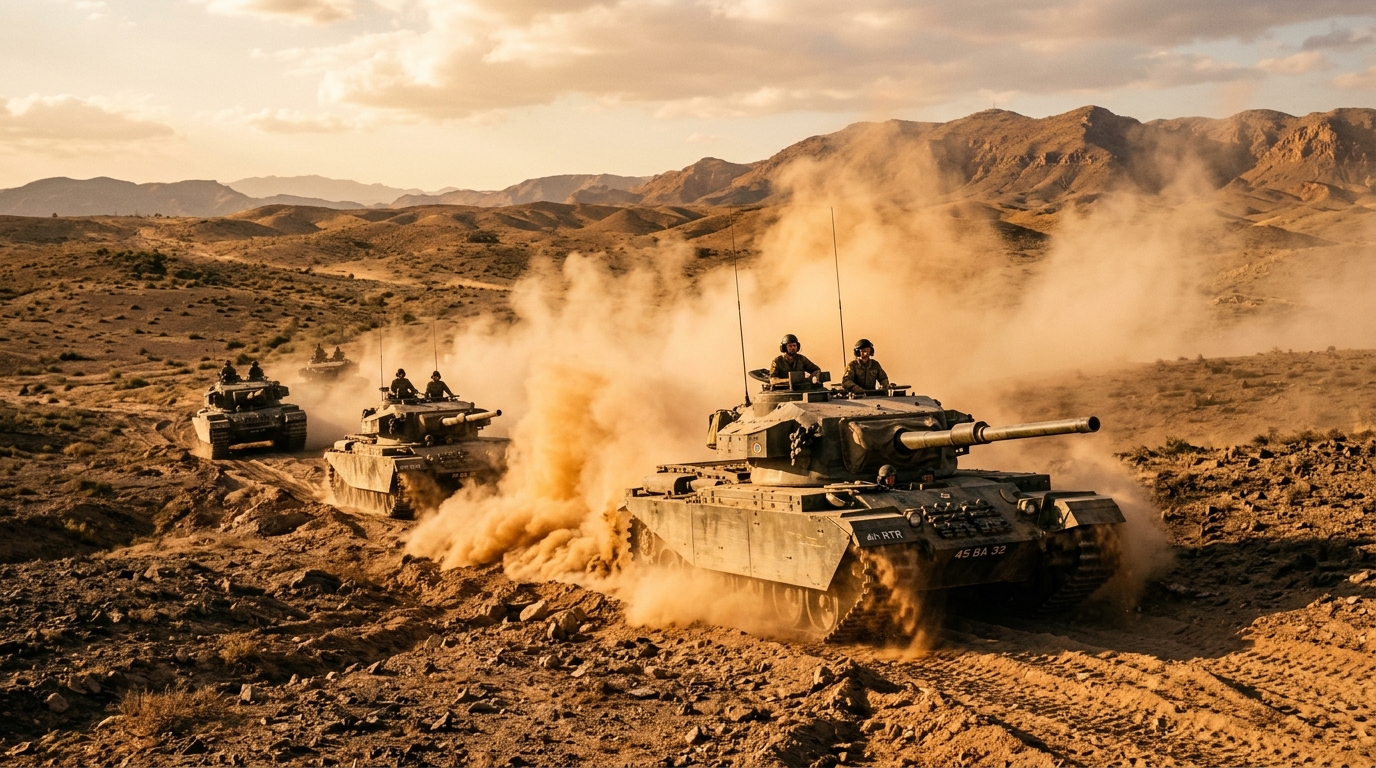
The Battle of Asal Uttar stands as one of the largest tank battles in military history. Pakistani forces launched a counter-offensive in the Khem Karan sector, aiming to push through Indian lines and capture the bridge over the Beas River. They deployed their elite 1st Armoured Division, boasting over 200 modern Patton tanks. The Indian forces, equipped with older Sherman and Centurion tanks, prepared a tactical trap.
Indian engineers deliberately breached local canals to flood the surrounding sugarcane fields. The heavy Patton tanks bogged down in the deep mud, making them easy targets for Indian anti-tank gunners and infantry. Company Quartermaster Havildar Abdul Hamid destroyed multiple Patton tanks with a jeep-mounted recoilless gun before falling in combat, earning the Param Vir Chakra. The battlefield became known as "Patton Nagar" (Patton City) due to the sheer number of destroyed and abandoned Pakistani tanks left behind.
Armored Offensives and Aerial Engagements Define the Tactics
Both militaries relied heavily on armored thrusts and air support to break ground stalemates. The Indian Air Force and Pakistan Air Force engaged in intense dogfights, while tank regiments clashed in the open plains. These battles highlighted the limits of technological superiority without sound tactical execution.
September 11–16: The Phillora Tank Battle
Following the success at Asal Uttar, the Indian I Corps launched its own armored offensive in the Sialkot sector. The goal was to draw out the remaining Pakistani armor and destroy it in open combat. The resulting Battle of Phillora featured massive tank-on-tank engagements stretching across miles of agricultural land. Indian Centurion tanks proved highly effective against the Pakistani armor.
The Indian tank commanders utilized superior gunnery tactics, engaging the enemy at optimal ranges. The battle raged for several days, resulting in the destruction of dozens of Pakistani tanks and forcing their withdrawal from the Phillora region. This engagement severely degraded Pakistan's offensive armored capabilities. It cemented the reality that the war would end in a stalemate rather than a decisive breakthrough for either side.
The Role of the Air War
The aerial conflict played a crucial role in shaping the ground realities of the 1965 war. The Pakistan Air Force relied on advanced American F-86 Sabres and F-104 Starfighters. The Indian Air Force operated a mixed fleet of British Hunters, indigenous HF-24 Maruts, and the nimble Folland Gnats. The small, highly maneuverable Gnat quickly earned the nickname "Sabre Slayer" for its success in close-quarters dogfights.
Squadron Leader Trevor Keelor scored the first confirmed kill against a Sabre, boosting the morale of the Indian forces. Both air forces conducted strategic bombing missions against enemy airbases, supply depots, and radar stations. While Pakistan achieved early successes in pre-emptive strikes, the Indian Air Force maintained relentless pressure on enemy ground forces. The air war demonstrated the critical need for indigenous defense manufacturing, a lesson that shaped future Indian military procurement.
International Pressure Halts the 1965 Indo-Pakistani War Timeline
Global superpowers grew alarmed as the conflict threatened to draw in other regional actors like China. The United Nations Security Council passed unanimous resolutions demanding an immediate halt to the fighting. Diplomatic leverage and economic realities eventually forced both exhausted militaries to accept a ceasefire.
September 20: UN Security Council Resolution 211
The escalation of the conflict caught the attention of the United States, the Soviet Union, and the United Kingdom. Cold War dynamics complicated the diplomatic landscape, as both superpowers wanted to prevent China from intervening on Pakistan's behalf. The United Nations Security Council passed Resolution 211, demanding that both nations cease hostilities and withdraw their armed personnel to the positions held before August 5.
To enforce this resolution, the United States and the United Kingdom imposed a strict arms embargo on both India and Pakistan. This embargo disproportionately affected Pakistan, which relied almost entirely on American military hardware and spare parts. The sudden halt in military supplies placed immense pressure on both economies. You can read more about how conflicts impact national finances in our guide to Economic Milestones in Indian History: From 1947 to Present.
September 23: The Ceasefire Takes Effect
At 03:30 hours on September 23, the guns finally fell silent across the western front. Both nations accepted the UN-mandated ceasefire, locking the frontlines in place. At the time of the ceasefire, India held a significant territorial advantage. Indian troops occupied roughly 1,900 square kilometers of Pakistani territory, including strategic positions in the Sialkot and Lahore sectors.
Pakistan held approximately 540 square kilometers of Indian territory, primarily in the Chhamb sector and desert regions of Sindh. The ceasefire line effectively became a new, temporary border that required intense diplomatic negotiations to resolve. Both militaries remained on high alert, entrenched in their forward positions while the political leadership prepared for peace talks. The 1965 Indo-Pakistani war timeline of active combat ended here, but the diplomatic struggle was just beginning.
The Tashkent Agreement Reshapes the Diplomatic Landscape
The Soviet Union stepped in to mediate the post-war peace settlement in the city of Tashkent. Both nations agreed to return to their pre-war positions, restoring the status quo ante bellum. The sudden death of the Indian Prime Minister hours after signing cast a long shadow over the treaty.
January 4–10, 1966: Negotiations in the Soviet Union
Soviet Premier Alexei Kosygin hosted Indian Prime Minister Lal Bahadur Shastri and Pakistani President Ayub Khan in Tashkent. The negotiations proved difficult, as both leaders faced immense domestic pressure to secure a favorable outcome. India wanted a guarantee that Pakistan would cease its covert infiltration into Kashmir. Pakistan demanded a formal mechanism to resolve the broader Kashmir dispute.
After days of deadlocked talks, Kosygin managed to broker a compromise. The Tashkent Declaration required both countries to withdraw their forces to the pre-August 5 positions by February 25, 1966. It also mandated the restoration of diplomatic relations and the repatriation of prisoners of war. The agreement essentially restored the borders to their exact pre-war status, meaning India had to return the hard-won Haji Pir Pass.
January 11, 1966: The Tragedy of Lal Bahadur Shastri
Just hours after signing the historic Tashkent Declaration, Prime Minister Lal Bahadur Shastri suffered a fatal heart attack in his hotel room. His sudden death shocked the Indian nation and transformed the public perception of the peace treaty. Shastri had led the country through a severe crisis with his famous slogan "Jai Jawan, Jai Kisan" (Hail the Soldier, Hail the Farmer).
His death forced an immediate leadership transition in New Delhi, leading to the elevation of Indira Gandhi as Prime Minister. For more context on subsequent political shifts, you can explore the Timeline of Indian Prime Ministers and Their Key Decisions. The Tashkent Agreement held the peace, but the underlying territorial disputes remained unresolved, eventually leading to the 1971 war just five years later.
Related Reading
- The 1971 India-Pakistan War: Key Dates and Historical Summary
- India at the Olympics: A Timeline of Historic Sporting Milestones
- Dr. B.R. Ambedkar's Life: A Chronological Timeline of Legacy
- December 1984: A Historical Timeline of the Bhopal Gas Tragedy
FAQ
Q: Who won the 1965 Indo-Pakistani war?
The war ended in a UN-mandated ceasefire with no formal victor, though neutral military historians widely consider it a strategic and tactical victory for India. India successfully thwarted Pakistan's objective of capturing Kashmir and captured significantly more enemy territory than it lost.
Q: Why is the Battle of Asal Uttar historically significant?
It was one of the largest tank battles since World War II and resulted in the destruction of Pakistan's elite armored division. The battle proved that superior tactics, defensive positioning, and terrain exploitation could defeat technologically advanced military hardware.
Q: How did the 1965 war affect the Indian economy?
The war placed immense strain on the Indian economy, diverting crucial funds from civilian development to defense spending. The subsequent US arms embargo forced India to rapidly accelerate its indigenous defense manufacturing and forge closer military ties with the Soviet Union.
Q: What was the main objective of Pakistan's Operation Gibraltar?
Operation Gibraltar aimed to infiltrate covert forces into Jammu and Kashmir to incite a local rebellion against the Indian government. The operation failed because the local Kashmiri population did not support the insurgents and instead alerted the Indian military.
Q: Did the 1965 war change the border between India and Pakistan?
No. The Tashkent Agreement forced both nations to return all captured territory and withdraw to their pre-August 5, 1965 positions. The borders and the Ceasefire Line in Kashmir remained exactly as they were before the conflict began.
Visit the National War Memorial in New Delhi or explore the digital archives of the Ministry of Defence to read the original citations of soldiers who fought in 1965. Cross-reference these unit histories with modern topographical maps of the Punjab and Kashmir sectors to better visualize the sheer scale of the frontline and the geographical constraints both armies faced.