Mythological Epics in Indian Cinema: A Historical Timeline
The Quick Read
The history of Indian mythological cinema begins with the 1913 silent film Raja Harishchandra and spans over a century of technological evolution. Filmmakers transitioned from silent black-and-white reels to musical talkies, television mega-serials, and modern CGI-heavy pan-Indian blockbusters, continuously adapting ancient epics for new generations.
Key Takeaways
- Dadasaheb Phalke's 1913 silent film Raja Harishchandra launched India's first indigenous feature film genre.
- The arrival of sound in the 1930s turned mythological films into massive musical blockbusters.
- Southern film industries dominated the genre through the mid-20th century with legendary screen idols.
- Television broadcasts in the late 1980s temporarily moved mythological epics away from cinema halls.
- Modern filmmaking relies heavily on visual effects to tell ancient stories on a pan-Indian scale.
Most people believe the Indian film industry started with romantic musicals or social dramas. In reality, the foundation of Indian cinema was built entirely on mythological epics. When early filmmakers looked for stories to adapt for the silver screen, they bypassed contemporary literature and went straight to the Ramayana and the Mahabharata.
These ancient texts offered ready-made audiences. Viewers already knew the characters, the conflicts, and the moral resolutions. This built-in familiarity allowed early directors to focus on the monumental task of mastering a brand-new medium. By bringing gods and heroes to life on screen, they created a visual language that still influences how we consume media today. Tracing the history of Indian mythological cinema reveals not just how filmmaking techniques evolved, but how a nation visualizes its deepest cultural roots. From simple stage-play adaptations to sprawling digital universes, the journey of the mythological film mirrors the broader historic milestones of Indian cinema on the global stage.
The silent era established the history of Indian mythological cinema
Early Indian filmmakers chose mythological stories because audiences already knew the plots, eliminating the need for complex intertitles. This strategic choice during the silent era birthed the history of Indian mythological cinema, turning familiar religious narratives into India's first visual spectacles.
Dadasaheb Phalke and Raja Harishchandra (1913)
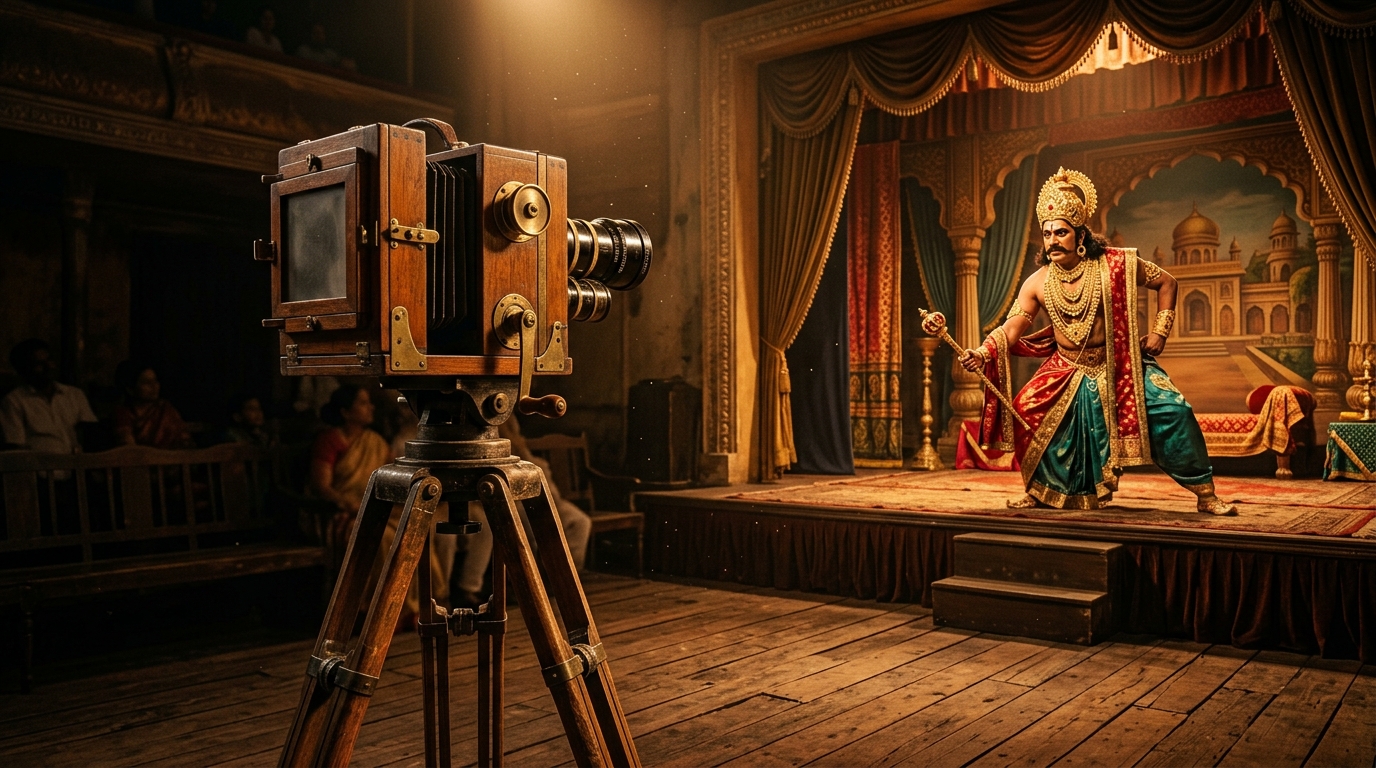
The story of Indian cinema starts with Dhundiraj Govind Phalke, widely known as Dadasaheb Phalke. In 1913, he released Raja Harishchandra, a silent film based on the legend of a righteous king who sacrifices everything to honor his promise. Phalke shot the film over six months. He handled the direction, cinematography, set design, and editing himself.
Finding actors proved difficult. Acting was not considered a respectable profession at the time. Phalke had to cast a male actor, Anna Salunke, to play the female lead, Queen Taramati. Despite these hurdles, the film premiered at the Coronation Cinematograph in Mumbai. It was a massive commercial success. Audiences were mesmerized by the moving images of characters they had revered their entire lives.
The proliferation of silent mythologicals
Following the success of Raja Harishchandra, Phalke and other early pioneers doubled down on the genre. Phalke produced Lanka Dahan in 1917 and Shri Krishna Janma in 1918. Lanka Dahan became so popular that coins collected at the ticket counters had to be transported in bullock carts.
Other studios quickly joined the fray. The Kohinoor Film Company and the Maharashtra Film Company began producing their own mythological epics. These silent films relied heavily on theatrical acting styles, elaborate costumes, and early trick photography to depict miracles.
| Year | Milestone Film | Director | Significance |
|---|---|---|---|
| 1913 | Raja Harishchandra | Dadasaheb Phalke | India's first full-length feature film |
| 1917 | Lanka Dahan | Dadasaheb Phalke | First major box-office blockbuster |
| 1919 | Kaliya Mardan | Dadasaheb Phalke | Early use of special effects and trick photography |
| 1920 | Sita Swayamvar | S.N. Patankar | Early color tinting experiments |
Publishers and archivists today note that optimizing historical images with descriptive alt text—like "Archival still from 1917 silent film Lanka Dahan"—helps preserve this visual legacy in modern search engines. Unfortunately, very few complete reels from this era survive today.
Sound technology transformed divine narratives into musical spectacles
The introduction of synchronized sound in 1931 allowed screen deities to speak and sing, fundamentally changing how audiences interacted with mythological films. Studios quickly realized that combining devotional music with ancient epics guaranteed box office success across diverse regional demographics.
Ayodhyecha Raja and the first talkies
When Alam Ara introduced sound to Indian cinema in 1931, the mythological genre adapted instantly. The Prabhat Film Company released Ayodhyecha Raja in 1932. Directed by V. Shantaram, it was the first Marathi talkie and a bilingual release in Hindi.
Sound brought a new dimension to these films: devotional music. Characters could now sing bhajans (devotional songs) on screen. This addition transformed the viewing experience from a silent visual marvel into a communal religious event. Audiences would often sing along, and some theater owners reported patrons throwing coins and flowers at the screen during scenes featuring deities.
The golden age of mythological musicals
The 1940s and 1950s saw the genre reach new heights of musical and technical sophistication. Prakash Pictures released Ram Rajya in 1943. Directed by Vijay Bhatt, the film is historically significant for a unique reason. It is the only film Mahatma Gandhi is officially recorded to have watched. You can explore more about his life in the timeline of Mahatma Gandhi's nonviolent movements in India.
Filmmakers during this period began using better lighting, more realistic sets, and orchestral scores. The music directors became just as important as the film directors. Songs from films like Baiju Bawra (1952)—while more historical than purely mythological—showed how classical Indian music could elevate period storytelling. The history of Indian mythological cinema during this era is defined by this seamless integration of classical music and divine storytelling.
Regional industries drove the history of Indian mythological cinema forward
While Hindi cinema shifted toward social dramas in the 1950s, Southern film industries embraced and expanded the history of Indian mythological cinema. Tamil and Telugu studios produced massive, technically advanced epics that established regional stars as living deities in the public imagination.
Telugu and Tamil cinema's mythological dominance
As the Hindi film industry in Mumbai began focusing on nation-building narratives and romantic melodramas, studios in Chennai and Hyderabad kept the mythological epic alive. Vijaya Vauhini Studios and other major production houses invested heavily in the genre.
The 1957 Telugu film Mayabazar stands as a towering achievement. Directed by K.V. Reddy, the film adapted a specific episode from the Mahabharata. It featured groundbreaking cinematography by Marcus Bartley. His use of miniature sets and forced perspective to create the illusion of magical events remains impressive today. The film's commercial performance set benchmarks that are still studied, mirroring other record-breaking runs: historic dates in Indian regional cinema.
Iconic stars who became screen deities
The regional mythological films created a unique phenomenon: actors who became inextricably linked to the gods they portrayed. Nandamuri Taraka Rama Rao, universally known as N.T.R., first played Lord Krishna in Maya Bazaar. He would go on to portray Krishna, Rama, and Ravana in numerous films over his career.
N.T.R.'s portrayal was so definitive that people would hang his film posters in their household shrines. When he eventually entered politics, his divine screen image played a massive role in his mass appeal. Similarly, in Kannada cinema, Dr. Rajkumar achieved legendary status through his roles in mythological and devotional films like Babruvahana (1977). These actors did not just play characters; they embodied cultural ideals.
The television boom shifted mythologicals from theaters to living rooms
During the late 1980s, the mythological genre largely vanished from cinema halls because state-run television began broadcasting high-quality serialized epics. Families stopped buying movie tickets for religious films when they could watch comprehensive, multi-episode adaptations of the Ramayana and Mahabharata for free at home.
Ramanand Sagar's Ramayan (1987)
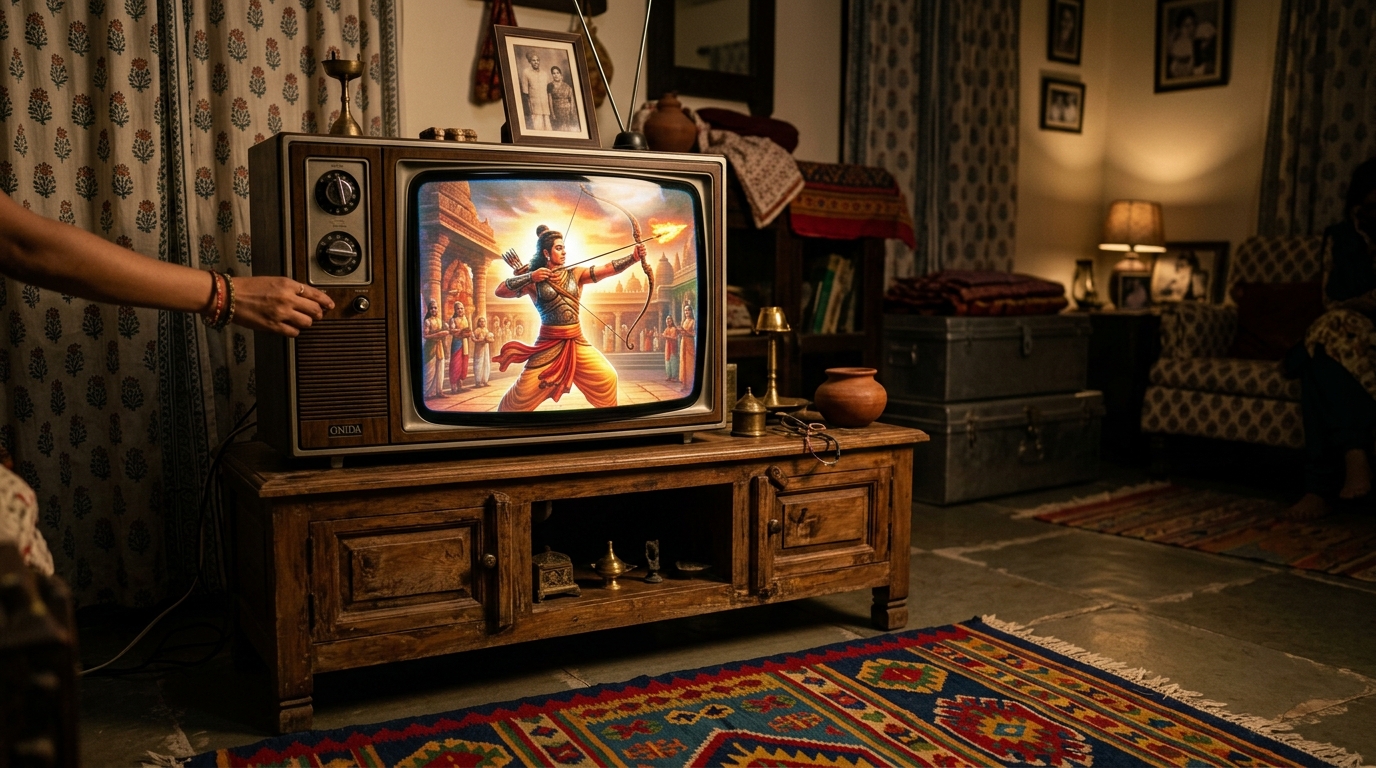
In January 1987, the state-owned broadcaster Doordarshan began airing Ramanand Sagar's Ramayan. The impact was unprecedented. Every Sunday morning, streets across India emptied. Public transport halted. People bathed and purified their television sets with garlands and incense before the broadcast began.
The serialized format allowed Sagar to explore the epic in detail that a three-hour film never could. Spanning 78 episodes, the show reached an estimated 100 million viewers. It changed the economics of Indian entertainment entirely. Advertisers realized the immense power of television, and the film industry realized they could no longer compete with TV when it came to mythological storytelling.
B.R. Chopra's Mahabharat (1988)
Following the success of Ramayan, B.R. Chopra launched Mahabharat in 1988. If Ramayan was viewed as a devotional experience, Mahabharat was celebrated for its complex political drama and philosophical depth. The show featured a unique narrative device: "Samay" (Time) personified as the narrator, voiced by Harish Bhimani.
This television era created a two-decade drought for theatrical mythological films. Why would audiences pay to see a condensed, rushed version of an epic in a theater when they were receiving expansive, culturally resonant adaptations in their living rooms? Film studios pivoted hard into action films and family dramas, leaving the gods to rule the small screen.
Modern VFX revived the theatrical history of Indian mythological cinema
Advanced computer-generated imagery allowed 21st-century filmmakers to finally match the grand scale described in ancient texts, bringing the history of Indian mythological cinema full circle. Today's directors use international VFX pipelines to market these ancient stories as pan-Indian action blockbusters rather than simple devotional films.
The transition to big-budget visual spectacles
The turning point for the modern era was S.S. Rajamouli's Baahubali franchise (2015, 2017). While technically a fantasy film rather than a direct mythological adaptation, Baahubali proved that Indian audiences hungered for ancient, larger-than-life narratives if the visual effects matched Hollywood standards.
This success triggered a massive wave of direct mythological adaptations. Filmmakers realized that with modern CGI, they could finally depict the cosmic weapons (astras), flying chariots, and giant demons described in the original Sanskrit texts. The tone shifted. Modern adaptations are marketed less like traditional religious films and more like superhero origin stories. They focus on kinetic action, high-contrast color grading, and thunderous background scores.
Pan-Indian mythological adaptations today
Recent years have seen massive investments in the genre. Films like Adipurush (2023) and Brahmāstra: Part One – Shiva (2022) represent this new approach. They are conceived as "pan-Indian" films—shot or dubbed in multiple languages simultaneously to capture a nationwide audience.
This modern approach comes with intense scrutiny. Audiences have precise expectations regarding character design, costume authenticity, and tonal respect. When visual effects or dialogue fail to meet these expectations, the public backlash is immediate and severe. However, when executed well, these films achieve historic box office numbers. They prove that the core appeal of these ancient stories remains as strong today as it was when Dadasaheb Phalke first loaded his camera in 1913.
Archival preservation remains the biggest challenge for early films
India has lost nearly all of its silent and early sound mythological films due to poor storage conditions and the volatile nature of nitrate film stock. Archival organizations are currently racing to digitize the surviving fragments before this foundational visual history disappears completely.
The loss of nitrate film
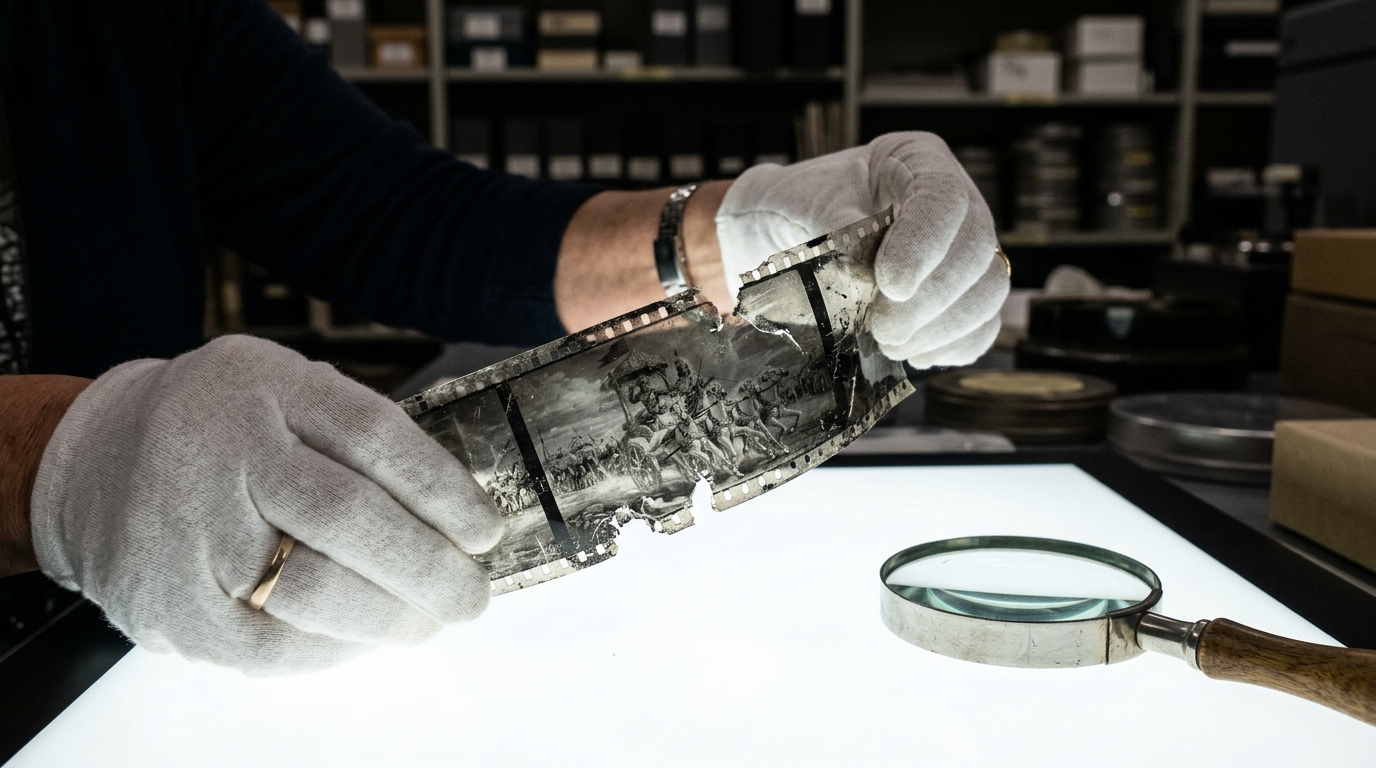
Until the 1950s, motion pictures were shot on cellulose nitrate film. This material is highly flammable and chemically unstable. If not stored in strict temperature and humidity-controlled vaults, nitrate film literally turns to dust or catches fire. India's tropical climate accelerated this decay.
As a result, an estimated 99% of India's silent cinema is gone forever. We have posters, song booklets, and written reviews of hundreds of early mythological films, but the actual footage no longer exists. Even India's first talkie, Alam Ara, is considered a lost film. The history of Indian mythological cinema from its first three decades exists mostly in fragments and paper archives.
Modern restoration efforts
Today, organizations like the National Film Archive of India (NFAI) and the Film Heritage Foundation work tirelessly to preserve what remains. They locate surviving prints in private collections, old theater basements, and international archives.
These surviving reels are carefully cleaned, scanned at 4K resolution, and digitally restored to remove scratches and stabilize the image. This archival work is critical. Without it, future generations will only be able to read about the origins of Indian cinema rather than watch the magical moments that started it all.
Related Reading
- Historic Milestones of Indian Cinema on the Global Stage
- Record-Breaking Runs: Historic Dates in Indian Regional Cinema
- Milestones in Indian Women's History: A Chronological Guide
- 1,000 Years of Indian Medical History: A Chronological Guide
FAQ
Q: What was the first Indian mythological film? The first Indian mythological film was Raja Harishchandra, released in 1913. Directed by Dadasaheb Phalke, it was a silent film and is also recognized as India's first full-length feature film.
Q: Why did mythological films decline in Bollywood during the 1970s? Hindi cinema shifted focus toward action films and social dramas featuring the "angry young man" archetype. Audiences wanted stories that reflected contemporary socio-economic struggles rather than ancient epics.
Q: Which Indian actor is most famous for playing Lord Krishna? N.T. Rama Rao (N.T.R.) is widely considered the most iconic on-screen Krishna in Indian cinema history. His portrayal in Telugu films like Mayabazar was so revered that people worshipped his photographs.
Q: How did television affect mythological cinema? The broadcast of serialized epics like Ramanand Sagar's Ramayan (1987) and B.R. Chopra's Mahabharat (1988) moved the audience for mythologicals from theaters to living rooms, causing a steep decline in theatrical adaptations for over a decade.
Q: Are modern mythological films different from the classics? Yes. Modern adaptations rely heavily on computer-generated visual effects and are marketed as high-octane action blockbusters. Classic films focused more on devotional music, traditional theatrical acting, and moral messaging.
Search for a highly-rated documentary on the National Film Archive of India tonight to see actual restored footage of these early silent films. Watching those surviving black-and-white frames move gives you a profound appreciation for the pioneers who built the world's largest film industry from scratch.