Motorsport Milestones in India: A Historical Timeline of Racing Events
What Is the Bottom Line of Indian Motorsport History?
Indian motorsport history is a century-long record of automotive competition that spans from the 1904 Delhi-to-Bombay endurance trial to modern international racing events [Entrepreneur India, 2024]. The sport evolved through post-independence airstrip races at Sholavaram to purpose-built tracks in Irungattukottai and Greater Noida, alongside contemporary championships, street circuits, and factory-backed two-wheeler competitions.
Key Takeaways
- Organized motor racing in India began with the 1904 Delhi-to-Bombay endurance trial.
- Grassroots racing expanded in 1987 through Sundaram Karivardhan's affordable Formula Maruti cars.
- Buddh International Circuit hosted Formula 1 from 2011 to 2013 through private investment.
- Two-wheeler events generate the highest domestic participation alongside rally raids like Desert Storm.
- Night street racing arrived in 2024 with the 3.839 km Chennai Formula Racing Circuit.
Many sports fans assume that Indian motorsport history began only when Formula 1 arrived in Greater Noida in 2011. Competitive racing in the subcontinent actually stretches back more than a century to long-distance road reliability trials in 1904.
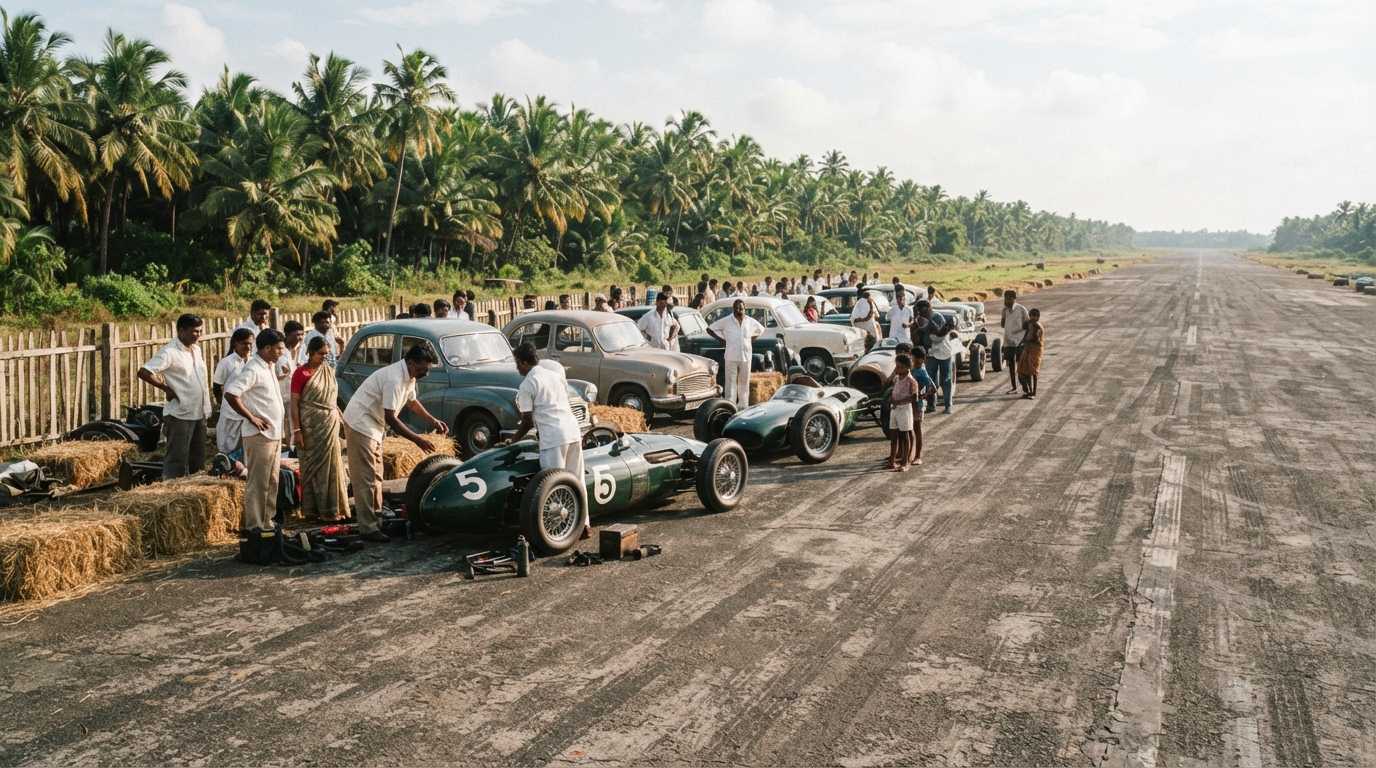
Long before modern telemetry and purpose-built tracks, racing in India grew through amateur motor clubs, military airfields, and local workshops. Enthusiasts modified road cars and built open-wheel single-seaters using domestic production engines. While major athletic milestones often center on traditional games, as seen in the timeline of India at the Olympics, the country has also built a distinct automotive racing culture. Understanding this timeline reveals how regional clubs, visionary engineers, and domestic tire manufacturers turned a niche hobby into a structured professional sport.
The Colonial Origins and Early Airstrip Racing Era
Organized motor racing in India originated during the early twentieth century as long-distance endurance tests before finding a home on decommissioned military airfields. These post-independence airstrip sprints laid the organizational foundation for modern track racing, bringing regional automobile clubs together under a single national governing framework.
+-----------------------------------------------------------------------------------+
| EARLY RACING TIMELINE |
| |
| 1904 1953 1971 |
| Delhi-to-Bombay Trial Sholavaram Airstrip Racing FMSCI Founded |
| (First organized run) (MMSC amateur circuit) (National rulebook set) |
+-----------------------------------------------------------------------------------+
The 1904 Delhi-to-Bombay Endurance Trial
Motor racing debuted in India in 1904 with a grueling road trial organized by the Motor Union of Western India [Entrepreneur India, 2024] [IARC India, 2014]. Competitors drove early European automobiles over rough dirt tracks, riverbeds, and unpaved cart roads connecting Delhi to Bombay.
The trial was not designed as a pure sprint race. Organizers set up the event to test mechanical reliability, fuel consumption, and vehicle durability under extreme weather conditions. European manufacturers used the results to market their vehicles to Indian royalty and colonial administrators. This event proved that motor vehicles could handle long-distance travel across the subcontinent. It sparked interest in competitive driving and led to the formation of regional automobile associations across Bombay, Calcutta, and Madras over the following two decades.
Post-Independence Airstrip Battles at Sholavaram
Following independence, motorsport found an unexpected home on World War II military airstrips. The Madras Motor Sports Club (MMSC), formed in 1953, began hosting sprint events on the abandoned runway at Sholavaram, near Chennai.
Sholavaram quickly became the center of Indian motorsport between the 1950s and the late 1980s. Racers competed on a T-shaped runway configuration that tested top speed and heavy braking on abrasive concrete slabs. The grid featured an eclectic mix of machinery, from modified Fiat 1100s and Standard Heralds to vintage Triumphs, Royal Enfields, and handcrafted specials. Mechanics built race cars from salvage yards, tuning carburetors and lightening chassis without access to imported racing parts. Thousands of spectators traveled from across the country every February to watch drivers race in clouding dust and coastal heat.
The Establishment of the FMSCI in 1971
As regional motor clubs multiplied across the country, racing lacked uniform technical rules and safety standards. In 1971, regional clubs united to establish the Federation of Motor Sports Clubs of India (FMSCI). The founding members included the Madras Motor Sports Club, the Calcutta Motor Sports Club, the Bangalore Motor Sports Club, and the Western India Automobile Association.
The FMSCI introduced standardized vehicle classifications, driver licensing, and track safety guidelines across all competitive categories. This institutional framework helped Indian racing align with international standards set by the Fédération Internationale de l'Automobile (FIA) and the Fédération Internationale de Motocyclisme (FIM). The federation also coordinated a structured national calendar, ensuring events did not overlap and enabling private sponsors to invest with greater confidence during broad shifts in the economic history of the country.
How Did Domestic Innovation Build Grassroots Indian Racing?
Grassroots Indian motorsport innovation is the engineering and infrastructural movement that democratized domestic competition during the late 1980s and 1990s through localized manufacturing and dedicated racing circuits. Industrialists and regional motor clubs solved the prohibitive expense of imported racing equipment by engineering affordable open-wheel single-seaters around domestic production powertrains, such as the Maruti 800 engine.
This technological pivot transformed amateur racing from improvised airstrip sprints into a structured driver development ladder. Engineers like Sundaram Karivardhan introduced purpose-built tubular chassis that made entry costs accessible for middle-class drivers, creating a pipeline that eventually produced Formula 1 talent such as Narain Karthikeyan and Karun Chandhok. Simultaneously, the development of permanent FIA-certified facilities like the Madras International Circuit at Irungattukottai in 1990 and Kari Motor Speedway in 2003, supported by tire manufacturers JK Tyre and MRF, replaced decommissioned runways with technical tracks featuring proper pit complexes and standardized safety barriers.
Sundaram Karivardhan and the Formula Maruti Revolution
High costs kept open-wheel single-seater racing out of reach for most Indian drivers until the late 1980s. Industrialist, driver, and race engineer Sundaram Karivardhan solved this problem in 1987 by launching Formula Maruti.
Karivardhan designed a lightweight, tubular spaceframe chassis powered by a standard 800cc engine from the Maruti 800 road car. The parts were cheap, reliable, and readily available across India. Formula Maruti dramatically lowered the cost of single-seater racing, making entry affordable for middle-class drivers. The series became the ultimate training ground for a generation of racers, including future Formula 1 drivers Narain Karthikeyan and Karun Chandhok. Karivardhan's emphasis on mechanical simplicity and driver skill reshaped the economics of Indian motorsport history.
Purpose-Built Permanent Tracks in the South
Racing on flat military runways had clear limits for vehicle tuning and driver safety. In 1990, the Madras Motor Sports Club opened India's first permanent, purpose-built circuit: the Madras International Circuit (MIC) at Irungattukottai, near Sriperumbudur.
+-----------------------------------------------------------------------------------+
|                        PERMANENT CIRCUITS COMPARISON                              |
|                                                                                   |
|  Circuit                 Location          Opened   FIA Grade   Length            |
|  -------------------------------------------------------------------------------  |
|  Madras Int. Circuit     Irungattukottai   1990     Grade 2     3.717 km          |
|  Kari Motor Speedway     Coimbatore        2003     Grade 3     2.100 km          |
|  Buddh Int. Circuit      Greater Noida     2011     Grade 1     5.125 km          |
+-----------------------------------------------------------------------------------+
The 3.717 km layout earned an FIA Grade 2 certification, allowing it to host international Asian regional championships alongside domestic series. Following Karivardhan's death in a 1995 plane crash, his former private runway in Coimbatore was rebuilt as the Kari Motor Speedway in 2003. These permanent facilities featured proper pit complexes, runoff areas, and technical corners that helped drivers learn high-speed racecraft. Southern India established itself as the operational capital of domestic motorsport, a status it retains today.
The National Racing Championship Framework
Tire manufacturers stepped in to finance national series as circuit infrastructure matured. The JK Tyre National Racing Championship and the MRF National Racing Championship became the two pillars of domestic circuit racing.
These corporate programs funded championships for both single-seaters and modified touring cars. JK Tyre supported the launch of the Formula LGB series, named after chassis manufacturer L.G. Balakrishnan & Brothers. MRF developed its own high-downforce single-seaters, culminating in the Formula 2000 series powered by Mountune race engines. These series gave drivers consistent track time on home soil, removing the need to move to Europe during the earliest stages of their careers.
What Was the Formula 1 Era and the Rise of Buddh International Circuit?
The Formula 1 era in India is the milestone period between 2005 and 2013 characterized by national driver debuts, team ownership by Force India, and the construction of the Buddh International Circuit [Entrepreneur India, 2024]. This phase brought premier global open-wheel racing to Greater Noida before local tax disputes and high operational costs halted the Grand Prix.
+-----------------------------------------------------------------------------------+
|                              THE FORMULA 1 CHAPTER                                |
|                                                                                   |
|  2005                      2008                          2011–2013                |
|  Narain Karthikeyan Debuts Force India F1 Founded        Indian Grand Prix Held   |
|  (First Indian in F1)      (Regular podium contender)    (Buddh Int. Circuit)     |
+-----------------------------------------------------------------------------------+
Indian Drivers and Teams on the Global Grid
In March 2005, Narain Karthikeyan made history at the Australian Grand Prix with Jordan Grand Prix, becoming the first Indian driver to start a Formula 1 race. Five years later, in 2010, Karun Chandhok joined the Hispania Racing Team, putting a second Indian driver on the F1 grid.
Indian participation expanded beyond drivers into team ownership. In late 2007, a consortium led by Vijay Mallya bought the Spyker F1 team and renamed it the Force India Formula 1 Team for the 2008 season. Operating out of Silverstone, the team scored its maiden pole position and podium finish at the 2009 Belgian Grand Prix with Giancarlo Fisichella. Force India regularly challenged better-funded factory outfits, securing top-five finishes in the Constructors' Championship over multiple seasons. The team proved that Indian-backed operations could compete at the top of international motorsport, matching major milestones in modern Indian history.
Constructing the Buddh International Circuit
Formula 1's growing domestic popularity led to the construction of a world-class racing facility in Northern India. The Jaypee Group invested between $400 million and $500 million in private capital to build the Buddh International Circuit (BIC) in Greater Noida, Uttar Pradesh [Entrepreneur India, 2024].
+-----------------------------------------------------------------------------------+
|                        BUDDH INTERNATIONAL CIRCUIT METRICS                        |
|                                                                                   |
|  Track Length:       5.125 km (3.185 miles)                                       |
|  Number of Turns:    16 corners                                                   |
|  Longest Straight:   1.060 km (high-speed overtaking zone)                        |
|  Top Speed Recorded: Over 320 km/h (F1 machinery)                                 |
+-----------------------------------------------------------------------------------+
Designed by German track architect Hermann Tilke, the 5.125 km circuit received an FIA Grade 1 homologation. The track layout earned praise from drivers for its rapid elevation changes, blind apexes, and wide overtaking zones into Turn 4. On October 30, 2011, the inaugural Indian Grand Prix took place before a packed grandstand of roughly 95,000 spectators, with Sebastian Vettel taking victory for Red Bull Racing.
Bureaucracy, Taxation, and the F1 Hiatus
The Indian Grand Prix ran for only three editions, from 2011 to 2013, before commercial disputes brought it to a halt. Race-day spectator attendance steadily fell from 95,000 at the 2011 debut to approximately 65,000 in 2013 [Entrepreneur India, 2024] [BlackBook Motorsport, 2023].
The primary hurdle was a tax dispute with local authorities. The Government of Uttar Pradesh classified Formula 1 as entertainment rather than an official sporting event. This classification stripped the race of standard sports customs exemptions, hitting Formula 1 and the race promoters with heavy entertainment taxes and import duties on temporary freight. Combined with falling ticket revenue and financial strain on the circuit owners, the race was left off the 2014 calendar. The event never returned, leaving the world-class facility underused for international open-wheel events.
What Role Do Two-Wheeler Competitions and Rallies Play?
Two-wheeler circuit racing and cross-country rally raids form the operational backbone of Indian motorsport, even when open-wheel series capture mainstream headlines. These competitions draw direct investment from domestic motorcycle manufacturers, offering viable careers for local riders and testing road vehicles across harsh environments.
+-----------------------------------------------------------------------------------+
|                           MOTORCYCLE & RALLY ECOSYSTEM                            |
|                                                                                   |
|  Off-Road Raids            Factory Two-Wheeler Racing    Global Events            |
|  (Raid de Himalaya,        (TVS Racing, Hero MotoSports  (MotoGP Bharat at BIC    |
|   Desert Storm)             factory programs)             draws 111,000+ fans)    |
+-----------------------------------------------------------------------------------+
Indian National Rally Championship and Off-Road Raids
Off-road rallying has run parallel to circuit racing for decades. The Indian National Rally Championship (INRC), regulated by the FMSCI, tests drivers on closed gravel, dirt, and tarmac stages across the country.
Cross-country rally raids take endurance driving to extreme environments:
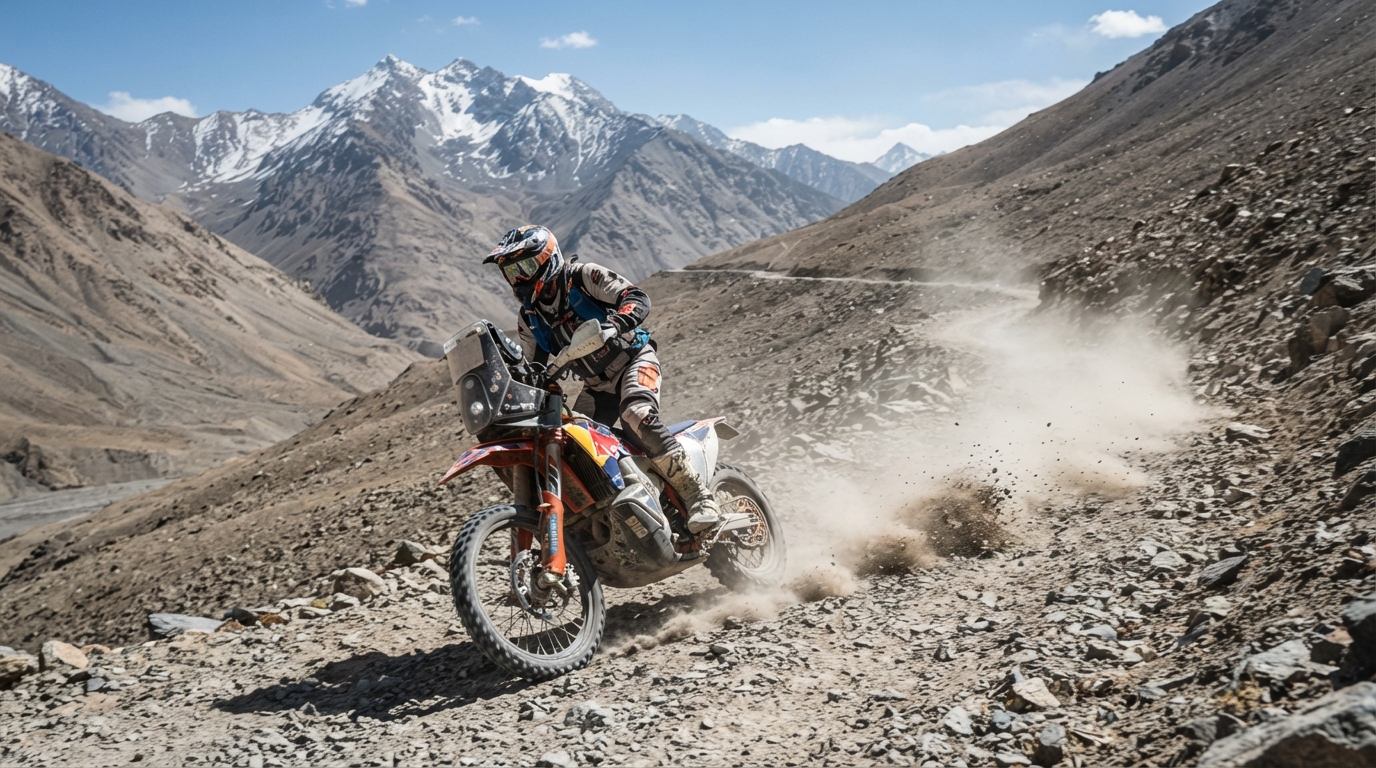
- Raid de Himalaya (Founded 1999): Competitors race through high-altitude Himalayan mountain passes above 14,000 feet, facing freezing conditions and severe engine power loss from thin air.
- Desert Storm: Drivers navigate high-speed navigation stages across the soft sand dunes and rocky trails of Rajasthan in extreme desert heat.
- Dakshin Dare: A multi-day endurance rally that covers thousands of kilometers across the hills, forests, and rural routes of Southern India.
These events serve as testing grounds where automotive manufacturers evaluate the structural durability of production SUVs, commercial tires, and off-road components.
Domestic Motorcycle Supremacy and National Grids
India is the largest two-wheeler market in the world, making motorcycle competition a commercial priority for local manufacturers. TVS Racing, founded in 1982, established India's first factory-backed motorcycle racing team, followed by major racing divisions from Yamaha, Honda, and Hero MotoCorp.
These factory programs support the Indian National Motorcycle Racing Championship across stock, modified, and supersport categories. The investment has helped Indian riders move up to international competitions. In rally raid events, Hero MotoSports and privateer entries have produced standout performances at the grueling Dakar Rally, with riders like CS Santosh and Harith Noah achieving historic stage wins and top-ten class finishes.
The Arrival of MotoGP Bharat in 2023
International motorcycle racing returned to India in September 2023 with the inaugural MotoGP Bharat, held at the Buddh International Circuit. Dorna Sports CEO Carmelo Ezpeleta noted that India is a critical market for the championship because hundreds of millions of citizens use two-wheelers daily [BlackBook Motorsport, 2024].
+-----------------------------------------------------------------------------------+
|                             MOTOGP BHARAT 2023 IMPACT                             |
|                                                                                   |
|  Total Weekend Attendance:   111,762 spectators [BlackBook Motorsport, 2023]      |
|  Economic Turnover:          ₹933.76 crore (€106 million) [ET Auto, 2023]         |
|  Track Adaptations:          Safety gravel traps and modified runoffs at BIC      |
|  Next Scheduled Round:       Rescheduled return targeting 2026 calendar           |
+-----------------------------------------------------------------------------------+
The three-day event drew a combined weekend attendance of 111,762 fans [BlackBook Motorsport, 2023]. According to figures from the Government of Uttar Pradesh, the race weekend generated ₹933.76 crore (€106 million) in business turnover and regional economic impact [ET Auto, 2023]. Marco Bezzecchi took victory for VR46 Racing Team. While operational disputes postponed the event's immediate follow-up to 2026, the race proved that two-wheeler international motorsport attracts deep spectator interest in the country.
City Street Tracks and the Modern Electric Racing Scene
Modern Indian motorsport is moving toward downtown street circuits, sustainable electric powertrains, and franchise-based city leagues. These projects bring wheel-to-wheel competition directly to urban crowds, though they require close coordination with municipal authorities.
+-----------------------------------------------------------------------------------+
|                        THE NEW URBAN RACING LANDSCAPE                             |
|                                                                                   |
|  2023                      2024                          2025 & Beyond            |
|  Hyderabad E-Prix          Chennai Night Street Circuit  Standardized Ladders     |
|  (FIA Formula E World Cup) (South Asia's 1st night track)(FMSCI youth programs)   |
+-----------------------------------------------------------------------------------+
Formula E in Hyderabad and Municipal Challenges
In February 2023, the ABB FIA Formula E World Championship brought top-tier electric racing to India with the inaugural Hyderabad E-Prix. Organizers built a temporary 2.835 km street track along the shores of Hussain Sagar Lake, with the open-wheel Gen3 electric race cars hitting speeds over 280 km/h.
The event gave local fans a direct look at modern electric powertrain technology. However, organizing races on public city roads brings administrative risks. Ahead of the 2024 season, Formula E terminated its multi-year host city contract following administrative and financial disagreements with the newly elected state government [DIVEBOMB Motorsport, 2026]. The cancellation showed how closely city street racing depends on long-term local political alignment.
Chennai Formula Racing Circuit and Night Racing (2024)
In August and September 2024, the Sports Development Authority of Tamil Nadu (SDAT) teamed up with Racing Promotions Private Limited (RPPL) to launch the Chennai Formula Racing Circuit at Island Grounds [Autocar India, 2024].
+-----------------------------------------------------------------------------------+
|                    CHENNAI FORMULA RACING CIRCUIT SPECIFICATIONS                  |
|                                                                                   |
|  Circuit Length:       3.839 km [Driven International, 2024]                      |
|  Number of Turns:      19 technical corners                                       |
|  Lighting System:      High-output LED floodlights across all sectors             |
|  Distinction:          South Asia's first FIA-certified night street race         |
|  Featured Series:      Indian Racing League & FIA Formula 4 Indian Championship   |
+-----------------------------------------------------------------------------------+
The 3.839 km layout featured 19 corners winding past the Napier Bridge and Marina Beach area [Driven International, 2024]. It stood as the first FIA-certified night street race in South Asia. The circuit hosted rounds for the franchise-based Indian Racing League and the FIA Formula 4 Indian Championship. Unlike remote permanent circuits, the downtown location let fans watch high-level single-seater racing right in the heart of the city.
+---------------------------------------------------------------------------------------------------+
|                         KEY MILESTONES IN INDIAN MOTORSPORT HISTORY                               |
|                                                                                                   |
|  Year     Milestone Event             Location               Key Stakeholders   Significance      |
|  -----------------------------------------------------------------------------------------------  |
|  1904     Delhi-to-Bombay Trial       Delhi to Bombay        Motor Union W.Ind. Subcontinent run  |
|  1953     Sholavaram Airstrip Sprints Chennai, Tamil Nadu    MMSC               Post-war racing   |
|  1971     FMSCI Established           National Body          Regional Clubs     Unified rulebook  |
|  1987     Formula Maruti Debut        National Tracks        S. Karivardhan     Affordable racing |
|  1990     Madras Int. Circuit Opens   Irungattukottai, TN    MMSC               First FIA track   |
|  2005     First Indian in Formula 1   Melbourne, Australia   N. Karthikeyan     Global milestone  |
|  2011     Inaugural Indian GP         Greater Noida, UP      Jaypee / F1        FIA Grade 1 track |
|  2023     Inaugural MotoGP Bharat     Greater Noida, UP      Dorna Sports / UP  Major 2-wheel run |
|  2024     Chennai Night Street Race   Chennai, Tamil Nadu    SDAT / RPPL        First night track |
+---------------------------------------------------------------------------------------------------+
Modern Governance and Grassroots Development
Indian motorsport governance has increasingly prioritized grassroots talent development and financial sustainability over one-off luxury events. Under the leadership of FMSCI President Arindam Ghosh and Vice President Farooq Ahmed, the federation focuses on building standardized regional karting pipelines [Indian Motoring, 2025].
The biggest challenge facing Indian racing is the cost gap between karting and international single-seater series. While domestic cricket attracts massive commercial sponsorships, young drivers often struggle to find backing for competitive seats abroad. To fix this, domestic series now offer FIA Super License points on home soil through the Indian F4 Championship. Standardizing domestic single-seater chassis and expanding entry-level karting academies helps Indian motorsport build a clear path to global grids.
Frequently Asked Questions
Q: Who was the first Indian driver to compete in Formula 1?
Narain Karthikeyan became the first Indian Formula 1 driver when he started for the Jordan Grand Prix team at the Australian Grand Prix in March 2005. He later drove for the HRT Formula 1 Team during the 2011 and 2012 seasons. Karun Chandhok joined the grid five years later in 2010.
Q: Why was the Formula 1 Indian Grand Prix discontinued after 2013?
The Indian Grand Prix ended primarily due to tax disputes and bureaucratic hurdles between Formula 1 organizers and the Uttar Pradesh state government. Authorities classified Formula 1 as entertainment rather than sport, denying organizers customs tax exemptions for freight. These costs, combined with dropping spectator attendance and financial pressure on circuit owners, led to the event's cancellation.
Q: What is the significance of Formula Maruti in Indian racing history?
Sundaram Karivardhan created Formula Maruti in 1987 to make open-wheel racing affordable for local drivers. It used a standard 800cc Maruti engine mounted in a simple, locally built tubular spaceframe chassis. The series lowered equipment costs and served as the primary training ground for generations of top Indian drivers.
Q: Where are India's permanent FIA-certified racing circuits located?
India's primary permanent circuits include the Buddh International Circuit in Greater Noida (FIA Grade 1), the Madras International Circuit in Irungattukottai near Chennai (FIA Grade 2), and the Kari Motor Speedway in Coimbatore (FIA Grade 3). These tracks host national circuit championships, motorcycle racing, and testing programs throughout the year.
What Are the Actionable Takeaways for Motorsport Enthusiasts?
Motorsport engagement in India is an accessible multi-tier framework allowing fans to transition from spectators to grassroots competitors through domestic circuits, arrive-and-drive karting tracks, and FMSCI-sanctioned events. Enthusiasts can attend National Racing Championship rounds between July and February at the Madras International Circuit in Sriperumbudur and Kari Motor Speedway in Coimbatore at minimal spectator cost.
Aspiring drivers can also access competitive karting through arrive-and-drive programs at national-grade tracks like Meco Kartopia in Bengaluru or the Kari Motor Speedway kart track in Coimbatore. These specialized facilities provide twin-engine four-stroke rental karts to teach drivers racing lines, racecraft fundamentals, and throttle control. In addition, tracking the Federation of Motor Sports Clubs of India (FMSCI) national calendar enables enthusiasts to participate in grassroots autocross competitions and regional rally stages across Indian states.
Where Can You Find Further Reading on Indian Motorsport History?
Indian motorsport documentation is a collection of official regulatory archives, historical club records, and track engineering case studies maintained by primary governing bodies and design firms [Driven International, 2024]. These resources provide detailed technical rulebooks, historical race records from venues like Sholavaram, and circuit blueprints documenting India's racing infrastructure from 1904 to the present.
- FMSCI Official Rulebook and Calendar (fmsci.co.in): The Federation of Motor Sports Clubs of India portal detailing national driver licensing, technical regulations, and upcoming championship dates [Indian Motoring, 2025].
- Madras Motor Sports Club Archive (mmsc.in): Historical records, track booking details, and technical archives documenting racing history at the Sholavaram runway and the Madras International Circuit at Irungattukottai.
- Driven International Design Case Studies (driveninternational.com): Engineering briefs detailing the track layout, FIA safety homologation, and urban construction of the Chennai Formula Racing Circuit [Driven International, 2024].
Related Reading
- Milestones in Indian Women's History: A Chronological Guide
- 1,000 Years of Indian Medical History: A Chronological Guide
- Economic Milestones in Indian History: From 1947 to Present
- What Are the Major Events in Indian History? (FAQ Archive)
Sources
- 1904 Indian Reliability Trial — Grace's Guide, 2019. Supports: The 1904 Delhi-to-Bombay endurance trial organized by the Motor Union of Western India as the debut of competitive motor trials across the subcontinent.
- Our History — Madras Motor Sports Club, 2026. Supports: The post-independence airstrip racing at Sholavaram, the establishment of the Federation of Motor Sports Clubs of India (FMSCI) in 1971, and the construction of the permanent Irungattukottai circuit in 1990.
- Remembering Kari – A man who gave so much to Indian motorsport — Evo India, 2018. Supports: Sundaram Karivardhan's development and 1987 launch of affordable Formula Maruti single-seaters using 800cc Maruti engines.
- 2013 FORMULA 1 AIRTEL INDIAN GRAND PRIX - RACE RESULT — Formula 1, 2013. Supports: Buddh International Circuit in Greater Noida hosting the Formula 1 Indian Grand Prix through the 2011 to 2013 seasons.
- Chennai's night street race a shot in the arm for Indian motorsports — The Hindu, 2024. Supports: India's inaugural night street race in 2024 hosted at the Chennai Formula Racing Circuit around Island Grounds.
- Indian Racing Festival 2024 guide: Tickets, Chennai street circuit and more — Autocar India, 2024. Supports: The active role and calendar usage of permanent and street racing venues across India, including the Madras International Circuit and Kari Motor Speedway.