Instrument Of Accession Historical Documents
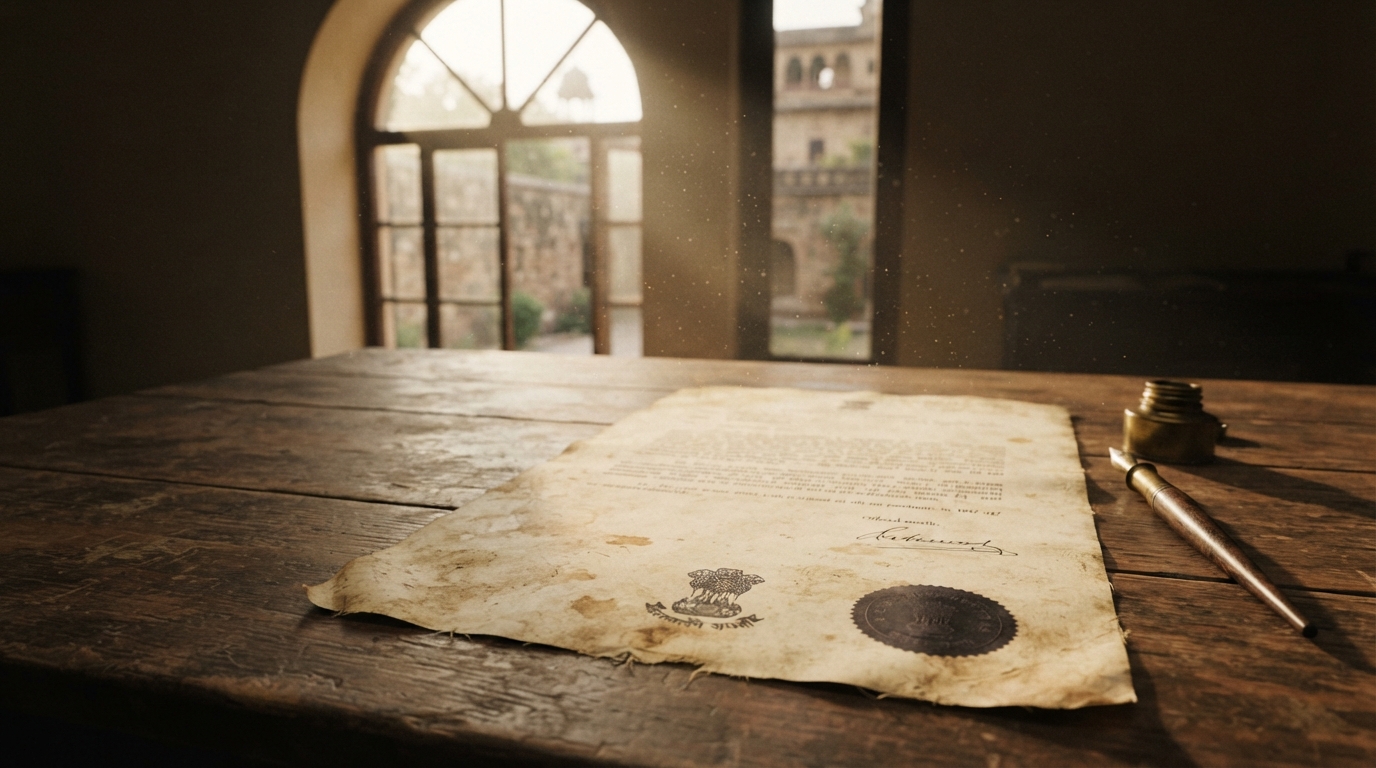
In Short
The Instrument of Accession was a legal form that a princely state's ruler signed in 1947 to 1948 to join India or Pakistan. According to Wikipedia's account, the form usually handed over three subjects: defence, external affairs and communications. The Instrument took effect only when the Governor-General of the receiving dominion accepted it.
Originals of these documents sit mainly in national archives. The National Archives of India uploads digitised records to its Abhilekh Patal portal, according to the Press Information Bureau (PIB, 2019). Full texts of some Instruments, including the Kashmir Instrument, are available online.
Key Takeaways
- An Instrument took effect only after the dominion's Governor-General formally accepted it.
- Most Instruments transferred just three subjects: defence, external affairs and communications.
- The Jammu and Kashmir original is preserved at the National Archives of India.
- Pakistan also used Instruments, including Kalat, Makran, Kharan and Lasbela in 1948.
- Abhilekh Patal, RTI requests and Wikisource are the practical routes to the texts.
Between 562 and 565 princely states existed when British rule ended in 1947. Exam-prep sources such as Drishti IAS (2023) use 562, while Wikipedia lists 565. V.P. Menon, who drafted the form, wrote of "more than 550 princely states." Each one had to choose a future, and most made that choice on paper. Those papers are the instrument of accession historical documents that students still study today. They are short, typed, and full of blanks filled in by hand. Yet a few pages decided the map of South Asia. This guide explains what the documents say, how the process worked, and where you can read them yourself.
What Were the Instrument of Accession Historical Documents?
The Instrument of Accession was a standard legal form drafted in 1947. A ruler signed the Instrument to join a princely state to India or Pakistan. The form usually ceded only defence, external affairs and communications. The ruler kept control of everything else. The document became binding only when the Governor-General of the receiving dominion signed an acceptance.
The legal basis for accession
The legal basis for accession was the Government of India Act, 1935, as adapted for independence, which gave the Instrument of Accession its legal force. The Indian Independence Act of 1947 ended British paramountcy over the princely states. The end of paramountcy left each ruler legally free, at least on paper, to accede to India or Pakistan.
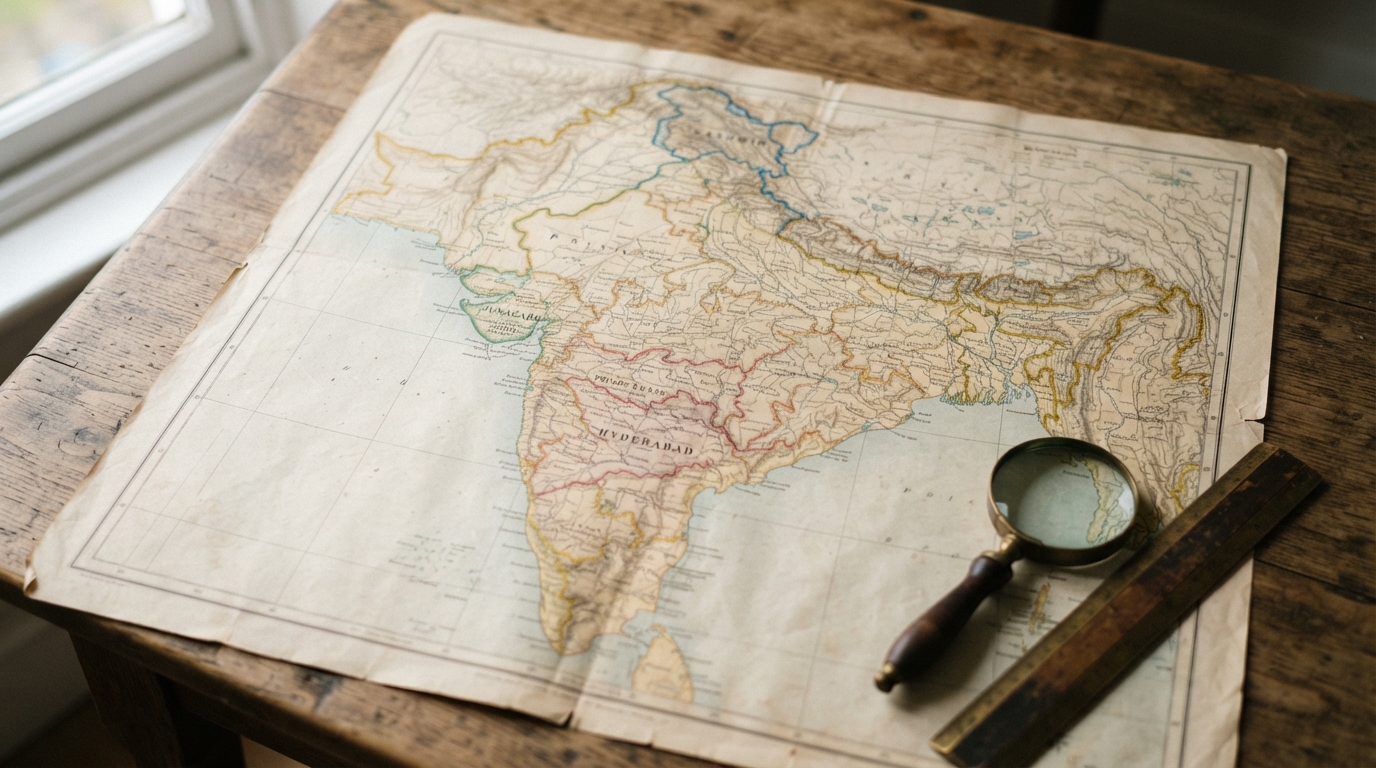
The States Department, led by Sardar Vallabhbhai Patel with V.P. Menon as secretary, drafted the Indian version in mid-1947. The States Department paired the Instrument with a second document called the Standstill Agreement. The Standstill Agreement kept existing arrangements running, such as railways, customs and postal links, while talks went on.
The three subjects in the schedule
The core of each Instrument is its schedule. The schedule is a list of subjects the ruler handed to the dominion legislature. According to Wikipedia's account, the standard list had three headings:
- Defence, including the naval, military and air forces
- External affairs, including treaties and relations with other countries
- Communications, including posts, telegraphs, telephones, wireless and broadcasting
Everything outside the schedule stayed with the ruler. That meant land revenue, local police and courts. The terms were not identical everywhere, though. SelfStudyHistory notes that the subject matters varied depending on the acceding state. So reading one Instrument doesn't tell you exactly what another said.
The acceptance step most summaries skip
The acceptance step is the second half of accession: an Instrument of Accession took effect only if the Government of India or the Government of Pakistan accepted it after the ruler signed. In practice, the Governor-General added a signed acceptance below or beside the ruler's text.
The acceptance detail matters more than it looks. The two-step process explains why historians focus on two dates for some states: the day the ruler signed and the day acceptance followed. For Jammu and Kashmir, Maharaja Hari Singh's signature is dated 26 October 1947. Lord Mountbatten's acceptance as Governor-General is dated 27 October 1947.
The Kashmir Instrument Is the Most Studied Copy
The Jammu and Kashmir Instrument is the most examined of all the instrument of accession historical documents. Its original is held at the National Archives of India under a specific register number. Researchers have confirmed it is well preserved. Its signing date has been debated since a British historian challenged it in 1993.
What the physical document looks like
The original is a typed form on several pages with handwritten entries. A researcher who got access through a Right to Information (RTI) request confirmed that it exists and is safe. That researcher described it as well preserved, as reported by Daily Excelsior and The Wire around 2016.
Page 2 is the key page. It bears the signature of Maharaja Hari Singh and the acceptance by Mountbatten. The text also includes clauses that limit its reach. Clause 7 says nothing in the Instrument commits the ruler to accept any future constitution of India. Clause 8 states that the ruler's sovereignty over the state continues, except as limited by the Instrument.
The archive reference number
Precise citation makes archival work faster. Wikimedia Commons lists the J&K Instrument's reference as:
- National Archives Register No. R.R. 271
- Page no. 27
- File P-I/20/47
- Year 1947
If you ever write to the National Archives, quote these details exactly. A clear reference cuts down back-and-forth with archive staff.
The date debate and its answer
Alastair Lamb, a British historian, argued in 1993 that it was "beyond a shadow of a doubt that the date is false." He claimed the Instrument was signed no earlier than 27 October. Pakistani commentary still repeats this point.
A 2026 piece in ThePrint argues against Lamb's antedating claim. It says that even if the signing slipped one day, "that one-day difference has no legal or substantive significance." Its reasoning is simple. Accession was complete once the Governor-General accepted it, and that acceptance is dated 27 October.
The same RTI researcher also found overwriting in at least one other Instrument. This is a useful lesson from handling real files. Corrections and overwrites were common in rushed 1947 paperwork. A smudge or changed figure alone doesn't prove a forgery.
For the wider context of these months, our visual history of the Indian independence movement lays out the key dates leading to August 1947.
How Did Different Princely States Sign?
States joined at very different speeds and on different terms. Several signed before 15 August 1947. Others held out for months, and a few faced military action or plebiscites. Pakistan used its own Instruments for states such as Kalat, Makran, Kharan and Lasbela. The timeline ran from mid-1947 to well into 1948.
Early signers and late holdouts
According to Wikipedia's entry on privy purses, Travancore, Bhopal and Jodhpur signed before 15 August 1947. Each of these had wavered first. Travancore's Dewan had spoken of independence. Jodhpur's ruler had held talks with Pakistan before signing with India.
Not every delay involved a big state. Piploda, a small state in central India, did not accede until March 1948. Its case shows the process wasn't finished on Independence Day. It dragged on for months in some corners of the map.
The problem states
A handful of states became flashpoints. This table summarises how each one's path differed.
| State | Dominion | Key date | What happened |
|---|---|---|---|
| Jammu and Kashmir | India | 26–27 Oct 1947 | Hari Singh signed; Mountbatten accepted next day |
| Junagadh | Pakistan, then India | Aug–Nov 1947 | First princely state to accede to Pakistan; later came under Indian control |
| Hyderabad | India | Sept 1948 | Signed a Standstill Agreement in Nov 1947; integrated after the September 1948 police action |
| Travancore | India | Before 15 Aug 1947 | Signed after earlier talk of independence |
| Jodhpur | India | Before 15 Aug 1947 | Signed after early contact with Pakistan |
| Piploda | India | March 1948 | Small central Indian state; one of the last to accede |
| Kalat | Pakistan | 27 March 1948 | Khan Ahmed Yar Khan signed the Instrument |
Junagadh is a strong teaching case. It shows that a ruler's signature alone didn't settle the matter. A plebiscite held in February 1948 confirmed the state's place in India.
Pakistan's side of the story
Most Indian summaries leave out Pakistan's Instruments. That gap distorts the picture. The Kalat accession, signed by Khan Ahmed Yar Khan, is dated 27 March 1948, as reported by Dawn (2026).
A 2026 Dawn analysis adds an important correction. It says treating Kalat's Instrument as covering all of Balochistan mixes up a single princely state with an entire province. Makran, Kharan and Lasbela acceded to Pakistan through separate Instruments of Accession. Reading these alongside the Indian ones shows that both dominions used the same legal tool.
Instrument of Accession Historical Documents Live in a Few Key Archives
Instrument of Accession historical documents are held mainly by the National Archives of India in New Delhi, which uploads digitised files to its Abhilekh Patal portal. RTI requests under the Right to Information Act can open specific files. Full transcriptions of the Kashmir Instrument appear on Wikisource and SabrangIndia, which suits students who need the text quickly.
National Archives of India and Abhilekh Patal
The National Archives of India in New Delhi is the main home for Indian Instruments. Digitised records are uploaded on Abhilekh Patal, the archive's online portal, according to the Press Information Bureau (PIB, 2019).
Here's the honest limitation. No official count exists of how many Instruments have been digitised or put online. Search results on Abhilekh Patal can be patchy. A state's file may sit under the ruler's name, the States Department, or a file code. Try several search terms before you assume a document is missing.
Using an RTI request
The Right to Information Act gives citizens a formal way to ask public bodies for records. The researcher who confirmed the J&K original used exactly this route.
A practical RTI request should include:
- The name of the state and the ruler who signed
- The year of accession
- Any known file or register number
- A clear ask, such as a certified copy or confirmation of custody
Precise requests get faster replies. Vague requests often come back with questions.
Full text you can read today
You don't need an archive visit to read the Kashmir Instrument. The full text of the Kashmir Instrument is on Wikisource. A PDF transcription is also hosted by SabrangIndia as "Legal Document No 113."
Transcriptions are useful but imperfect. Transcriptions don't show handwriting, stamps, or overwriting. For exam answers, a transcription is enough. For research on authenticity, you need the original or a certified image.
New work keeps using these files. A 2025 peer-reviewed study in the Russian journal Vestnik RUDN drew on unpublished documents on Kashmir's accession from the National Archives of India. The 2025 study shows the National Archives of India still holds accession material that hasn't been fully studied.
The Documents Still Shape Law and the Calendar
The Instruments of Accession are not just museum pieces. Courts still read their clauses closely: in December 2023, the Supreme Court of India relied on the Kashmir Instrument when it upheld the abrogation of Article 370, as reported by SCC Online (2023). Jammu and Kashmir also marks Accession Day every 26 October as a public holiday.
The 26 October date links back to Maharaja Hari Singh's signature on the Kashmir Instrument in 1947, so a single signing still appears on the calendar decades later. The bench in the 2023 case, led by CJI D.Y. Chandrachud, read the Instrument's text alongside later constitutional steps, which shows that a 1947 form can still decide present-day legal questions. For students, the Instruments are primary sources that show exactly how India's borders took shape, from the ruler's signature to the Governor-General's acceptance and, for most states, the merger agreements of 1948 and 1949.
Courts still read the clauses
In December 2023, the Supreme Court of India unanimously upheld the Union's action of abrogating Article 370. The bench, led by CJI D.Y. Chandrachud, held that Jammu and Kashmir did not retain any element of sovereignty after executing the Instrument, as reported by SCC Online (2023).
The 2023 ruling shows how a 1947 form can carry weight decades later. The Supreme Court looked at the Instrument's text alongside later constitutional steps. For a student, the Article 370 case is a clear example of a historical document becoming a live legal source.
Accession Day on the calendar
Accession Day remains a public holiday in Jammu and Kashmir. Accession Day falls on 26 October each year. In 2025, Accession Day fell on a Sunday, according to greytHR's 2025 holiday listing.
Dates like 26 October anchor our daily archive. The 26 October entry ties a single signature to a recurring public observance. Our list of the most searched dates in Indian history explains why certain days draw so much attention.
How to read an Instrument as a primary source
Primary sources reward slow reading. Use this short checklist when you open any Instrument:
- Find both signatures. Note the ruler's date and the acceptance date separately.
- Read the schedule. Check which subjects were ceded and whether the list differs from the standard three.
- Look for limiting clauses. Clauses like J&K's clauses 7 and 8 show what the ruler kept.
- Check the custody details. Note the archive, register number, and file code.
Most states later signed merger agreements in 1948 and 1949, which went much further than the original Instruments. Comparing the two kinds of document shows how integration moved from limited accession to full union. A dedicated timeline of the integration of princely states would place each signing in order. Later border events, such as those in the 1971 India-Pakistan war, also make more sense once you know how the 1947 map was drawn.
Related Reading
- Scientific Milestones in Indian History: A Date-Wise Guide
- Visual History of the Indian Independence Movement: Key Dates
- The Aftermath of April 13: Historic Events Following Jallianwala Bagh
- December 1984: A Historical Timeline of the Bhopal Gas Tragedy
FAQ
Q: Who drafted the Instrument of Accession? V.P. Menon drafted the Indian form in 1947 while working as secretary of the States Department. Sardar Vallabhbhai Patel led the department and the wider integration effort. The pair also drafted the Standstill Agreement that kept existing links running during talks.
Q: How many princely states signed an Instrument of Accession? Sources give different totals for the number of princely states. Wikipedia lists 565, Drishti IAS (2023) uses 562, and V.P. Menon wrote of "more than 550." Not every state signed a standard Instrument, since some, like Hyderabad, followed a different path.
Q: Was the Instrument of Accession the same for every state? No. The standard schedule covered defence, external affairs and communications. SelfStudyHistory notes that subject matters varied depending on the acceding state. Individual clauses could also differ, so each document needs to be read on its own.
Q: Where can I see the original Jammu and Kashmir Instrument? The original is held at the National Archives of India under Register No. R.R. 271, page 27, file P-I/20/47. A researcher confirmed through an RTI request that it is well preserved. The full text is also available on Wikisource and as a PDF from SabrangIndia.
Q: Did Pakistan use Instruments of Accession too? Yes. Kalat's ruler, Khan Ahmed Yar Khan, signed on 27 March 1948, as reported by Dawn (2026). Makran, Kharan and Lasbela joined Pakistan through separate Instruments of their own.
Open the Wikisource text of the Jammu and Kashmir Instrument today and find three things: Hari Singh's signature date, Mountbatten's acceptance date, and the schedule of ceded subjects. Write each one down with its source. That ten-minute exercise turns a textbook topic into a primary source you've read yourself.
Sources
- Instrument of Accession — Wikipedia. Supports: Most Instruments transferred only three subjects (defence, external affairs and communications), the 1935 Government of India Act gave the Instrument its legal basis, and 565 princely states existed.
- File: Instrument of Accession and Standstill Agreement of Jammu and Kashmir to Dominion of India.pdf — Wikimedia Commons. Supports: The J&K Instrument's archive reference is National Archives Register No. R.R. 271, page no. 27.
- A True Copy of Jammu & Kashmir's Instrument of Accession — Daily Excelsior, 2016. Supports: A researcher confirmed that the J&K original exists and is safe and well preserved at the National Archives of India.
- Why Alastair Lamb's hypothesis on Kashmir's Instrument of Accession remains irrelevant — ThePrint, 2026. Supports: Lamb's 1993 claim that the date was "beyond a shadow of a doubt" false, and the counter-argument that a one-day difference has no legal significance because accession was complete on the Governor-General's acceptance.
- Setting the record straight on Balochistan's 'accession' and charting a path for its future — Dawn, 2026. Supports: The Khan of Kalat signed the Instrument of Accession on 27 March 1948, and Makran, Kharan and Lasbela acceded separately.
- Digitisation undertaken by National Archives of India — Press Information Bureau, 2019. Supports: The National Archives of India uploads digitised records to its Abhilekh Patal portal.
- Live Report – Supreme Court Judgment on Article 370 — SCC Online, 2023. Supports: In December 2023 the Supreme Court held that J&K kept no element of sovereignty after executing the Instrument of Accession.
- Index: Instrument of Accession and Standstill Agreement of Jammu and Kashmir to Dominion of India.pdf — Wikisource. Supports: The full text of the Kashmir Instrument can be read on Wikisource.