Indian Diaspora Milestones: Key Dates in Global Political History

The political rise of the Indian diaspora began in the 21st century with tech executives and Western elections. The truth is that Indian-origin communities have actively shaped global governance for over 150 years, starting in the Caribbean, Africa, and Southeast Asia. Tracking Indian diaspora history milestones reveals a massive demographic shift from colonial-era labor forces to modern global leadership. Today, an estimated 35.4 million people make up the global Indian diaspora, split evenly between Non-Resident Indians and Persons of Indian Origin [Ministry of External Affairs, 2025]. This timeline maps out exactly when and how these individuals transformed into a strategic asset driving policy influence and cultural diplomacy worldwide.
What are Indian diaspora history milestones?
Indian diaspora history milestones are the documented political and demographic events tracking the ascent of Indian-origin individuals from 19th-century indentured labor movements to modern executive offices. These milestones include the June 5, 1873 arrival of laborers in Suriname, the 1946 establishment of the Malaysian Indian Congress, and the 2021 election of over 200 Indian-origin leaders across 15 countries [Indiaspora, 2021]. Tracking these historical markers reveals how a population of 35.4 million people transformed from colonial-era workers into a global diplomatic force by 2025 [Ministry of External Affairs, 2025]. The timeline highlights specific breakthroughs, such as Seewoosagur Ramgoolam becoming the first Chief Minister of Mauritius in 1961, which set a precedent for Indian-origin governance. Later milestones shift toward institutional power, marked by the creation of the United States India Political Action Committee (USINPAC) in 2002. By generating $135 billion in remittances annually, the modern diaspora utilizes these historical foundations to actively shape international trade agreements and domestic policies across North America, Europe, and Southeast Asia.
Key Takeaways
- Over 200 Indian-origin leaders currently hold senior public service roles across 15 nations.
- The global Indian diaspora reached an estimated 35.4 million people by early 2025.
- Early political milestones occurred in South America and Africa long before Western breakthroughs.
- Advocacy organizations transformed immigrant communities into recognized institutional lobbying powerhouses.
- Record remittances of $135 billion provide the diaspora with immense influence over domestic policy.
How did early migration shape Indian diaspora history milestones?
Early migration shaping Indian diaspora history milestones is the 19th-century relocation of over one million indentured laborers to the Caribbean, Africa, and South America, which established the demographic foundations required for future political power. Between 1834 and 1917, the British colonial labor system transported Indian workers to plantations, where these laborers eventually organized agrarian unions and fought for civil rights. The descendants of these 19th-century laborers formed political parties that secured national leadership roles following post-colonial independence movements in the 1960s. For example, the Indian community in Guyana used their population size to help elect Cheddi Jagan as Premier in 1961. Similarly, Indian migrants in Southeast Asia established the Malaysian Indian Congress in 1946, securing permanent political representation for the Indian minority during Malaysia's 1957 independence. These early migration waves transformed temporary plantation workers into permanent political stakeholders. By building civic infrastructure and labor unions, early Indian migrants created a blueprint for political organizing that enabled future generations to achieve sovereign executive power across multiple continents.
The 1873 Arrival in Suriname
The arrival of the ship Lalla Rookh in Suriname in 1873 marks a critical starting point. Indian indentured laborers arrived to replace emancipated enslaved people on sugar plantations. They faced harsh conditions but gradually built strong community structures. By organizing agrarian unions, these laborers laid the groundwork for political representation. Fast forward to the present, and this deep political integration is visible at the highest levels. President Chandrikapersad Santokhi took his oath of office in Sanskrit, highlighting the enduring cultural and political roots of the community [Ministry of External Affairs, 2023].
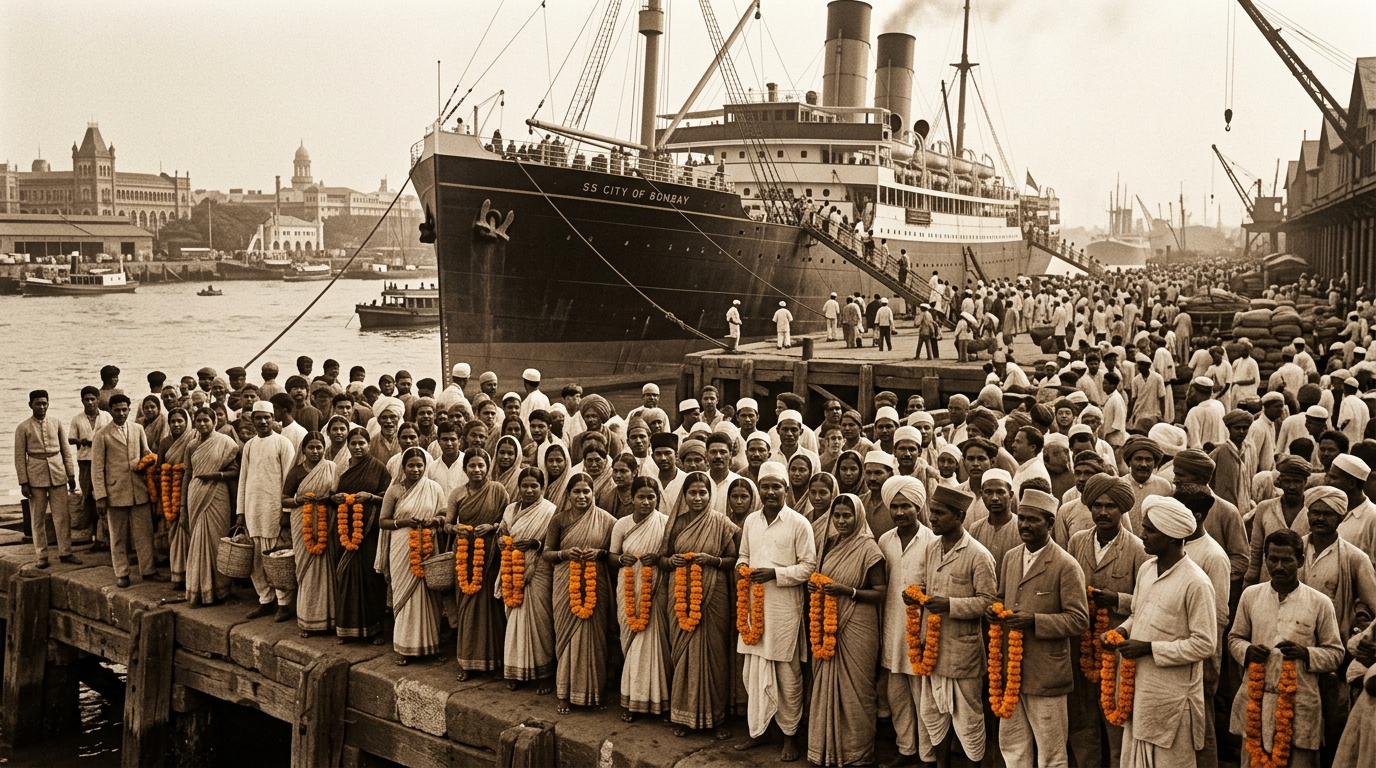
The Indian government recently recognized this legacy through concrete policy changes. They extended Overseas Citizen of India (OCI) card eligibility from the 4th to the 6th generation for descendants of original Indian immigrants in Suriname [Ministry of External Affairs, 2026]. This policy shift directly acknowledges the historical weight of these early migration routes. Readers exploring the 10 Most Searched Dates in Indian History and Why They Matter often find that international migration dates carry just as much weight as domestic events. The survival and political ascendance of the Surinamese Indian community proves that early forced migration eventually translated into sovereign political power.
Post-Colonial Shifts in Southeast Asia
Migration to Southeast Asia followed a different trajectory, driven by trade, colonial administration, and plantation labor. In countries like Malaysia and Singapore, Indian communities became deeply embedded in the civic infrastructure early on. They formed trade unions and political parties like the Malaysian Indian Congress (MIC), founded in 1946. The MIC played a vital role in Malaysia's independence movement. They joined the ruling coalition and secured permanent political representation for the Indian minority.
In Singapore, Indian-origin leaders helped draft the nation's constitution and establish its legal frameworks. These early civic engagements proved that Indian migrants could transition from temporary workers to permanent political stakeholders. The transition required navigating complex ethnic coalitions. It also demanded active advocacy for minority rights within newly independent nations. This era established a blueprint for diaspora political organizing that later generations would adapt across the globe. You can trace similar patterns of civic organization in the history of indian indentured labor.
When did Indian-origin leaders first gain executive power?
Indian-origin leaders first secured executive power in the late 20th century, primarily in nations with large diaspora populations like Mauritius, Guyana, and Trinidad and Tobago. These early victories paved the way for the recent surge of Indian-origin politicians reaching the highest levels of government in Western democracies.
Breakthroughs in the Caribbean and Africa
Electoral victories in Mauritius provide one of the earliest Indian diaspora history milestones. Seewoosagur Ramgoolam became the first Chief Minister in 1961. He later served as the first Prime Minister of independent Mauritius in 1968. His leadership established a firm precedent for Indian-origin governance. In Guyana, Cheddi Jagan became Premier in 1961, leading the anti-colonial struggle against British rule. These leaders emerged from massive diaspora populations. They used their demographic weight to secure democratic victories.
These early leaders faced intense opposition. They frequently navigated Cold War geopolitics and deep-seated ethnic tensions within their countries. Their success demonstrated that diaspora communities could govern multi-ethnic nations effectively. This era of political awakening closely parallels the domestic struggles documented in the Timeline of Mahatma Gandhi's Nonviolent Movements in India. Many diaspora leaders drew direct inspiration from the Indian independence movement, applying those tactics to their own local contexts.
The Rise in Western Democracies
The 21st century witnessed a geographic shift in executive milestones. By the early 2020s, the electoral environment in Western democracies had transformed. Over 200 Indian-origin leaders occupied senior public service roles, including presidents, prime ministers, and diplomats, across 15 countries [Indiaspora, 2021]. The ascent of Kamala Harris to Vice President of the United States marked a watershed milestone. She represented the first time a person of Indian heritage reached the executive office of the world's oldest democracy [Media India Group, 2021].
Similar milestones occurred rapidly across Europe. Indian-origin politicians secured prime ministerial roles in the United Kingdom, Ireland, and Portugal. MR Rangaswami of Indiaspora notes that the community has had time to lay deep roots in their adoptive countries [Indiaspora, 2021]. This deep rooting allowed a new generation to rise to the call of public service and shape policy on a global scale. This shift reflects the transition from post-1965 highly skilled migration to active, high-level civic participation.
What are the key Indian diaspora history milestones in modern diplomacy?
The key Indian diaspora history milestones in modern diplomacy are the establishment of formal advocacy organizations and state-sponsored engagement programs that transformed scattered immigrant communities into unified foreign policy assets. Milestones like the 2002 founding of the United States India Political Action Committee (USINPAC) enabled Indian-Americans to actively shape bilateral relations, trade agreements, and immigration policies. These institutional lobbying powerhouses played crucial roles in securing the 2008 US-India civilian nuclear agreement by funding political campaigns and hosting policy forums. The Indian government formalized diplomatic ties by launching the Know India Programme (KIP) in 2003, which has connected over 2,500 diaspora youth from 53 countries with their ancestral political roots [Ministry of External Affairs, 2023]. Additionally, the 2003 establishment of Pravasi Bharatiya Divas (Non-Resident Indian Day) on January 9th explicitly links diaspora history with national identity. These modern diplomatic milestones demonstrate how the global Indian community evolved from a migrant workforce into a strategic global asset driving technology transfer and cultural diplomacy across Western democracies.
Institutional Lobbying Powerhouses
The establishment of formal advocacy groups marks a distinct shift in diaspora political strategy. Organizations like the United States India Political Action Committee (USINPAC) and Indiaspora successfully transformed Indian-Americans from an immigrant community into an institutionally recognized lobbying powerhouse [Beyond Migration, 2026]. These groups fund political campaigns. They host policy forums and advocate for strategic cooperation between their host countries and India. They played crucial roles in securing the US-India civilian nuclear agreement. They also actively shape skilled immigration policy.
Dr. Thomas Abraham of the Global Organization of People of Indian Origin (GOPIO) highlights this transformation. He states that the diaspora has evolved from a migrant workforce seeking economic opportunity into a strategic global asset [India Empire, 2026]. This evolution drives policy influence, technology transfer, and cultural diplomacy. Maintaining this influence requires immense financial resources and highly coordinated political action. The transition from informal community groups to professional lobbying mirrors the domestic economic shifts outlined in Economic Milestones in Indian History: From 1947 to Present.
State-Sponsored Engagement Initiatives
The Indian government actively cultivates these diplomatic ties through structured programs. The "Know India Programme" (KIP) represents a flagship diaspora engagement initiative. This program recently marked its 20th anniversary. It has connected over 2,500 diaspora youth from 53 countries with their ancestral political and cultural roots [Ministry of External Affairs, 2023]. By bringing young diaspora members to India, the government fosters long-term political and economic alliances.
These programs explicitly define Indian historical figures and heritage sites as global entities. They encourage participants to act as cultural ambassadors in their home countries. The establishment of Pravasi Bharatiya Divas (Non-Resident Indian Day) in 2003 further cemented this relationship. Celebrated annually on January 9th, it commemorates Mahatma Gandhi's return to India from South Africa. This date choice explicitly links diaspora history with national identity, framing overseas Indians as integral to the modern Indian state.
How do economic milestones impact diaspora political influence?
Economic milestones impacting diaspora political influence are the record-breaking financial remittances and the concentration of Indian-origin executives in global technology sectors, which provide the capital required to fund political campaigns and establish think tanks. By generating $135 billion in remittances during the 2025 fiscal year, the diaspora forces host nations to accommodate Indian political interests [India Empire, 2026]. This massive capital flow stabilizes the Indian economy while granting the 35.4 million-strong global Indian diaspora significant sway over domestic Indian policy. Politicians in the United States, the United Kingdom, and Canada actively court Indian-origin voters by promising favorable trade relations with New Delhi. Furthermore, the appointment of Indian-origin executives to lead major technology firms like Alphabet and Microsoft allows these corporate leaders to directly shape digital policy and international data privacy laws. The sheer volume of wealth generated by the Indian diaspora enables community leaders to bankroll specific advocacy campaigns, creating a reciprocal relationship where economic success guarantees immediate legislative attention in Western parliaments.
Record Remittances and Strategic Value
The financial footprint of the diaspora provides immense political power. In the 2025 fiscal year, the diaspora sent a record high of $135 billion in remittances to India [India Empire, 2026]. This massive capital flow stabilizes the Indian economy. It also grants the diaspora significant influence over domestic Indian policy. Host nations recognize this economic power clearly. Politicians in countries like the US, UK, and Canada actively court diaspora voters by promising favorable trade relations with India.
The sheer volume of wealth generated by these communities allows them to fund political action committees. They can easily bankroll specific advocacy campaigns. This dynamic creates a reciprocal relationship where economic success guarantees political visibility. When a demographic group controls billions in annual capital flow, their political concerns receive immediate legislative attention. This financial reality underpins many recent Indian diaspora history milestones in Western legislatures.
Tech Leadership Translating to Policy Power
The concentration of Indian-origin executives in the global technology sector creates another avenue for political influence. Leaders of major tech firms regularly engage with heads of state. They directly shape digital policy, data privacy laws, and international trade regulations. This corporate power translates directly into civic power. Tech leaders fund diaspora advocacy groups and use their massive platforms to highlight issues relevant to their communities.
However, this focus on elite success often overshadows the broader working-class diaspora. The narrative of the wealthy "model minority" can obscure the diverse economic realities faced by many Indian immigrants. Plumbers, taxi drivers, and retail workers form a massive portion of the diaspora, yet their political concerns rarely make international headlines. When analyzing political influence, we must account for both the boardrooms of Silicon Valley and the labor unions of the Caribbean.
Where do internal divides complicate the global diaspora narrative?
The diaspora is not a political monolith. Internal fractures based on class, religion, and historical migration waves complicate efforts to project a unified voice. Transnational political movements often import domestic Indian conflicts into host countries, creating friction with local political integration.
Class Divides and Historical Tensions
The division between descendants of 19th-century indentured laborers and post-1965 skilled migrants creates distinct political priorities. Working-class diaspora communities in places like South Africa or Guyana often focus on local civil rights and labor protections. In contrast, newer, affluent migrant groups in Western democracies may prioritize skilled visa regulations and bilateral trade. These differing priorities make it difficult to form cohesive global policies.
Imported caste-based discrimination also remains a significant issue within diaspora communities. Recent legislative battles in the United States over adding caste to non-discrimination policies highlight these internal fractures. City councils and state legislatures have debated these measures intensely. These debates show that historical domestic issues continue to shape diaspora politics abroad. The community often struggles to present a united front when internal hierarchies remain unresolved.
Transnational Political Movements
The global expansion of domestic Indian political ideologies introduces new complexities. Hindu nationalist organizations have significantly expanded their global footprint to mobilize the diaspora. The international network Hindu Swayamsevak Sangh (HSS) serves as a prime example of this expansion [BTI, 2026]. This mobilization sparks new debates about transnational political polarization. Host nations increasingly scrutinize the dual-loyalty tensions that arise when diaspora groups actively lobby for homeland political interests.
This friction between host-country political integration and homeland advocacy forces diaspora leaders to walk a delicate line. They must represent their local constituents while managing the severe political pressures of their ancestral homeland. Critics argue that importing domestic political polarization weakens the community's standing in host nations. Supporters counter that maintaining strong ideological ties to India is essential for cultural survival. This ongoing debate represents one of the most complex Indian diaspora history milestones of the current decade.
What data points define the modern Indian diaspora landscape?
The data points defining the modern Indian diaspora landscape are the 35.4 million total population size, the $135 billion in annual remittances, and the election of over 200 Indian-origin leaders across 15 nations. This combination of demographic scale, geographic distribution, and economic output explains exactly why political parties worldwide actively court Indian-origin voters. According to the Ministry of External Affairs in 2025, the 35.4 million individuals making up the global Indian diaspora represent the largest transnational population globally. This massive demographic weight fundamentally changes the electoral math in dozens of countries, particularly the United States and the United Kingdom. Generating $135 billion in remittances alters global financial flows and forces host nations to respect the economic power of the Indian diaspora [India Empire, 2026]. Additionally, state-sponsored engagement initiatives like the Know India Programme have successfully built long-term cultural alliances by training over 2,500 diaspora youth from 53 countries. Every specific metric translates directly into measurable political influence for the global Indian community.
Demographic and Economic Metrics
The following table breaks down the key data points that define the current state of the global Indian diaspora. Tracking these numbers provides context for their expanding political footprint.
| Metric | Value | Source | Significance |
|---|---|---|---|
| Total Population | 35.4 million | Ministry of External Affairs, 2025 | Largest diaspora population globally, offering massive demographic weight in local elections. |
| Annual Remittances | $135 billion | India Empire, 2026 | Provides critical foreign exchange reserves and immense economic sway over domestic policy. |
| Global Political Leaders | 200+ across 15 nations | Indiaspora, 2021 | Demonstrates the successful transition from civic participation to executive governance. |
| KIP Alumni | 2,500+ youth | Ministry of External Affairs, 2023 | Builds long-term cultural and political alliances with the next generation of diaspora leaders. |
These figures represent specific milestones in their own right. Reaching a population of 35.4 million people fundamentally changes the electoral math in dozens of countries. Generating $135 billion in remittances alters global financial flows and forces host nations to respect diaspora economic power. Every data point in this table translates directly into measurable political influence.
Related Reading
- Indian History Milestones: The Maurya and Gupta Empires
- Milestones in Indian Women's History: A Chronological Guide
- Economic Milestones in Indian History: From 1947 to Present
- Today in Indian History: March Events, Birthdays, and Milestones
FAQ
Q: What is the largest Indian diaspora population in the world? The global Indian diaspora totals roughly 35.4 million people as of 2025. This population is split evenly between Non-Resident Indians (NRIs) and Persons of Indian Origin (PIOs) across multiple continents.
Q: When did the first Indian diaspora political leaders emerge? Early political leaders emerged in the mid-20th century in countries like Mauritius and Guyana. Leaders like Seewoosagur Ramgoolam and Cheddi Jagan secured executive power during post-colonial independence movements.
Q: How does the Indian diaspora influence host country politics? The diaspora influences politics through demographic voting blocks, campaign financing, and institutional lobbying groups like Indiaspora. They actively shape bilateral relations and domestic policies in their host nations by applying their economic success.
Q: What is the Know India Programme? The Know India Programme is a government initiative that connects diaspora youth with their Indian heritage. It recently celebrated its 20th anniversary, having brought over 2,500 participants from 53 countries to India to study their ancestral roots.
Your next move is to map the specific diaspora populations within your own industry or region of interest. Look beyond the standard Silicon Valley narrative and examine the civic organizations, labor unions, and historical migration routes that shape local policy. Understanding these distinct political histories allows you to engage with diaspora communities based on their actual priorities, not just their demographic labels.
Sources
- Question No-4812 Enhancement of Regional Strategic Cooperation — Ministry of External Affairs, 2025. Supports: The global Indian diaspora reached an estimated 35.4 million people by early 2025, split between Non-Resident Indians and Persons of Indian Origin.
- 2021 Indiaspora Government Leaders List — Indiaspora, 2021. Supports: Over 200 Indian-origin leaders hold senior public service roles across 15 nations.
- Prawas Din — Wikipedia, 2024. Supports: The June 5, 1873 arrival of Indian indentured laborers in Suriname aboard the ship Lalla Rookh.
- Our Story — Malaysian Indian Congress, 2024. Supports: The Malaysian Indian Congress was established in 1946 to secure political representation for the Indian minority.
- Seewoosagur Ramgoolam — Wikipedia, 2024. Supports: Seewoosagur Ramgoolam became the first Chief Minister of Mauritius in 1961.
- About USINPAC — United States India Political Action Committee, 2024. Supports: The United States India Political Action Committee (USINPAC) was created in 2002.
- Cheddi Jagan — Wikipedia, 2024. Supports: Cheddi Jagan became Premier of Guyana in 1961.