Indian Cinema Milestones
TL;DR
Indian cinema milestones track the evolution from 1913 silent films to a ₹2.78 trillion media powerhouse in 2025. This timeline highlights the arrival of talkies, the dominance of regional pan-India blockbusters, and the structural shift toward digital platforms that now generate more revenue than traditional television broadcasts.
Key Takeaways
- Digital media surpassed television as the largest segment of India's entertainment industry in 2025.
- Regional cinema now accounts for more than 65% of all films produced nationwide.
- Mid-budget films are driving box office growth, reducing reliance on top-heavy blockbusters.
- Indian production houses cite a severe shortage of quality writers as their primary challenge.
- Theaters saw a 5% increase in footfalls in early 2026, reversing a three-year decline.
Most people think the history of Indian film is simply a timeline of Mumbai-based Hindi blockbusters. The reality is that regional industries and digital platforms drive the industry's economic growth and creative evolution. Tracking indian cinema milestones requires looking past traditional theatrical models to see how technology and regional storytelling intersect. The Media and Entertainment (M&E) sector grew 9% year-on-year to ₹2.78 trillion in 2025 [FICCI-EY Report, 2026]. That growth stems from a complex history of technological adoption, shifting audience habits, and landmark creative breakthroughs. Understanding these historical shifts explains how the modern market functions.
How did the transition from silent films to digital epics reshape the industry?
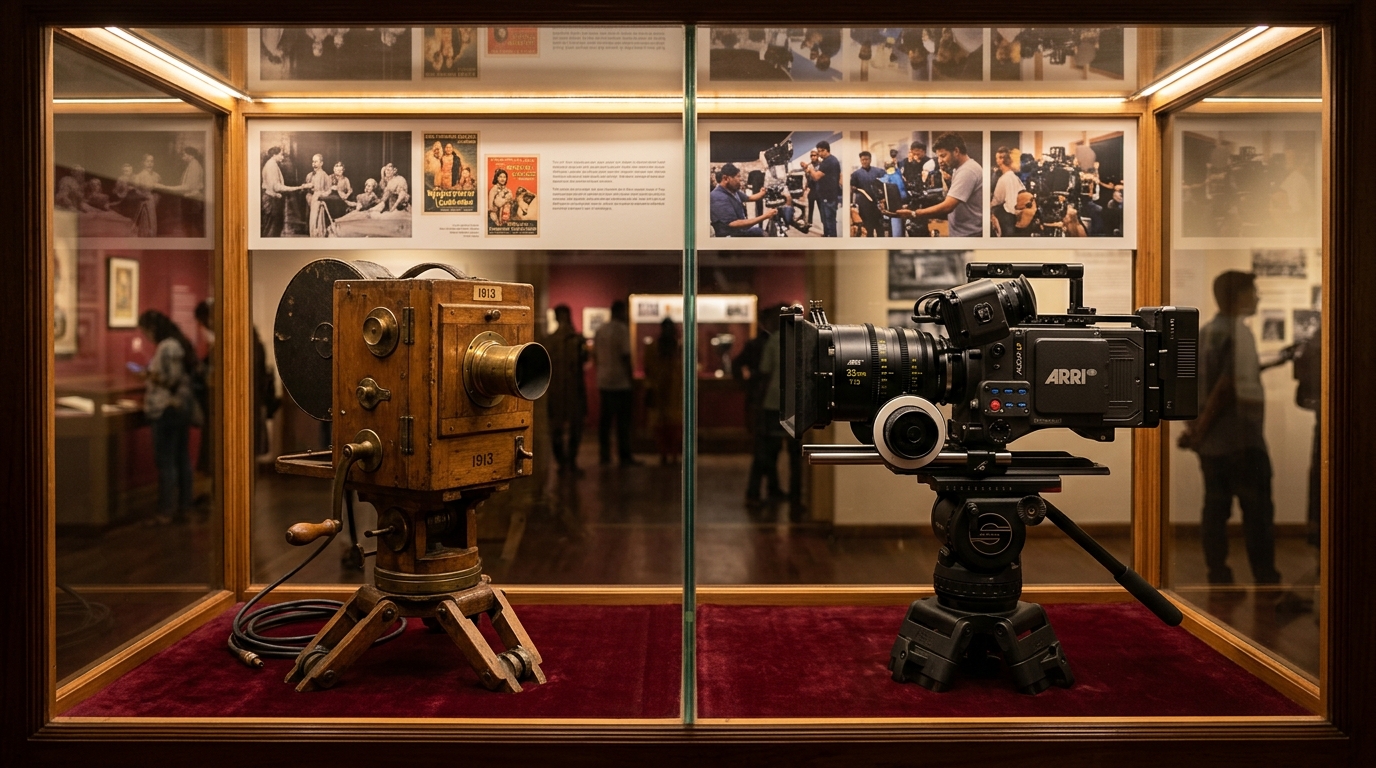
The technical evolution of filmmaking in India is a historical progression from 1913 silent black-and-white reels to 1931 synchronized sound and modern digital projection. According to industry records, each technological leap between 1913 and 2026 forced Mumbai and regional studios to adapt production business models and creative storytelling approaches.
Early foundations and the first talkies
Dadasaheb Phalke released Raja Harishchandra in 1913. This silent film established the mythological genre that still heavily influences Indian visual storytelling. Ardeshir Irani directed Alam Ara in 1931. This project introduced synchronized sound to the subcontinent. The arrival of talkies fragmented the national audience by language for the first time.
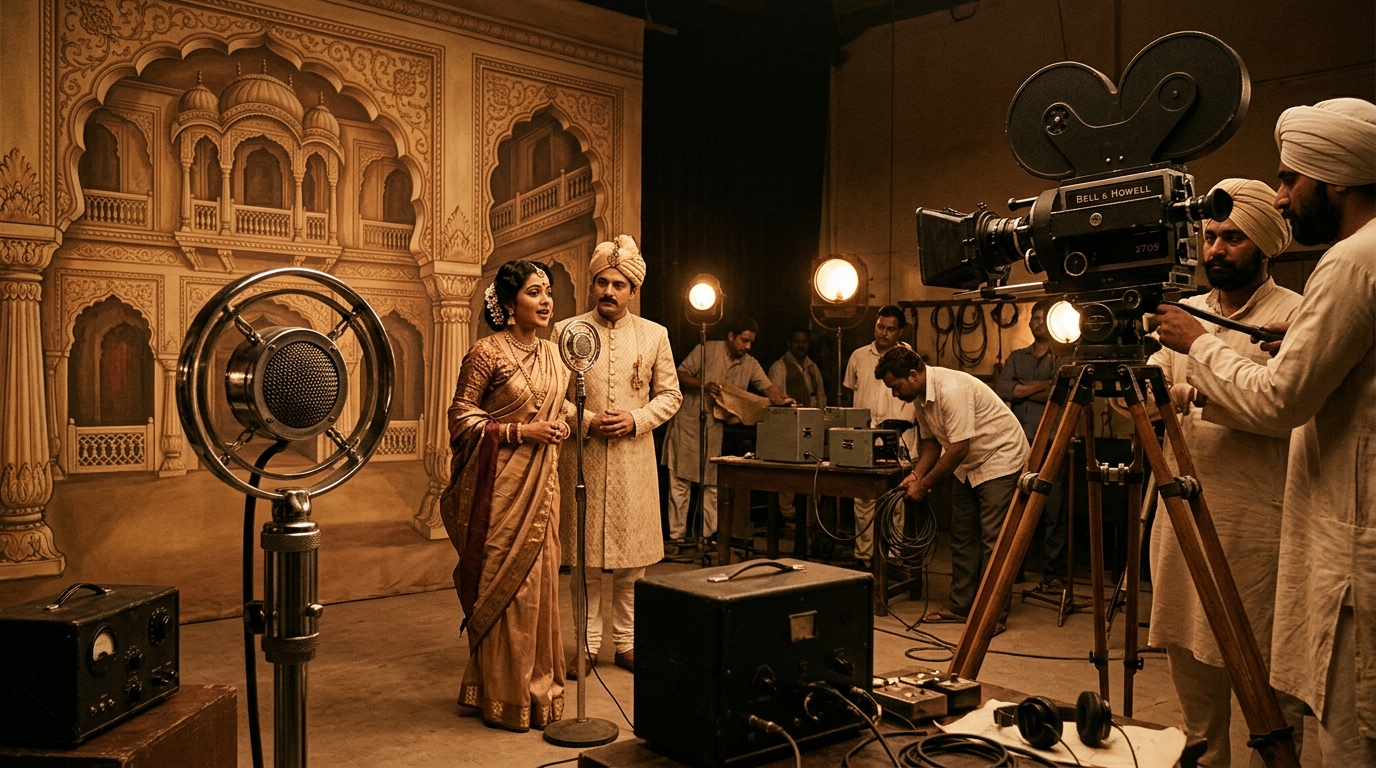
Studios had to choose which regional markets to serve. You can track similar regional developments in our guide to Record-Breaking Runs: Historic Dates in Indian Regional Cinema. The transition required new equipment, soundproof stages, and actors who could deliver dialogue clearly. Early studios like Bombay Talkies and Prabhat Film Company built massive infrastructures to support these new audio requirements.
The golden age of parallel cinema
The 1950s introduced a neo-realist movement that countered mainstream musical formulas. Directors like Satyajit Ray and Bimal Roy focused on social issues and naturalistic acting. Ray's Pather Panchali (1955) won international acclaim at Cannes. This era proved Indian filmmakers could compete at global festivals without relying on massive budgets.
The parallel cinema movement established a critical framework for evaluating film as art rather than pure commerce. State funding through the Film Finance Corporation supported these non-commercial ventures. This government backing allowed directors to experiment with narrative structures that commercial producers refused to finance.
The modern digital transition
Celluloid gave way to digital formats in the early 2010s. Digital projection reduced distribution costs drastically. It allowed films to open on thousands of screens simultaneously. This shift eliminated the gradual roll-out strategy of previous decades.
It created the modern opening-weekend box office model. The first half of 2026 saw theatrical footfalls increase by 5% year-on-year to 378 million [Ormax Media, 2026]. This reversed a three-year trend of declining or stagnant cinema admissions. Digital distribution makes this scale of simultaneous exhibition possible. Exhibitors can shift programming instantly based on real-time ticket sales.
How does regional language content drive national consumption?
Regional language content is the primary driver of India's national film market, with Southern film industries dictating commercial direction. According to the 2026 FICCI-EY Report, Telugu, Tamil, Malayalam, and Kannada productions now generate the majority of ticket sales, forcing Mumbai studios to dub and remake southern properties to maintain market share.
The rise of pan-India blockbusters
Regional cinema now contributes over 65% of all films produced in India [FICCI-EY Report, 2026]. The "pan-India" release strategy involves dubbing a regional film into multiple languages for a simultaneous national release. Baahubali: The Beginning (2015) proved this model could generate unprecedented revenue outside a film's native region.
Allu Aravind of Geetha Arts notes that the South is no longer a regional footnote but the benchmark for the Indian M&E sector [FICCI-EY Report, 2026]. His strategy focuses on building world-class, Indian-owned intellectual property and franchises. This approach shifts power away from traditional Hindi-language production hubs. Producers now design narratives specifically to appeal across cultural and linguistic borders.
OTT platforms fuel regional growth
Streaming services accelerated the national acceptance of regional content. Regional cinema's share in OTT viewership grew from 27% in 2020 to 56% in 2025 [FICCI-EY Report, 2026]. Viewers became comfortable reading subtitles and watching dubbed versions of Malayalam thrillers and Tamil dramas.
This shift forces streaming platforms to allocate larger acquisition budgets to southern producers. The economic impact of this shift mirrors broader Economic Milestones in Indian History: From 1947 to Present. Platforms like Netflix and Amazon Prime Video now prioritize regional licensing deals over expensive Hindi acquisitions.
Expanding theatrical footprints
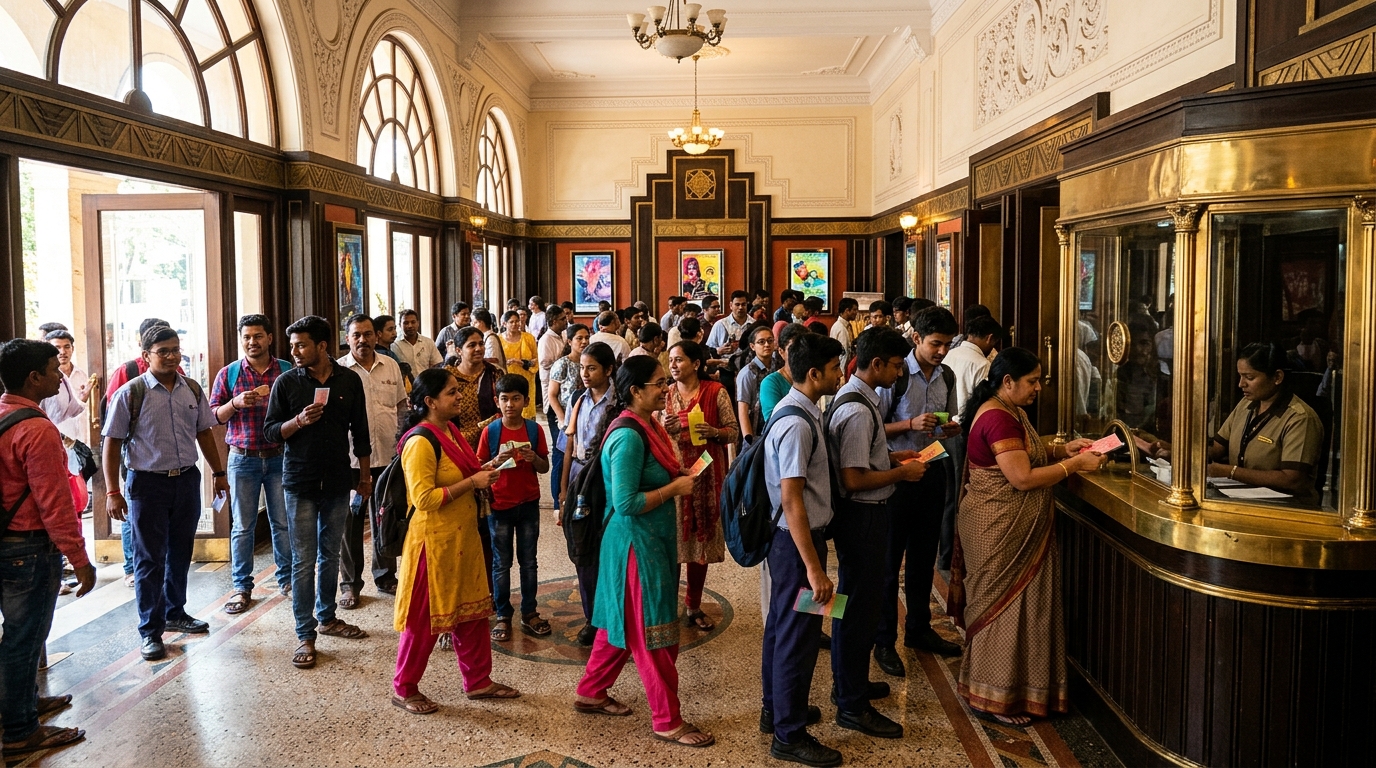
Theatrical exhibitors format their screen allocations based on these new viewing habits. Multiplexes in northern states dedicate significant screen time to original Telugu and Tamil releases. Domestic box office collections reached an all-time mid-year record of ₹6,398 crore in the first half of 2026 [Ormax Media, 2026].
This represents a 10% increase over the same period in 2025. Regional films drove a substantial portion of this growth. Theater owners prefer regional blockbusters because they often secure higher advance booking rates. This guarantees weekend revenue before the first screening even begins.
Why does the box office economy rely on mid-budget films?
The Indian box office economy is a financial ecosystem that depends on consistent mid-budget film output rather than a few massive hits. According to Ormax Media in 2026, mid-budget films provide the necessary volume to keep theaters profitable between major holiday releases, protecting multiplexes from the financial ruin of single high-profile flops.
Declining dependence on top-heavy releases
The share of the top 10 films at the India Box Office declined from 41% in 2024 to 33% in 2025 [Ormax Media, 2026]. This signals a resurgence of mid-budget films. In 2025, 37 films crossed the ₹100 crore mark, compared to just 22 in 2024.
A broader base of profitable films creates a healthier ecosystem for distributors and exhibitors. It reduces the risk associated with massive action spectacles. When a ₹300 crore production fails, it damages the entire supply chain. When multiple ₹30 crore films succeed, the wealth distributes more evenly across production houses.
The crisis of quality writers
Despite the box office growth, studios struggle to source original material. Exactly 78% of Indian production houses identify the shortage of quality writers and compelling local stories as their biggest unresolved challenge [FICCI-EY / Producers Guild of India, 2026].
Producers frequently rely on remakes or franchise extensions because developing original scripts carries higher risk. This writer shortage creates a bottleneck in production pipelines across all languages. The industry lacks formal development structures and standard compensation models for screenwriters. This structural flaw forces studios to outbid each other for the few proven writers in the market.
Action spectacles still dominate the peaks
While mid-budget films provide volume, massive action films still set the upper limits of box office potential. The Hindi action sequel Dhurandhar: The Revenge grossed over ₹1,273 crore in March 2026 alone [Ormax Media, 2026].
This made it the largest single theatrical driver in Indian cinema history. Studios balance their slates by funding dozens of mid-budget projects to offset the massive capital requirements of a single tentpole release. These massive films often require two to three years of production time. They tie up studio capital and limit the number of projects a production house can manage simultaneously.
How does international recognition expand beyond traditional award categories?
International recognition for Indian cinema is a growing movement where filmmakers no longer restrict international ambitions to the Best International Feature category. According to 2026 Oscars coverage, Indian producers now structure US theatrical distribution strategies to qualify films for general Academy Award categories like Best Picture and Best Director.
General category Oscar pushes
India's 2026 Oscars push expanded beyond the Best International Feature category [Oscars Coverage, 2026]. Films independently qualify for general categories by meeting US theatrical requirements. This bypasses the official selection committee process.
Homebound, directed by Neeraj Ghaywan, advanced to the Academy's Top 15 shortlist for Best International Feature Film in early 2026. This socially rooted narrative demonstrates the global appetite for specific, localized Indian stories. You can explore more about this in our timeline of Historic Milestones of Indian Cinema on the Global Stage. Independent producers now budget specifically for US theatrical runs to ensure qualification.
Animation and mythological epics
The scale of Indian animation has reached global standards. Mahavatar Narasimha entered the 2026 Academy Awards competition as a 3D mythological epic [Oscars Coverage, 2026]. This marks a major milestone for ambitious Indian animated projects seeking global recognition.
Animation allows filmmakers to depict mythological scale without the physical limitations of live-action production. Indian visual effects studios historically provided backend support for Hollywood blockbusters. They now use that technical expertise to develop their own intellectual property. This transition moves Indian studios from service providers to primary creators.
What is the government support for global expansion?
Government support for global expansion is a strategic state-level policy initiative designed to provide financial subsidies for international co-productions and improve local post-production infrastructure. According to the 2026 FICCI-EY Report Launch, these targeted government incentives actively lower the financial barrier for Indian film producers aiming at global markets. Ashish Shelar, Minister of IT & Cultural Affairs for Maharashtra, stated that growing global recognition of Indian stories makes 2026 a defining moment for India to transition into a leading global content hub. You can read more about the evolution of the local visual effects industry in our guide to the history of indian animation.
Digital media officially overtakes television in total revenue
Internet-based content delivery generates more revenue than traditional broadcast television for the first time in Indian history. Smartphone penetration and affordable data plans shifted consumer behavior permanently. This transition forces legacy broadcasters to restructure their business models around streaming applications rather than linear channels.
The shift in media and entertainment economics
Digital media officially overtook television as the largest segment of the Indian M&E industry. It crossed the ₹1 trillion revenue mark for the first time in 2025 [FICCI-EY Report, 2026]. Advertisers follow the audience, moving their budgets from prime-time television slots to digital video platforms.
This shift impacts how production budgets are allocated. Television networks historically funded long-running daily soap operas. They now divert those funds to produce high-end limited series for their affiliated streaming apps. The metrics for success shifted from daily broadcast ratings to monthly active user retention.
The rise of micro-dramas
The format of digital content is changing rapidly. OTT content production fell 7% in volume and 18% in value in 2025 [FICCI-EY Report, 2026]. Total OTT content spend dropped from ₹26.7 billion to ₹21.8 billion.
This decline occurred amid a shift toward micro-dramas. These short-form, vertically shot narratives cater to mobile viewers with shorter attention spans. They cost significantly less to produce than premium episodic series. Platforms monetize these micro-dramas through freemium models, where viewers pay small fees to unlock individual episodes. This model generates immediate cash flow compared to standard monthly subscriptions.
Comparing content distribution models
Understanding the differences between traditional and modern distribution clarifies where the industry is heading. Each model requires entirely different marketing and production strategies.
| Feature | Theatrical Model (Pre-2010) | Digital OTT Model (Current) |
|---|---|---|
| Release Strategy | Gradual regional roll-out | Simultaneous global release |
| Revenue Source | Direct ticket sales | Subscription and ad revenue |
| Primary Metric | Box office collections | Watch time and completion rate |
| Content Length | 150+ minutes with intermission | Flexible (Micro-dramas to series) |
The transition between these models represents one of the most critical indian cinema milestones of the modern era. Producers who fail to adapt to the digital model find themselves unable to secure theatrical distribution.
Related Reading
- Historic Milestones of Indian Cinema on the Global Stage
- Indian History Milestones: The Maurya and Gupta Empires
- Milestones in Indian Women's History: A Chronological Guide
- Record-Breaking Runs: Historic Dates in Indian Regional Cinema
FAQ
Q: What was the first Indian sound film? Ardeshir Irani released Alam Ara in 1931. This film introduced synchronized sound to Indian audiences and established the template for the musical format that still defines mainstream commercial releases.
Q: How big is the Indian media and entertainment industry? The sector grew to ₹2.78 trillion in 2025 and is projected to reach ₹3.3 trillion by 2028. Digital media currently represents the largest single segment of this revenue, having recently surpassed traditional television.
Q: Why are regional films performing so well nationally? Streaming platforms habituated audiences to reading subtitles, while studios perfected the "pan-India" model of dubbing regional blockbusters into multiple languages for simultaneous wide release.
Q: What is the biggest challenge facing Indian film production? According to a 2026 FICCI-EY report, 78% of production houses cite the shortage of quality writers and original local stories as their primary operational challenge.
Review the top-grossing films playing at your local multiplex this weekend and track their original production language. You will quickly see how regional cinema dominates the modern theatrical landscape and dictates the future of the national box office.
Sources
- Raja Harishchandra — Wikipedia, 2026. Supports: Dadasaheb Phalke released the silent film Raja Harishchandra in 1913.
- Alam Ara — Wikipedia, 2026. Supports: Ardeshir Irani directed Alam Ara, which introduced synchronized sound to the subcontinent in 1931.
- Pather Panchali — Wikipedia, 2026. Supports: Satyajit Ray's Pather Panchali (1955) won international acclaim at the Cannes Film Festival.
- Entertainment Sector - FICCI Media — FICCI, 2026. Supports: The Indian Media and Entertainment sector grew 9% year-on-year to ₹2.78 trillion in 2025.
- Media Center - Ormax Media — Ormax Media, 2026. Supports: The first half of 2026 saw theatrical footfalls increase by 5% year-on-year to 378 million, and domestic box office collections reached a mid-year record of ₹6,398 crore.