India in the 1940s: A Timeline of War, Partition, and Independence
September 3, 1939, set the stage for the most turbulent decade in the subcontinent's history. Lord Linlithgow declared India at war with Germany without consulting a single Indian political leader. This unilateral decision triggered mass resignations across provincial ministries. It set the tone for India in the 1940s. The decade began with a reluctant entry into global conflict. It ended with a newly independent, partitioned republic writing its constitution.
To study this era is to look at a compressed timeline of human struggle. The events of these ten years redrew maps, displaced millions, and birthed new nations. This guide breaks down the critical dates and movements that defined the decolonization era.
The Early 1940s: World War II and Growing Resistance
The first few years of the decade saw Indian political leaders wrestling with a massive dilemma. They opposed fascism globally, but they also opposed British imperialism locally. This tension defined the early political landscape.
The Lahore Resolution (March 1940)
March 1940 changed the political map permanently. The All-India Muslim League gathered in Lahore for its annual session. On March 24, the party passed the Lahore Resolution. Drafted by Sikandar Hayat Khan and presented by A.K. Fazlul Huq, the document formally demanded separate states for Muslims in the northwestern and eastern zones of British India.
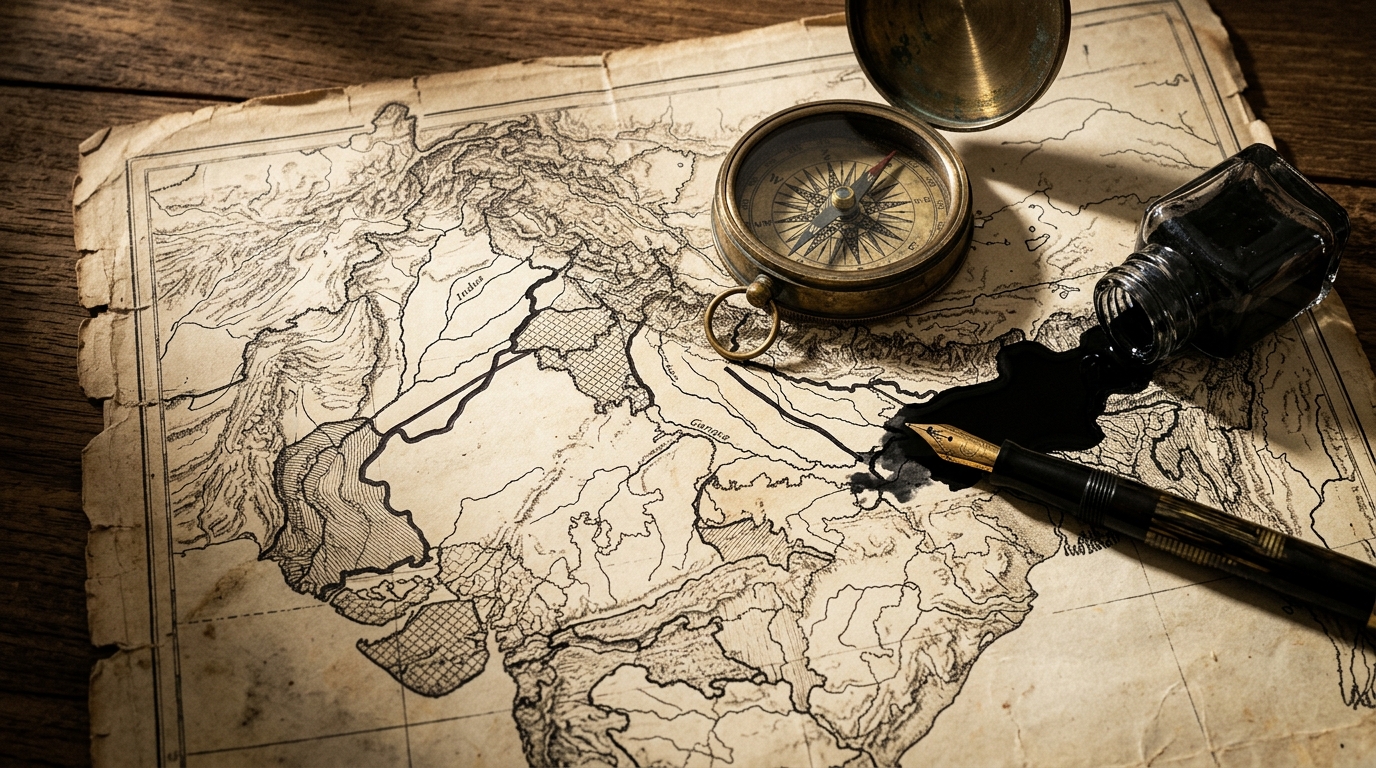
The resolution did not explicitly use the word "Pakistan" at first. The press quickly branded it the Pakistan Resolution anyway. This document planted the political seed that would eventually split the subcontinent.
The Cripps Mission (March 1942)
By early 1942, the Japanese Imperial Army was rapidly advancing through Southeast Asia. Rangoon fell in March. The threat to India became immediate. The British government desperately needed full Indian cooperation for the war effort.
Prime Minister Winston Churchill sent Sir Stafford Cripps to Delhi. Cripps offered a proposal: India would receive dominion status and a constituent assembly after the war ended. In exchange, Indian leaders had to support the war immediately. The Indian National Congress rejected the offer. Mahatma Gandhi famously called the proposal a "post-dated cheque on a crashing bank." The mission failed completely.
The Quit India Movement (August 1942)
August 8, 1942, marked a breaking point. Following the failure of the Cripps Mission, Gandhi launched the Quit India Movement at the Gowalia Tank Maidan in Bombay. He delivered his famous "Do or Die" speech, demanding an immediate end to British rule.
The British response was swift and brutal. Within hours, colonial authorities arrested the entire Congress working committee. Gandhi, Jawaharlal Nehru, and Sardar Vallabhbhai Patel went to prison. In their absence, mass protests erupted across the country. Students, workers, and farmers attacked symbols of British authority. The British suppressed the movement with mass detentions and military force. You can track the exact progression of these protests through a visual history of the Indian independence movement.
The Mid-1940s: Famine, Mutiny, and Political Deadlock
As World War II raged on, the economic and human toll on India grew catastrophic. The mid-1940s exposed the fatal flaws of colonial administration.
The Bengal Famine (1943)
1943 brought unimaginable tragedy to the Bengal province. A complex mix of factors caused a devastating famine. A cyclone hit the region in late 1942, destroying crops. The Japanese occupation of Burma cut off rice imports. Most critically, British wartime policies prioritized military supplies over civilian survival.
The colonial government implemented a "Denial Policy" to destroy boats and rice stocks in coastal Bengal. They wanted to prevent advancing Japanese troops from seizing supplies. This policy cut off local transport and food access. Economist Amartya Sen's later research showed that food was available, but hyperinflation made it impossible for the rural poor to buy it. Estimates place the death toll between two and three million people.
The Indian National Army Trials (1945)
Subhas Chandra Bose had formed the Indian National Army (INA) with Japanese support to fight the British. After the war ended, the British captured thousands of INA soldiers. In November 1945, colonial authorities put three prominent INA officers on trial for treason at the Red Fort in Delhi.
The defendants were a Hindu (Prem Kumar Sahgal), a Muslim (Shah Nawaz Khan), and a Sikh (Gurbaksh Singh Dhillon). The trial backfired on the British. It united Indians across religious and political lines. Massive demonstrations took place across the country. Top Indian lawyers, including Bhulabhai Desai and a returning Jawaharlal Nehru, defended the officers. Public pressure grew so intense that the British commander-in-chief eventually remitted their sentences.
The Royal Indian Navy Mutiny (February 1946)
February 18, 1946, started with a strike over poor food and racist behavior by British officers. Sailors on the HMIS Talwar in Bombay harbor mutinied. The rebellion spread rapidly. Within 48 hours, 78 ships and 20 shore establishments joined the mutiny.
The mutineers hoisted the flags of the Congress, the Muslim League, and the Communist Party on their ships. The British realized a terrifying truth: they could no longer rely on Indian armed forces to maintain control. Though Indian political leaders eventually persuaded the sailors to surrender, the mutiny accelerated the British exit timeline.
The Path to Partition: India in the 1940s Reaches a Tipping Point
The end of World War II brought a Labour government to power in Britain. Prime Minister Clement Attlee recognized that holding onto India was no longer possible. The question shifted from if the British would leave, to how they would leave.
Direct Action Day (August 1946)
For anyone studying India in the 1940s, August 16, 1946, marks the moment Partition became inevitable. Muhammad Ali Jinnah and the Muslim League called for "Direct Action" to press their demand for a separate Muslim state.
The day triggered the Great Calcutta Killings. Massive communal riots broke out across the city. Armed mobs roamed the streets. In just 72 hours, roughly 4,000 people died. Another 100,000 lost their homes. The violence quickly spread to Noakhali, Bihar, and the Punjab. The sheer brutality convinced many Congress leaders that a united India was an impossible dream.
The Mountbatten Plan (June 1947)
Lord Louis Mountbatten arrived as the last Viceroy in March 1947. He quickly concluded that the political deadlock between the Congress and the Muslim League was unbreakable. On June 3, 1947, he announced the Mountbatten Plan.
The plan outlined the partition of British India into two independent dominions: India and Pakistan. Crucially, Mountbatten moved the British departure date up. The original target was June 1948. Mountbatten shifted it to August 1947. This gave the administration just ten weeks to divide the military, the treasury, the civil service, and the physical landmass of the subcontinent. This rushed timeline guaranteed administrative chaos.
1947: Independence and the Trauma of Partition
August 1947 brought the highest highs and the lowest lows in modern subcontinent history. Freedom arrived, but it carried a massive human cost.
The Radcliffe Line (August 1947)
Sir Cyril Radcliffe arrived in India in early July 1947. The British government tasked him with drawing the exact borders of India and Pakistan. Radcliffe had exactly five weeks to complete the job. He had never visited India before. He relied on outdated census maps and conflicting local reports.
Radcliffe submitted his boundary award on August 9. The British delayed publishing it until August 17, two days after independence. Millions of people celebrated independence without knowing which country they actually lived in. When the line went public, communities found themselves split down the middle.
August 15, 1947: A Nation Awakes
At the stroke of midnight on August 15, India became an independent nation. Jawaharlal Nehru delivered his famous "Tryst with Destiny" speech to the Constituent Assembly. He spoke of India waking to life and freedom.
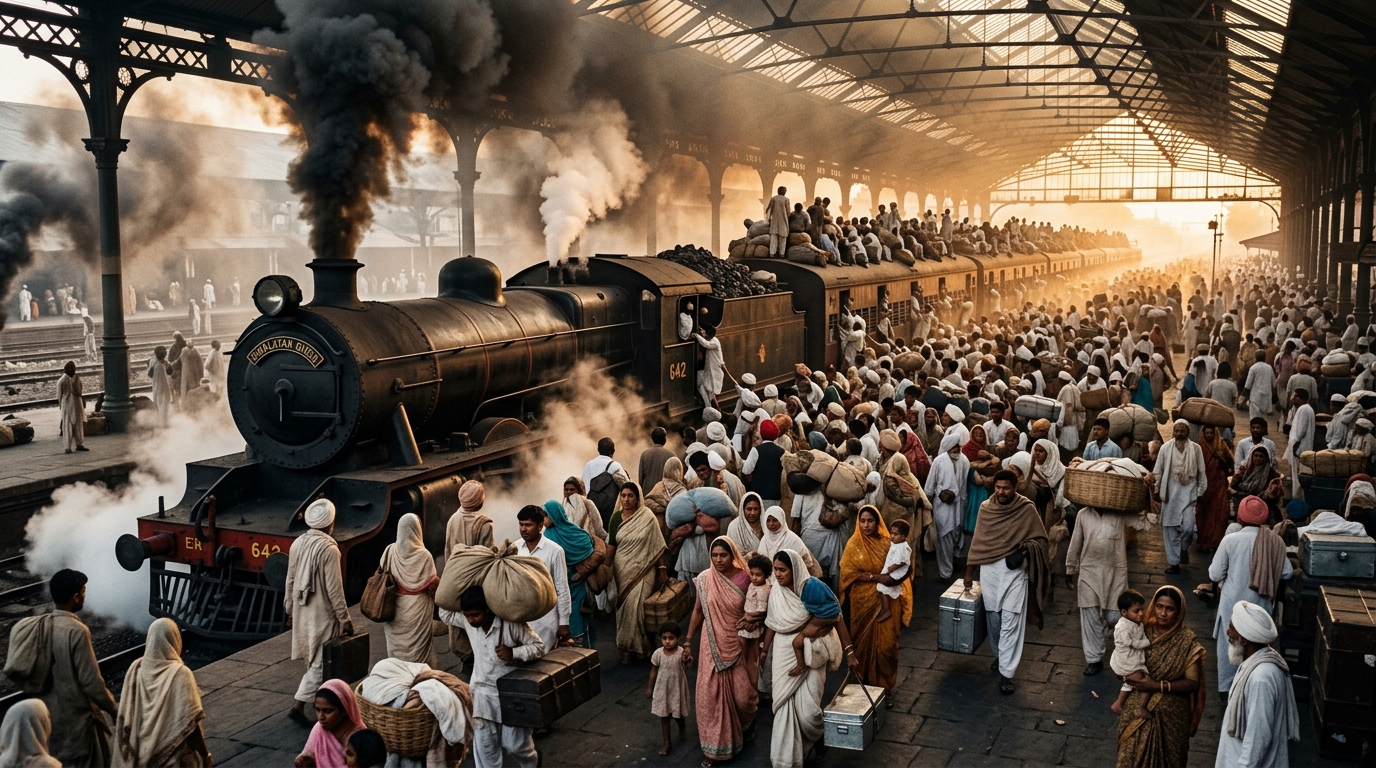
The joy of independence mixed heavily with the sorrow of Partition. The new borders triggered the largest mass migration in human history. Over 15 million people crossed the borders on foot, in bullock carts, and on packed trains. Hindus and Sikhs fled west to east. Muslims fled east to west. Communal violence exploded along the migration routes. Estimates suggest up to two million people died in the violence. To trace the timeline of the new republic from this day forward, review the historic dates in modern India.
The First Indo-Pakistani War (1947-1948)
Conflict erupted almost immediately over the princely state of Jammu and Kashmir. In October 1947, Pashtun tribal militias, backed by the Pakistani military, invaded the state. Maharaja Hari Singh, the ruler of Kashmir, panicked. He signed the Instrument of Accession, formally joining India in exchange for military help.
Indian troops airlifted into Srinagar on October 27. They pushed back the tribal forces. The conflict escalated into a full war between the two new nations. The fighting lasted until the United Nations brokered a ceasefire, which took effect on January 1, 1949. The ceasefire line established the Line of Control, creating a geopolitical dispute that continues today.
Scientific and Cultural Shifts of the Decade
While politics and partition dominated the headlines, the 1940s also saw crucial institution-building. Leaders recognized that a new nation needed strong scientific and cultural foundations.
Establishing Scientific Institutions
Science in India in the 1940s took a massive leap forward. In 1942, the government established the Council of Scientific and Industrial Research (CSIR). Shanti Swarup Bhatnagar served as its first director-general. The CSIR built a network of national laboratories to drive industrial research.
In 1945, physicist Homi J. Bhabha founded the Tata Institute of Fundamental Research (TIFR) in Bombay. With funding from J.R.D. Tata, the institute became the cradle of India's atomic energy program. Bhabha understood that political independence required scientific self-reliance. You can explore more of these foundational dates in our guide to scientific milestones in Indian history.
The Progressive Artists' Group (1947)
Cultural expression also found a new voice. In December 1947, a group of young painters formed the Progressive Artists' Group (PAG) in Bombay. Founders included F.N. Souza, S.H. Raza, and M.F. Husain.
They wanted to break away from the revivalist nationalism of the Bengal School. They also rejected the academic styles taught in British art schools. The PAG embraced international modernism while grounding their subjects in Indian reality. Their work defined the visual language of post-independence Indian art.
The Late 1940s: Assassination, Integration, and a New Republic
The final years of the decade focused on survival and consolidation. The new government had to unify hundreds of fragmented territories and draft a legal framework for the future.
The Assassination of Mahatma Gandhi (January 1948)
January 30, 1948, brought national mourning. Nathuram Godse, a Hindu nationalist, shot Mahatma Gandhi three times at point-blank range during a prayer meeting in New Delhi. Godse believed Gandhi was too accommodating to Pakistan during the Partition violence.
Nehru addressed the nation on the radio that evening. He spoke the famous words, "The light has gone out of our lives, and there is darkness everywhere." The assassination shocked the country. It briefly quelled the ongoing communal violence as the nation stopped to grieve its founding father.
Integrating the Princely States (1948-1949)
When the British left, the subcontinent included 565 princely states. These states had the option to join India, join Pakistan, or remain independent. A fragmented map would have destroyed the new Indian state.
Sardar Vallabhbhai Patel, the Minister of Home Affairs, and his secretary V.P. Menon faced this massive task. They used diplomacy, persuasion, and threats to integrate these states into the Indian Union. Most signed the Instrument of Accession willingly. A few required force. In September 1948, the Indian Army launched Operation Polo to annex Hyderabad after its Nizam refused to join India. By 1949, Patel had successfully unified the political map. If you want to dive deeper into the legal mechanics of this process, check out our suggested reading on the Instrument of Accession.
Drafting the Constitution (November 1949)
The Constituent Assembly sat for exactly two years, eleven months, and eighteen days to draft the nation's rulebook. Dr. B.R. Ambedkar chaired the crucial Drafting Committee.
On November 26, 1949, the Assembly officially adopted the Constitution of India. The document established a sovereign, democratic republic. It guaranteed fundamental rights to all citizens. It established universal adult franchise, allowing every adult to vote regardless of property or education. Crucially, Article 17 formally abolished the practice of untouchability. The constitution would officially come into effect on January 26, 1950, closing the chapter on the 1940s and opening a new era. For a broader view of how this fits into the nation's long story, use our chronological timelines.
Timeline Summary: Major Events of India in the 1940s
Use this table to quickly reference the decade's defining moments.
| Year | Exact Date | Historical Event | Primary Impact |
|---|---|---|---|
| 1940 | March 24 | Lahore Resolution Passed | Formalized the demand for separate Muslim states. |
| 1942 | March 30 | Cripps Mission Fails | British fail to secure Indian support for WWII. |
| 1942 | August 8 | Quit India Movement Launched | Mass arrests of Congress leaders; nationwide protests. |
| 1943 | All Year | Bengal Famine Peaks | 2-3 million die due to colonial policies and war shortages. |
| 1945 | November 5 | INA Trials Begin | Public unites against British prosecution of Indian soldiers. |
| 1946 | February 18 | Royal Indian Navy Mutiny | British lose confidence in the loyalty of Indian armed forces. |
| 1946 | August 16 | Direct Action Day | Mass communal violence in Calcutta makes Partition likely. |
| 1947 | June 3 | Mountbatten Plan Announced | Formalizes the partition of India and accelerates the exit. |
| 1947 | August 15 | Indian Independence Day | End of British rule; Jawaharlal Nehru becomes Prime Minister. |
| 1947 | October 27 | First Kashmir War Begins | Indian troops land in Srinagar to repel tribal invasion. |
| 1948 | January 30 | Gandhi Assassinated | Nation pauses communal violence to mourn. |
| 1948 | September 13 | Operation Polo | Indian Army integrates the princely state of Hyderabad. |
| 1949 | November 26 | Constitution Adopted | Assembly finalizes the legal framework for the republic. |
Moving Forward with Your Historical Study
Reviewing India in the 1940s reveals a blueprint of modern decolonization. You see the mechanics of how an empire retreats and how a new republic builds its foundation.
To make this history stick, do not just memorize the dates. Build a study habit. Take the timeline table above and create physical or digital flashcards. Put the date on one side and the primary impact on the other. Test yourself on the sequence of events between 1946 and 1947. Understanding the rapid escalation from Direct Action Day to the Radcliffe Line makes the trauma of Partition much easier to comprehend.