From Kalaripayattu to MMA: A Timeline of Indian Martial Arts History
The Quick Read
Indian martial arts history spans over 3,000 years, beginning with ancient disciplines like Kalaripayattu and Silambam designed for battlefield combat. Over centuries, these regional fighting styles evolved through royal patronage and colonial suppression, ultimately blending into the modern era where traditional techniques influence today's global mixed martial arts landscape.
Key Takeaways
- Kalaripayattu emerged in Kerala over 3,000 years ago as the foundational Indian combat system.
- Regional styles like Silambam and Gatka developed distinct weapon-based techniques for local terrains.
- British colonial rule banned many traditional martial arts, forcing practitioners to train in secret.
- The post-independence era sparked a revival of indigenous combat sports across India.
- Modern Indian fighters actively blend ancient techniques with global mixed martial arts disciplines.
Over 3,000 years ago, warriors in southern India developed combat systems so precise they mapped 108 vulnerable points on the human body. This ancient knowledge forms the bedrock of Indian martial arts history. From the legendary training grounds of Kerala to the modern MMA cages in Mumbai, the evolution of combat in India is a story of survival, adaptation, and discipline.
Warriors refined bare-knuckle strikes, staff fighting, and sword mastery over millennia. When empires clashed, these skills turned the tide of battles. When colonial powers banned them, masters kept the traditions alive in the shadows.
Today, we see a fascinating resurgence. Ancient disciplines are stepping out of the history books and into international arenas. Fighters recognize that the footwork, mobility, and grappling mechanics developed centuries ago still work against modern opponents.
Ancient Origins Rooted in Kalaripayattu Establish the Foundation
Kalaripayattu developed in Kerala as a combat system integrating strikes, grappling, and weaponry with Ayurvedic healing. Ancient texts like the Dhanurveda codified these early martial practices, establishing a structured approach to warfare that deeply influenced Indian martial arts history and eventually spread throughout the wider Asian continent.
The Anatomy of a Kalari
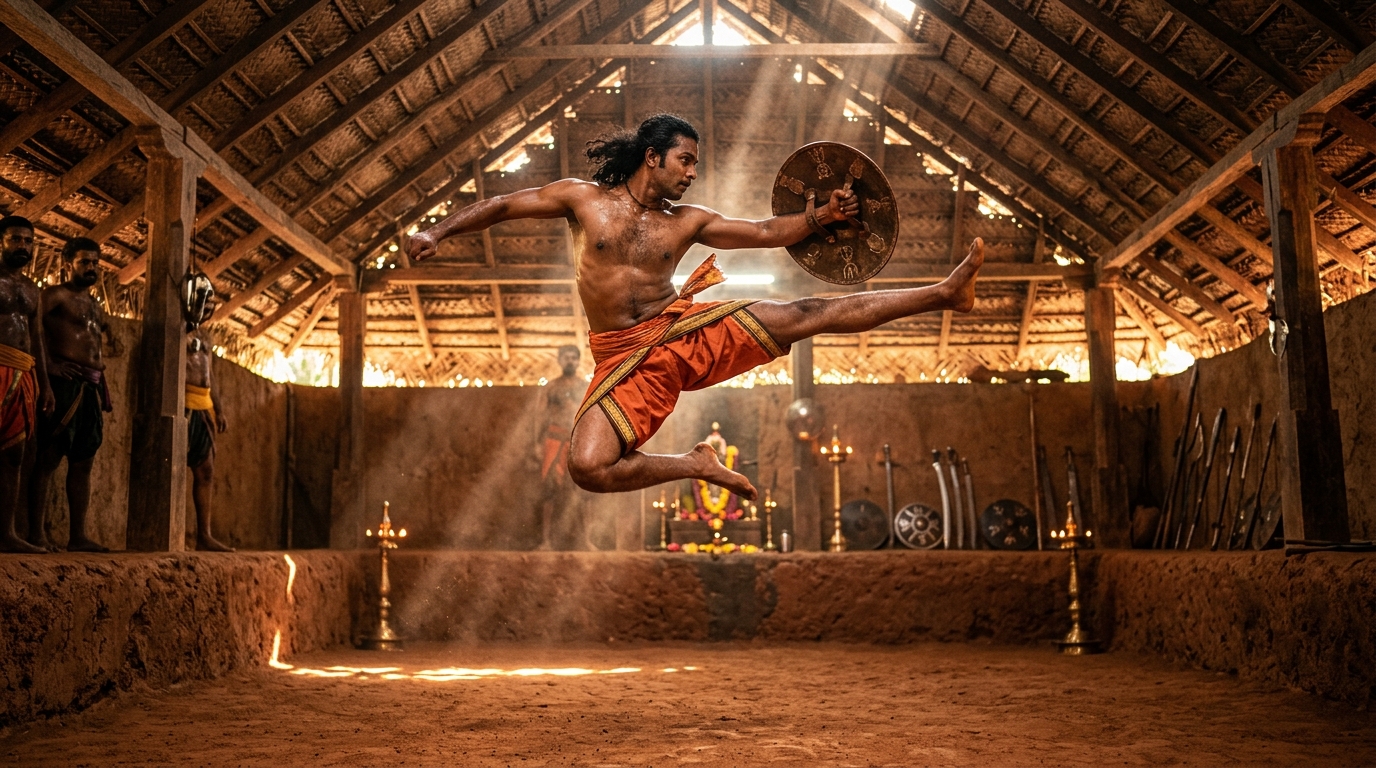
A Kalari is not just a gym. It is a specially constructed training ground dug into the earth to maintain a specific temperature and humidity. The sunken floor prevents injuries and creates an environment where practitioners can train for hours. Students enter the Kalari with their right foot first, touching the ground to show respect to the earth and their master.
Training begins with intense physical conditioning. Masters focus on animal-inspired postures—like the lion, boar, and snake—to build flexibility and core strength. This conditioning phase lasts for years before a student ever touches a weapon.
Weapons and Empty-Hand Combat
Once a student masters their own body, weapon training begins. The progression is strictly linear. Students start with blunt wooden weapons like the long staff and short stick. They eventually graduate to lethal metal weapons, including the dagger, sword, and shield.
The ultimate weapon in Kalaripayattu is the Urumi. This flexible, whip-like sword features multiple sharp blades. Wielding it requires absolute mastery of body mechanics, as a single mistake can severely injure the user.
Empty-hand combat, or Verumkai, is taught last. It focuses on striking the body's vital points, known as marmas. This deep understanding of human anatomy links closely to traditional medicine. You can trace similar anatomical knowledge through 1,000 Years of Indian Medical History: A Chronological Guide.
Regional Fighting Styles Adapt to Local Geographies and Cultures
Diverse Indian landscapes birthed distinct martial arts tailored to regional warfare and available materials. Tamil Nadu perfected the bamboo staff combat of Silambam, while Punjab developed the swift, sword-centric Gatka, proving that geography dictated the evolution of local fighting techniques across the subcontinent.
Silambam and the Tamil Warrior Tradition
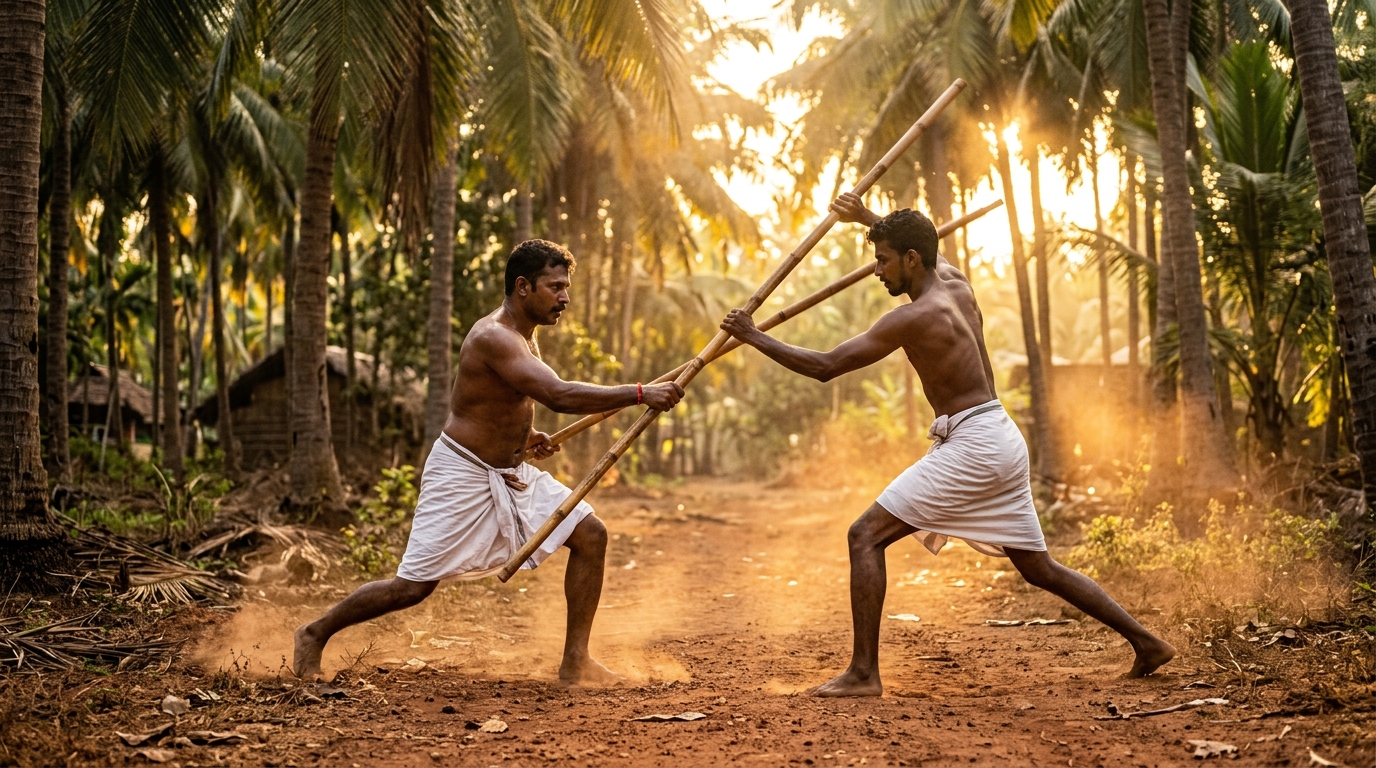
Silambam originated in Tamil Nadu and focuses heavily on the bamboo staff. The art traces its roots to the Sangam literature era. Warriors used the staff to defend against wild animals and enemy soldiers alike.
Footwork is the defining feature of Silambam. Practitioners use circular movements to evade attacks and generate momentum for strikes. The staff acts as an extension of the body. Skilled fighters spin the bamboo at high speeds to create a defensive shield that deflects incoming projectiles.
Gatka and Northern Martial Prowess
In the northern plains, the martial landscape looked very different. Gatka emerged as a stick-fighting style that simulated sword combat. It became deeply intertwined with Sikh martial traditions in the 17th century.
Gatka emphasizes continuous, flowing motion. Fighters use the Panthra, a rhythmic stepping pattern, to maintain balance while striking from multiple angles. This style proved highly effective in the chaotic open-field battles of northern India. The tactical importance of such combat readiness is evident when studying conflicts like those detailed in April 21, 1526: A Historical Timeline of the First Battle of Panipat.
Kushti and the Art of Pehlwani
Grappling holds a unique place in Indian history. Kushti, or Pehlwani, developed during the Mughal era by blending indigenous Malla-yuddha with Persian wrestling techniques.
Pehlwans train in an akhara, a traditional wrestling pit filled with earth mixed with ghee, turmeric, and buttermilk. This specific soil mixture prevents infections and cools the body during intense grappling sessions. The training regimen includes heavy mace swinging, thousands of squats, and a strict vegetarian diet.
| Martial Art | Region of Origin | Primary Focus | Historical Era |
|---|---|---|---|
| Kalaripayattu | Kerala | Strikes, Weapons, Vital Points | 3rd Century BCE |
| Silambam | Tamil Nadu | Bamboo Staff, Footwork | 4th Century BCE |
| Gatka | Punjab | Stick/Sword Combat, Flow | 15th Century CE |
| Kushti | Northern India | Grappling, Submissions | 16th Century CE |
| Thang-Ta | Manipur | Sword and Spear, Ritual Dance | 17th Century CE |
Colonial Suppression Forces Traditional Combat Underground
British colonial authorities systematically banned indigenous martial arts in the 19th century to prevent armed rebellions. This suppression forced masters to disguise combat techniques as folk dances or train students in secret, nearly erasing centuries of Indian martial arts history from public life.
The Arms Act and Its Impact
The Indian Rebellion of 1857 shook the British East India Company. In response, the colonial government passed the Indian Arms Act of 1878. This law restricted the ownership of swords, daggers, and spears.
Police raided traditional training grounds. Masters faced imprisonment for teaching combat techniques. The British sought to demilitarize the Indian population, systematically dismantling the local militias that relied on regional fighting styles. Weapons were confiscated and melted down. Whole lineages of martial knowledge vanished in a single generation.
Preservation Through Performance Art
Survival required adaptation. Martial arts masters disguised their deadly techniques as cultural performances. Kalaripayattu movements blended into Kathakali dance routines. The aggressive strikes were softened into theatrical gestures.
Silambam practitioners incorporated their staff spinning into temple festivals. By presenting the martial art as a religious offering or a folk dance, they avoided colonial scrutiny. Masters taught the true combat applications only to trusted disciples behind closed doors, ensuring the core mechanics survived the occupation.
Post-Independence Revival Brings Ancient Arts Back to Light
India's independence triggered a cultural renaissance that actively restored suppressed martial arts to their former glory. Organizations and dedicated masters established formal academies, standardizing rules and organizing state-level competitions to ensure these ancient combat systems survived for future generations.
Institutional Support and Standardization
After 1947, the newly formed Indian government recognized the need to preserve indigenous heritage. Masters who had trained in secret slowly reopened their akharas and kalaris to the public.
To gain modern legitimacy, these arts needed structure. Practitioners formed state and national federations. They drafted standardized rulebooks, implemented weight classes, and mandated safety equipment for sparring. This transition from battlefield combat to regulated sport allowed younger generations to practice safely.
Integration into Modern Sports
The revival pushed traditional arts into the sporting spotlight. Silambam and Gatka became regular features at the National Games of India. State governments began offering sports quotas for university admissions to students who excelled in indigenous martial arts.
These efforts mirrored India's broader push for athletic recognition on the global stage. The discipline required to master ancient combat forms translates well to modern athletic pursuits, a trajectory highlighted in India at the Olympics: A Timeline of Historic Sporting Milestones.
The Modern Era Fuses Traditional Techniques with Global MMA
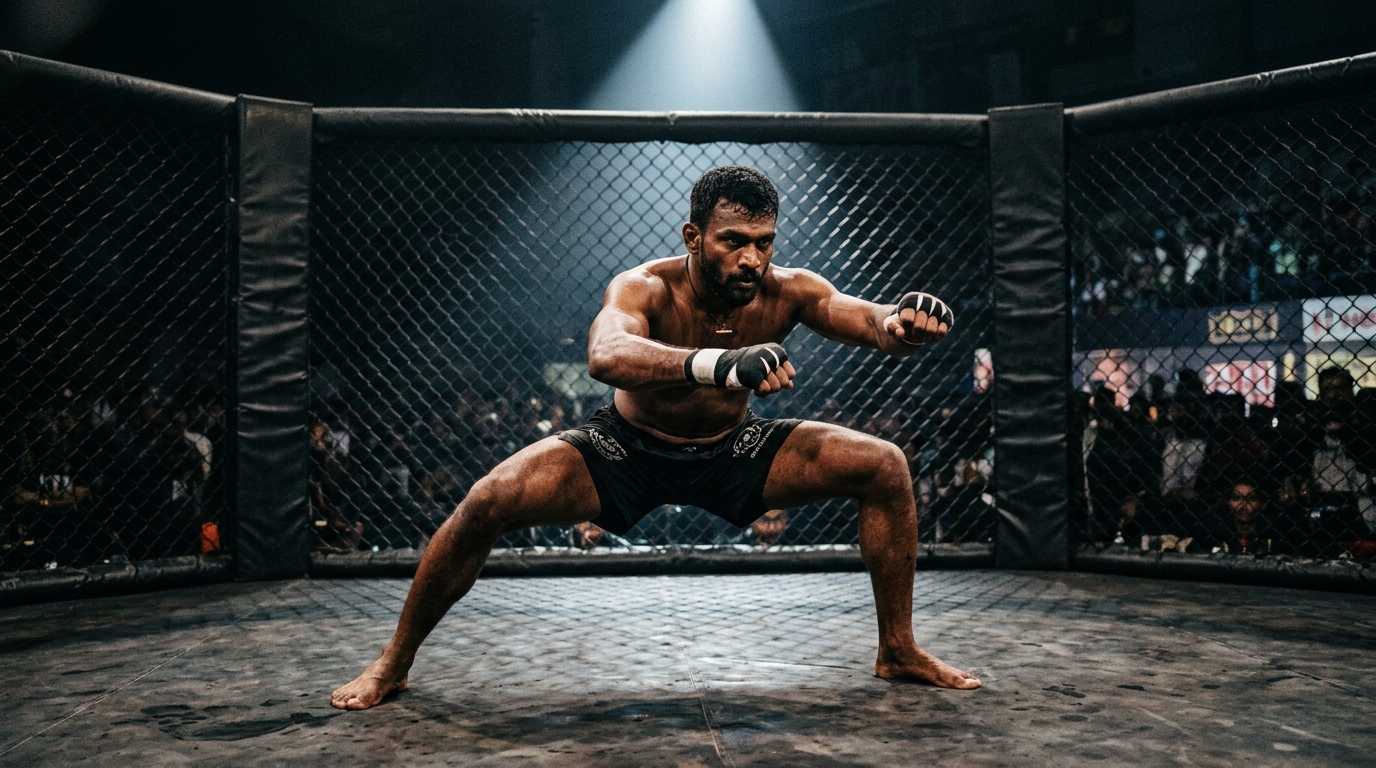
Contemporary Indian fighters now actively compete on the global stage by combining their indigenous martial arts backgrounds with modern mixed martial arts. This synthesis brings unique striking angles and grappling endurance to international cages, proving the enduring relevance of ancient Indian combat systems.
The Rise of Indian MMA Fighters
Mixed martial arts arrived in India in the early 2000s. Local promotions like Super Fight League and Matrix Fight Night gave Indian athletes a platform to compete under unified MMA rules.
Many of India's top MMA fighters transition from traditional Kushti. Their deep background in Pehlwani gives them exceptional takedown defense and top control. When these wrestlers add modern boxing and Jiu-Jitsu to their arsenal, they become formidable opponents. They use the raw physical strength built in the mud pits to dominate opponents in the cage. For a deeper look at this transition, explore the evolution of wrestling in India.
Global Recognition of Indian Disciplines
The exchange of knowledge flows both ways. International MMA fighters now travel to India to study Kalaripayattu. They seek the dynamic flexibility and joint mobility that the ancient art provides.
The low stances and explosive lunges of Kalaripayattu help modern fighters improve their lower body strength. Silambam's focus on ambidextrous coordination improves a fighter's ability to switch stances seamlessly. Ancient Indian martial arts history is no longer just a subject of study; it is an active component of modern combat sports training.
Related Reading
- Milestones in Indian Women's History: A Chronological Guide
- 1,000 Years of Indian Medical History: A Chronological Guide
- Economic Milestones in Indian History: From 1947 to Present
- What Are the Major Events in Indian History? (FAQ Archive)
FAQ
Q: What is the oldest martial art in India? Kalaripayattu is widely considered the oldest surviving martial art in India. It originated in the state of Kerala over 3,000 years ago. Its techniques heavily influenced both combat and traditional Ayurvedic healing.
Q: Did Indian martial arts influence Kung Fu? Historical records suggest that an Indian Buddhist monk named Bodhidharma traveled to China in the 5th or 6th century. He introduced physical conditioning exercises to the monks at the Shaolin Temple. These exercises laid the foundation for what eventually became Shaolin Kung Fu.
Q: Is Kalaripayattu used in modern MMA? While you rarely see pure Kalaripayattu in an MMA cage, its principles are highly relevant. Modern fighters use its conditioning exercises to improve flexibility, balance, and explosive movement. The animal stances help athletes develop unpredictable striking angles.
Q: How did British rule affect Indian martial arts? The British colonial government viewed native martial arts as a threat to their rule. They enacted laws like the 1878 Arms Act to ban weapons and outlawed many traditional fighting styles. This forced masters to practice in secret or disguise their arts as folk dances to avoid arrest.
Visit a local akhara or Kalari training center to witness these ancient mechanics in person. Observing the footwork, the grip fighting, and the body mechanics firsthand reveals the practical physics behind the history. You will quickly understand why these techniques survived for thousands of years and how they still apply to combat today.