From Ancient Ploughs to Agri-Tech: A Timeline of Indian Farming Innovations
TL;DR
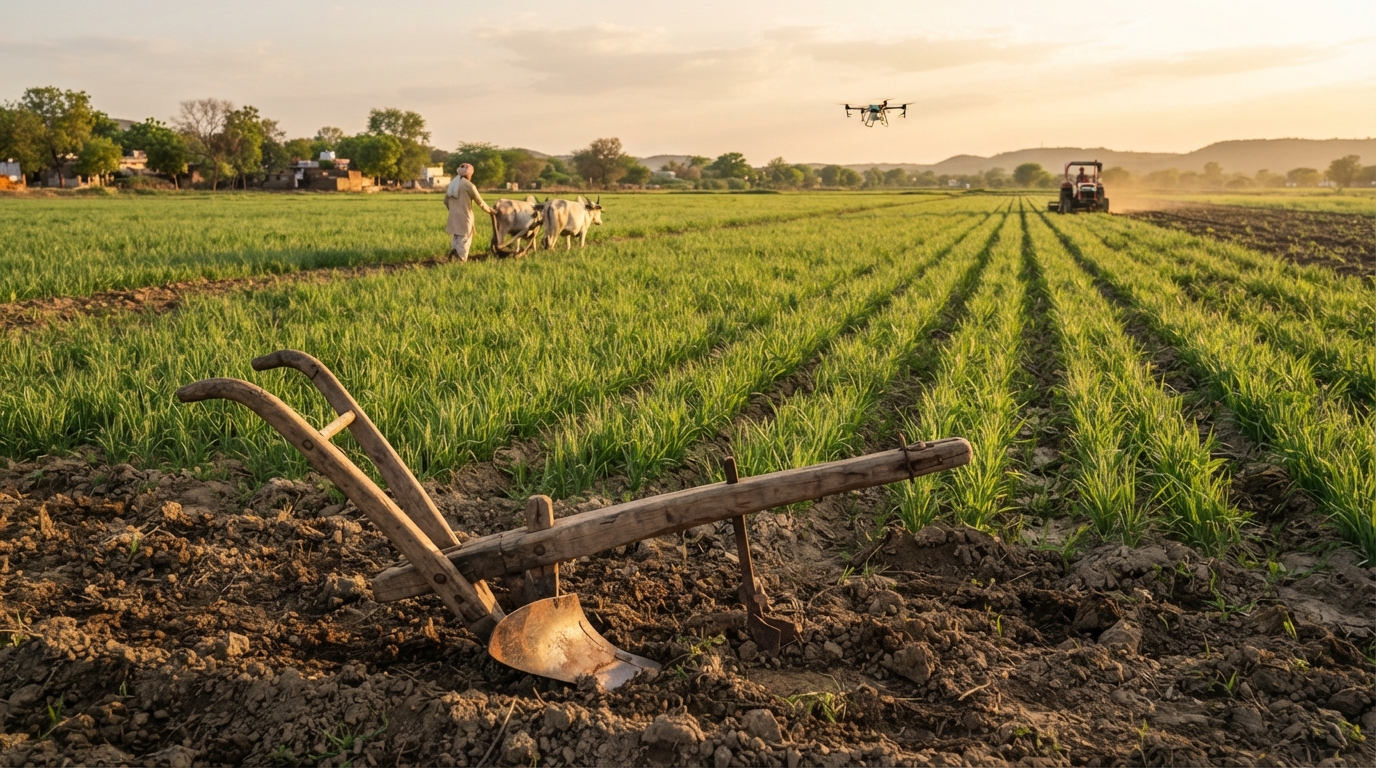
Indian agriculture history runs from farming villages at Mehrgarh, now dated to about 5200–4900 BCE, to Harappan ploughed fields and Chola and Sultanate irrigation. Colonial canals and research institutes came next, followed by the 1966 Green Revolution and the 1970 Operation Flood. Digital farmer IDs, drones, and genome-edited rice released in 2025 form the newest phase.
Key Takeaways
- Mehrgarh's farming start was re-dated in 2025 to roughly 5200–4900 BCE.
- Water control, not machinery, drove most Indian farming gains before 1900.
- Mexican dwarf wheat covered about 35% of India's wheat area by 1969-70.
- Agriculture employs about 43.5% of workers but makes up about 16% of GDP.
- Agritech startup funding fell from $498.3M in 2023 to $182M in 2025.
It's 7:40 a.m. in a Class 11 classroom in Ludhiana. Ms. Kaur, a history teacher, writes "Mehrgarh, 7000 BCE" on the board, copying the date from a reference book printed years ago. A 2025 study in Scientific Reports says that date is off by roughly two thousand years.
That gap sums up a real problem with Indian agriculture history. The story keeps changing as new evidence arrives, but many timelines online still repeat old dates. Below is a dated, source-checked sequence of the tools, water systems, seeds, and policies that shaped how India farms. Where scholars disagree, we say so.
Indian agriculture history starts later than most textbooks say
India's farming story begins in the northwest of the subcontinent. Radiocarbon work published in 2025 moves the start of farming at Mehrgarh to about 5200–4900 BCE. Kalibangan in Rajasthan holds a ploughed field from around 2800 BCE. Harappan farmers grew wheat, barley, pulses, and cotton across a wide region.
Mehrgarh's new date changes the opening chapter
Mehrgarh sits in present-day Balochistan. For decades, books placed its first farming at around 7000–8000 BCE. In 2025, researchers re-dated tooth enamel from 23 graves and got a much later start: 5200–4900 BCE (Scientific Reports, reported by Nature India, 2025).
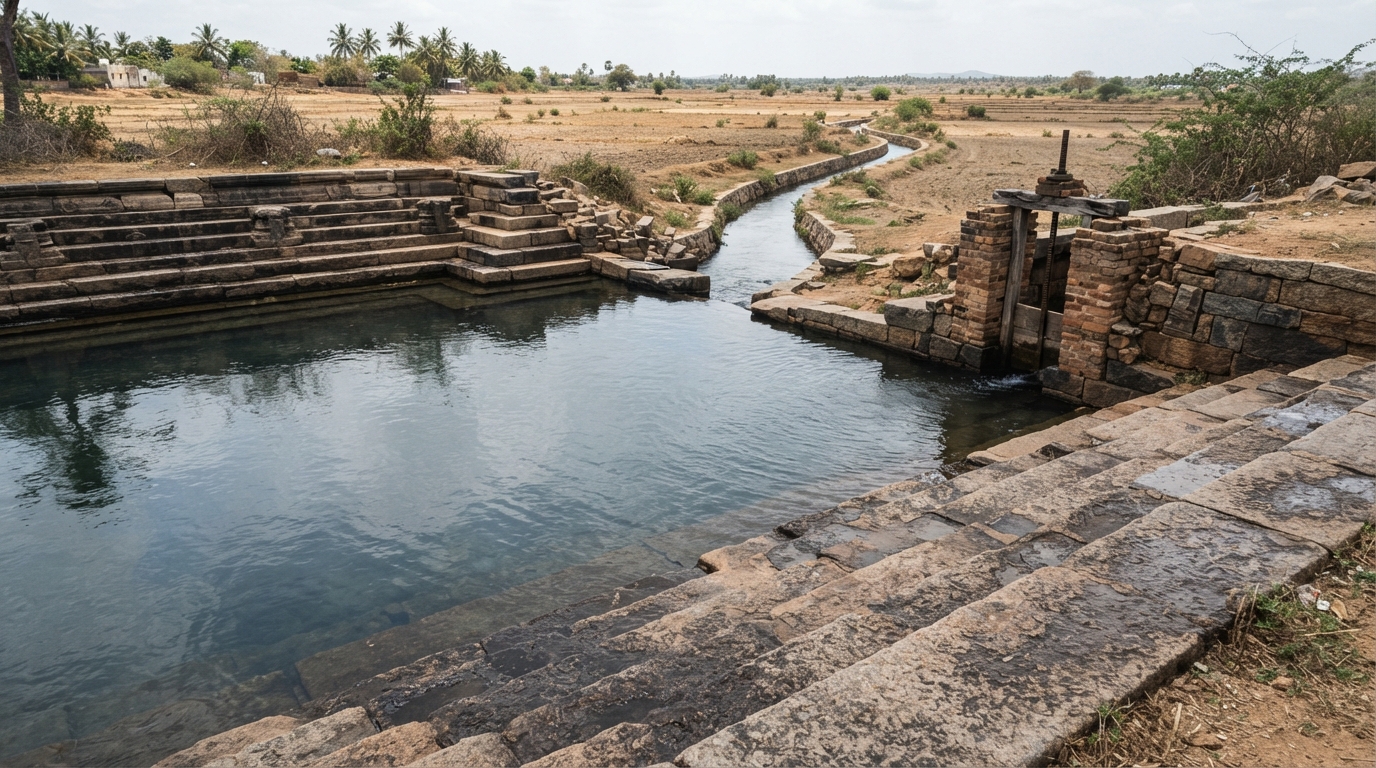
The authors argue that farming likely arrived with farmers moving into the region. That's a big shift. Benjamin Mutin of Sorbonne University told Nature India the new dates change the whole account of how farming began in the Indus region. In his view, it started neither as early nor as independently as once thought.
For students, the practical point is simple. If your source gives 7000 BCE without mentioning the 2025 study, treat it as outdated.
Kalibangan holds the oldest known ploughed field
Kalibangan is a pre-Harappan site in Rajasthan's Hanumangarh district where Archaeological Survey of India (ASI) excavations found a field marked with a grid of furrows. The Kalibangan field dates to about 2800 BCE and is widely called the earliest ploughed field found in South Asia, making the site a fixed starting point for plough-based farming in the region.
One detail makes the Kalibangan field memorable. ASI excavation summaries note that the crisscross furrow pattern resembles how local farmers in Hanumangarh still sow mustard and gram together in the same field. Mixed cropping in that part of Rajasthan may therefore be nearly 5,000 years old.
Harappan farmers grew a mixed basket of crops
Harappan agriculture is the mixed farming system of the Indus civilisation, and excavated Harappan sites show wheat, barley, peas, sesame, and dates alongside cotton. Cotton matters most for later history: the Indus people were among the earliest known cotton growers, and Indian cotton cloth would be traded for thousands of years after the Harappan era ended.
Large brick structures at Harappa and Mohenjo-daro were long called "granaries." Some archaeologists now question the "granary" label for the Harappa and Mohenjo-daro buildings. Treat the word "granary" as a working theory, not a settled fact.
Ancient and medieval India built water systems before machines
Before 1900, most of India's farming gains came from controlling water, not from new machines. Rulers built tanks, weirs, and canals, and farmers adopted the Persian wheel to lift groundwater. Several of these works, like the Grand Anicut on the Kaveri, stayed in use for centuries.
The Arthashastra treated farming as state business
The Arthashastra, attributed to Kautilya, describes a sitadhyaksha, a superintendent of agriculture. The text discusses sowing seasons, rainfall, and charges for using state irrigation. Scholars debate its exact date, with estimates ranging from about the 4th century BCE to the early centuries CE.
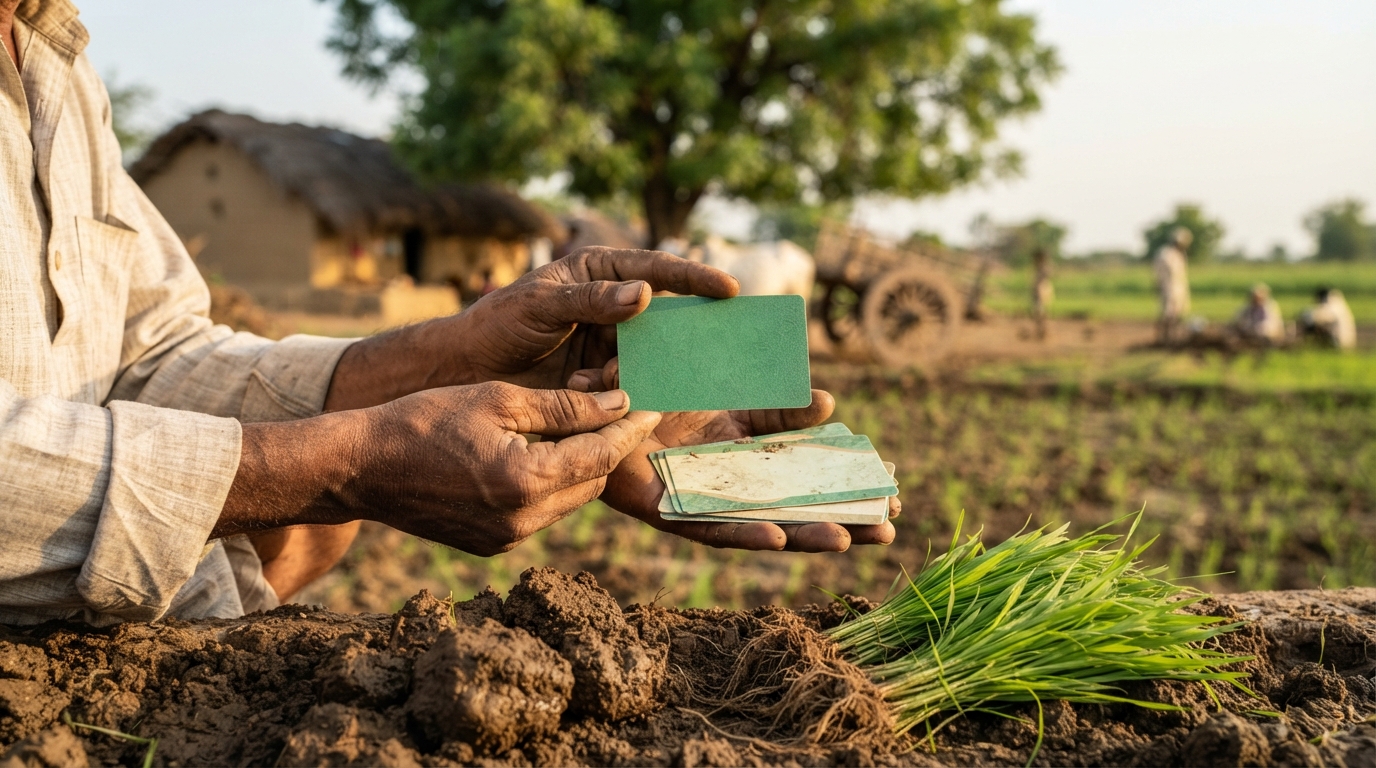
The takeaway is about organisation. Farming was already something the state measured, taxed, and managed.
The Grand Anicut and Sudarshana lake show long-lived engineering
The Grand Anicut, or Kallanai, is a stone weir across the Kaveri river in Tamil Nadu. Tradition credits the Chola king Karikala, around the 2nd century CE. It still diverts water to fields in the Kaveri delta today.
In Gujarat, the Sudarshana lake near Girnar tells a longer story. It was built under Chandragupta Maurya, repaired by the Saka ruler Rudradaman around 150 CE, and repaired again under Skandagupta. The Junagadh rock inscription records these repairs. You can see how this fits the wider period in our guide to the Maurya and Gupta empires.
The Persian wheel and Sultanate canals spread irrigation north
The Persian wheel is a chain of pots driven by oxen. It became common in north India during the medieval period. In the early 16th century, Babur described it in his memoir, the Baburnama, noting its use around Lahore, Dipalpur, and Sirhind.
Firuz Shah Tughlaq built the Western Yamuna Canal in the mid-14th century. Mughal engineers under Shah Jahan restored it. The British rebuilt it again in the 19th century, so one canal links three eras. For a deeper look at these systems, see our planned piece on the history of irrigation in India.
Colonial rule turned fields into export suppliers and labs
British rule changed what Indian farmers grew and who profited. New land settlements fixed revenue demands, large canals opened, and cash crops like indigo spread under pressure. The same era also created India's first formal crop research institutes, at Pusa in 1905 and through the Imperial Council of Agricultural Research in 1929.
Canals and land settlements reshaped rural India
The Permanent Settlement and the Ganges Canal are the two colonial-era milestones that best show how British policy reshaped rural India. The Permanent Settlement of 1793 fixed land revenue in Bengal under Lord Cornwallis, and the Ganges Canal, designed by Proby Cautley and opened on 8 April 1854, irrigated large parts of the Doab.
Two dates frame this period:
- 1793: The Permanent Settlement under Lord Cornwallis fixed land revenue in Bengal. Zamindars gained ownership rights, and cultivators frequently lost security.
- 8 April 1854: The Ganges Canal opened, designed by Proby Cautley. The Ganges Canal irrigated large parts of the Doab between the Ganga and Yamuna.
Colonial canals raised farm output in some districts. The canals also raised revenue for the British government, which was frequently the government's main goal.
Indigo and Champaran exposed the human cost
Indigo planters forced many Bengal farmers to grow the dye crop on poor terms. The Indigo Revolt of 1859–60 was a direct response. In 1917, the Champaran Satyagraha in Bihar challenged the tinkathia system, which made tenants grow indigo on 3/20 of their land.
The Bengal Famine of 1943 marks the darkest point of this era. Historians usually estimate 2 to 3 million deaths. That memory shaped India's push for food self-sufficiency after 1947.
Pusa and ICAR set up formal crop research
The Imperial Agricultural Research Institute opened at Pusa, Bihar, in 1905. After the 1934 Bihar earthquake damaged its buildings, it moved to Delhi in 1936. It's now the Indian Agricultural Research Institute, still widely known as "Pusa."
The Royal Commission on Agriculture reported in 1928. Its advice led to the Imperial Council of Agricultural Research on 16 July 1929, which is today's ICAR. Many seed varieties sold in Indian markets now trace back to these two bodies.
The Green and White Revolutions redefined Indian agriculture history after 1947
The Green Revolution is the sharp rise in Indian grain output from 1966 onward, driven by big dams, high-yielding Mexican wheat, and fertiliser use. The White Revolution is the dairy cooperative movement built through Operation Flood, launched in 1970. Both programmes served India's post-1947 focus on food security, and both brought groundwater and soil costs that are still debated.
Dams and seed imports set up the 1966 turning point
The Bhakra dam was dedicated by Jawaharlal Nehru on 22 October 1963. The Bhakra dam supplied water to Punjab and Haryana, the regions that would lead the Green Revolution. The Food Corporation of India and the Agricultural Prices Commission were both set up in 1965.
In 1966, India imported about 18,000 tonnes of Mexican semi-dwarf wheat seed, including Lerma Rojo 64 and Sonora 64. Norman Borlaug bred these varieties. M.S. Swaminathan led their testing and spread in India. Swaminathan later argued that Borlaug's pledge to end hunger should be carried through to its conclusion (Nature India, 2009).
The results came fast. A 2025 book excerpt published by The Wire puts wheat output at 6 million tonnes in 1965-66, 11.8 million in 1966-67, and 24 million in 1967-68. By 1969-70, Mexican dwarf wheat or varieties bred from it covered about 35% of India's wheat area (Encyclopedia.com). The term "Green Revolution" itself was coined in 1968 by USAID's William Gaud.
Operation Flood made dairy a cooperative movement
The National Dairy Development Board was created in 1965, with Verghese Kurien as its chairman. Operation Flood began on 13 January 1970. Operation Flood linked village milk cooperatives, modelled on Amul in Anand, Gujarat, to city markets.
By 1998, India had become the world's largest milk producer. The "White Revolution" reached far more small farmers than the wheat boom did, because a household needed only one or two animals to join a milk cooperative.
The Green Revolution came with real costs
Most popular timelines stop at the success story. A fuller account has to include the downsides:
- Groundwater: Tube wells and free or cheap power led to falling water tables in Punjab and Haryana.
- Soil health: Heavy fertiliser use, often weighted toward nitrogen, hurt long-term soil balance.
- Crop focus: Gains centred on wheat and rice, while pulses and millets got less attention.
- Regional gaps: Irrigated northwest India gained far more than rain-fed regions.
An essay from IIT Delhi questions the standard success narrative along similar lines. Students should know both sides. Exams usually ask about the gains, but essays and debates reward the full picture. Our timeline of economic milestones since 1947 places these farm changes in the wider economy.
Digital farming in India is more a policy story than a startup story
Since 2015, India's newest farming milestones have come mostly from government schemes and public research. Soil cards, online mandis, crop insurance, cash transfers, digital farmer IDs, drones, and genome-edited rice all fall here. Private agritech funding, by contrast, has dropped sharply since 2023.
Schemes from 2015 to 2019 added data and cash transfers
A short run of launches built the base for digital farming:
- 19 February 2015: Soil Health Card scheme launched at Suratgarh, Rajasthan.
- 2016: Pradhan Mantri Fasal Bima Yojana, a crop insurance scheme, launched.
- 14 April 2016: e-NAM, an online national agriculture market, went live.
- 24 February 2019: PM-KISAN began paying eligible farmers ₹6,000 a year in three instalments.
Biotech also arrived earlier, in March 2002, when India approved Bt cotton, its first genetically modified crop.
AgriStack, drones, and gene-edited rice mark the 2020s
The Digital Agriculture Mission, approved in 2024, builds AgriStack. It has three parts: a farmer registry, geo-referenced village maps, and a crop-sown registry (PIB, 2024). Its Farmer ID works like an Aadhaar number for farmers. More than 10.31 crore Farmer IDs have been issued, and the Rabi 2025-26 Digital Crop Survey covered 648 districts and 31.3 crore plots (BioVoice News, 2026).
The Namo Drone Didi scheme gives 15,000 drones to women's self-help groups. Its budget is ₹1,261 crore for 2023-24 to 2025-26 (PIB, 2025). The drones spray fertiliser and pesticide for hire.
In May 2025, ICAR released DRR Dhan 100 (Kamala) and Pusa DST Rice 1. They were billed as the world's first genome-edited rice varieties, with claimed yields up to 30% higher and maturity 15–20 days sooner (Business Standard, 2025). ICAR-IIRR in Hyderabad edited Kamala from Samba Mahsuri by targeting the CKX2/Gn1a gene.
Gene editing is not the same as GM. These rice lines used SDN-1 editing, which adds no foreign DNA. India exempted SDN-1 and SDN-2 edits from its GM rules in 2022. That's why these rice lines reached farmers faster than Bt cotton's long approval path would suggest.
The agritech funding boom has cooled
Tracxn data reported by Entrepreneur India shows agritech funding at $498.3M in 2023, $390.5M in 2024, and about $182M in 2025. For January–August 2026, Tracxn counts $144M across 45 rounds, against $203M across 91 rounds in the same months of 2025.
Some firms still raise money. Ecozen Solutions in Pune, which makes solar cold rooms and pumps, has raised $76.4M (Tracxn, 2026). Ninjacart, DeHaat, and WayCool were once near unicorn status, but their funding plans have stalled (Entrackr, 2025). Jinesh Shah of Omnivore calls the 2025 drop a structural reset caused by several pressures at once, not the end of the sector.
Meanwhile, the bigger picture shows a paradox. Foodgrain output hit a record 357.73 million tonnes in 2024-25 (Agriculture Ministry via Global Agriculture, 2025). Yet agriculture still holds about 43.5% of jobs while producing about 16% of GDP (OECD, 2025). Record harvests haven't moved many people off the farm.
A date-by-date table makes the farming timeline easier to study
A single table turns 7,000 years of Indian agriculture history into something you can revise in five minutes. The table below lists one milestone per era with its type. Two study habits help: knowing how crop years work, and turning each date into a short card.
| Date | Milestone | Type |
|---|---|---|
| c. 5200–4900 BCE | Farming begins at Mehrgarh (2025 re-dating) | Archaeology |
| c. 2800 BCE | Furrowed field at Kalibangan | Implement |
| c. 2nd century CE | Grand Anicut on the Kaveri | Irrigation |
| Mid-14th century | Western Yamuna Canal | Irrigation |
| 1793 | Permanent Settlement | Policy |
| 8 April 1854 | Ganges Canal opens | Irrigation |
| 1905 | Pusa research institute founded | Research |
| 16 July 1929 | ICAR founded | Research |
| 1966 | Mexican dwarf wheat imported | Seeds |
| 13 January 1970 | Operation Flood begins | Dairy policy |
| March 2002 | Bt cotton approved | Biotech |
| 24 February 2019 | PM-KISAN launched | Policy |
| May 2025 | Genome-edited rice released | Biotech |
Watch for crop years versus calendar years
Indian farm data uses the agricultural year, which runs from July to June. So "1966-67" isn't a typo for 1966. It covers the kharif crop of 1966 and the rabi crop harvested in early 1967.
This trips up a lot of readers. One source says the Green Revolution began in 1966, another says 1967-68, and both can be right. Always check which kind of year a figure uses.
Turn each milestone into a date card
A date card is a flashcard built from one row of the timeline table: the date goes on one side, and the event plus one detail goes on the other. For example, one card can read "13 January 1970" on the front and "Operation Flood begins" on the back. Date cards are the format behind the daily cards on IndiaOnThisDay.
Our guide on learning history through chronological timelines explains how to space your review of date cards.
Keep each date card short: one date, one event, one number. If a date card needs two numbers, such as the 1966-67 and 1967-68 wheat figures, split that date card into two cards.
Related Reading
- Milestones in Indian Women's History: A Chronological Guide
- 1,000 Years of Indian Medical History: A Chronological Guide
- Economic Milestones in Indian History: From 1947 to Present
- What Are the Major Events in Indian History? (FAQ Archive)
FAQ
Q: When did farming begin in India? The oldest known farming settlement in South Asia is Mehrgarh, in present-day Balochistan. A 2025 study in Scientific Reports re-dated its start to about 5200–4900 BCE. Older books give 7000–8000 BCE, which the new evidence no longer supports.
Q: Where is the oldest ploughed field in India? The oldest known ploughed field is at Kalibangan in Rajasthan, dating to about 2800 BCE. ASI excavations found a grid of furrows there. Its crisscross pattern resembles how local farmers still sow mustard and gram together.
Q: What started the Green Revolution in India? The turning point came in 1966, when India imported about 18,000 tonnes of Mexican semi-dwarf wheat seed bred by Norman Borlaug. M.S. Swaminathan led its adoption, helped by irrigation from dams like Bhakra. By 1969-70, these varieties covered about 35% of India's wheat area.
Q: Is genome-edited rice the same as GM rice? No. India's 2025 genome-edited rice varieties used SDN-1 editing, which changes a plant's own genes without adding foreign DNA. India exempted SDN-1 and SDN-2 edits from GM regulations in 2022, so they follow a separate approval path.
Pick one milestone from the table above, look up its primary source tonight (the ASI summary for Kalibangan or the PIB release for PM-KISAN), and write it on a single date card with one verified number.
Sources
- New radiocarbon dates of human tooth enamel reveal a late appearance of farming life in the Indus Valley — Scientific Reports, 2025. Supports: Tooth enamel from 23 Neolithic graves re-dates the start of farming at Mehrgarh to about 5200–4900 BCE.
- Indus Valley farming started later than thought, radiocarbon study shows — Nature India, 2025. Supports: Nature India's coverage of the Mehrgarh re-dating, including Benjamin Mutin's comments on how farming began in the Indus region.
- How India's Green Revolution Created a Food Surplus Nation From One Dependent on Foreign Aid — The Wire, 2025. Supports: India's wheat output grew from 6 million tonnes (1965-66) to 11.8 million (1966-67) and 24 million (1967-68).
- Green Revolution — Encyclopedia.com. Supports: By the 1969-70 season, Mexican dwarf wheat was sown on about 35% of India's wheat area.
- India: Agricultural Policy Monitoring and Evaluation 2025 — OECD, 2025. Supports: Agriculture makes up about 16% of India's GDP and about 43.5% of its jobs.
- India's Foodgrain Output Jumps Nearly 8% to 357.73 Million Tonnes in 2024–25, Shows Final Estimate — Global Agriculture, 2025. Supports: Foodgrain output hit a record 357.73 million tonnes in 2024-25.
- From Boom to Slowdown: Agritech Faces Harsh Reset as Funding Plunges in 2025 — Entrepreneur India, 2025. Supports: Tracxn data showing agritech funding of about $182M in 2025, and Jinesh Shah's view that the drop is a structural reset.
- India releases genome-edited rice varieties to boost yields by up to 30% — Business Standard, 2025. Supports: The May 2025 release of DRR Dhan 100 (Kamala) and Pusa DST Rice 1, billed as the world's first genome-edited rice, with yields up to 30% higher and maturity 15–20 days sooner.
- Implementation of Drone Didi Scheme — PIB, 2025. Supports: Namo Drone Didi gives 15,000 drones to women's self-help groups with a budget of ₹1,261 crore for 2023-24 to 2025-26.
- Cabinet approves the Digital Agriculture Mission with an outlay of Rs. 2817 Crore — PIB, 2024. Supports: The Digital Agriculture Mission was approved in 2024 to build AgriStack, with a Farmer ID that works like an Aadhaar number for farmers.
- India creates over 10.31 crore Farmer IDs under AgriStack — BioVoice News, 2026. Supports: More than 10.31 crore Farmer IDs have been issued, and the Rabi 2025-26 Digital Crop Survey covered 648 districts and 31.3 crore plots.