Foundations of the Indian National Congress: Key Dates from 1885
The Quick Read
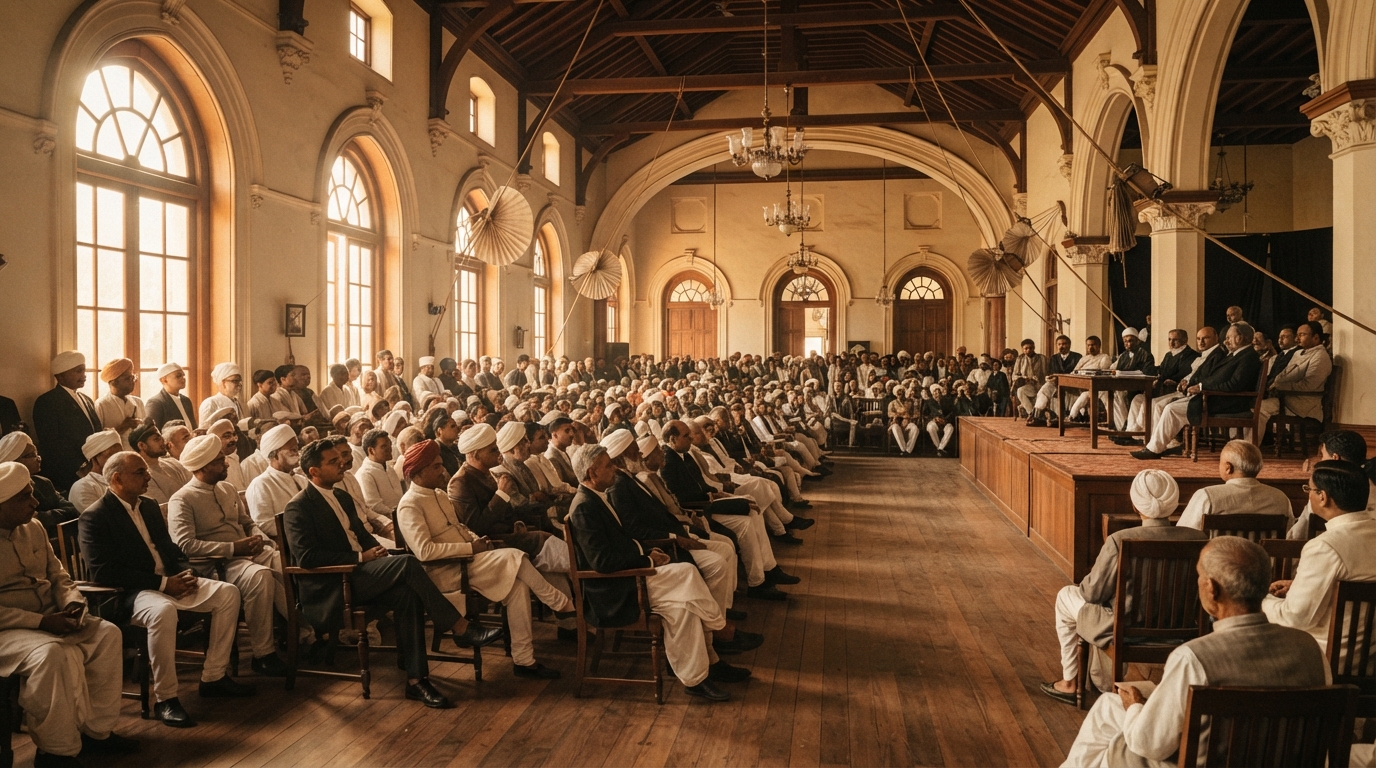
The Indian National Congress is an all-India political organization founded on December 28, 1885, at Gokuldas Tejpal Sanskrit College in Bombay by Allan Octavian Hume, Womesh Chandra Bonnerjee, and 72 founding delegates. According to official Congress records, the inaugural session established a constitutional platform to demand civil service access, legislative representation, and imperial expenditure reductions.
Key Takeaways
- The Indian National Congress held its inaugural session on December 28, 1885, in Bombay.
- Exactly 72 founding delegates attended the first meeting at Gokuldas Tejpal Sanskrit College.
- Allan Octavian Hume, Womesh Chandra Bonnerjee, and Dinshaw Wacha organized the initial proceedings.
- Early sessions focused on legislative expansion, lower military budgets, and Indian civil service access.
- The first decade established an all-India political dialogue across diverse regional associations.
Many people assume the Indian National Congress began as a radical movement demanding full independence from British rule. The reality was far more cautious. In December 1885, the organization emerged as an elite deliberative body seeking administrative reform, fair taxation, and legislative seats within the British Empire. Understanding Indian National Congress history begins by looking at this foundational bridge between regional associations and an organized national voice.

To trace India's long road toward self-rule, you have to examine how these early political networks formed. For students and researchers exploring 10 most searched dates in Indian history and why they matter, December 28, 1885, stands out as a clear turning point. It marked the moment scattered regional protests consolidated into a structured, all-India political movement.
What Sparked the Formation of the Congress in 1885?
Rising political awareness in the 1870s and 1880s created an urgent need for an all-India political body. British administrative blunders, economic drain, and racial bias in the judiciary pushed educated Indians across Bengal, Bombay, and Madras to coordinate their demands through a single representative organization.
Political consciousness in urban India expanded rapidly after the 1857 revolt. By the late 1870s, university graduates in law, journalism, and public administration realized that local petitions had little impact on London policymakers. They needed a shared platform.
The Political Climate Under Lord Lytton and Lord Ripon
Colonial policies between 1876 and 1884 accelerated this political awakening. Lord Lytton, serving as Viceroy from 1876 to 1880, introduced deeply unpopular measures. His administration held the lavish Imperial Durbar of 1877 while a severe famine killed millions across southern and western India.
Lytton then passed the Vernacular Press Act of 1878 to muzzle Indian-language newspapers. That same year, he enacted the Arms Act, which prevented Indians from owning firearms without a license while exempting Europeans.
Lord Ripon succeeded Lytton in 1880 and attempted moderate reforms. His law member, Sir Courtenay Ilbert, introduced the Ilbert Bill in 1883. The bill sought to allow senior Indian magistrates to try European offenders in criminal cases.
The European community in Calcutta and the tea-planting districts staged a furious, organized backlash. Their resistance forced Ripon to dilute the bill in January 1884. This retreat taught Indian intellectuals an enduring lesson: organized political pressure yields results, while unorganized public opinion gets ignored.
The Role of Allan Octavian Hume and the 'Safety Valve' Debate
Allan Octavian Hume, a retired British civil servant, stepped into this environment in 1883. Hume had served as Secretary to the Government of India in the Department of Revenue, Agriculture, and Commerce. In March 1883, he addressed an open letter to the graduates of Calcutta University, urging them to establish an organization dedicated to national regeneration.
March 1883: Hume's Open Letter to Calcutta Graduates
      │
      ▼
May 1884: Madras Mahajana Sabha founded
      │
      ▼
January 1885: Bombay Presidency Association formed
      │
      ▼
March 1885: Circular issued calling for December meeting
      │
      ▼
December 28, 1885: Inaugural Congress Session opens in Bombay
Hume traveled between Calcutta, Bombay, and London throughout 1884 and 1885. He met with British politicians and Indian leaders to secure broad backing for an annual gathering of educated representatives.
Historians later debated Hume's core motivation. In 1913, Congress veteran William Wedderburn published a biography of Hume that popularized the "safety valve" theory. This theory claimed that Hume, alarmed by secret police reports warning of violent peasant unrest, formed the Congress with Viceroy Lord Dufferin's approval to channel mass discontent into harmless discussion.
Modern archival research by historians such as Bipan Chandra challenged this view. Official British documents reveal that Dufferin viewed the gathering with mild curiosity rather than active sponsorship. Indian leaders used Hume as an organizing shield to avoid early administrative crackdowns, creating a practical alliance of mutual interest.
Precursor Organizations That Built the Network
The Congress did not appear out of thin air. It grew out of established regional political associations that had spent decades running civic campaigns.
Four primary organizations laid the groundwork:
- The Poona Sarvajanik Sabha (1870): Founded by Mahadev Govind Ranade and Ganesh Vasudeo Joshi, this body represented peasant grievances in western India and drafted economic representations.
- The Indian Association (1876): Formed in Calcutta by Surendranath Banerjee and Anandamohan Bose, it mobilized urban youth against the lowering of the Indian Civil Service exam age limit from 21 to 19.
- The Madras Mahajana Sabha (1884): Established by M. Veeraraghavachariar, G. Subramania Iyer, and P. Anandacharlu to coordinate regional political activities in southern India.
- The Bombay Presidency Association (1885): Launched by Pherozeshah Mehta, Kashinath Trimbak Telang, and Badruddin Tyabji to advocate for municipal and provincial representation.
Surendranath Banerjee organized the Indian National Conference in Calcutta in December 1883, followed by a second session in late December 1885. Because the second conference coincided with the Bombay meeting, Banerjee could not attend the first Congress session. He joined the Congress the following year, merging his network into the wider national body.
The First Session at Bombay: December 28 to 31, 1885
The inaugural Congress session took place from December 28 to December 31, 1885, at Gokuldas Tejpal Sanskrit College in Bombay. Presided over by Womesh Chandra Bonnerjee, 72 representatives met to debate nine core resolutions addressing civil administration, imperial expenditure, and legislative councils.
The meeting represented the first formal gathering of political delegates from every major province of British India.
┌─────────────────────────────────────────────────────────────┐
│                 THE FIRST CONGRESS SESSION                  │
│                     December 28–31, 1885                    │
├──────────────────────────────┬──────────────────────────────┤
│ Venue                        │ Gokuldas Tejpal College      │
│ City                         │ Bombay                       │
│ President                    │ Womesh Chandra Bonnerjee     │
│ Total Registered Delegates   │ 72                           │
│ Core Resolutions Passed      │ 9                            │
└──────────────────────────────┴──────────────────────────────┘
Why the Venue Moved from Poona to Bombay
The first national conference was scheduled to take place in Poona from December 25 to December 28, 1885. The Poona Sarvajanik Sabha offered to host the delegates and prepared local facilities.
In early December, an outbreak of cholera swept through Poona. Organizing committee members recognized that housing dozens of delegates in the affected city posed serious health risks.
On December 21, 1885, organizers transferred the venue to Bombay. Leaders from the Bombay Presidency Association, including Dinshaw Wacha and Kashinath Trimbak Telang, secured the premises of Gokuldas Tejpal Sanskrit College near Gowalia Tank. The college provided meeting halls, dining facilities, and dormitory rooms for the traveling delegates.
The 72 Delegates and Their First Nine Resolutions
At 12:00 PM on Monday, December 28, 1885, 72 men took their seats in the college hall. The composition reflected the educated urban professions of late nineteenth-century India.
Lawyers made up 39 of the 72 delegates. The rest included 14 journalists and editors, alongside merchants, academics, and landowners.
Regional representation split across the presidencies:
- Bombay Presidency: 38 delegates (including representatives from Poona, Surat, Ahmedabad, and Karachi)
- Madras Presidency: 21 delegates
- Bengal Presidency: 3 delegates
- United Provinces of Agra and Oudh: 7 delegates
- Punjab Province: 3 delegates
The four-day session produced nine resolutions. G. Subramania Iyer of Madras moved the first resolution, which requested a Royal Commission to investigate the working of Indian administration.
The second resolution demanded the abolition of the Council of the Secretary of State for India in London, which Indian leaders viewed as an expensive, unaccountable body.
The third resolution asked for the expansion of the Supreme and provincial legislative councils, demanding that half their members be elected.
The remaining resolutions demanded simultaneous Indian Civil Service (ICS) examinations in England and India, protested the military annexation of Upper Burma, and requested sharp reductions in military expenditures.
The final resolution established that the next Congress session would convene in Calcutta on December 28, 1886.
Womesh Chandra Bonnerjee's Presidential Address
Womesh Chandra Bonnerjee, a leading barrister from the Calcutta High Court, delivered the opening presidential address. His speech defined the initial scope of the movement.
Bonnerjee set four objectives for the organization:
- Promoting personal intimacy and friendship among political workers across the country.
- Eradicating provincial, racial, and religious prejudices among national leaders.
- Recording the mature opinions of educated classes on vital political issues.
- Outlining the lines of action for the coming twelve months.
His tone remained loyal to the British Crown while asserting the right of Indians to participate in their own governance. He stated plainly that the gathering did not seek separation from Britain, but rather the inclusion of educated Indians within the administrative framework.
How Did Early Indian National Congress History Shape National Politics?
Early Indian National Congress history established a constitutional method centered on petitions, annual conferences, and detailed economic critiques. Leaders like Dadabhai Naoroji turned public attention toward fiscal policy, forcing British administrators to justify colonial spending and tax structures before an increasingly informed public.
The first two decades of the organization are known as the Moderate phase. Activists during this era operated under the belief that British authorities were fundamentally fair but poorly informed about Indian conditions.
The Moderate Phase and the Constitutional Method
The Moderate Phase is the foundational era of Indian National Congress history spanning 1885 to 1905, characterized by constitutional advocacy through prayer, petition, and protest. Historian Bipan Chandra notes that early leaders drafted legislative memorandums, passed formal annual resolutions, and sent delegations to lobby the British Parliament rather than initiating street resistance.
Moderate leaders deliberately avoided street agitation and civil disobedience between 1885 and 1905. Instead, early Congress organizers focused on persuading the British electorate and imperial policymakers that bureaucratic misrule in India undermined the welfare of both the Indian public and the British Empire.
The constitutional approach drew criticism from later nationalist factions for adhering to cautious diplomacy. However, this constitutional strategy served a crucial institutional purpose during the 1880s and 1890s. The disciplined method prevented colonial administrators from banning the fledgling Indian National Congress, enabling the organization to establish enduring institutional roots across multiple provinces.
Dadabhai Naoroji and the Drain of Wealth Theory
Dadabhai Naoroji, who served as Congress President three times (1886, 1893, and 1906), transformed economic critique into a political weapon.
Naoroji formulated the "Drain of Wealth" theory, which he later compiled in his 1901 work, Poverty and Un-British Rule in India. He argued that Britain extracted millions of pounds from India annually without any equivalent economic return.
This drain occurred through "Home Charges," which included:
- Pensions and leaves paid to British civil servants and military officers in sterling.
- Interest guaranteed on British capital invested in Indian railways at inflated rates.
- Payments for military operations conducted outside India's borders.
- Administrative costs of the India Office in London.
Naoroji showed that this capital export starved Indian industry and agriculture of vital reinvestment. By publishing clear figures, the early Congress moved beyond abstract legal rights and directly attacked the economic underpinnings of colonial rule.
Expanding Representation at Calcutta (1886) and Madras (1887)
Expanding representation at Calcutta in 1886 and Madras in 1887 is the pivotal process that transformed the Indian National Congress from 72 founding members into a mass political assembly. As documented in early Congress proceeding records, delegate numbers expanded from 434 under Dadabhai Naoroji to 607 under Badruddin Tyabji through institutional elections and regional fundraising.
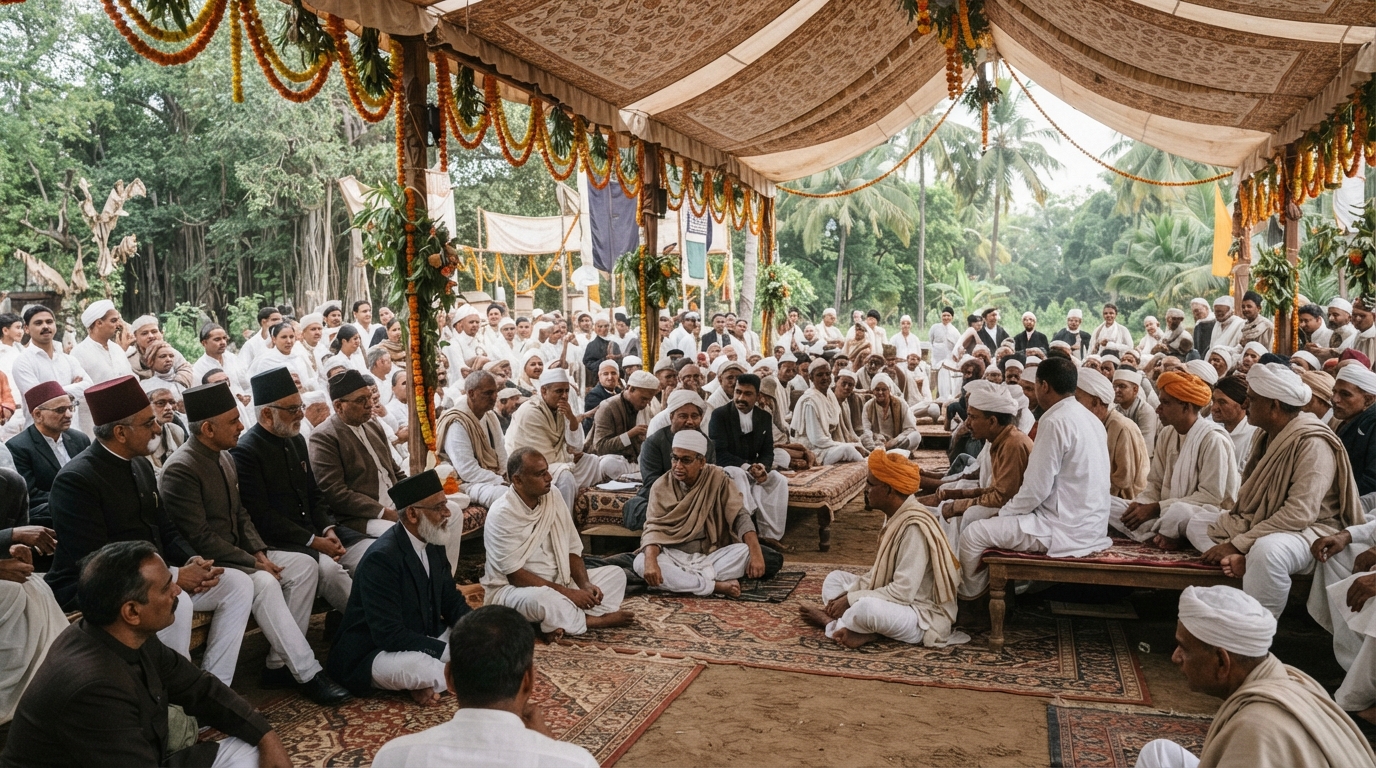
The second annual session met in Calcutta in late December 1886, chaired by Dadabhai Naoroji. The number of registered delegates increased from 72 in 1885 to 434 in 1886. Local trade bodies, municipal boards, and civic societies elected these 434 delegates, providing the Calcutta session with an expansive regional mandate across British India.
Delegate Growth: 1885–1889
┌──────┬────────────┬─────────────┬───────────┐
│ Year │ City       │ President   │ Delegates │
├──────┼────────────┼─────────────┼───────────┤
│ 1885 │ Bombay     │ W.C. Bonnerjee│ 72      │
│ 1886 │ Calcutta   │ D. Naoroji  │ 434       │
│ 1887 │ Madras     │ B. Tyabji   │ 607       │
│ 1888 │ Allahabad  │ G. Yule     │ 1,248     │
│ 1889 │ Bombay     │ W. Wedderburn│ 1,889    │
└──────┴────────────┴─────────────┴───────────┘
The third annual session took place in Madras in late December 1887, with Badruddin Tyabji serving as Congress president. Registered delegate attendance rose to 607 representatives. To fund the Madras gathering and broaden public participation, Congress organizers conducted a grassroots donation drive, collecting one rupee each from thousands of Indian citizens. This funding drive established financial support from working citizens rather than relying solely on wealthy patrons.
Key Milestones in Early Indian National Congress History: 1886 to 1892
Early Indian National Congress history from 1886 to 1892 is the critical consolidation era marked by institutional expansion, diverse coalition building, and legislative reform. Historical records demonstrate that this six-year period established multi-faith leadership under Badruddin Tyabji and George Yule, introduced voting women delegates, and secured the landmark Indian Councils Act of 1892.
These formative years transformed the Indian National Congress from an experimental 72-member gathering in Bombay into an established fixture of national public life across British India.
Badruddin Tyabji and George Yule: Building a Broad Coalition
The election of Badruddin Tyabji at Madras in 1887 marked an early effort to maintain communal representation. Tyabji, a distinguished judge and civic leader from Bombay, used his presidential speech to appeal directly to the Muslim community. He stated that religious differences should not prevent Indians of all backgrounds from working together for civil rights and administrative reform.
In 1888, the fourth session met at Allahabad under George Yule, a prominent Scottish merchant and former president of the Indian Chamber of Commerce. Yule became the first non-Indian president of the organization.
British officials in northern India attempted to block the Allahabad session. The Lieutenant Governor of the North-Western Provinces, Sir Auckland Colvin, actively discouraged landlords and municipal officials from renting grounds to the Congress.
The Maharaja of Darbhanga stepped in, purchased the Lowther Castle estate in Allahabad, and handed it over to the Congress committee for the gathering. Over 1,200 delegates attended despite colonial resistance.
Kadambini Ganguly and the Entry of Women Delegates
Kadambini Ganguly is the pioneering physician and political delegate who inaugurated the formal participation of women in the Indian National Congress in 1889 and 1890. Official Congress session records document that Dr. Ganguly joined nine other female delegates at the 1889 Bombay convention before becoming the first woman to address the assembly in 1890.
Ten women delegates attended the fifth annual session in Bombay in December 1889 as full voting members. Kadambini Ganguly had graduated from Calcutta Medical College in 1886 as one of the first female medical doctors in the British Empire, actively practicing medicine across Bengal.
At the sixth annual Congress session in Calcutta in December 1890, Dr. Kadambini Ganguly addressed the plenary assembly to deliver the official vote of thanks. Dr. Ganguly's speech marked the first occasion that a woman spoke from the Congress podium in the history of the organization.
1889: 10 Women Delegates Attend Bombay Session
      │
      ▼
1890: Dr. Kadambini Ganguly Delivers Address at Calcutta
      │
      ▼
1917: Annie Besant Elected as First Woman President
To explore how these early steps influenced later political rights, read our guide on Milestones in Indian Women's History: A Chronological Guide.
The Indian Councils Act of 1892 as an Early Legislative Benchmark
The primary legislative demand of the early Congress was the expansion of imperial and provincial councils. Parliament responded by passing the Indian Councils Act of 1892.
The act raised the number of additional members in the Central Legislative Council from 10 to a maximum of 16. It also allowed universities, district boards, and chambers of commerce to recommend candidates for council seats.
The act had clear limitations:
- Non-official members could discuss the annual budget, but could not vote on it.
- Members could not introduce supplementary questions.
- The government retained an official executive majority at all times.
Despite these limits, the law opened the door to legislative debates. Leaders such as Gopal Krishna Gokhale and Pherozeshah Mehta used these council seats to challenge government policies on education, famine relief, and land revenue.
Why Did the Early Moderates Face Growing Internal Criticism?
By the late 1890s, younger nationalists grew impatient with the Moderate strategy of polite petitions and slow appeals. British indifference, combined with devastating famines and bubonic plague epidemics, catalyzed a shift toward direct political action, boycott methods, and demands for complete self-rule.
The gap between administrative requests and tangible outcomes created friction within the party.
Moderate Strategy (1885–1905)       Assertive Strategy (1895–1907)
┌───────────────────────────────┐   ┌───────────────────────────────┐
│ • Memorandums & Petitions     │   │ • Swadeshi & Boycotts         │
│ • Faith in British Justice    │   │ • Self-Reliance & Direct Mass │
│ • Elite-Led Deliberation      │   │   Mobilization                │
│ • Administrative Reforms      │   │ • Swaraj (Self-Rule)          │
└───────────────────────────────┘   └───────────────────────────────┘
The Limitations of the Constitutional Approach
After a decade of annual meetings, the Moderates could point to few practical victories beyond the modest 1892 Act. British administrators continued to ignore resolutions on the salt tax, civil service age limits, and military budgets.
Viceroy Lord Elgin (1894–1899) and his successor, Lord Curzon (1899–1905), treated the Congress with open hostility. Curzon wrote in 1900 that the Congress was tottering to its fall, stating his ambition was to assist it to a peaceful demise.
Younger activists argued that sending polite deputations to London demeaned the national movement. They pointed out that British politicians only responded when political resistance disrupted commerce and administration.
The Emergence of Bal Gangadhar Tilak and Assertive Politics
Bal Gangadhar Tilak of Maharashtra emerged as the leading voice of this critical wing. Tilak rejected the Moderate approach, labeling it "political mendicancy" or begging.
In 1893, Tilak revived the public celebration of the Ganapati festival, followed by the Shivaji festival in 1895. He used these cultural gatherings to organize youth, distribute nationalist literature, and foster civic pride.
Through his Marathi newspaper, Kesari, and his English weekly, Mahratta, Tilak popularized the slogan: "Swaraj is my birthright, and I shall have it."
Other leaders echoed this demand across different provinces:
- Bipin Chandra Pal and Aurobindo Ghose in Bengal.
- Lala Lajpat Rai in Punjab.
Together, these leaders became known as the Extremists, or the Lal-Bal-Pal trio. They called for passive resistance, the boycott of foreign goods, and national education programs.
The Shift from Annual Conventions to Mass Movements
The ideological clash between Moderates and Extremists culminated in a formal split at the Surat session of 1907. While the Moderates retained legal control of the party machinery, the assertive faction commanded popular enthusiasm among students and workers.
The partition of Bengal in 1905 transformed the Congress from a seasonal assembly into a permanent mass movement. The Swadeshi agitation demonstrated that street demonstrations, consumer boycotts, and regional strikes could force policy reversals, as seen when the partition was undone in 1911.
This transition paved the way for modern resistance methods. You can trace this evolution in our detailed Timeline of Mahatma Gandhi's Nonviolent Movements in India, which shows how earlier debates over petitions transformed into nationwide nonviolent campaigns.
Frequently Asked Questions
Q: Who was the first president of the Indian National Congress?
Womesh Chandra Bonnerjee, a senior barrister from the Calcutta High Court, presided over the first Congress session in Bombay in December 1885. He outlined the core goals of the organization, focusing on national unity, political education, and civil representation.
Q: How many delegates attended the inaugural 1885 Congress session?
A total of 72 registered delegates attended the opening session at Gokuldas Tejpal Sanskrit College in Bombay. The largest contingent came from the Bombay Presidency with 38 representatives, followed by Madras with 21.
Q: What was the primary focus of early Indian National Congress history?
Early Indian National Congress history centered on constitutional methods to secure administrative and economic reforms. Leaders focused on expanding legislative councils, holding civil service exams in India, cutting military budgets, and exposing the colonial drain of wealth.
Q: What was the safety valve theory regarding the foundation of the Congress?
The safety valve theory suggested that Allan Octavian Hume founded the Congress with official British backing to provide an outlet for growing peasant discontent. Modern historians largely reject this view, showing that Indian leaders used Hume to organize without facing immediate British suppression.
Read the original nine resolutions passed at the December 1885 Bombay session through the digital archives at the National Archives of India to see how the country's foundational legislative debates first began.
Related Reading
- Milestones in Indian Women's History: A Chronological Guide
- 1,000 Years of Indian Medical History: A Chronological Guide
- Economic Milestones in Indian History: From 1947 to Present
- What Are the Major Events in Indian History? (FAQ Archive)
Sources
- Indian National Congress — Encyclopaedia Britannica, 2026. Supports: The founding of the Indian National Congress on December 28, 1885, in Bombay, attended by 72 delegates and presided over by Womesh Chandra Bonnerjee.
- Allan Octavian Hume — Encyclopaedia Britannica, 2026. Supports: Allan Octavian Hume's career as a British administrator in India and his central role in establishing the Indian National Congress.
- Vernacular Press Act — Encyclopaedia Britannica, 2026. Supports: Lord Lytton's enactment of the Vernacular Press Act in 1878 to suppress and restrict the Indian-language press.
- Ilbert Bill — Encyclopaedia Britannica, 2026. Supports: The introduction of the Ilbert Bill in 1883 and its subsequent dilution in January 1884 following intense resistance from the European community.
- Indian Association — Encyclopaedia Britannica, 2026. Supports: The founding of the Indian Association in 1876 by Surendranath Banerjee and Anandamohan Bose to campaign against the lowering of the Indian Civil Service exam age limit.
- Bombay Presidency Association — Encyclopaedia Britannica, 2026. Supports: The formation of the Bombay Presidency Association in January 1885 by Pherozeshah Mehta, Badruddin Tyabji, and Kashinath Trimbak Telang.
- Allan Octavian Hume, C.B.; "Father of the Indian National Congress", 1829 to 1912 — Internet Archive / T. Fisher Unwin, 1913. Supports: William Wedderburn's 1913 biography of Allan Octavian Hume, which popularized the historical narrative and "safety valve" theory regarding the founding of the Congress.