Deep Natural History: A Timeline of Prehistoric Origins in India
TL;DR
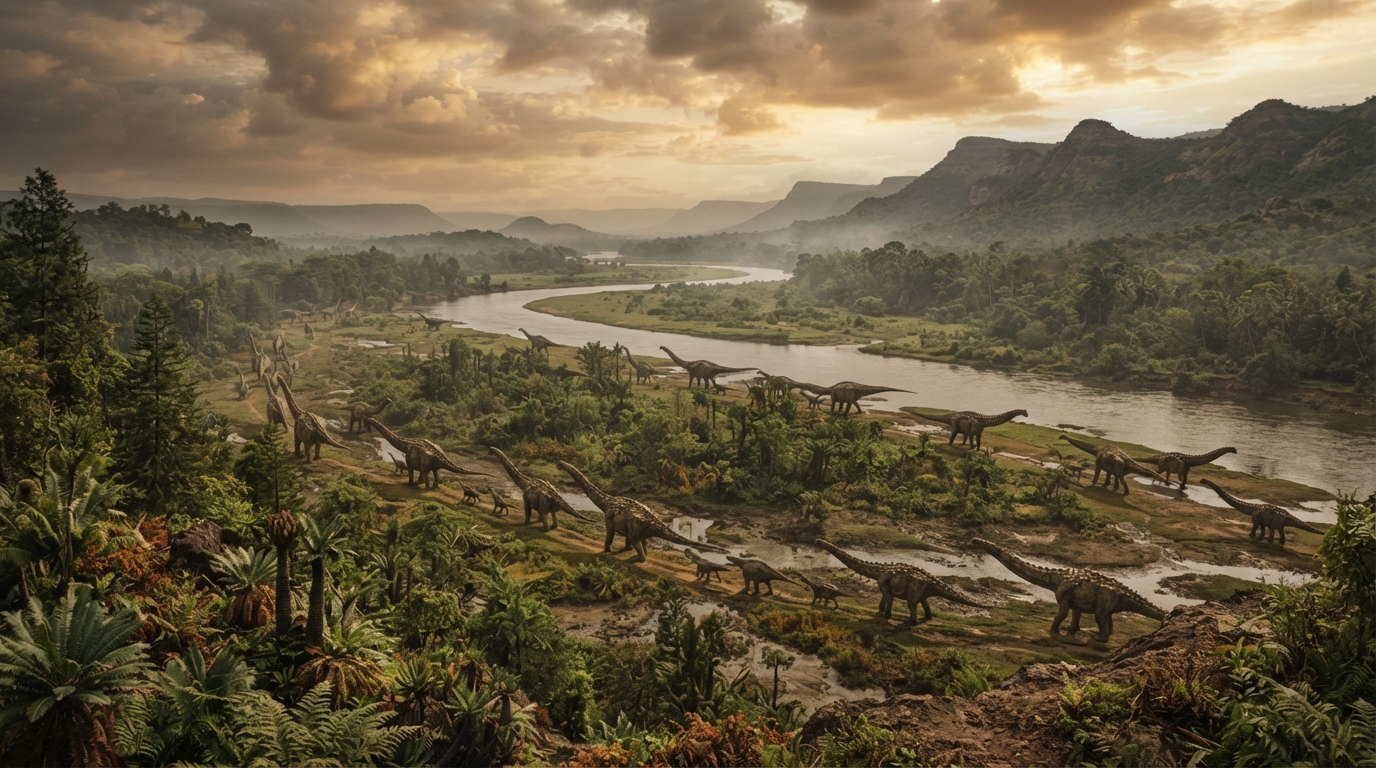
Prehistoric Indian natural history is the 3.5-billion-year chronological record of subcontinental geological evolution and biological diversification, beginning with the Archean Singhbhum Craton. During its 30-million-year northward drift across the Tethys Ocean as an isolated island, India fostered endemic titanosaurs, giant reptiles like Vasuki indicus, and early cetacean relatives like Indohyus before colliding with Eurasia.
Key Takeaways
- The Singhbhum Craton stabilized 3.5 billion years ago, forming early Earth crust.
- Central India's Lameta Formation preserves 256 titanosaur eggs across 92 colonial nesting sites.
- India drifted as an island ark, birthing the ancestors of modern whales.
- Massive Deccan volcanism erupted 1 million cubic kilometers of basalt across the subcontinent.
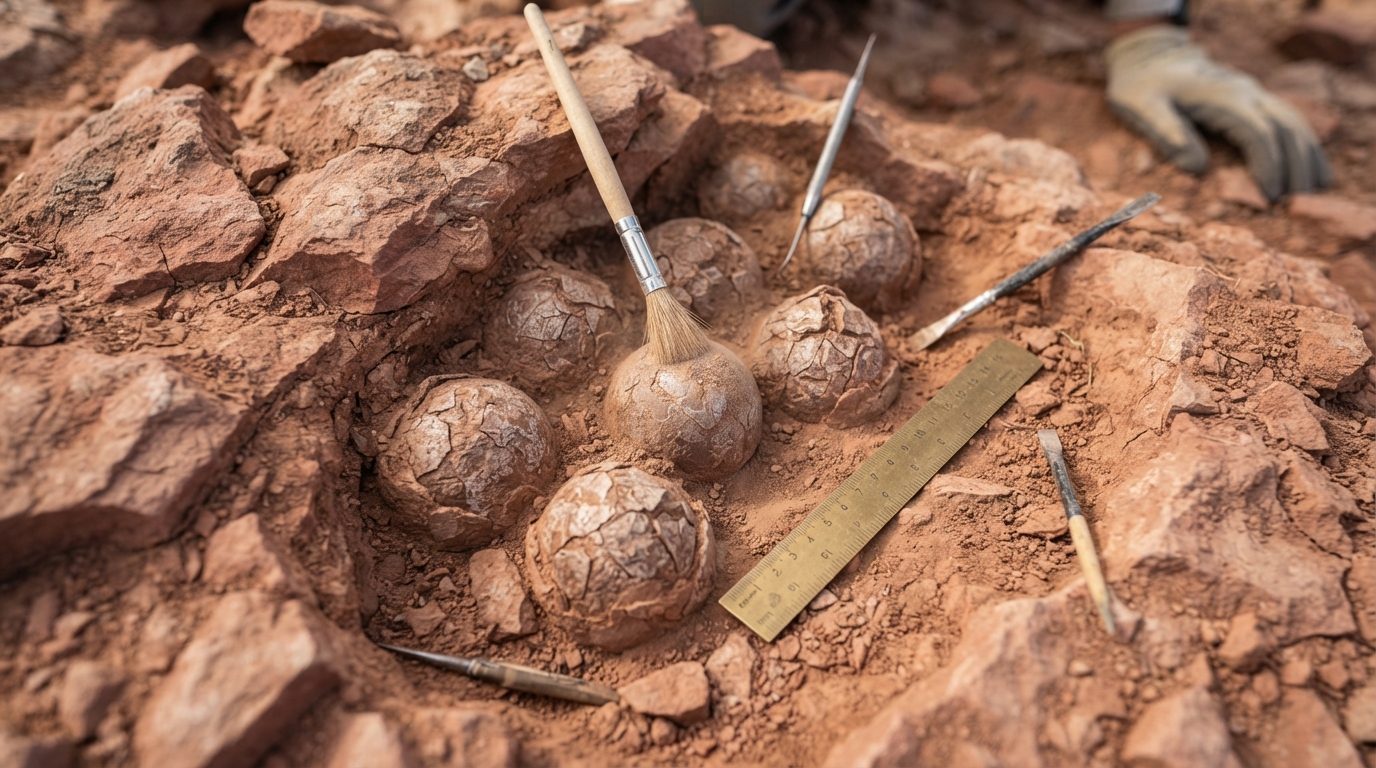
In the dry gullies of Dhar district in Madhya Pradesh, round stones sit half-buried in red silt. For generations, local farmers stacked them under banyan trees as "Kakar Bhairav," sacred village protector deities. In recent years, field paleontologists chipped away the rocky matrix around these stones. They revealed 66-million-year-old titanosaur dinosaur eggs.
These hatcheries represent just one layer of subcontinental deep time. The study of prehistoric Indian natural history reveals that India is not merely an ancient culture. It is one of the oldest physical foundations on Earth. From Archean crusts to drifting tectonic plates, the land preserves a deep record of biological origins. Readers can consult guides on how to learn Indian history easily through chronological timelines to connect deep geological epochs with recorded human events.
       DEEP-TIME TIMELINE OF THE INDIAN SUBCONTINENT
=============================================================
3.5 Ga          Singhbhum Craton emerges as stable continental crust
                [PNAS, 2021]
280–250 Ma      Gondwana coal basins deposit Glossopteris flora
120–66 Ma       India rifts from Madagascar; drifts north as an island ark
66 Ma           Deccan Traps erupt 1M km³ basalt; titanosaurs nest at Lameta
48–47 Ma        Indohyus thrives in Kashmir; Vasuki indicus hunts in Kutch
50–35 Ma        Indian plate collides with Eurasia, thrusting up the Himalayas
=============================================================
Ancient Cratons Formed the Bedrock of Prehistoric Indian Natural History
The bedrock of prehistoric Indian natural history is a foundational network of 3.5-billion-year-old Archean cratons that constitute some of Earth's earliest stable continental crust. Formed prior to multicellular life, these rigid tectonic blocks preserve stratigraphic evidence of ancient atmospheric transitions, volcanic eruptions, and marine sedimentation that anchored the subcontinental landmass across billions of years of deep planetary evolution.
The 3.5-Billion-Year-Old Singhbhum Craton
The Singhbhum Craton in eastern India sits among the oldest emerged landmasses on Earth. Research published in PNAS (2021) shows that sedimentary rocks in this craton formed in shallow marine environments between 3.2 and 3.5 billion years ago. Carbon biosignatures found in these rock strata date back roughly 3.497 billion years [Discover Magazine, 2026].
These rocks rose above sea level earlier than most continental land on the planet. Sedimentary core samples show evidence of ancient tidal river systems and shallow wave ripples. While most of the early Earth remained covered by deep ocean, parts of modern-day Jharkhand and Odisha already formed dry land. Weathering processes on these exposed cratons released key nutrients like phosphorus into early seas. That chemical flux helped feed the earliest single-celled life.
Dharwar and Bastar Crustal Formations
The Dharwar and Bastar crustal formations are ancient Archean tectonic provinces in southern and central India dating between 3.0 and 2.7 billion years old. Located across Karnataka, Andhra Pradesh, and central India, these stable continental blocks preserve basaltic greenstone belts, banded iron formations, and tonalite-trondhjemite-granodiorite gneisses that resisted mantle subduction to anchor the physical core of the subcontinent.
South of the Singhbhum shield, the Dharwar Craton in Karnataka and Andhra Pradesh preserves greenstone successions rich in ancient volcanic basalts and banded iron formations that geologists date to between 3.0 and 2.7 billion years old.
The Bastar Craton in central India bridges these northern and southern tectonic blocks. The Bastar Craton contains tonalite-trondhjemite-granodiorite gneisses that crystallized under extreme heat and pressure over 3 billion years ago. These stable Archean blocks resisted being recycled back into the mantle during later tectonic collisions. These formations gave the Indian landmass its durable physical core.
Correcting the Bhimbetka Ediacaran Fossil Record
Paleontologists must constantly test field claims against new analytical data. In 2021, researchers announced the discovery of a 550-million-year-old Dickinsonia fossil on the ceiling of the Bhimbetka Rock Shelters in Madhya Pradesh. Dickinsonia is a hallmark organism of the Ediacaran Period, representing Earth's earliest multicellular life.
A follow-up study published in Gondwana Research (2023) overturned that claim. Advanced chemical analyses revealed the imprint was not a fossil animal. It was the decayed wax remnant of a modern giant honeybee nest (Apis dorsata) left on the sandstone ceiling. The rock impression lacked any organic carbon signature or skeletal structure of Ediacaran fauna. Correcting the scientific record protects researchers from making faulty assumptions about the age of the Vindhyan Basin.
+------------------+------------------------+------------------------------------+
| Formation / Site | Age Range              | Key Geological / Fossil Marker     |
+------------------+------------------------+------------------------------------+
| Singhbhum Craton | 3.5 to 3.2 Billion Ga  | Early emerged continental crust    |
| Dharwar Craton   | 3.0 to 2.7 Billion Ga  | Banded iron & greenstone belts     |
| Damodar Basin    | 280 to 250 Million Ma  | Glossopteris seed-fern coal beds   |
| Lameta Strata    | 68 to 66 Million Ma    | Titanosaur nesting grounds & eggs  |
| Deccan Traps     | 66.5 to 65.5 Million Ma| Flood basalts (1 million km³)      |
| Subathu Basin    | 48 to 47 Million Ma    | Indohyus & early cetacean fossils  |
| Panandhro Lignite| 47 Million Ma          | Vasuki indicus (giant snake)       |
+------------------+------------------------+------------------------------------+
Gondwana Rifting Turned the Subcontinent into an Isolated Island Ark
Gondwana rifting in prehistoric Indian natural history is the Mesozoic tectonic process that fragmented the southern supercontinent and isolated the Indian plate for over 30 million years. Beginning roughly 140 million years ago, this continental divergence propelled India northward across the Tethys Ocean, fostering distinct evolutionary radiations in equatorial climates before subduction and collision with Eurasia.
       GONDWANA BREAKUP AND THE NORTHWARD DRIFT
=============================================================
~140 Ma: India, Madagascar, and Antarctica form East Gondwana.
~120 Ma: India and Madagascar separate from Antarctica.
~88 Ma:  India rifts from Madagascar, drifting isolated at ~15–20 cm/year.
~66 Ma:  Reunion plume triggers Deccan Traps eruptions.
~50 Ma:  Initial contact with Eurasian plate begins.
=============================================================
The 100-Million-Year Breakup of Supercontinents
During the early Mesozoic Era, the land that is now India formed the interior core of Gondwana. It was joined directly to Madagascar, Antarctica, Australia, and Africa. About 140 million years ago, tectonic rift systems split this giant block apart.
India separated from Antarctica first, around 120 million years ago. It remained locked to Madagascar until about 88 million years ago. Once it cleared Madagascar, the Indian plate accelerated across the ancient Tethys Ocean. It moved northward at speeds reaching 15 to 20 centimeters per year. This rate is remarkably fast for continental plates, which typically move at 2 to 5 centimeters annually. India became an isolated island ark drifting across the tropics.
Flora of the Gondwana Coal Basins
Before rifting occurred, Permian plant life carpeted the river valleys of central and eastern India. The Damodar, Son, and Godavari basins preserve deep layers of Glossopteris seed ferns. These gymnosperms dominated the cool, wet swamps between 280 and 250 million years ago.
Glossopteris leaves had distinct tongue-shaped outlines and net-like veins. As these plants died, their compressed plant matter formed the vast coal reserves worked today in Jharkhand, West Bengal, and Odisha. The presence of identical Glossopteris fossils in India, Antarctica, and South America served as primary evidence when Alfred Wegener first proposed continental drift.
The Role of Island Isolation in Speciation
Island isolation speciation in prehistoric Indian natural history is the evolutionary divergence that occurred when the Indian plate drifted northward as an isolated landmass for approximately 30 million years. This geographic separation allowed endemic taxa—including frogs, blind snakes, freshwater crabs, and flowering plants—to evolve in genetic isolation from Madagascar's separation at 88 Ma until Eurasian contact at 50 Ma.
Drifting isolated across warm oceans altered animal physiology. Subcontinental species evolved without genetic mixing from other major continents for roughly 30 million years. This geographic isolation created distinct lineages of frogs, blind snakes, freshwater crabs, and flowering plants.
Modern phylogenetic studies show that endemic species in the Western Ghats trace their lineage straight back to this drifting island era. The purple frog (Nasikabatrachus sahyadrensis) is a classic living relic. The closest living relatives of Nasikabatrachus sahyadrensis reside on the Seychelles islands, dating back to when India and the Seychelles formed a single drifting land fragment.
Cretaceous Dinosaurs Thrived Across Central and Western India
Late Cretaceous India hosted a thriving dinosaur ecosystem dominated by massive sauropods and abelisaurid apex predators. Preserved within the Lameta Formation of central India, these fossil beds show colonial nesting habits, unique nesting pathology, and top-tier carnivores that ruled the land before the Deccan Traps eruptions began.
      CRETACEOUS ECOSYSTEM OF THE LAMETA FORMATION
=============================================================
  Apex Predator: Rajasaurus narmadensis (Abelisaurid)
  Herbivores:    Isisaurus colberti & Jainosaurus (Sauropods)
  Reproduction:  92 colonial nesting sites with 256 eggs
  Pathology:     First sauropod "egg-in-egg" (ovum-in-ovo)
  Geographic Span: 1,000 km across Narmada Valley
=============================================================
The Titanosaur Hatcheries of the Lameta Formation
The Lameta Formation spans Madhya Pradesh, Gujarat, and Maharashtra. It represents one of the world's most productive field sites for sauropod dinosaur research. A landmark field study published in PLOS ONE (2023) documented 256 fossilized eggs across 92 titanosaur colonial nests in the Dhar district.
These nests belonged to two distinct titanosaur species: Isisaurus colberti and Jainosaurus septentrionalis. The nests sit tightly grouped in muddy fluvial sediments. This pattern suggests that titanosaurs returned year after year to the same riverbanks to lay eggs, much like modern sea turtles. Paleontologist Guntupalli V. R. Prasad from the University of Delhi pointed out that the 1,000-kilometer stretch across the Narmada Valley confirms central India was a massive dinosaur reproductive zone.
The PLOS ONE survey also revealed the world's first fossilized "egg-in-egg" (ovum-in-ovo) pathology in a sauropod dinosaur. The egg contained an inner shell encased within an outer shell layer. This anatomical condition occurs when stress causes an egg to back up into the oviduct. Its discovery proves that titanosaurs shared a sequential, segmented reproductive system similar to modern birds rather than the dual oviduct system of modern crocodiles.
Apex Predators of the Narmada Valley: Rajasaurus
Sauropod herds in the Lameta floodplains lived alongside powerful carnivores. In 2003, paleontologists from the Geological Survey of India, working with American researchers, described Rajasaurus narmadensis. The name translates to the "Princely Lizard of the Narmada."
           RAJASAURUS NARMADENSIS ANATOMY
  +-------------------------------------------------+
  | Skull:        Heavy, blunt snout                |
  | Head Crest:   Distinct rounded nasal-frontal horn|
  | Total Length: 7.6 to 9 meters                   |
  | Forelimbs:    Extremely short, four-fingered    |
  | Family:       Abelisauridae                     |
  +-------------------------------------------------+
Rajasaurus measured between 7.6 and 9 meters in length. It belonged to the Abelisauridae family, a group of theropods characterized by stocky hind legs, stunted forearms, and deep, blunt skulls. Unlike northern theropods such as Tyrannosaurus, Rajasaurus carried a distinct rounded horn on its forehead formed by nasal and frontal bones. It shared its hunting grounds with related abelisaurids, including Indosuchus and Indosaurus.
The Deccan Traps Volcanic Flood Basins
Around 66 million years ago, the drifting Indian plate passed directly over the Reunion mantle plume. The resulting volcanic activity triggered the Deccan Traps flood basalt event. Basalt lavas surfaced through giant fissures across central and western India for several hundred thousand years.
The Geological Society of America (2020) estimates that the eruptions produced over 1 million cubic kilometers of basaltic lava. The layers of cooled lava stack up to 2,000 meters thick in parts of Maharashtra. The volcanic gases released vast volumes of sulfur dioxide and carbon dioxide into the atmosphere. This intense climate disruption coincided with the Chicxulub asteroid impact in Mexico. Together, these events drove the Cretaceous-Paleogene (K-Pg) mass extinction, wiping out non-avian dinosaurs. Readers can view an Indian history timeline chart with key milestones to see where this geological cataclysm fits into the broader history of the land.
Cenozoic Fossils Reveal India as a Cradle for Global Mammalian Lineages
Following the dinosaur extinctions, prehistoric Indian natural history became an evolutionary cradle for several modern mammalian orders. Subcontinental fossils preserve critical transitional forms, including the terrestrial ancestor of modern whales and giant predatory reptiles that thrived in tropical Eocene coastal marshes across western India.
       CENOZOIC MAMMALIAN EVOLUTION IN INDIA
=============================================================
Indohyus (48 Ma, Kashmir)
  └─ Deer-like artiodactyl -> thick auditory bulla -> waded in water
       └─ Ambulocetus (47 Ma, Subathu Formation)
            └─ Modern Cetaceans (Whales, Dolphins, Porpoises)
=============================================================
Vasuki Indicus (47 Ma, Gujarat)
  └─ 10.9 to 15.2 m madtsoiid snake -> hunted in coastal swamps
=============================================================
Indohyus and the Subcontinental Birth of Whales
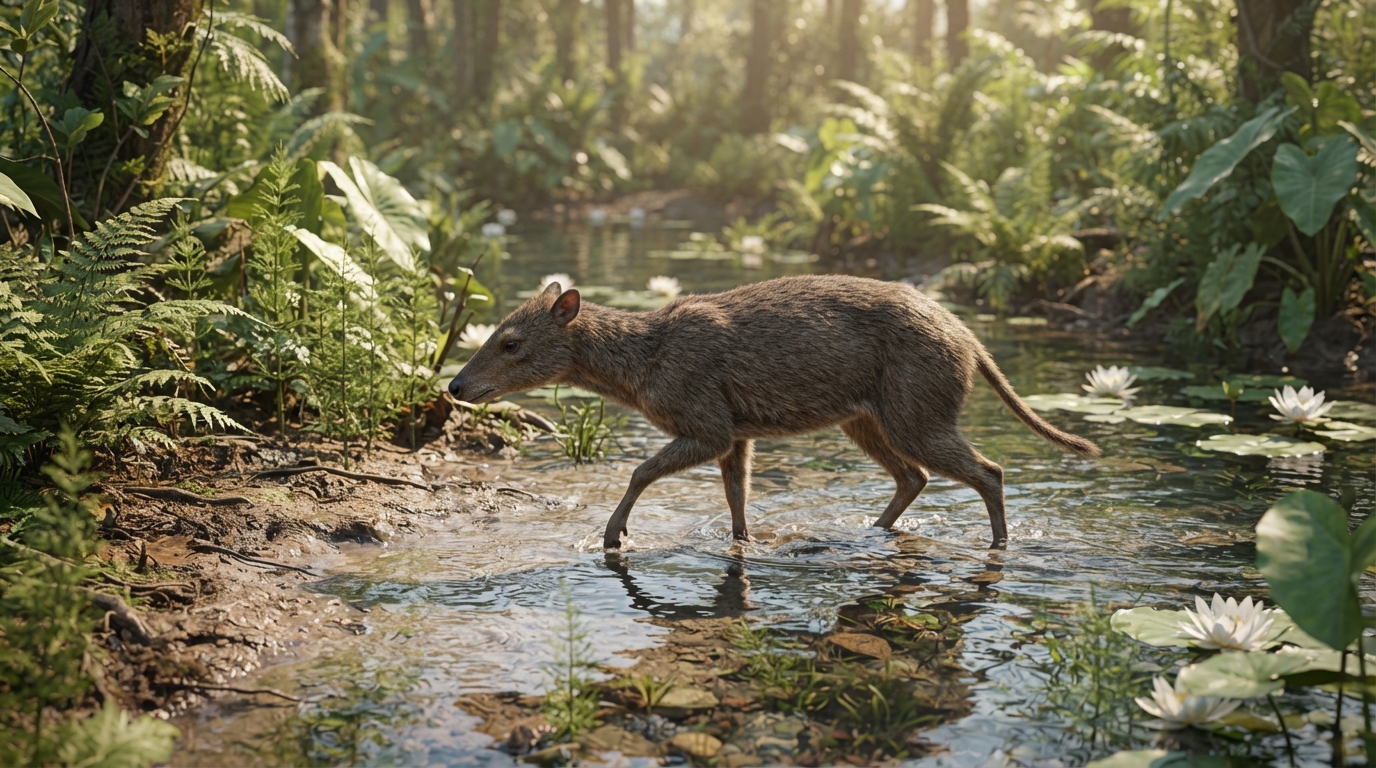
One of the most significant fossil discoveries in evolutionary biology occurred in the Subathu Formation of Jammu and Kashmir. In 2007, a research team led by Hans Thewissen published a description of Indohyus in Nature. Indohyus was a small, four-legged artiodactyl (even-toed ungulate) about the size of a domestic cat.
Indohyus lived roughly 48 million years ago along freshwater streams. While it looked like a tiny deer, its skeleton carried striking aquatic adaptations:
- Thickened Bone Walls (Osteosclerosis): Its limb bones were heavy and dense, acting as natural ballast to keep the animal submerged while feeding on underwater plants.
- Involucrum Ear Bone: The middle ear featured an thickened auditory bulla with an involucrum layer. This bone structure is found exclusively in cetaceans (whales and dolphins).
- Oxygen Isotope Signatures: Chemical ratios in its tooth enamel confirmed that it spent significant time foraging in fresh water to avoid land predators.
Fossil beds in Gujarat and Pakistan subsequently yielded Pakicetus and Ambulocetus ("the walking whale"). These discoveries confirmed that modern whales did not originate in open polar oceans. They evolved directly from terrestrial wading mammals living along the edges of the ancient Tethys Sea in northwestern India.
Vasuki Indicus and the Giant Reptiles of Kutch
During the Middle Eocene, roughly 47 million years ago, western India was covered by coastal mangrove marshes and shallow brackish lagoons. The Panandhro Lignite Mine in Kutch, Gujarat, preserves these warm swamp ecosystems.
In 2024, researchers from IIT Roorkee published the discovery of Vasuki indicus in Scientific Reports. The team recovered 27 well-preserved, articulated vertebrae measuring up to 11 centimeters wide.
               VASUKI INDICUS VITAL METRICS
  +---------------------------------------------------+
  | Classification:   Madtsoiidae (extinct constrictor)|
  | Estimated Length: 10.9 to 15.2 meters (36–50 ft)  |
  | Vertebra Width:   Up to 11.1 centimeters          |
  | Habitat:          Warm tropical coastal marshes   |
  | Geologic Age:     Middle Eocene (~47 Million Ma)  |
  | Discovery Site:   Panandhro Lignite Mine, Gujarat |
  +---------------------------------------------------+
Lead researcher Sunil Bajpai noted that Vasuki indicus reached an adult length between 10.9 and 15.2 meters. This makes it comparable in size to Titanoboa, the giant snake found in South America. Vasuki belonged to the extinct Madtsoiidae family. It was a slow-moving constrictor that hunted in shallow waters, feeding on ancient crocodilians, catfish, and primitive whales. The warm Eocene climate, with ambient tropical temperatures averaging 28 degrees Celsius, allowed cold-blooded reptiles to reach these massive proportions.
The Eurasian Tectonic Collision and Biotic Interchange
Around 50 to 45 million years ago, the drifting Indian plate made initial contact with the Eurasian plate. This collision closed the ancient Tethys Sea. The immense tectonic pressure buckled the earth's crust, slowly uplifting the Himalayas and the Tibetan Plateau.
This land connection opened up a two-way biological corridor known as the Great Indian-Asian Biotic Interchange. Lineages that evolved in isolation on the Indian island ark spread outward into Asia. These included primitive ungulates, ranid frogs, and dipterocarp rainforest trees. At the same time, Eurasian carnivores, rhinocerotids, and primitive primates migrated south into the subcontinent. The rising Himalayan barrier also altered atmospheric circulation, creating the seasonal monsoon system that still controls the region's climate.
Field Evidence Anchors Prehistoric Indian Natural History Today
Physical evidence for India's deep time exists across protected geoheritage sites, active open-cast lignite mines, and riverbeds. Understanding this physical record requires looking at both celebrated discoveries and ongoing field limitations. Subcontinental strata offer clear markers for mapping Earth's ancient biological and geological shifts.
+---------------------------+-------------------+-----------------------------------+
| Geoheritage Site / Region | State             | Primary Scientific Significance   |
+---------------------------+-------------------+-----------------------------------+
| Fossil Wood Park, Akal    | Rajasthan         | Jurassic petrified tree trunks    |
| Varkala Cliff Section     | Kerala            | Mio-Pliocene coastal strata       |
| Bagh Beds / Dhar District | Madhya Pradesh    | Marine fossils & titanosaur nests |
| Jhamarkotra Stromatolite  | Rajasthan         | Proterozoic biogenic structures   |
| Kutch Basin Lignite Beds  | Gujarat           | Eocene mammalian & reptile fossils|
+---------------------------+-------------------+-----------------------------------+
Key Geoconservation Sites in Modern India
The Geological Survey of India (GSI) has designated 34 official National Geological Monuments across the country. These sites preserve critical transitions in Earth's history:
- Jhamarkotra Stromatolite Park (Rajasthan): Preserves 2-billion-year-old rock structures built by colonies of photosynthetic cyanobacteria, documenting early oxygen production.
- Akal Fossil Wood Park (Rajasthan): Contains 180-million-year-old petrified tree trunks from Jurassic coastal forests that grew where the Thar Desert sits today.
- Bagh Beds (Madhya Pradesh): Marine limestone strata containing Cretaceous ammonites, echinoids, and marine bivalves deposited when a shallow seaway flooded central India.
- Sendra Granite (Rajasthan): Features granite formations sculpted by wind and water erosion over 900 million years.
Studying these field sites helps researchers track how climate zones moved across millions of years. For more background on foundational dates across different historical fields, check out the major events in Indian history FAQ archive for detailed breakdowns.
Limitations and Tradeoffs in Subcontinental Paleontology
Field paleontology in India faces distinct geographic and logistical limitations. Tropical weathering represents the biggest hurdle. High humidity, heavy annual monsoons, and acidic soil chemistry break down delicate bone structures much faster than in arid regions like the American West or the Gobi Desert.
       CHALLENGES IN SUBCONTINENTAL FIELD PALEONTOLOGY
=============================================================
1. Tropical Monsoon Weathering:
   Acidic rains and high humidity rapidly dissolve exposed bone.
2. Rapid Industrial & Agricultural Expansion:
   Open-cast mining and farmland expansion risk burying field strata.
3. Lack of Unified Fossil Protection Laws:
   Fossil discoveries outside forest reserves lack strong statutory safeguards.
4. Limited Dedicated Field Infrastructure:
   Fewer specialized university prep labs compared to North America or Europe.
=============================================================
Another major challenge is commercial activity. Key fossil layers often sit inside active open-cast mines, such as the lignite pits of Kutch and Neyveli. Mining operations expose fresh fossil-bearing layers, but heavy excavation equipment can destroy specimens before field teams can document them.
Fossil protection laws also vary across states. Centralized statutory protections for geological heritage sites remain weaker than laws protecting archeological ruins. Paleontologists frequently rely on the goodwill of local landowners to preserve important nesting sites. You can read our review of early Indian fossil discoveries to see how early field naturalists navigated these same terrain challenges.
Integrating Deep Time into Subcontinental History
Deep natural history provides the physical framework for human history. The basalt soils of the Deccan Traps create the moisture-retaining black cotton soil (regur) that powered western India's agrarian economies. Silt carried down from the young, uplifting Himalayas formed the fertile Indo-Gangetic plain, supporting large human civilizations.
Human history covers thousands of years, but geological processes operate across millions. Connecting deep-time paleontology with subcontinental timelines gives students and researchers a clearer view of why India's geography looks and behaves the way it does today.
Frequently Asked Questions
Q: What is the oldest geological formation discovered in India?
The Singhbhum Craton in eastern India is the oldest confirmed formation, dating back 3.2 to 3.5 billion years. It contains ancient granite gneisses, greenstone belts, and early marine sandstones that formed stable continental crust during the Archean Eon.
Q: Did dinosaurs live in India during the prehistoric era?
India hosted a wide range of dinosaurs during the Cretaceous Period, including the abelisaurid apex predator Rajasaurus narmadensis and giant sauropods like Isisaurus. The Lameta Formation in central India contains some of the world's densest fossilized titanosaur nesting colonies.
Q: How did the Indian subcontinent help give rise to modern whales?
Fossils from Jammu and Kashmir prove that Indohyus, a small four-legged artiodactyl that lived 48 million years ago, is the closest extinct terrestrial relative of cetaceans. It featured thickened bone walls for wading and the distinct involucrum ear bone structure unique to whales.
Q: Why was the discovery of Vasuki indicus important?
Described in 2024 from 47-million-year-old lignite beds in Gujarat, Vasuki indicus was a giant madtsoiid snake estimated at 10.9 to 15.2 meters long. It shows that warm Eocene climates allowed massive cold-blooded reptiles to thrive in the tropical coastal marshes of isolated India.
Your Next Move
Field exploration of prehistoric Indian natural history is the hands-on examination of subcontinental geological strata, rock exposures, and fossil deposits accessible across various regional landscapes in India. Observers can analyze surface expressions spanning 3.5 billion years of planetary history, from Archean granite cratonic basements in the peninsular south to Late Cretaceous fossiliferous sedimentary strata in central India.
Pick one geological era from the table in this guide and examine its modern surface expression near your home state. If you live near central India, visit the Lameta exposures or a local regional museum in Bhopal or Jabalpur to observe fossilized titanosaur nests firsthand. If you live in peninsular India, explore the exposed granite tors of the Deccan shield to connect directly with billions of years of subcontinental crustal history.
Related Reading
- Milestones in Indian Women's History: A Chronological Guide
- 1,000 Years of Indian Medical History: A Chronological Guide
- Economic Milestones in Indian History: From 1947 to Present
- What Are the Major Events in Indian History? (FAQ Archive)
Sources
- Magmatic thickening of crust in non–plate tectonic settings initiated the subaerial rise of Earth’s first continents 3.3 to 3.2 billion years ago — Proceedings of the National Academy of Sciences, 2021. Supports: The finding that the Singhbhum Craton emerged as stable, subaerial continental crust between 3.2 and 3.5 billion years ago.
- New Late Cretaceous titanosaur sauropod dinosaur egg clutches from lower Narmada valley, India: Palaeobiology and taphonomy — PLOS ONE, 2023. Supports: The discovery of 256 titanosaur eggs across 92 colonial nesting sites in Dhar district and the first observed sauropod "egg-in-egg" pathology.
- Largest known madtsoiid snake from warm Eocene period of India suggests intercontinental Gondwana dispersal — Scientific Reports, 2024. Supports: The identification of Vasuki indicus, a 10.9-to-15.2-meter extinct madtsoiid constrictor snake from the Panandhro Lignite Mine in Gujarat.
- Whales originated from aquatic artiodactyls in the Eocene epoch of India — Nature, 2007. Supports: The discovery that Indohyus from Kashmir possessed thickened bone walls and an involucrum ear bone, establishing it as the terrestrial sister taxon to cetaceans.
- Stinging News: 'Dickinsonia' discovered in the Upper Vindhyan of India not worth the buzz — Gondwana Research, 2023. Supports: The re-evaluation overturning the Bhimbetka Dickinsonia fossil discovery by proving the rock imprint was decayed wax from a modern Apis dorsata beehive.
- A new abelisaurid (Dinosauria, Theropoda) from the Lameta Formation (Cretaceous, Maastrichtian) of India — Contributions from the Museum of Paleontology, University of Michigan, 2003. Supports: The formal description and anatomical classification of the horned apex theropod Rajasaurus narmadensis.