Cross-Cultural Learning: A History of Foreign Education Exchanges in India
Bottom Line
Foreign education exchange in India is the two-millennium evolution of cross-border academic mobility from ancient residential monasteries hosting Asian scholars to modern offshore branch campuses. According to historical records and the Ministry of Education, this cross-border scholarship shifted from Buddhist manuscript translations to colonial administrative studies in Britain, post-independence multilateral technical partnerships, and contemporary international university campuses.
Key Takeaways
- Ancient monastic universities like Nalanda hosted over 10,000 students from across Asia.
- Colonial policies redirected Indian scholarly travel toward British institutions for administrative and legal training.
- Post-independence technical collaborations built premier engineering institutes with American, Soviet, and European support.
- Modern India faces a structural exchange deficit, sending 1.25 million students abroad annually.
- New regulations permit top 500 global universities to open independent campuses in India.
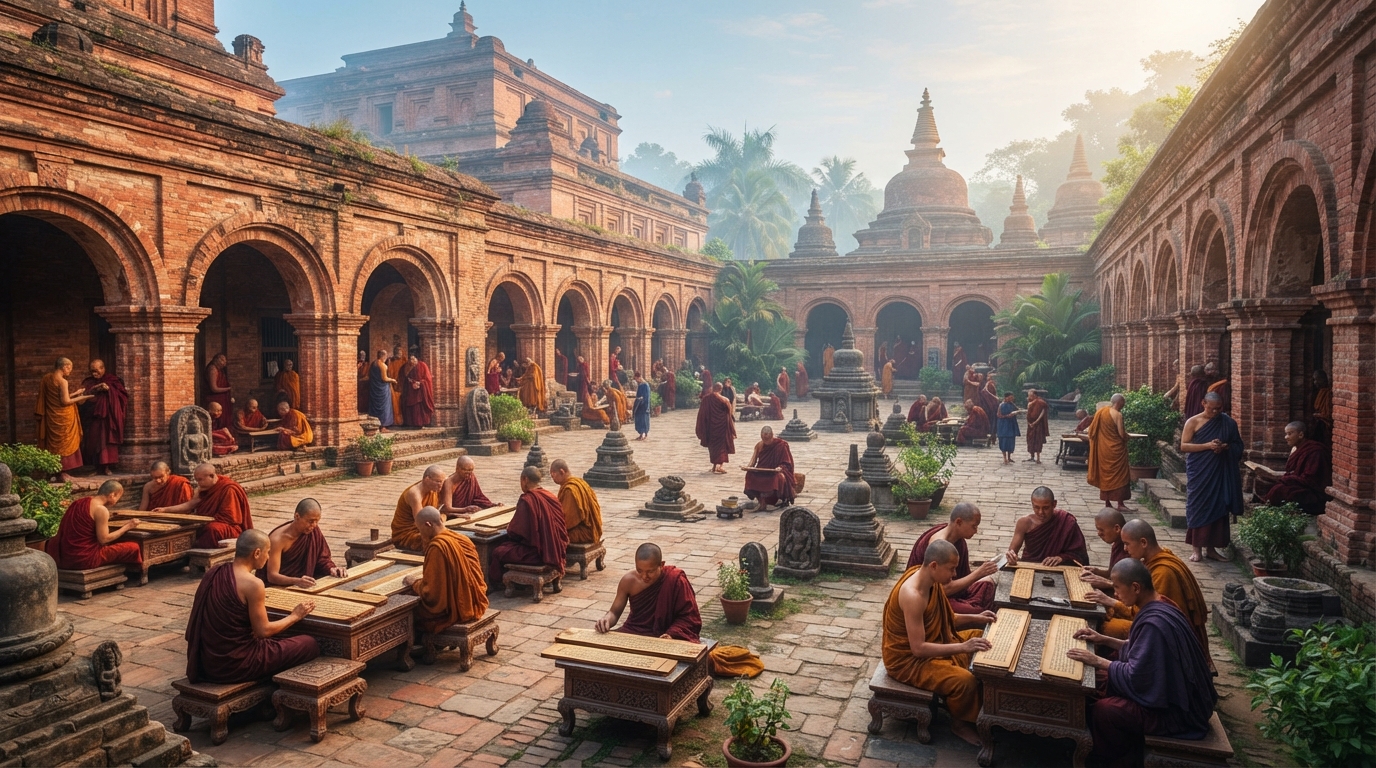
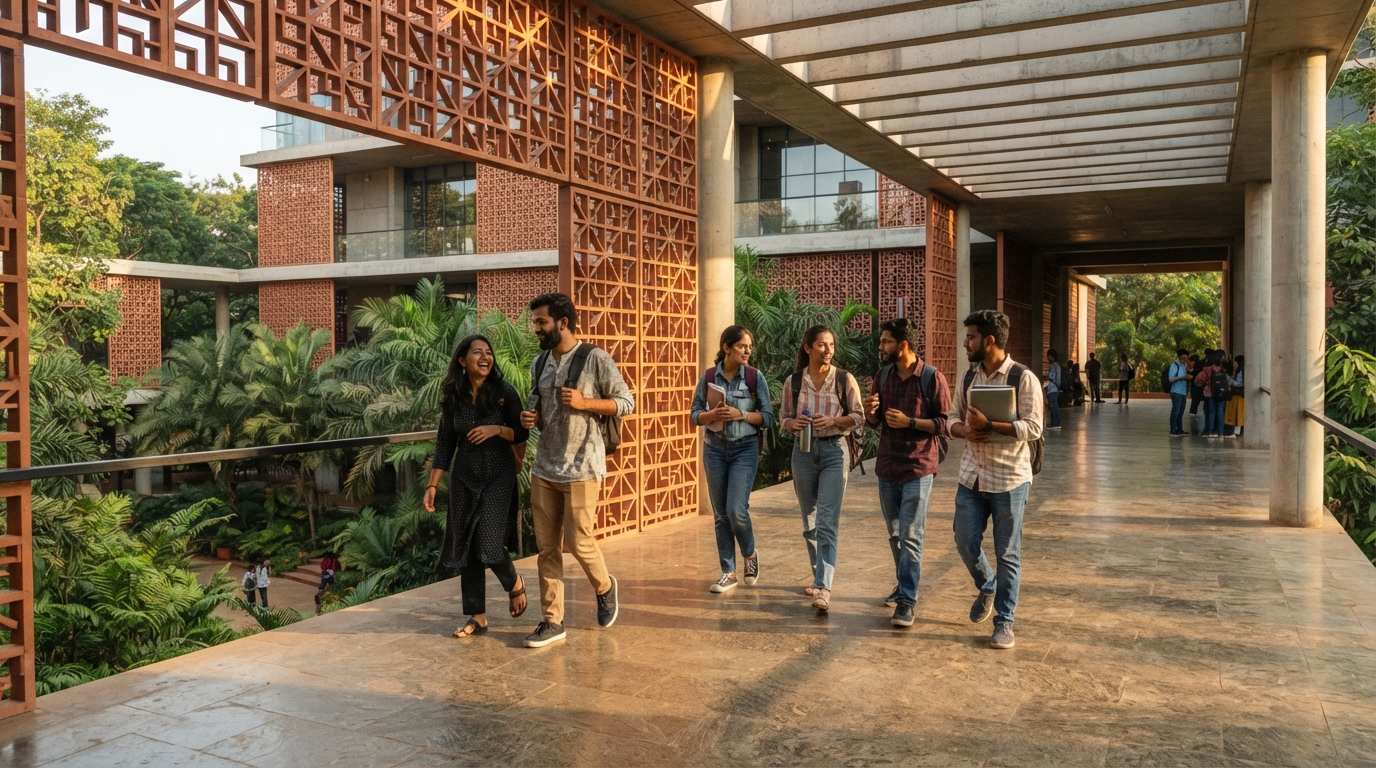
Excavation sites at Nalanda reveal rows of stone dormitories where scholars from China, Korea, and Java lived side by side during the seventh century. Thousands of miles away in Gujarat, modern glass buildings in GIFT City now house campuses for Australian universities teaching cybersecurity and business analytics.
These two settings illustrate the long arc of Indian education history. Academic mobility across the subcontinent did not begin with modern study abroad agencies. It began more than two millennia ago through caravan routes, maritime paths, and state-sponsored learning missions.
Ancient Monasteries Built the First International Scholarly Networks
Ancient Indian higher education operated through monastic centers that drew thousands of foreign scholars seeking primary texts, philosophical training, and language immersion. These centers relied on royal land grants and village revenues to provide free tuition, lodging, and meals to admitted foreign students who passed strict oral entrance examinations.
ANCIENT SCHOLARLY MOBILITY TIMELINE
┌─────────────────┐ ┌─────────────────┐ ┌─────────────────┐
│ c. 6th C. BCE │ │ 630s-640s CE │ │ 1193 CE │
│ Takshashila │──────>│ Xuanzang at │──────>│ Nalanda Complex │
│ draws Pan- │ │ Nalanda │ │ suffers sack & │
│ Asian students │ │ Mahavihara │ │ decline │
└─────────────────┘ └─────────────────┘ └─────────────────┘
Nalanda and Takshashila Welcomed Scholars Across Asia
Takshashila functioned as an early center for specialized studies starting around the sixth century BCE. Located along northern trade corridors, it attracted students from Babylonia, Greece, Syria, and across the subcontinent. The curriculum covered eighteen arts, military strategy, medicine, and astronomy.
Centuries later, Nalanda Mahavihara in modern Bihar expanded residential education to an unprecedented scale. During its peak in the seventh century CE, Nalanda supported an estimated residential population of 10,000 students and 2,000 teachers [International Journal of History, 2026].
Chinese monk Xuanzang arrived at Nalanda in the 630s CE after surviving years of overland travel across Central Asian deserts. He studied Sanskrit grammar, logic, and Yogacara philosophy for five years under the guidance of Venerable Shilabhadra. Xuanzang eventually returned to Tang China carrying 657 primary Sanskrit manuscripts, which he spent the rest of his life translating. Fellow pilgrim Yijing arrived decades later, documenting similar daily routines, rigorous debates, and water-clock schedules at the monastery.
Indian Monks Carried Manuscripts Across Central Asia and China
Outbound monastic education in ancient India is the historical transmission of Buddhist philosophy, linguistic systems, and texts by Indian scholar-monks to Central Asia, China, and Tibet between the fourth and eighth centuries CE. According to historical accounts, scholars like Kumarajiva, Bodhidharma, and Padmasambhava traveled along Asian trade routes to build foreign translation bureaus and monastic institutions.
Kumarajiva traveled to Chang'an in the fourth century CE to lead state-sponsored translation bureaus that converted complex Mahayana scriptures into readable Chinese. Bodhidharma traveled to southern China, introducing dhyana meditation practices that formed the basis of Chan and Zen traditions.
Centuries later, Padmasambhava journeyed from the Swat Valley to Tibet to help establish Samye Monastery in the eighth century. These Indian teachers did not simply deliver lectures; the scholars built local institutional capacity, developed phonetic transliteration systems, and trained generations of indigenous scribes.
Residential Living Fostered Rigorous Debate and Multilingual Translation
Admission into institutions like Nalanda, Vikramashila, and Vallabhi required passing rigorous oral screenings conducted by gatekeepers (Dwarapanditas). Historical records show that only two or three out of ten applicants gained entry.
Once admitted, international students lived in multi-story residential blocks equipped with private study cells, stone beds, and communal lecture halls. The daily curriculum balanced private manuscript copying with structured public debates.
Scholars refined their arguments in front of peer assemblies before publishing written commentaries. This residential model created a shared intellectual vocabulary across diverse Asian kingdoms, preserving complex philosophical systems across national boundaries.
Colonial Directives Reshaped Indian Education History and Academic Outflows
Colonial education policy in nineteenth-century India is the administrative restructuring of Indian education history through British legislative mandates, primarily Thomas Babington Macaulay's 1835 Minute and the 1854 Wood's Despatch. According to historical records, these directives replaced traditional Sanskrit, Persian, and Arabic patronage with English-medium instruction, compelling Indian students to travel to British universities for advanced legal, administrative, and medical qualifications.
The 1835 Macaulay Minute Disrupted Multilingual Exchange Systems
Thomas Babington Macaulay's 1835 'Minute on Indian Education' redirected state funding away from Sanskrit, Persian, and Arabic scholarship toward English-medium instruction. Macaulay argued that western scientific and administrative concepts could only be taught effectively through English.
The British administration institutionalized this view with the English Education Act of 1835 and the 1854 Wood's Despatch. The new policy framework established formal universities in Calcutta, Bombay, and Madras in 1857.
These institutions operated primarily as examining bodies rather than residential research centers. The structural pivot severed traditional educational exchanges with East and Southeast Asia, aligning the subcontinent's academic system exclusively with the British imperial core. To explore how traditional learning systems transformed during this era, see our guide on 1,000 years of Indian medical history.
Early Indian Students Traveled West for Law and Medicine
With local higher education geared toward lower administrative roles, ambitious Indian students sought advanced degrees abroad. London became the primary destination for young Indians studying law, civil administration, and clinical medicine.
Mahatma Gandhi traveled to University College London in 1888 to train for the bar. Decades later, B.R. Ambedkar pursued graduate degrees at Columbia University in New York and the London School of Economics, studying public finance, sociology, and constitutional law.
Pioneering women broke comparable barriers in western medical institutions. Dr. Anandibai Joshi graduated from the Woman's Medical College of Pennsylvania in 1886, becoming one of the first Indian women to earn an overseas medical degree.
These scholars faced significant social resistance at home, including ritual purification demands from orthodox community councils for crossing the ocean (kala pani). For deeper biographical timelines of trailblazing women scholars, read our overview of milestones in Indian women's history.
         NOTABLE EARLY OUTBOUND SCHOLARS
┌───────────────────────┬────────────────────────┬───────────────┐
│ Scholar               │ Foreign Institution    │ Focus Area    │
├───────────────────────┼────────────────────────┼───────────────┤
│ Dr. Anandibai Joshi   │ WMC of Pennsylvania    │ Medicine      │
│ Mahatma Gandhi        │ UCL / Inner Temple     │ Law           │
│ B.R. Ambedkar         │ Columbia Univ. / LSE   │ Economics/Law │
│ Dr. Jamini Sen        │ Royal College, Glasgow │ Medicine      │
└───────────────────────┴────────────────────────┴───────────────┘
Mid-Twentieth Century Exchanges Focused on Post-War Reconstruction
Following the First and Second World Wars, international educational mobility became more institutionalized. Private philanthropies and international trusts funded bilateral fellowships to rebuild global scientific ties.
The Rhodes Scholarship program, established in 1902, opened its selection process to Indian applicants in the 1940s. The Rockefeller Foundation and the Carnegie Corporation financed research visits for Indian agricultural scientists and public health officials to study western laboratory methods.
These programs established formal academic networks that survived the transition to independence, creating an experienced cohort of scholars who later designed India's national research laboratories.
Post-Independence Treaties Expanded Bilateral Technical Programs
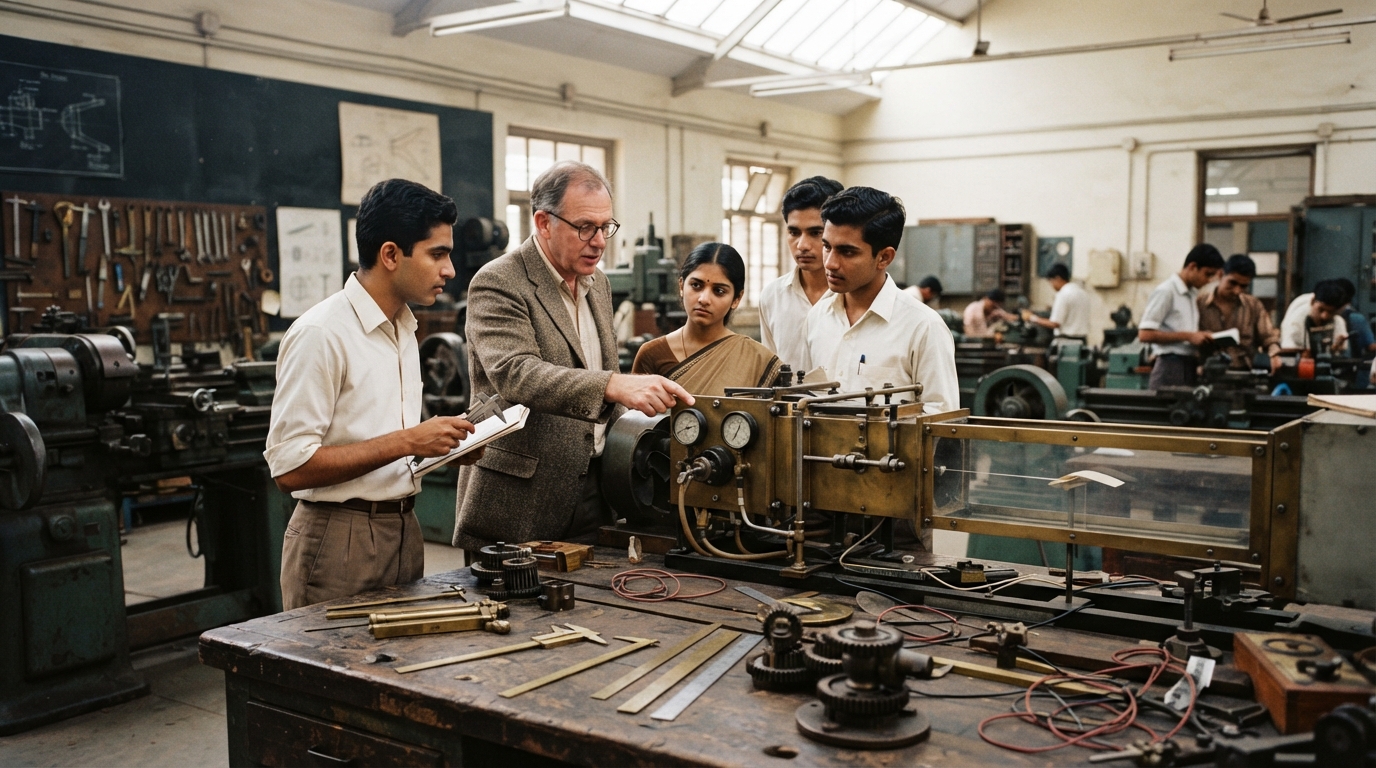
Following independence in 1947, the Indian government used bilateral treaties and foreign technical assistance to build domestic engineering and scientific institutions. International partners supplied laboratory equipment, visiting faculty, and curriculum models to train the technical workforce needed for state-led industrialization.
       POST-INDEPENDENCE IIT PARTNERSHIP MATRIX
┌─────────────────────────────────────────────────────────────┐
│ IIT Kharagpur (1951)  <── UNESCO & International Consortium │
│ IIT Bombay (1958)     <── Soviet Union Assistance           │
│ IIT Madras (1959)     <── West German Government            │
│ IIT Kanpur (1959)     <── American University Consortium    │
│ IIT Delhi (1961)      <── United Kingdom Collaboration      │
└─────────────────────────────────────────────────────────────┘
The Colombo Plan and Cold War Technical Collaborations
The Colombo Plan, established in 1950, organized technical cooperation across South and Southeast Asia. Member nations shared technical expertise, provided equipment for regional polytechnics, and offered reciprocal scholarships.
Indian engineers trained in Australia, Canada, and the United Kingdom on modern infrastructure methods. In return, India hosted hundreds of students from neighboring Asian and African nations in forestry, irrigation engineering, and railway administration programs.
Educational diplomacy became a core instrument of non-aligned foreign policy during the Cold War. The country accepted technical assistance from both western and eastern blocs while avoiding exclusive alignment with either power.
Establishing the Indian Institutes of Technology with Global Partners
The creation of the Indian Institutes of Technology (IITs) represents one of the most successful multilateral technology-transfer initiatives in post-independence Indian education history. Each early institute partnered with a different international sponsor:
- IIT Kharagpur (1951) received technical assistance and specialized workshop equipment through UNESCO and a consortium of European experts.
- IIT Bombay (1958) was established with substantial financial and academic backing from the Soviet Union, including equipment imports and Soviet engineering professors.
- IIT Madras (1959) partnered with the West German government, which provided laboratory infrastructure, faculty training in German engineering methods, and joint research grants.
- IIT Kanpur (1959) developed under the Kanpur Indo-American Program (KIAP), a consortium of nine American universities including MIT, Caltech, and Princeton.
- IIT Delhi (1961) received direct faculty support and equipment funds from the government of the United Kingdom and the Imperial College London.
These partnerships exposed Indian students to world-class technical curricula without requiring them to relocate abroad permanently. To learn more about the broader policy environment of this era, read our breakdown of economic milestones in Indian history from 1947 to present.
The Cultural Relations Network Expanded African and Asian Scholarships
Maulana Abul Kalam Azad established the Indian Council for Cultural Relations (ICCR) in 1950 to build academic and cultural ties with newly independent nations. The council administered dedicated scholarship schemes for students from Africa, Southeast Asia, and the Middle East.
Thousands of students enrolled in Indian state universities to study medicine, agriculture, law, and liberal arts. Many ICCR alumni later served as cabinet ministers, diplomats, and university chancellors in their home countries.
This diplomatic program solidified India's reputation as an affordable, high-quality higher education hub for the Global South throughout the 1970s and 1980s.
Structural Realities Shape Modern Inbound and Outbound Student Flows
The modern Indian educational exchange structure is an asymmetric mobility framework defined by an imbalance between inbound foreign student enrollments and outbound student departures. According to data from the Ministry of Education and Ministry of External Affairs, India hosts approximately 58,134 international students annually—predominantly from neighboring South Asian countries—while sending over 1.25 million Indian students abroad for higher education.
Current Enrollment Metrics Show a Persistent Exchange Deficit
According to the All India Survey on Higher Education (AISHE) report released by the Ministry of Education, 58,134 international students from 173 countries enrolled in Indian higher education institutions during the 2023–24 academic session [AISHE Report / Ministry of Education, 2026]. This represents an 18.9% increase over five years.
In contrast, 1.25 million Indian students studied abroad in foreign institutions annually during the same period [Ministry of External Affairs, 2025]. The United States, Canada, the United Kingdom, and Australia receive the vast majority of these outbound scholars.
This creates a substantial outward flow of private capital, estimated at tens of billions of dollars annually in tuition fees and living expenses.
       ANNUAL STUDENT MOBILITY COMPARISON (2025-2026)
┌─────────────────────────────────────────────────────────────┐
│ Inbound Students to India:    58,134                        │
│ █▍                                                          │
├─────────────────────────────────────────────────────────────┤
│ Outbound Indian Students:     1,250,000                     │
│ ███████████████████████████████████████████████████████████ │
└─────────────────────────────────────────────────────────────┘
Regional Neighbor Dominance Defines Inbound Demographics
Most international students in India come from neighboring South Asian and African nations. Proximity, shared cultural ties, and affordable English-medium degree programs drive this recruitment.
             TOP ORIGIN COUNTRIES FOR FOREIGN STUDENTS
┌──────────────────────┬──────────────────────┬───────────────┐
│ Country of Origin    │ Share of Foreign Total│ Primary Fields│
├──────────────────────┼──────────────────────┼───────────────┤
│ Nepal                │ 24.1%                │ Engg, Med, BCA│
│ United Arab Emirates │ 7.0%                 │ Commerce, BBA │
│ United States (OCI)  │ 5.9%                 │ Humanities, BS│
│ Bangladesh           │ 5.9%                 │ Engineering   │
│ Nigeria              │ 5.5%                 │ Pharmacy, IT  │
└──────────────────────┴──────────────────────┴───────────────┘
Data source: AISHE Report / Ministry of Education, 2026.
Students from Nepal make up nearly a quarter of all foreign enrollments. Most pursue undergraduate degrees in engineering, computer applications, pharmacy, and management across private and state universities in Punjab, Karnataka, Tamil Nadu, and Maharashtra.
Visa Friction and Infrastructure Limit Inbound Growth
Several structural bottlenecks prevent India from meeting its targeted inbound student capacity. Foreign students frequently face complex registration protocols with Foreigners Regional Registration Offices (FRRO), restrictions on part-time campus employment, and uneven hostel infrastructure.
Rahul Choudaha, Principal at DrEducation Research, notes that while inbound student numbers are growing, India's target of becoming a global study hub faces headwinds unless accompanied by faster visa processing, clearer post-study work pathways, and stronger institutional branding [The PIE News, 2026].
Without clear post-study internship rights, institutions struggle to attract diverse cohorts from Western Europe, East Asia, and the Americas outside of short-term cultural exchange programs. For a deeper look at the evolution of educational policy documents over time, review our analysis of colonial education policy in India.
| Historical Era | Primary Exchange Direction | Key Disciplines | Defining Feature |
|---|---|---|---|
| Ancient Era (c. 6th BCE–12th CE) | Inbound from East/SE Asia | Philosophy, Logic, Sanskrit | Residential monastic complexes with royal funding |
| Colonial Era (1835–1947) | Outbound to Western Europe | Law, Administration, Medicine | English-medium civil service preparation |
| Post-Independence (1950–1990) | Bilateral Technical Aid | Engineering, Agriculture | Multilateral treaties, IITs, and ICCR fellowships |
| Modern Era (1991–Present) | Massive Outbound Outflow | Computer Science, Management | Large mobility deficit alongside branch campus reforms |
Regulatory Reforms Permit Foreign University Branch Campuses on Indian Soil
India's foreign university branch campus framework is a regulatory policy established under the National Education Policy 2020 and University Grants Commission guidelines allowing top-500 global institutions to operate standalone Indian campuses. According to Ministry of Education directives, eligible foreign universities receive complete administrative, financial, and curricular autonomy to deliver international degrees locally in GIFT City, Mumbai, and Gurugram.
GIFT City Created the First Operational Special Education Zones
Gujarat International Finance Tec-City (GIFT City) served as the regulatory testing ground for foreign branch campuses under the International Financial Services Centres Authority (IFSCA). The framework exempted accredited foreign institutions from domestic university quotas and fee caps.
Australia's Deakin University became the first foreign institution to open a physical campus in India in July 2024. Its GIFT City facility launched postgraduate programs in Business Analytics and Cyber Security.
The University of Wollongong followed in November 2024, launching specialized finance programs. These campuses operate with smaller initial cohorts—Deakin's opening batch enrolled roughly 43 students—to refine local delivery models and industry internship pipelines [IFSCA / PIB, 2026].
UGC Regulations Opened Mainland Campuses for Top 500 Global Institutions
Following the GIFT City pilot, the University Grants Commission (UGC) notified the Foreign Higher Educational Institutions (FHEI) regulations in November 2023. These rules allow top 500 global institutions (overall or subject-wise) to establish standalone campuses anywhere in mainland India [University Grants Commission, 2023].
The Ministry of Education issued formal approvals to several leading international universities:
- University of Southampton secured approval to establish a multi-faculty teaching and research campus in Gurugram, becoming the first UK institution to enter under mainland UGC rules.
- University of Bristol and University of York received approvals in June 2026 to open campuses in Mumbai [Press Information Bureau, 2026].
- University of New South Wales (UNSW) received approval for a campus in Bengaluru [Press Information Bureau, 2026].
M. Jagadesh Kumar, Chairman of the University Grants Commission (UGC), noted that granting top-500 global institutions operational, financial, and curricular autonomy on Indian soil democratizes foreign qualifications for local and regional students at lower costs [UGC / PIB, 2026].
Academic Twinning and Dual Degrees Bridge Cross-Border Curricula
Alongside physical branch campuses, Indian institutions maintain thousands of collaborative degree pathways with overseas universities. Modern UGC regulations permit three distinct international partnership formats:
- Twinning Programs: Students complete up to 30% of their course credits at an overseas partner institution while receiving a degree from their home Indian university.
- Joint Degree Programs: Indian and foreign universities design a unified curriculum, delivering a single degree certificate with joint institutional branding upon completion.
- Dual Degree Programs: Students fulfill concurrent academic requirements at both institutions, receiving two separate qualifying degrees for a single articulated course of study.
These arrangements allow Indian universities to update laboratory standards, implement credit-transfer systems, and participate in collaborative research without requiring full campus relocations. For more on early residential models that influenced modern cross-border systems, see our archive on ancient Indian universities.
Frequently Asked Questions
Q: How does ancient international student mobility compare to modern Indian education history?
Ancient Indian institutions like Nalanda operated as major inbound destinations where foreign scholars traveled to India for advanced philosophical and linguistic study. Modern patterns feature a significant outward deficit, with over 1.25 million Indian students traveling abroad annually while domestic institutions host roughly 58,000 foreign students.
Q: What requirements must a foreign university meet to open a campus in India?
Under UGC regulations, an overseas university must rank within the top 500 globally in overall institutional rankings or within the top 500 in specific subject tables. The institution must deliver identical curriculum quality, faculty standards, and degree equivalencies to those maintained at its home campus.
Q: Which country sends the highest number of international students to India?
Nepal sends the largest contingent of international students to India, accounting for 24.1% of all foreign enrollments [AISHE Report / Ministry of Education, 2026]. The United Arab Emirates, the United States, Bangladesh, and Nigeria follow as the next largest origin countries.
Q: Why was the inauguration of the modern Nalanda University significant for international education?
Prime Minister Narendra Modi inaugurated the 455-acre modern Nalanda University campus in Rajgir, Bihar, in June 2024 with diplomatic support from 17 partner nations across the East Asia Summit [Press Information Bureau, 2024]. The project revives the historical legacy of the ancient monastery as a collaborative international research university.
Your Next Move
If you are evaluating foreign degree options, compare the cost structure of newly opened branch campuses in GIFT City, Mumbai, or Gurugram against direct overseas enrollment. You can secure equivalent international accreditation and faculty instruction at roughly one-third of the living and tuition expenses of studying abroad. Check the official UGC portal to verify that your target program holds current Foreign Higher Educational Institution licensing before submitting application fees.
Related Reading
- Milestones in Indian Women's History: A Chronological Guide
- 1,000 Years of Indian Medical History: A Chronological Guide
- Economic Milestones in Indian History: From 1947 to Present
- What Are the Major Events in Indian History? (FAQ Archive)
Sources
- Archaeological Site of Nalanda Mahavihara at Nalanda, Bihar — UNESCO World Heritage Centre, 2016. Supports: Details the ancient residential monastic university at Nalanda, Bihar, which hosted thousands of scholars and transmitted Buddhist knowledge across Asia.
- In India, with India, for India: Deakin to open world-first campus — Deakin University, 2023. Supports: Verifies the establishment of Australia's Deakin University branch campus in GIFT City, Gujarat, offering postgraduate programs in cybersecurity and business analytics.
- Compendium of UGC Regulations 1957-2023: Setting up and Operation of Campuses of Foreign Higher Educational Institutions in India Regulations, 2023 — University Grants Commission, 2023. Supports: Outlines the regulatory framework permitting foreign universities ranked within the global top 500 to establish independent branch campuses in India.
- Question No- 4166: Indian Students Going Abroad for Higher Studies — Ministry of External Affairs, Government of India, 2024. Supports: Provides official government data indicating approximately 1.3 million Indian students pursuing higher education abroad.
- South Asia and the Institute: The Indian Institutes of Technology — Massachusetts Institute of Technology, 2021. Supports: Covers post-independence multilateral technical collaborations with American, Soviet, and European institutions to establish the Indian Institutes of Technology.
- “No More Worlds Here for Him to Conquer” – Dr B R Ambedkar at LSE — London School of Economics and Political Science, 2016. Supports: Documents Dr. B.R. Ambedkar's higher education abroad at Columbia University and the London School of Economics.