August 1947: A Day-by-Day Timeline of India's Independence Month
TL;DR
The August 1947 Indian history timeline captures the frantic 31-day transition from British rule to independence. It spans the final legislative approvals of the Mountbatten Plan, the rushed drawing of the Radcliffe Line, the midnight transfer of power on August 15, and the immediate onset of mass partition migration.
Key Takeaways
- The hasty 73-day timeline from the Mountbatten Plan forced a chaotic August transition.
- Cyril Radcliffe drew the border lines in just five weeks without visiting the actual regions.
- The official border announcement was delayed until August 17 to avoid independence day riots.
- Over 500 princely states negotiated their formal accession before the August 15 deadline.
- The Constituent Assembly formed the Drafting Committee on August 29 to build the new republic.
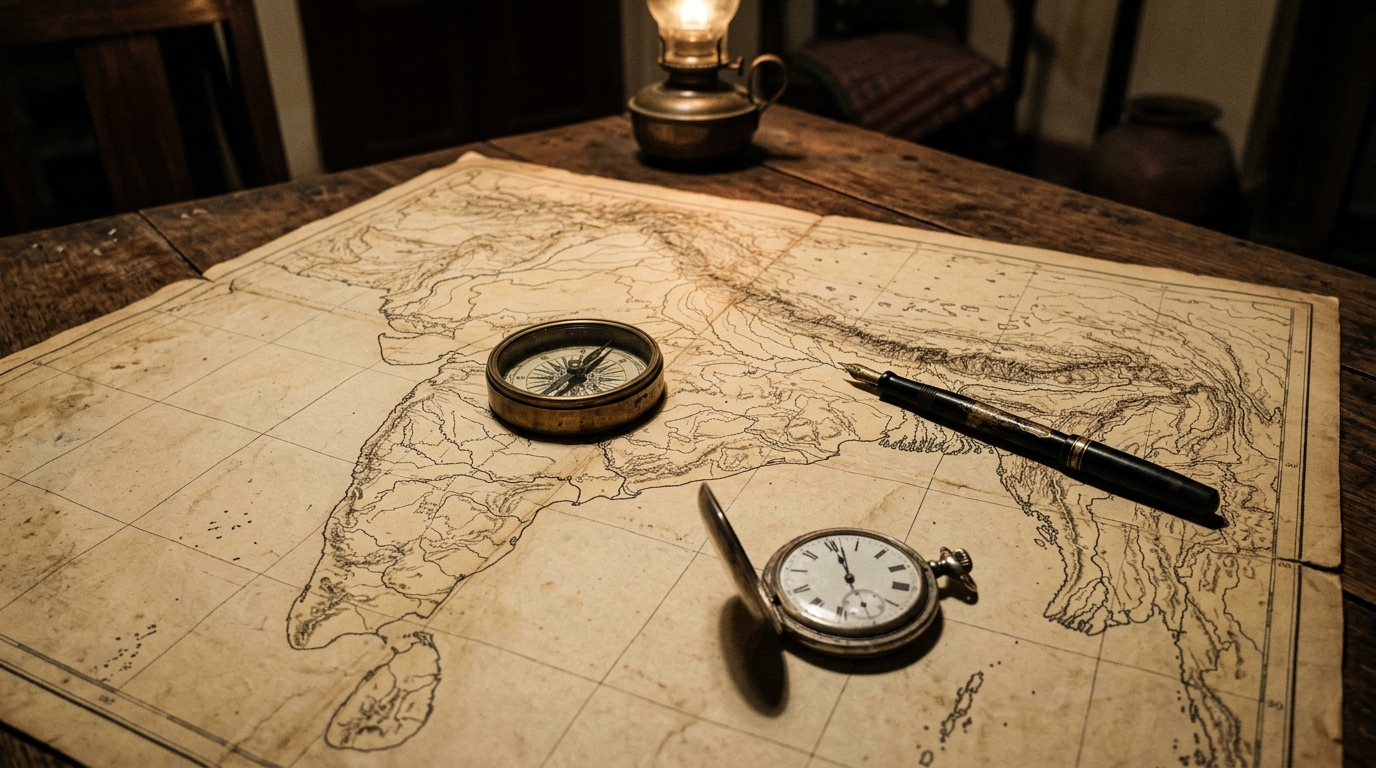
Sir Cyril Radcliffe sat in a sweltering Delhi bungalow in early August 1947, staring at outdated maps of Punjab and Bengal. He had never visited India before, yet he had just weeks to draw a border that would divide millions of people. This single impossible task defined the tension of the entire month.
Building an accurate August 1947 Indian history timeline requires looking past the midnight speeches and celebratory photographs. The reality of those 31 days involved frantic negotiations, legislative scrambling, and a massive administrative overhaul. At India On This Day, we spend our time combing through primary sources from the National Archives to piece together exactly how these events unfolded. Understanding this month day-by-day reveals the sheer logistical weight of building a new nation overnight. The transition required dividing everything from military regiments to library books.
What set the stage for August 1947?
The rushed timeline for independence began with the Mountbatten Plan on June 3, 1947. British Parliament originally targeted June 1948 for the transfer of power. Escalating communal violence forced Lord Mountbatten to abruptly advance the date to August 15, leaving just 73 days for the transition.
The Mountbatten Plan's tight deadline
British Prime Minister Clement Attlee originally promised independence by June 1948. This allowed a full year for a peaceful transition of power. Lord Louis Mountbatten arrived in India as the last Viceroy in March 1947 to execute this plan.
He quickly realized the political situation was deteriorating faster than London understood. Communal riots were spreading across the subcontinent. To force the Indian National Congress and the Muslim League to an agreement, Mountbatten drastically moved the deadline forward. He chose August 15 because it marked the second anniversary of Japan's surrender in World War II, a date he considered personally lucky.
This arbitrary decision set the clock ticking. It forced administrators to compress a year of complex state-building into a few chaotic weeks. The foundation of any August 1947 Indian history timeline rests on this single, hurried decision.
The formation of the Boundary Commissions
Once partition became inevitable, the physical lines had to be drawn. The British government established two Boundary Commissions in late June 1947. One focused on dividing Punjab in the west. The other focused on dividing Bengal in the east.
Each commission included four judges: two chosen by the Indian National Congress and two chosen by the Muslim League. They immediately deadlocked on almost every territorial claim. This left the final decisions entirely in the hands of the chairman, Sir Cyril Radcliffe. He arrived in India on July 8 with a mandate to finish the borders before the August 15 deadline. The political leaders agreed in advance to accept his final lines, sight unseen.
Early August: The Final Legislative Preparations
The first two weeks of August focused entirely on administrative survival. British officials packed up decades of files while Indian leaders worked desperately to secure the accession of over 500 princely states. Every government asset, from railway carriages to state funds, required formal division.
The scramble for princely state accession
The Indian Independence Act technically released the 565 princely states from British paramountcy. This meant each state became legally independent on August 15. They had the option to join India, join Pakistan, or attempt to remain independent.
Sardar Vallabhbhai Patel and his chief civil servant, V.P. Menon, spent early August working the phones and holding endless meetings. They used a mix of diplomacy, persuasion, and implicit threats to convince the princes to sign the Instrument of Accession.
Most rulers realized they could not survive geographically isolated within the new nation. By August 15, almost all states within India's new borders had signed. Only three major holdouts remained: Kashmir, Junagadh, and Hyderabad.
Dividing the military and state assets
Partition required splitting the entire apparatus of the British Indian Empire. The Armed Forces Reconstitution Committee worked through early August to divide regiments, ships, and equipment.
The division ratio was roughly two-thirds to India and one-third to Pakistan. This split applied to everything. Administrators counted chairs, typewriters, and police uniforms. They even divided the books in the Imperial Library.
You can trace the long-term impact of these early financial splits in our guide to Economic Milestones in Indian History: From 1947 to Present. The disputes over the transfer of cash balances and military stores continued long after the August deadline passed.
| Asset Type | India's Share | Pakistan's Share |
|---|---|---|
| Army Regiments | 64% | 36% |
| Cash Balances | 82.5% | 17.5% |
| Railway Mileage | 83% | 17% |
How did the partition lines actually get drawn?
Cyril Radcliffe chaired two Boundary Commissions tasked with dividing Punjab and Bengal. Working with outdated census data from 1941, he finalized the borders by August 12. Mountbatten deliberately withheld the publication of these lines until after independence to avoid marring the celebrations with violence.
Radcliffe's arrival and impossible task
Radcliffe was a brilliant legal mind but knew nothing about Indian geography or demographics. The British government considered this ignorance an asset. They believed it made him impartial.
He worked from a bungalow in Delhi, relying on maps and the 1941 census. The census data was already six years out of date and notoriously inaccurate. He had to draw lines through contiguous villages, separating farmers from their fields and communities from their water sources.
He completed his work on August 9 for Bengal and August 12 for Punjab. He submitted the final reports to Mountbatten, packed his bags, and left India shortly after. He never returned.
The delay in publishing the borders
Mountbatten received the final boundary awards just days before independence. He made a highly controversial decision to lock them in his safe.
He knew the lines would spark immediate outrage and likely violence from both sides. He did not want British troops managing riots on the day they formally handed over power. He also wanted the new independent governments of India and Pakistan to bear the responsibility for maintaining order when the lines went public.
This delay meant that on August 15, millions of people in Punjab and Bengal celebrated independence without knowing which country they actually lived in. For a deeper look at how specific regions navigated historical transitions, see our timeline of the Portuguese Era in Goa: Key Dates and Architectural Milestones.
Mid-August: The Midnight Hour and Transfer of Power
The actual transfer of power occurred over two days. Pakistan held its ceremonies on August 14 in Karachi to allow Lord Mountbatten to attend. India celebrated its independence at midnight on August 15 in New Delhi, marked by Jawaharlal Nehru's famous "Tryst with Destiny" speech.
August 14: Pakistan's creation
Mountbatten flew to Karachi on August 13. The next morning, he addressed the Constituent Assembly of Pakistan. He formally transferred power to Muhammad Ali Jinnah, who became the first Governor-General of the new nation.
The ceremonies were formal and brief. Mountbatten had to fly back to New Delhi that same afternoon to prepare for India's midnight ceremony. Because the Indian Independence Act specified August 15 as the date of independence for both dominions, Pakistan officially came into existence at the same midnight hour as India.
August 15: India awakens to life and freedom
New Delhi buzzed with anticipation on the night of August 14. Crowds gathered outside the Council House (now the Parliament building) despite heavy monsoon rain.
Inside, the Constituent Assembly convened at 11:00 PM. Jawaharlal Nehru delivered his iconic speech just before midnight. He spoke of India waking to life and freedom while the world slept. At the stroke of midnight, India officially became an independent dominion.
The next morning, August 15, Mountbatten was sworn in as the first Governor-General of independent India. Nehru was sworn in as the first Prime Minister. The day featured flag-hoisting ceremonies, parades, and massive public celebrations across the country.
These events form the core of the August 1947 Indian history timeline. They are among the 10 Most Searched Dates in Indian History and Why They Matter.
A Timeline of Key Mid-August Events
- August 11: Jinnah delivers his first presidential address to the Constituent Assembly of Pakistan.
- August 12: Radcliffe finalizes the Punjab boundary award.
- August 14: Mountbatten transfers power in Karachi.
- August 15: India achieves independence at midnight.
- August 17: The Radcliffe Line is officially published.
What happened in the immediate aftermath?
The euphoria of August 15 gave way to immediate crisis on August 17 when the Radcliffe Line was finally published. Millions of people suddenly found themselves on the wrong side of the border. This triggered one of the largest and deadliest mass migrations in human history.
The Radcliffe Line publication on August 17
When the border details hit the newspapers and radio broadcasts on August 17, panic set in. Entire districts that expected to be in India found themselves in Pakistan, and vice versa.
The city of Lahore went to Pakistan, devastating its large Hindu and Sikh populations. Major parts of the Gurdaspur district went to India, angering the Muslim League. The abstract lines drawn on a map in Delhi suddenly became a violent reality on the ground.
Local police forces, themselves divided by the partition, largely collapsed. The Punjab Boundary Force, a joint military unit set up to maintain peace, proved entirely inadequate to stop the ensuing violence.
Mass migration and the refugee crisis
People grabbed whatever they could carry and fled toward the new borders. Hindus and Sikhs moved east toward India. Muslims moved west toward Pakistan.
They traveled by train, by bullock cart, and in massive foot caravans that stretched for miles. These columns were frequently attacked. Trains arrived at stations on both sides of the border filled with dead bodies. The death toll from the partition violence remains disputed, but historians estimate between one and two million people died.
During this time, Mahatma Gandhi was not in Delhi celebrating. He was in Calcutta, fasting and walking through riot-torn neighborhoods to stop the communal violence. His efforts in Bengal were largely successful, earning him the title of the "one-man boundary force." You can trace his broader strategies in our Timeline of Mahatma Gandhi's Nonviolent Movements in India.
Late August: Establishing the New Republic's Foundations
The final weeks of August forced the new Indian government to simultaneously manage a refugee crisis and build a constitutional framework. The Constituent Assembly quickly established a Drafting Committee on August 29 to begin writing the formal Constitution of India.
Appointing the first cabinet
Nehru's first cabinet had to hit the ground running. The government faced an unprecedented humanitarian disaster in Punjab.
Sardar Patel took charge of the Home Ministry and the Ministry of Information and Broadcasting. He focused on restoring law and order in Delhi, which was rapidly filling with traumatized refugees. The government set up massive relief camps, requisitioned food supplies, and tried to establish secure transit routes for those still trying to cross the border.
The administrative machinery was severely strained. Many experienced British officers had left, and the remaining Indian officers were stretched to their limits.
Forming the Drafting Committee
Despite the chaos, the political leadership knew they had to secure the nation's legal future. India was currently operating as a dominion under the modified Government of India Act of 1935.
On August 29, the Constituent Assembly took a massive step forward. They passed a resolution appointing a Drafting Committee to scrutinize the draft constitution and prepare a final version.
They elected Dr. B.R. Ambedkar as the chairman of this committee. His legal expertise and deep understanding of social inequalities made him the ideal architect for the new republic's foundational document. You can explore his full journey in Dr. B.R. Ambedkar's Life: A Chronological Timeline of Legacy.
This committee's formation marks the final major milestone in the August 1947 Indian history timeline. The month began with the dismantling of an empire and ended with the first blueprints of a modern democratic republic.
Related Reading
- Economic Milestones in Indian History: From 1947 to Present
- Indian History Timeline Chart: Key Milestones (Digital Reference)
- Indian History Milestones: The Maurya and Gupta Empires
- Milestones in Indian Women's History: A Chronological Guide
FAQ
Q: Why was August 15 chosen for India's independence? Lord Mountbatten abruptly chose August 15 because it marked the second anniversary of Japan's surrender to Allied forces in World War II. He considered the date a personal lucky anniversary from his time as Supreme Allied Commander in South East Asia.
Q: When was the border between India and Pakistan actually announced? The official borders, known as the Radcliffe Line, were published on August 17, 1947. Mountbatten deliberately delayed the announcement until two days after independence to avoid disrupting the handover ceremonies with anticipated border violence.
Q: What happened to the princely states during August 1947? Over 500 princely states had to sign an Instrument of Accession to join either India or Pakistan before August 15. Sardar Patel successfully negotiated the accession of almost all states within Indian territory, with the notable exceptions of Kashmir, Junagadh, and Hyderabad.
Q: Where was Mahatma Gandhi on August 15, 1947? Gandhi boycotted the independence celebrations in New Delhi. He spent August 15 in Calcutta (now Kolkata), fasting and praying in an effort to stop the intense communal riots tearing through Bengal.
Further reading
- "Freedom at Midnight" by Larry Collins and Dominique Lapierre: A highly readable, detailed narrative of the final year of British rule and the personalities driving the transition.
- "The Great Partition" by Yasmin Khan: A critical historical look at the human cost of the partition and the chaotic execution of the border division.
- National Archives of India (Digital Collections): Explore digitized primary source documents, including original drafts of the Indian Independence Act and Constituent Assembly debates.
- The Partition Museum, Amritsar: A suggested physical and digital resource dedicated entirely to the memory, art, and oral histories of the 1947 partition survivors.