Ancient India's Global Influence: Key Dates in Intellectual Exports

In Short
Ancient Indian intellectual history shaped global mathematics, astronomy, and medicine through distinct translation movements between 400 CE and 1200 CE. Key texts like the Surya Siddhanta and Sushruta Samhita traveled along trade routes to the Middle East and China, establishing foundational concepts like the zero worldwide.
Key Takeaways
- The numeral zero transformed global mathematics after reaching Baghdad in 773 CE.
- Buddhist monks carried Indian philosophical texts to China starting in the 1st century CE.
- Arabic scholars translated core Sanskrit medical treatises during the 8th-century Abbasid Caliphate.
- Maritime trade routes facilitated the export of Indian astronomical models to Southeast Asia.
In 773 CE, a single astronomical text carried by an Indian scholar to Baghdad triggered a translation movement that replaced Roman numerals across Europe within 400 years. The scholar, known in Arabic records as Kanaka, presented the Brahmasphutasiddhanta to Caliph al-Mansur. This event sparked a massive effort to translate Sanskrit texts into Arabic. The resulting knowledge transfer reshaped the medieval world.
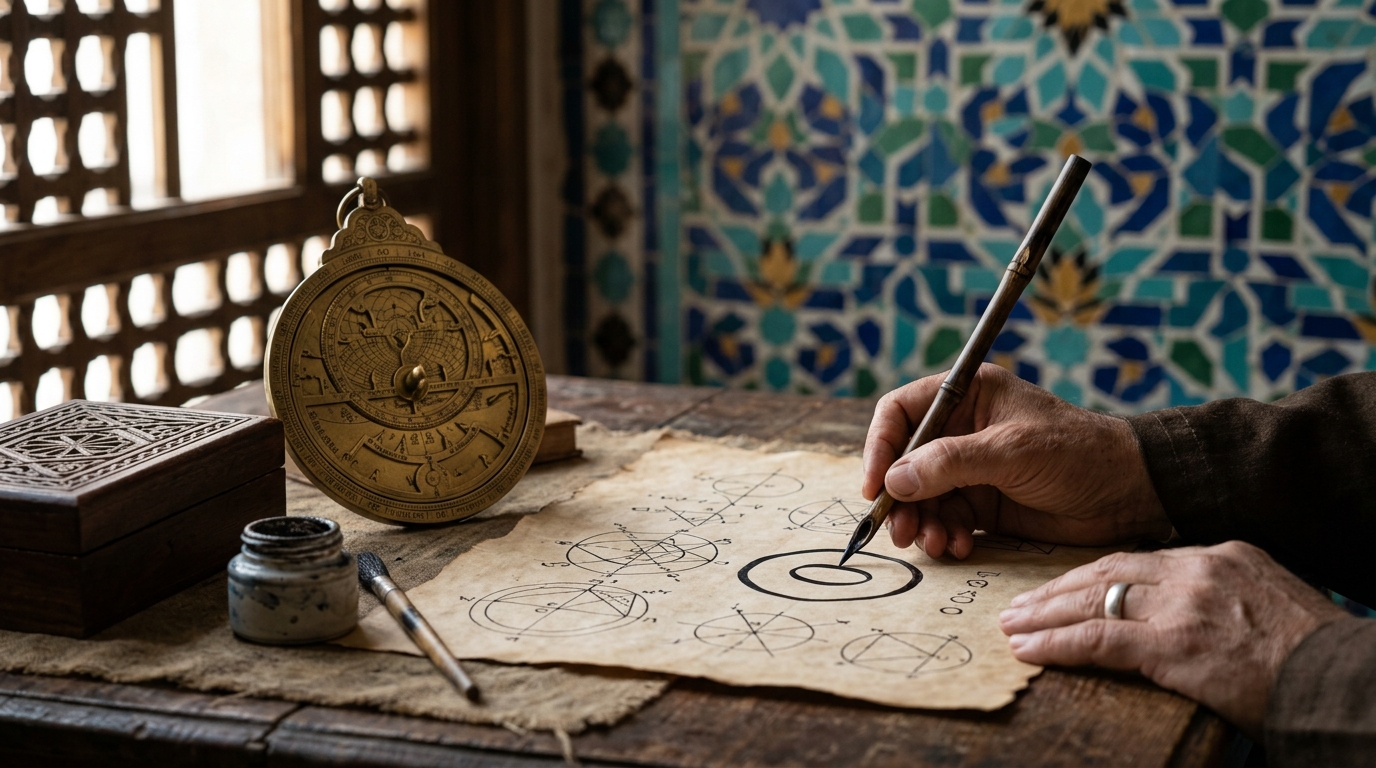
Understanding ancient Indian intellectual history requires looking beyond the subcontinent. Ideas rarely stay in one place. They travel with merchants, diplomats, and monks. When a concept solves a real problem, other cultures adopt it quickly. Indian scholars developed highly practical systems for calculating planetary positions, treating complex diseases, and organizing societal logic.
These practical solutions made Indian knowledge a valuable export. The resulting exchange created a foundation for the scientific revolution centuries later. By tracking specific dates and texts, we can map exactly how Indian ideas moved across the globe.
What Are the Core Eras of Ancient Indian Intellectual History?
The timeline of ancient Indian intellectual history spans three major phases. The Vedic period (1500–500 BCE) established foundational philosophy. The Classical era (320–550 CE) produced major mathematical and astronomical breakthroughs. The Translation movement (700–1200 CE) exported this knowledge across Asia and the Middle East.
The Vedic Foundations (1500–500 BCE)
The earliest phase of intellectual development in India centered on oral traditions. Scholars composed the Vedas and Upanishads during this period. These texts focused heavily on philosophy, ritual, and early linguistics. The need for precise timing in rituals drove early astronomical observations. Priests had to know the exact position of the moon and stars to perform ceremonies correctly.

This period also saw the development of early geometry. The Shulba Sutras, composed around 800 BCE, contain rules for constructing fire altars. These rules include early statements of the Pythagorean theorem. They show a practical application of mathematics long before formal proofs became common. The focus was on utility. If a geometric rule produced the correct altar shape, scholars recorded it and passed it down.
The Gupta Empire's Golden Age (320–550 CE)
The Gupta period marks a massive shift toward systematic scientific writing. Scholars began to record complex theories in written Sanskrit. The establishment of major learning centers, like Nalanda University, allowed scholars to collaborate. This era produced some of the most influential minds in Indian history.
In 499 CE, a 23-year-old mathematician named Aryabhata completed the Aryabhatiya. This text introduced the concept of the Earth rotating on its axis. It also provided highly accurate approximations of pi and the solar year. Aryabhata's work separated astronomy from ritual. He treated it as a pure mathematical science. This shift in thinking set the stage for later exports. When foreign scholars encountered these texts, they found rigorous, mathematically sound models that they could immediately apply to their own scientific work.
The Era of Global Transmission (700–1200 CE)
The third phase involves the active export of Indian knowledge. The rise of the Abbasid Caliphate in the Middle East created a massive demand for scientific texts. Baghdad became a center of global translation. Caliphs funded scholars to find and translate Greek, Persian, and Indian manuscripts.
Indian mathematics and medicine were highly prized. Scholars at the House of Wisdom worked directly with Indian experts to translate complex Sanskrit terminology into Arabic. This period transformed regional Indian discoveries into a global scientific baseline. You can explore more about these specific eras in our guide to the 10 Most Searched Dates in Indian History and Why They Matter.
How Did Indian Mathematics Reach the Middle East and Europe?
Indian mathematical concepts traveled through diplomatic missions and trade networks. Arabic scholars translated Sanskrit texts into Arabic during the 8th century. European mathematicians later encountered these Arabic translations in the 12th century, adopting the Hindu-Arabic numeral system that replaced Roman numerals across the continent.
The Journey of the Zero (773 CE)
The concept of zero as a placeholder and a number originated in India. Brahmagupta defined the mathematical rules for zero in 628 CE. He explained how to add, subtract, and multiply with it. This was a radical departure from earlier numerical systems. Roman numerals lacked a zero, making complex calculations incredibly difficult.
When Kanaka brought Brahmagupta's work to Baghdad in 773 CE, Islamic scholars recognized its value immediately. The Caliph ordered the text translated into Arabic. This translation became known as the Zij al-Sindhind. It introduced the base-10 positional numeral system to the Islamic world. Merchants quickly adopted the system. It made accounting and trade calculations much faster and less prone to error.
The Role of Al-Khwarizmi (825 CE)
The Persian mathematician Al-Khwarizmi played a crucial role in spreading Indian numerals. Around 825 CE, he wrote a book titled On the Calculation with Hindu Numerals. This text explained the Indian base-10 system in clear, practical terms. He showed how to use the nine digits and the zero to represent any number.
Al-Khwarizmi's work became the standard mathematical textbook in the Islamic world. His writings standardized the shape of the numerals. As Arabic trade networks expanded, so did the use of these numbers. They moved across North Africa and into Islamic Spain. The numerals became the default system for scientific and commercial calculations throughout the region.
Fibonacci's European Introduction (1202 CE)
Europeans learned about Indian numerals through trade with North Africa. A young Italian merchant named Leonardo of Pisa, later known as Fibonacci, studied mathematics in Algeria. He realized the Hindu-Arabic system was vastly superior to Roman numerals.
In 1202 CE, Fibonacci published Liber Abaci (The Book of Calculation). This book introduced the Indian number system to Europe. He explained how to use the numerals for practical business applications, like converting currencies and calculating profit margins. European merchants slowly adopted the system. By the 15th century, the Indian numeral system had completely replaced Roman numerals in European mathematics, laying the groundwork for the modern scientific era.
When Did Indian Medical Knowledge Cross Borders?
Indian medical knowledge first crossed borders during the 8th century CE under the patronage of the Barmakid family in Baghdad. Translators converted the Sushruta Samhita and Charaka Samhita into Arabic, making ancient Indian surgical techniques and pharmacology available to hospitals across the Islamic world.
The Translation of the Charaka Samhita
The Charaka Samhita is one of the foundational texts of Ayurveda. Compiled around the 2nd century CE, it focuses on internal medicine, disease prevention, and medical ethics. The text categorizes diseases and prescribes specific herbal treatments.
During the reign of Caliph Harun al-Rashid (786–809 CE), the Barmakid viziers directed the translation of Indian medical texts. They invited Indian physicians to Baghdad to manage hospitals and translate texts. The Charaka Samhita was translated first into Persian and then into Arabic. Arabic physicians used it as a primary reference for pharmacology. The text introduced hundreds of new medicinal plants to the Middle Eastern pharmacopeia.
Surgical Exports from the Sushruta Samhita
The Sushruta Samhita, dating back to the 6th century BCE, is a pioneering text on surgery. It details over 300 surgical procedures and 120 surgical instruments. The text includes precise instructions for reconstructive surgery, particularly rhinoplasty (nose reconstruction).
When Arabic scholars translated the Sushruta Samhita in the 8th century, it revolutionized surgical practice in the Islamic world. Prominent physicians like Al-Razi (Rhazes) cited Indian surgical techniques in their own medical encyclopedias. These Arabic texts eventually reached Europe during the Renaissance. The Indian methods for reconstructive surgery heavily influenced early modern European surgeons. For a deeper dive into this timeline, see our 1,000 Years of Indian Medical History: A Chronological Guide.
Why Did Indian Philosophical Concepts Influence Asian Cultures?
Indian philosophy influenced Asian cultures because Buddhist monks actively carried texts along the Silk Road. Rulers in China, Japan, and Southeast Asia adopted these frameworks to organize their societies. The translation of Sanskrit sutras into local languages integrated Indian logic and ethics into regional governance.
The Silk Road Transmission (1st Century CE)
The transmission of Indian philosophy to East Asia began in the 1st century CE. Buddhist monks traveled with merchant caravans along the Silk Road. They carried physical manuscripts and oral traditions. The Han Dynasty in China showed early interest in these texts.
In 401 CE, a scholar named Kumarajiva arrived in China. He led a massive translation bureau, converting core Sanskrit Buddhist texts into Chinese. Kumarajiva focused on conveying the philosophical meaning rather than strict literal translation. His work introduced Indian concepts of logic, metaphysics, and ethics to the Chinese intellectual class. These ideas blended with native Daoist and Confucian thought, creating new philosophical schools that spread to Korea and Japan.
The Spread to Southeast Asia (400–800 CE)
Indian intellectual influence reached Southeast Asia through maritime trade routes. Between 400 and 800 CE, kingdoms in modern-day Indonesia, Cambodia, and Thailand adopted Indian administrative and religious frameworks. They did not do this through conquest. They voluntarily imported Indian scholars to help organize their expanding states.
Sanskrit became the language of courts and administration in empires like Srivijaya. Rulers adopted Indian concepts of kingship and statecraft from texts like the Arthashastra. The architectural layout of massive temple complexes, such as Angkor Wat, followed precise geometric rules laid out in Indian Vastu Shastra manuals. This peaceful export of ideas created a shared cultural and intellectual zone across South and Southeast Asia.
How Do We Track the Spread of Ancient Indian Intellectual History Today?
Historians track ancient Indian intellectual history today by cross-referencing surviving manuscripts, translation records, and architectural alignments. Modern scholars use digital archives and entity definition tools like Wikification to map how specific Indian scholars and texts influenced global scientific developments across centuries.
Analyzing Surviving Manuscripts
Tracking the movement of ancient ideas requires physical evidence. Historians rely heavily on surviving manuscripts. Because palm leaves and birch bark decay quickly in India's climate, many original Sanskrit texts are lost. However, scholars often find the oldest surviving copies of Indian texts in dry climates like Tibet or preserved in library archives in the Middle East.
By comparing an Arabic translation from the 9th century with a Sanskrit manuscript from the 12th century, linguists can reconstruct the original text. They look for specific loan words. If a Persian astronomical table uses a term derived from Sanskrit, it proves a direct intellectual link. Modern digital archives have accelerated this process, allowing researchers to compare high-resolution scans of manuscripts from different continents instantly.
Mapping Trade Route Evidence
Beyond texts, historians look at physical artifacts and architectural data. The spread of Indian board games, like chess (Chaturanga), provides a clear map of cultural export. Chess moved from India to Persia in the 6th century, then to the Islamic world, and finally to Europe.
Educators and digital historians now use advanced tools to map these connections. By explicitly defining historical figures as entities using Wikification (linking to Wikipedia or adding sameAs properties in schema markup), researchers help search engines understand the exact relationships between an Indian astronomer and an Arabic translator. Additionally, historical sites thrive on imagery. Adding relevant photos of manuscripts or trade routes with descriptive alt text helps visualize these complex historical networks. You can see similar mapping approaches in our ancient Indian astronomy timelines.
Timeline of Key Intellectual Exports
| Year / Period | Indian Text or Concept | Export Destination | Global Impact |
|---|---|---|---|
| 1st Century CE | Early Buddhist Sutras | China (via Silk Road) | Introduced Indian logic and metaphysics to East Asia. |
| 6th Century CE | Chaturanga (Chess) | Sassanid Persia | Became the foundation for modern global chess. |
| 773 CE | Brahmasphutasiddhanta | Baghdad (Abbasid Caliphate) | Introduced the numeral zero and base-10 system to the Middle East. |
| 8th Century CE | Sushruta Samhita | Baghdad | Provided advanced surgical techniques to Islamic hospitals. |
| 8th Century CE | Charaka Samhita | Baghdad | Expanded the Middle Eastern pharmacological database. |
| 1202 CE | Hindu-Arabic Numerals | Europe (via Fibonacci) | Replaced Roman numerals, enabling modern European mathematics. |
Related Reading
- Milestones in Indian Women's History: A Chronological Guide
- 1,000 Years of Indian Medical History: A Chronological Guide
- Economic Milestones in Indian History: From 1947 to Present
- What Are the Major Events in Indian History? (FAQ Archive)
FAQ
Q: When did the Indian numeral system reach Europe? The Indian numeral system officially reached Europe in 1202 CE. Leonardo of Pisa, known as Fibonacci, introduced the system through his book Liber Abaci. The system slowly replaced Roman numerals over the next few centuries.
Q: Who was the most influential ancient Indian mathematician? Aryabhata and Brahmagupta are widely considered the most influential. Aryabhata introduced crucial astronomical models in 499 CE. Brahmagupta formalized the mathematical rules for zero in 628 CE.
Q: How did ancient Indian texts survive translation? Scholars translated them systematically at centers like the House of Wisdom in Baghdad. Translators often worked in pairs, with an Indian scholar explaining the Sanskrit and an Arabic scholar writing the translation. This collaborative method ensured technical accuracy.
Q: Did ancient India export medical knowledge? Yes. Arabic caliphs actively sought out Indian medical texts in the 8th century. They translated major works on internal medicine and surgery, which later influenced both Middle Eastern and European medical practices.
Review the specific dates of these historical exports to understand the timeline of global scientific progress. Cross-reference the texts mentioned above with modern historical databases to see how these ancient ideas still underpin the mathematics and medicine you use today.