Ancient Indian Numismatics Coins: From Punch-Marks to Gupta Gold
TL;DR
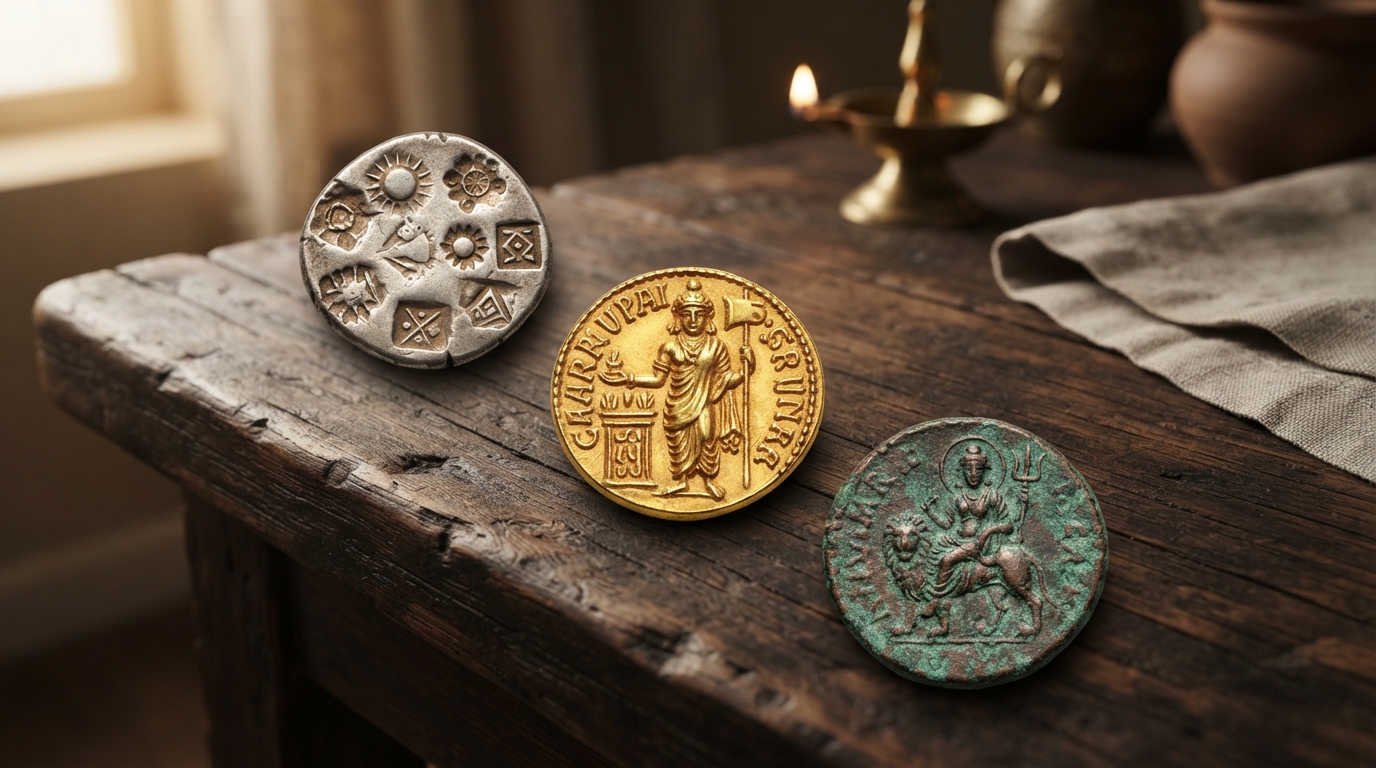
Ancient Indian numismatics is the study of coins from the Indian subcontinent, starting with silver punch-marked pieces from around the 6th century BCE. Indo-Greek, Kushan and Gupta rulers later issued coins carrying portraits, scripts and gods. These coins help historians date kings, map trade routes and track religious change across more than a thousand years.
Finds and new methods keep revising that picture. The Bayana Hoard of 1946 held about 2,000 Gupta gold coins, according to A. S. Altekar's count. A 2024 Scientific Reports (Nature) paper used XRD and XPS lab methods to study punch-marked silver.
Key Takeaways
- Coins often fill gaps where written records about ancient Indian kings are missing.
- Punch-marked silver coins from about the 6th century BCE are India's earliest documented coinage.
- Indo-Greek and Kushan coins mixed Greek, Indian and Iranian scripts, kings and gods.
- Gupta gold coins show kings hunting, playing music and performing horse sacrifices.
- Lab analysis and online coin databases are now reshaping long-settled numismatic questions.
In 1946, three boys in Rajasthan followed a hunting party of the Maharaja of Bharatpur near Bayana. They came home with a buried hoard of Gupta gold. CoinWeek (2022) puts the count at about 2,100 coins. A.S. Altekar's catalogue gives roughly 2,000 and calls it the largest coin hoard ever found in India. That one find gave scholars dozens of new coin types and dated reigns that texts barely mention. This is why ancient Indian numismatics coins matter to students and teachers. Coins are small, hard and often precisely made, and they outlast palaces. The sections below follow the main coin series in order. Each one notes what a coin can prove and what it can't.
Ancient Indian Numismatics Coins Begin With Punch-Marked Silver
Punch-marked coins are India's first documented coins: cut pieces of silver stamped with symbols, dated by the RBI Currency Museum to about the 7th to 6th century BCE. Punch-marked coins carry no king's name and no writing. Instead, each piece bears stamped symbols such as suns, animals and hills.
Punch-marked silver coins circulated across the early kingdoms of north India. Because the coins lack names or inscriptions, historians cannot assign them to individual rulers the way they can with later Indo-Greek or Gupta issues. The symbols, the weight of each piece and the places where hoards turn up become the main evidence instead. For that reason, the study of ancient Indian numismatics coins begins with careful attention to metal, weight and findspot rather than written legends. The RBI Currency Museum's dating gives students and teachers a fixed starting point for any timeline of Indian money.
Why the Indus seals don't count as coins
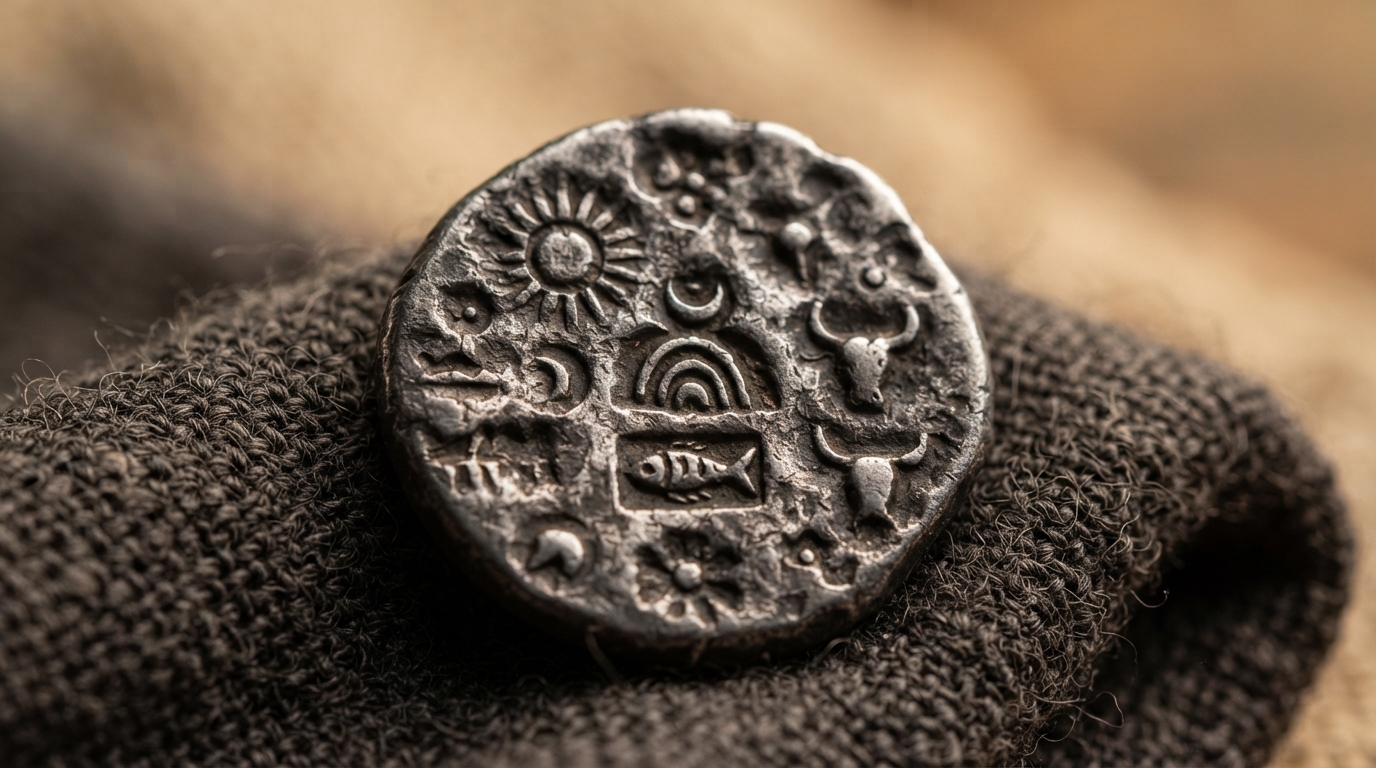
Many school timelines start Indian money with the Indus Valley. That's misleading. The Harappan seals from Mohenjo-daro and Harappa carry animals and an undeciphered script. The RBI notes that whether the seals served as money is disputed. Most scholars treat the Harappan seals as trade or identity seals, not currency.
So a careful timeline starts with punch-marked coins. If you're building a lesson plan, place the Indus seals in a separate "pre-coinage" box. That one choice prevents a common exam error.
How punch-marked coins were made
The process was simple and repeatable:
- A silver sheet or bar was cut into pieces of a set weight.
- Each piece was trimmed to adjust the weight.
- Officials or merchants struck symbols onto the piece with separate punches.
- Later users sometimes added their own small marks.
The weight standard mattered more than the shape. Coins of this kind are often called karshapanas in old texts. Their shapes range from rough rectangles to near-circles. Under the Mauryas, the symbol sets became more uniform. For the political backdrop, see our guide to the Maurya and Gupta empires.
What the Bhir Mound hoard tells us
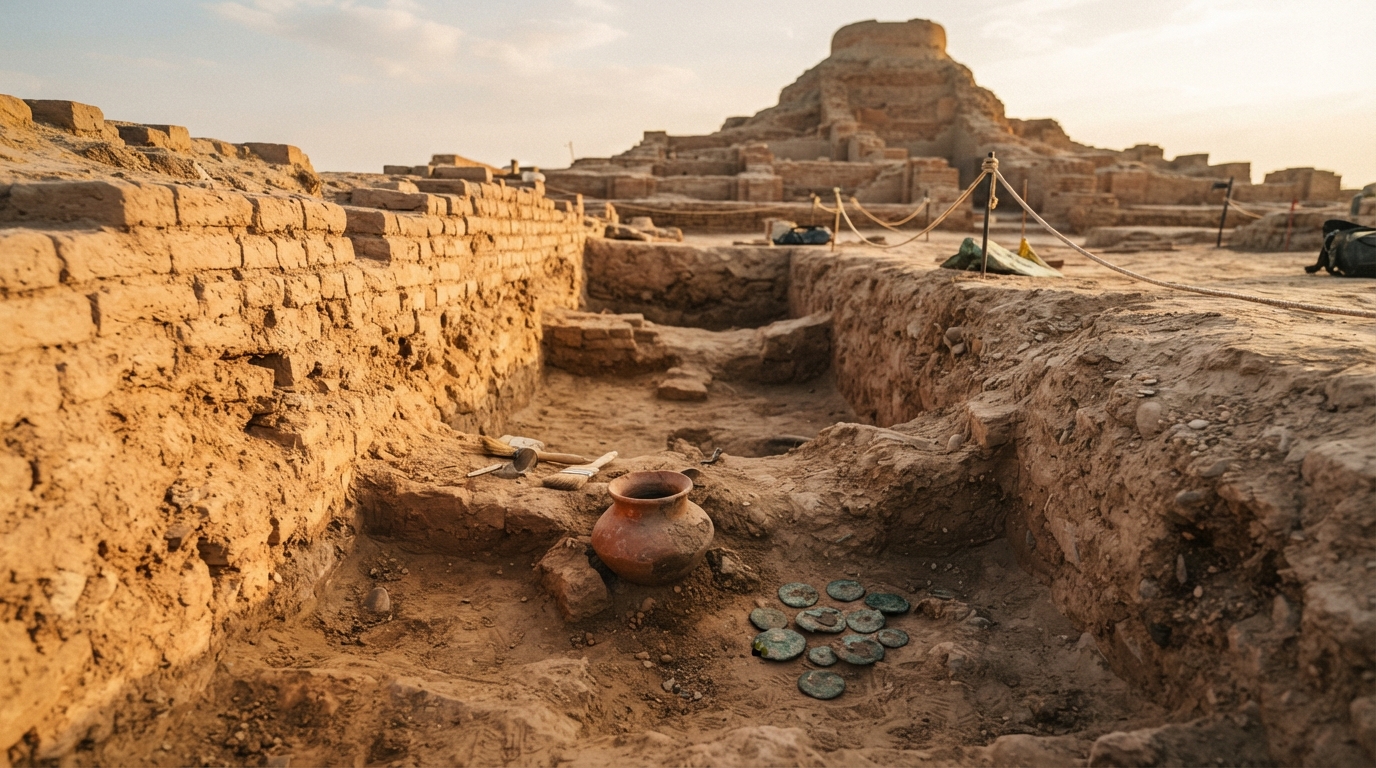
A single hoard can date a whole coin series. In 1924, excavators at the Bhir Mound in Taxila found 1,055 worn punch-marked coins. Two mint-condition coins of Alexander the Great lay alongside them (Indian Coins and History site). The worn punch-marked coins had clearly circulated for a long time before Alexander's era. The fresh Greek coins helped anchor the date of burial to the late 4th century BCE.
The Bhir Mound find shows the core logic of numismatics. Wear tells you age. Datable foreign coins tell you when the hoard closed.
Foreign Rulers Brought Faces and Scripts to Indian Coins
Indo-Greek and Kushan rulers changed Indian coin design between about the 2nd century BCE and the 3rd century CE. They added royal portraits, written names and gods on the reverse. Their coins often carry two scripts. That bilingual design is how scholars first read Kharoshthi, an ancient script of the northwest.
Indo-Greek bilingual coins
Indo-Greek kings ruled parts of present-day Afghanistan, Pakistan and northwest India. Their silver coins usually show the king's portrait with a Greek legend on the front. The back repeats the title in Prakrit, written in Kharoshthi. Menander, remembered in Buddhist texts as Milinda, issued large numbers of these.
For dozens of Indo-Greek kings, coins are almost the only evidence. A ruler with no surviving inscription may still be known from his coin legends. That makes typology, the sorting of coins into types, central to this period.
Kushan gold and its many gods
The Kushans brought gold into regular Indian coinage. Vima Kadphises issued gold double dinars. Kanishka and his successors filled their reverses with deities from several traditions. CoinWeek (2022) lists Ardoksho, Oesho and Nana among the figures. Others include Greek, Iranian and Buddhist figures, including rare Buddha images.
For a classroom, Kushan coins are a ready-made lesson on religious diversity. One ruler might honour a Zoroastrian deity on one issue and a Shiva-like Oesho on another. The coins show a court addressing many communities at once.
New finds keep surfacing. In January 2024, a pot of Kushan copper coins about 2,000 years old was found near the Buddhist stupa at Mohenjo-daro (The Friday Times, 2024).
What these coins sell for today
Rare pieces fetch high prices. A Kushan gold dinar showing Nana seated on a lion sold for $55,000 (CoinWeek, 2022). A Vima Kadphises gold double dinar sold for £13,000 at Spink in December 2021.
Those numbers draw forgers. Price is a warning sign for buyers, not a guide to authenticity. Common Kushan copper coins, by contrast, remain affordable for students who want a real object to hold.
| Coin series | Approx. period | Main metal | Script(s) | Key feature |
|---|---|---|---|---|
| Punch-marked | c. 6th–2nd century BCE | Silver | None | Stamped symbols, no ruler named |
| Indo-Greek | c. 2nd–1st century BCE | Silver, copper | Greek, Kharoshthi | Realistic royal portraits |
| Kushan | c. 1st–3rd century CE | Gold, copper | Greek-derived Bactrian, Kharoshthi | Many deities from many faiths |
| Gupta | c. 4th–6th century CE | Gold, silver | Brahmi | Kings in action scenes, Sanskrit verse |
Gupta Gold Coins Show Kings at Their Most Ambitious
Gupta gold coins, called dinaras, are gold coins issued by Gupta kings from about the 4th to 6th century CE. Gupta dinaras show kings as archers, hunters, musicians and sponsors of horse sacrifices, with Sanskrit legends in Brahmi script. The dinaras act as royal propaganda and help historians rebuild Gupta succession and ideology.
Samudragupta's coin types
Samudragupta issued several famous types. The Archer type shows Samudragupta holding a bow. The Ashvamedha type shows a sacrificial horse, linked to his claim of imperial power. A Lyrist type shows Samudragupta playing a stringed instrument.
Samudragupta's Tiger-Slayer dinara is among the rarest. Only about 17 examples are known, and most sit in museums (CoinWeek, 2022). Each Samudragupta type promotes a different virtue. Military skill, ritual authority and culture all appear in gold.
Chandragupta II and Kumaragupta I
Chandragupta II added the Lion-Slayer type. The lion on the Lion-Slayer type likely points to his campaigns in western India, a region known for lions. Kumaragupta I pushed variety further. Kumaragupta I issued 14 distinct gold coin types, more than any other Gupta ruler, according to the Indian Coins and History site. That count of 14 types should be checked against scholarly catalogues before you cite it in formal work.
A practical point for learners: start with the Archer type. The Archer type is the most common Gupta design. Once you know the Archer type well, you'll spot variations in other types quickly.
The Bayana Hoard
The Bayana Hoard is a 1946 find of about 2,000 Gupta gold coins, by A. S. Altekar's count (IndianCulture.gov.in / Numismatic Society of India), and it remains the reference point for Gupta gold. The Bayana Hoard covered many Gupta rulers and many coin types in one find. Altekar's published catalogue turned the hoard into a teaching collection for generations of scholars.
Big hoards like Bayana matter because sample size matters. Ten coins can mislead. Two thousand coins let you count die links, track weight changes and see which types were common.
Coins Have Rewritten Chapters of Indian History
Coins are evidence, and evidence can overturn assumptions. Researchers have used coin weight, design and legends to reassign mystery kings, map Roman trade in South India and find new mint marks. These studies show that ancient Indian numismatics coins work as primary sources, not just as collectibles.
The Prakasaditya puzzle
For decades, a king called Prakasaditya was placed among the Guptas. His name appears only on coins. Pankaj Tandon of Boston University studied more than 60 specimens. He argued that Prakasaditya was a Hun ruler, not a Gupta (BU, 2016). That changes the story of who controlled parts of north India in the late Gupta period.
Joe Cribb, former Keeper of Coins at the British Museum, is quoted in the same BU report on how central coins are to this history. The case shows why careful counting and comparison beat assumptions drawn from a single coin.
Roman gold in South India
Roman coins turned up across India through trade with the Mediterranean world. About 170 finds of Roman coins are recorded, spread over roughly 130 sites (EH.net review of Symbols of Trade). They cluster in the Krishna valley of Andhra and around Coimbatore in Tamil Nadu.
The Pudukkottai hoard in Tamil Nadu held Roman gold of Augustus, Caligula and Nero. Many carry deliberate slash marks. One common explanation is that the cuts tested the metal, or took the coins out of circulation as money. Either way, they were likely valued as bullion.
Trade links ran both ways. In August 2025, Russia's Institute of Archaeology reported Indian coins at the Gnezdilovo burial ground near Suzdal (HeritageDaily, 2025). These belong to the early medieval period, and the coin types still need checking against the primary report. We plan to cover this theme in a future piece on India's ancient trade routes.
New mint marks on Gupta coins
Even well-studied series hold surprises. Papers from a Gupta numismatics seminar, published in Nidhi Vol. III (2025), report the first known Brahmi mint letter "dī". It appears between the king's feet on Skandagupta's Archer-type gold coins.
A single letter may point to a specific mint. That helps map where Gupta gold was struck late in the dynasty's power.
Science and Digital Tools Are Changing Ancient Indian Numismatics Coins Research
Scientific and digital numismatics is the use of laboratory analysis and online databases alongside traditional coin study. Surface analysis such as XRD and XPS reveals metal makeup without destroying coins, while digital typologies let scholars compare thousands of coin images. These tools add precision to the study of ancient Indian numismatics coins.
Lab methods and databases now reach well beyond what symbol-reading alone can offer. A 2024 Scientific Reports (Nature) paper applied XRD and XPS to punch-marked silver, and the BIGR / OXUS-INDUS project is building an online typology of Graeco-Bactrian and Indo-Greek coinage. Yet these tools also expose a hard limit. Scholars can only analyse coins that survive. The 1851 Bharsar hoard, for example, held 160 coins, and only 32 survived because the rest were melted down. No laboratory method can recover the metal content or die details of a coin that no longer exists, so every lost hoard leaves a permanent gap in the record.
Metal analysis with XRD and XPS
In 2024, a paper in Scientific Reports (Nature) analysed nine series of punch-marked coins dated 600–200 BCE. The researchers used XRD and XPS, two methods that read the structure and chemistry of a coin's surface. The coins came from the Numismatic Society of India collection at Banaras Hindu University. The Numismatic Society of India is the country's oldest institution devoted to coin research.
Metal studies answer questions that symbols can't. Was the silver debased over time? Did different regions use different ore sources? The tradeoff is that surface readings reflect corrosion too. A coin's skin may not match its core.
Online typologies and machine learning
The BIGR / OXUS-INDUS project brings together Oxford, the Ashmolean Museum and the American Numismatic Society. Backed by a £250,000 AHRC grant, the BIGR / OXUS-INDUS project is building an online typology of Graeco-Bactrian and Indo-Greek coinage (Oxford Classics; Brepols). Researchers have also tested machine-learning methods to classify Gupta coin types from images.
Interest in cross-border series keeps growing. In November 2025, the ANS hosted a talk by Yale and University of Chicago researchers on a rare Bactrian copper series that imitates Indian coins. For students, these online databases are useful because they're free and searchable by ruler.
Lost hoards, forgeries and other limits
Coins only teach us if they survive. The 1851 Bharsar hoard held 160 coins. Only 32 survived because the rest were melted down. Even today, finders sometimes sell gold for its metal value.
Recent finds show the pattern continues. In November 2025, temple restoration workers near the Javvadu Hills in Tiruvannamalai found 103 gold coins in a buried pot (Archaeology Magazine / Daijiworld, 2025). The Tiruvannamalai coins are Chola-period coins from the medieval era, not ancient ones. The workers' quick reporting is still the model every find should follow.
Forgery is the other big problem. High auction prices encourage fakes, and coins without a recorded findspot lose much of their research value. Here's what to check before trusting any coin:
- A documented findspot or collection history
- Weight within the known range for its type
- Die details matching published catalogue examples
- A seller willing to accept independent expert review
For more on reading history in order, our guide to learning Indian history through chronological timelines pairs well with coin study.
Related Reading
- Milestones in Indian Women's History: A Chronological Guide
- 1,000 Years of Indian Medical History: A Chronological Guide
- Historic Milestones of Indian Cinema on the Global Stage
- Economic Milestones in Indian History: From 1947 to Present
FAQ
Q: What were the earliest coins in ancient India? Punch-marked silver coins are the earliest documented Indian coinage. The RBI Currency Museum dates them to the 7th–6th century BC. They carry stamped symbols but no ruler's name or writing.
Q: Were Indus Valley seals used as money? This is disputed, according to the RBI. Most scholars see the seals as tools for trade, identity or administration. They are best placed before true coinage on any timeline.
Q: Why are Gupta gold coins so famous? They combine fine artistry with rich information. Types like the Archer, Lion-Slayer and Ashvamedha show how Gupta kings wanted to be seen. Hoards such as Bayana, with about 2,000 coins, give scholars large samples to study.
Q: How do coins change what we know about history? They give names, dates, places and images that texts may lack. Pankaj Tandon's study of more than 60 Prakasaditya coins suggested the king was a Hun, not a Gupta (BU, 2016). Roman coin finds at roughly 130 Indian sites also map ancient trade.
Q: Can students study ancient coins without buying any? Yes. Museum collections, published catalogues and online databases offer high-quality images for free. Buying raises forgery and provenance risks, so viewing reliable collections is the safer start.
Further Reading
Pick one coin series this week, start with Gupta Archer-type dinaras, and compare five museum images side by side. Note the bow, the legend and the reverse goddess. That small exercise trains the eye faster than any summary. Our Indian history timeline chart can help you place each ruler as you go.
- A.S. Altekar, Catalogue of the Gupta Gold Coins in the Bayana Hoard (1954): The standard reference for the largest Gupta gold find.
- Parmeshwari Lal Gupta, Coins (National Book Trust): A short, readable overview of Indian coinage for beginners.
- CoinIndia (coinindia.com), run by Pankaj Tandon: Free online galleries of Indian coin series with clear type images.
- BIGR / OXUS-INDUS online typology: A searchable database for Graeco-Bactrian and Indo-Greek coins.
- Scientific Reports (2024) punch-marked coin study: A clear example of how XRD and XPS reveal ancient metal chemistry.
Sources
- Catalogue of the Gupta Gold Coins in the Bayana Hoard — Indian Culture Portal (Government of India), undated. Supports: The Bayana Hoard, found near Bayana in Rajasthan in 1946, held about 2,000 Gupta gold coins and is called the largest coin hoard ever found in India.
- CoinWeek Ancient Coin Series: Coinage of the Guptas — CoinWeek, 2022. Supports: CoinWeek's count of 2,100 coins for the Bayana Hoard, found by three boys following the Maharaja of Bharatpur's hunting party, and the figure of about 17 known Tiger-Slayer dinaras of Samudragupta, most of them in museums.
- Ancient India Coinage: Punch Marked Coins — Reserve Bank of India Currency Museum, undated. Supports: Scholars disagree on whether the Indus Valley seals were coins, and documented Indian coinage begins with punch-marked coins.
- Surface elemental and structural analysis of ancient Indian punch-marked coins (600 to 200 BCE): insights into metallurgy and economic practices — Scientific Reports (Nature), 2024. Supports: The 2024 study that used XRD and XPS to analyse nine series of punch-marked coins dated 600–200 BCE.
- Coins Reveal Important History of Ancient India — Boston University (Bostonia), 2017. Supports: Pankaj Tandon studied more than 60 images of the Prakasaditya coins, and the long-held view that Prakasaditya was a Gupta was challenged by the Hun identification.
- Symbols of Trade: Roman and Pseudo-Roman Objects Found in India (book review) — EH.net, undated. Supports: There are nearly 170 recorded finds of Roman coins in India.
- CoinWeek Ancient Coin Series: Coins of the Kushan Empire — CoinWeek, 2022. Supports: Nana and other deities appear on Kushan coins, and a rare gold dinar showing Nana on a lion sold for $55,000.
- Archaeological Breakthrough: Hoard Of 2,000-Year-Old Kushan Coins Found At Mohenjo-Daro — The Friday Times, 2024. Supports: A hoard of Kushan copper coins about 2,000 years old was found at the Buddhist stupa of Mohenjo-daro.