A History of Indian Mountaineering: Milestones in Himalayan Expeditions
The Quick Read
Indian mountaineering history traces the evolution of high-altitude exploration from early twentieth-century survey missions to record-breaking ascents of Mount Everest and beyond. This timeline highlights the establishment of the Indian Mountaineering Foundation, pioneering summits by Indian climbers, and the remarkable achievements of Indian women in the Himalayas.
Key Takeaways
- The 1965 Indian Everest expedition put nine climbers on the summit, setting a 17-year world record.
- The Indian Mountaineering Foundation (IMF) centralized and funded high-altitude expeditions starting in 1958.
- Bachendri Pal's 1984 Everest summit paved the way for generations of female Indian mountaineers.
- Technical ascents on Kangchenjunga and Nanda Devi proved India's capability beyond standard commercial Everest routes.
- Modern Indian climbers balance record-setting ambitions with growing concerns over Himalayan ecological preservation.
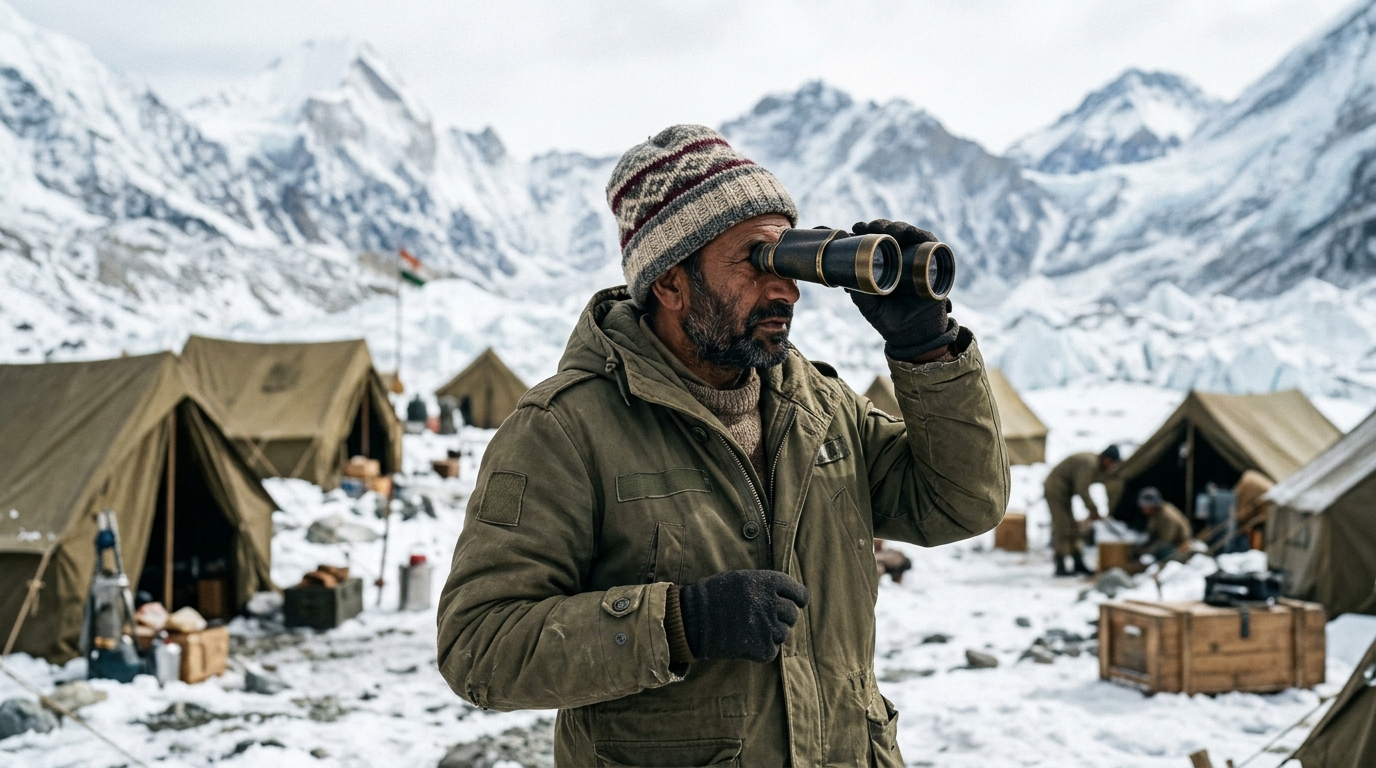
On May 20, 1965, Captain M.S. Kohli watched through binoculars from Base Camp as his team inched toward the summit of Mount Everest. The wind howled across the South Col, but the radio soon crackled with historic news. That day, India did not just reach the top of the world; they placed nine men on the peak, shattering existing records and transforming Indian mountaineering history overnight. The tension of those final steps gave way to a national celebration that redefined the country's relationship with the Himalayas.
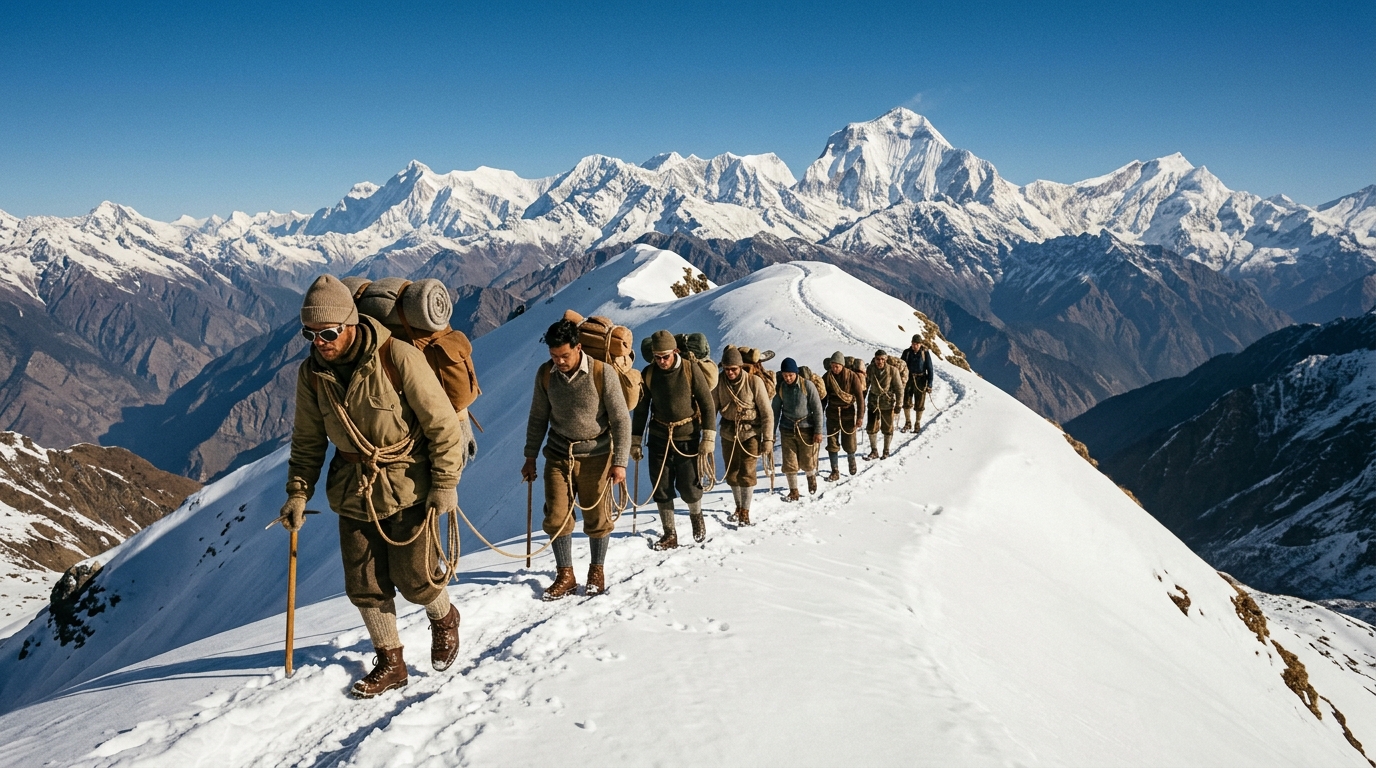
Before the mid-twentieth century, the high Himalayas were largely the domain of foreign expeditions. British, Swiss, and French teams arrived with heavy gear, relying heavily on local Sherpa and Bhotiya populations for logistics, route-finding, and load-bearing. Indians were participants, but rarely the expedition leaders or celebrated summiteers.
The shift from local support staff to primary explorers marks a fascinating chapter in India's sporting and exploratory heritage. Much like the milestones detailed in India at the Olympics: A Timeline of Historic Sporting Milestones, the nation's push into the death zone of the Himalayas required institutional support, immense physical endurance, and a generation of pioneers willing to risk everything.
Early Explorations and the Birth of Institutional Climbing
Before independence, Himalayan climbing was dominated by British expeditions relying on local Sherpa and Bhotiya support. The formalization of Indian mountaineering history began in the 1950s with the establishment of the Himalayan Mountaineering Institute (HMI) in Darjeeling, creating a structured path for native climbers to lead their own high-altitude ascents.
The Survey of India and Early Pioneers
The foundation of modern mountaineering in the subcontinent rests on the meticulous work of the Survey of India. In the 19th century, surveyors like Radhanath Sikdar, a brilliant Indian mathematician, calculated the height of Peak XV, later named Mount Everest, proving it was the highest mountain in the world.
During this era, local populations were indispensable. The Pundit explorers, native surveyors trained by the British, mapped vast tracts of the Himalayas and Tibet disguised as pilgrims. Men like Nain Singh Rawat paced out distances using prayer beads. They did not climb for sport, but their geographical knowledge laid the groundwork for every expedition that followed.
Founding the Himalayan Mountaineering Institute (1954)
The turning point for recreational and expeditionary climbing in India occurred in 1953. Tenzing Norgay, a Nepali-Indian Sherpa residing in Darjeeling, reached the summit of Mount Everest alongside Edmund Hillary. This monumental achievement sparked immense national pride.
Recognizing the need to capitalize on this momentum, Prime Minister Jawaharlal Nehru and Chief Minister of West Bengal Dr. Bidhan Chandra Roy established the Himalayan Mountaineering Institute (HMI) in Darjeeling in 1954. Tenzing Norgay served as its first Director of Field Training. HMI transformed climbing from a foreign pursuit into an accessible discipline for young Indians, teaching ice craft, rock climbing, and high-altitude survival.
The Establishment of the Indian Mountaineering Foundation
As local interest surged, the sport required a central organizing body. In 1957, a sponsoring committee was formed to back an Indian expedition to Cho Oyu, the world's sixth-highest mountain. Following the expedition's success, this committee evolved into the Indian Mountaineering Foundation (IMF) in 1958.
The IMF became the apex regulatory body for the sport. It began funding domestic expeditions, issuing climbing permits, and coordinating rescue operations. By institutionalizing the sport, the IMF ensured that Indian mountaineering history would be written by well-funded, highly trained domestic teams rather than isolated individuals.
How Did the 1965 Everest Expedition Change Indian Alpinism?
The 1965 Indian Everest Expedition, led by Captain M.S. Kohli, successfully placed nine climbers on the summit. This landmark achievement stood as a world record for 17 years, proving India's capability to organize, execute, and dominate massive siege-style expeditions on the world's highest peaks.
Planning and Logistics of a Siege Ascent
The 1965 expedition was a massive undertaking, reflecting the "siege style" of climbing popular in that era. The team consisted of 21 core members, supported by 50 high-altitude Sherpas and over 800 lowland porters carrying tons of equipment from Darjeeling through Nepal.
This approach required establishing a series of heavily stocked camps up the mountain. Climbers fixed thousands of feet of rope, slowly pushing the route higher while returning to lower camps to acclimatize. The logistical precision resembled a military campaign, which made sense given that many of the core climbers, including Kohli, came from the Indian Armed Forces.
The Historic Summit Successes
On May 20, 1965, Avtar Singh Cheema and Nawang Gombu reached the summit. Gombu made history that day by becoming the first man in the world to climb Everest twice, having previously summited with an American team in 1963.
Over the next ten days, the expedition capitalized on a rare window of good weather. Three more summit parties successfully reached the top. Sonam Gyatso, Sonam Wangyal, C.P. Vohra, Ang Kami, H.P.S. Ahluwalia, H.C. Rawat, and Phu Dorjee all stood on the highest point on Earth. Placing nine people on the summit in a single expedition was an astonishing feat that captured global headlines. The date remains one of the most celebrated in the climbing community, much like the pivotal dates explored in 10 Most Searched Dates in Indian History and Why They Matter.
Comparing Expedition Styles
The 1965 expedition exemplifies a style of climbing that has largely evolved over the decades. Here is how that historic ascent compares to modern approaches:
| Feature | 1965 Siege Style (Everest) | Modern Alpine Style |
|---|---|---|
| Team Size | Massive (21 climbers, 850+ support staff) | Small (2 to 4 climbers) |
| Camps | Multiple fully stocked camps (Base Camp to Camp 6) | Minimal or no pre-stocked camps |
| Pace | Slow, methodical, spanning months | Fast and light, spanning days |
| Oxygen | Heavy reliance on supplemental oxygen | Often attempted without supplemental oxygen |
| Ropes | Extensive fixed ropes top-to-bottom | Minimal fixed ropes, climbers carry their own |
The National Impact and Recognition
The success of the 1965 team triggered a wave of national euphoria. The climbers received a hero's welcome in New Delhi. The Indian government awarded the entire team the Arjuna Award, and several members received the Padma Bhushan and Padma Shri.
More importantly, the expedition proved that Indian climbers could compete at the highest levels of global alpinism. It inspired a generation of young Indians to enroll in mountaineering institutes, rapidly expanding the domestic climbing community.
The Rise of Indian Women in High-Altitude Climbing
Indian women began breaking high-altitude barriers in the 1980s, fundamentally shifting the demographics of the sport. Bachendri Pal's historic 1984 Everest summit catalyzed a movement, leading to numerous all-women expeditions and subsequent generations of female climbers setting global records across the Himalayas.
Bachendri Pal's Historic 1984 Summit
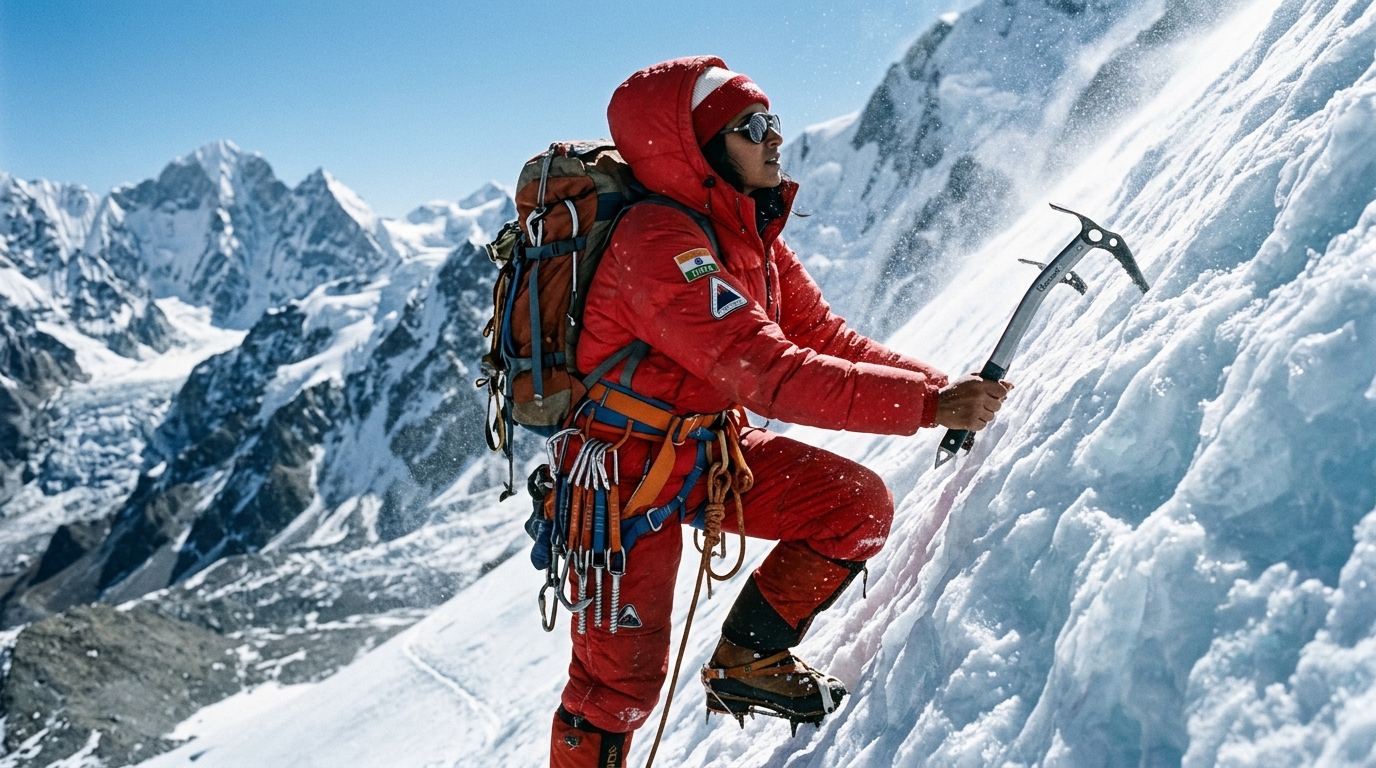
Indian mountaineering history reached a vital milestone on May 23, 1984, when Bachendri Pal became the first Indian woman to reach the summit of Mount Everest. Her journey was fraught with extreme danger. While sleeping at Camp III (24,000 feet), a massive ice serac collapsed, triggering an avalanche that buried her tent.
Pal had to be dug out with knives. Despite an injury to her head and the option to retreat, she chose to push forward. Her resilience and ultimate success shattered gender barriers in Indian adventure sports. Her achievement is a prominent highlight in the broader context of Milestones in Indian Women's History: A Chronological Guide.
Santosh Yadav and the Double Ascent
Following Pal's breakthrough, Indian women began setting international records. Santosh Yadav emerged as a powerhouse in the 1990s. In 1992, she summited Everest. Just one year later, in 1993, she summited again, becoming the first woman in the world to climb Mount Everest twice.
Yadav's ascents were notable not just for their repetition, but for her technical proficiency. During her 1992 climb, she saved the life of another climber by sharing her oxygen. She also successfully climbed the difficult Kangshung Face of Everest, proving that Indian women were tackling the mountain's most dangerous routes.
The Modern Era of Female Mountaineers
The foundation laid by Pal and Yadav paved the way for modern record-breakers. In 2013, Arunima Sinha became the world's first female amputee to scale Mount Everest, a feat of unimaginable physical and mental endurance following a tragic train accident.
Other notable figures include Premlata Agarwal, who became the oldest Indian woman to scale Everest at age 48, and later became the first Indian woman to scale the Seven Summits (the highest peaks on all seven continents). Today, all-women expeditions regularly tackle technically demanding peaks across the Garhwal and Karakoram ranges, fundamentally altering the face of the Indian climbing community.
What Are the Major Peaks Conquered by Indian Teams?
While Everest captures the public imagination, Indian mountaineering history features significant ascents on notoriously difficult peaks like Kangchenjunga, Nanda Devi, and Annapurna. Conquering these technically demanding mountains demonstrated the advanced technical proficiency of Indian climbers beyond standard commercial routes.
The Kangchenjunga Challenge
Kangchenjunga, the third highest mountain in the world, sits on the border of Nepal and the Indian state of Sikkim. It is widely considered far more dangerous and technically demanding than Everest.
In 1977, an Indian Army expedition led by Colonel Narinder "Bull" Kumar made a historic ascent of Kangchenjunga. They chose the previously unclimbed Northeast spur route. The expedition was incredibly challenging, requiring climbers to navigate vertical ice walls and severe avalanche terrain. Their success firmly established the technical prowess of Indian military mountaineers on the global stage.
Nanda Devi and the Domestic Frontier
Nanda Devi (25,643 ft) is the highest mountain located entirely within India. Guarded by a ring of peaks known as the Nanda Devi Sanctuary, it is an exceptionally difficult mountain to access, let alone climb.
Indian teams made several successful ascents of Nanda Devi in the 1960s and 1970s. However, the mountain also hosts a controversial chapter in Indian history. In 1965, a joint CIA-Indian Intelligence Bureau operation attempted to place a nuclear-powered telemetry relay listening device on the summit to monitor Chinese missile tests. The device was lost in an avalanche and never recovered. Environmental concerns and the sensitive nature of the region led the Indian government to close the Nanda Devi Sanctuary to climbers in 1983, making it an untouched ecological reserve today.
Scaling the Eight-Thousanders
There are 14 mountains in the world that stand taller than 8,000 meters, all located in the Himalayan and Karakoram ranges. For decades, climbing all 14 was a feat achieved only by Western and Sherpa climbers.
In recent years, Indian mountaineers have shifted their focus to these peaks. Climbers like Arjun Vajpai and Keval Kakka have systematically targeted these mountains, executing complex Indian Himalayan expeditions to peaks like Makalu, Lhotse, and Annapurna. This marks a maturation of the sport in India, moving away from Everest-centric goals toward broader, more technically diverse alpine achievements.
The Evolution of Climbing Styles and Ecological Concerns
Modern Indian mountaineering has transitioned from massive, military-style siege expeditions to smaller, fast-and-light alpine ascents. Simultaneously, climbers and organizations are grappling with the severe ecological impact of commercial climbing, prioritizing sustainable practices and waste management on fragile Himalayan ecosystems.
From Siege Style to Alpine Style
The massive, heavily funded expeditions of the 1960s are largely a thing of the past. Today, elite Indian mountaineers prefer "alpine style" climbing. This approach relies on small teams of two to four people who carry all their own gear, use no fixed ropes, and often climb without supplemental oxygen.
Alpine style is faster and leaves a much smaller footprint on the mountain. However, it carries significant tradeoffs. Without pre-stocked camps or fixed ropes, retreat during a storm becomes incredibly dangerous. The margin for error is razor-thin. Yet, for purists, this style represents the true spirit of alpinism, relying entirely on the climber's skill rather than logistical infrastructure.
The Commercialization of the Himalayas
The late 1990s and 2000s saw a massive boom in commercial guiding. Mountains that were once the exclusive domain of elite athletes are now accessible to amateur climbers willing to pay hefty fees.
This commercialization has created severe bottlenecks. Photos of "traffic jams" on the Hillary Step of Mount Everest have shocked the world. For Indian climbers, this commercial traffic presents a dual challenge. It makes securing permits and finding isolation on popular peaks difficult, pushing serious alpinists to seek out unclimbed, lesser-known peaks in the Zanskar and Karakoram ranges.
Conservation and Sustainable Mountaineering
The environmental toll of decades of climbing is undeniable. Discarded oxygen cylinders, torn tents, human waste, and the bodies of fallen climbers litter the high camps of popular mountains.
Authoritative bodies like the Himalayan Club and the Indian Mountaineering Foundation have actively pivoted toward conservation. The IMF now mandates strict environmental protocols for all expeditions operating in the Indian Himalayas. Furthermore, Indian teams regularly organize "cleaning expeditions." The Indian Army, for instance, has launched several missions specifically to retrieve tons of garbage from high-altitude camps, working to restore the pristine nature of these sacred peaks.
Related Reading
- Milestones in Indian Women's History: A Chronological Guide
- 1,000 Years of Indian Medical History: A Chronological Guide
- Economic Milestones in Indian History: From 1947 to Present
- What Are the Major Events in Indian History? (FAQ Archive)
FAQ
Q: Who was the first Indian to climb Mount Everest? Avtar Singh Cheema was the first Indian man to reach the summit of Mount Everest. He accomplished this feat on May 20, 1965, as part of the historic nine-man Indian expedition led by Captain M.S. Kohli.
Q: When was the Indian Mountaineering Foundation established? The Indian Mountaineering Foundation (IMF) was officially formed in 1958. It evolved from a sponsoring committee that had successfully organized an Indian expedition to Cho Oyu, becoming the national apex body for the sport.
Q: Who was the first Indian woman to climb Mount Everest? Bachendri Pal became the first Indian woman to summit Mount Everest on May 23, 1984. She survived a massive camp-destroying avalanche during her ascent before pushing on to the peak.
Q: What is the highest mountain peak located entirely within India? Nanda Devi, standing at 25,643 feet (7,816 meters), is the highest peak located entirely within the borders of India. Kangchenjunga is taller, but it sits on the border between India and Nepal.
Q: What is the difference between alpine and siege style climbing? Siege style involves large teams, fixed ropes, and multiple pre-stocked camps established over weeks. Alpine style involves small teams carrying their own gear and pushing for the summit in a single, continuous, fast-and-light effort.
Look up the Indian Mountaineering Foundation's official website today and review their list of approved trekking peaks in the Garhwal or Himachal regions. You do not need to be an elite alpinist to experience high-altitude adventure; booking a registered, eco-friendly trek allows you to walk the exact approach trails used by the pioneers of Indian mountaineering history while supporting the local mountain economy.