A Historical Timeline of Early Labor Movements and Trade Unions in India
In Short
Indian labor movement history began in the late 19th century as textile and railway workers protested brutal working conditions. The movement grew from informal localized strikes in the 1880s to legally recognized trade unions by the 1920s. These early struggles ultimately shaped modern workplace rights and became a core pillar of India's fight for independence.
Key Takeaways
- The 1890 Bombay Mill Hands Association was India's first organized labor welfare group.
- World War I inflation sparked mass strikes and the creation of formal unions.
- The All India Trade Union Congress formed in 1920 to represent workers globally.
- The 1926 Trade Union Act finally gave worker organizations legal protection against lawsuits.
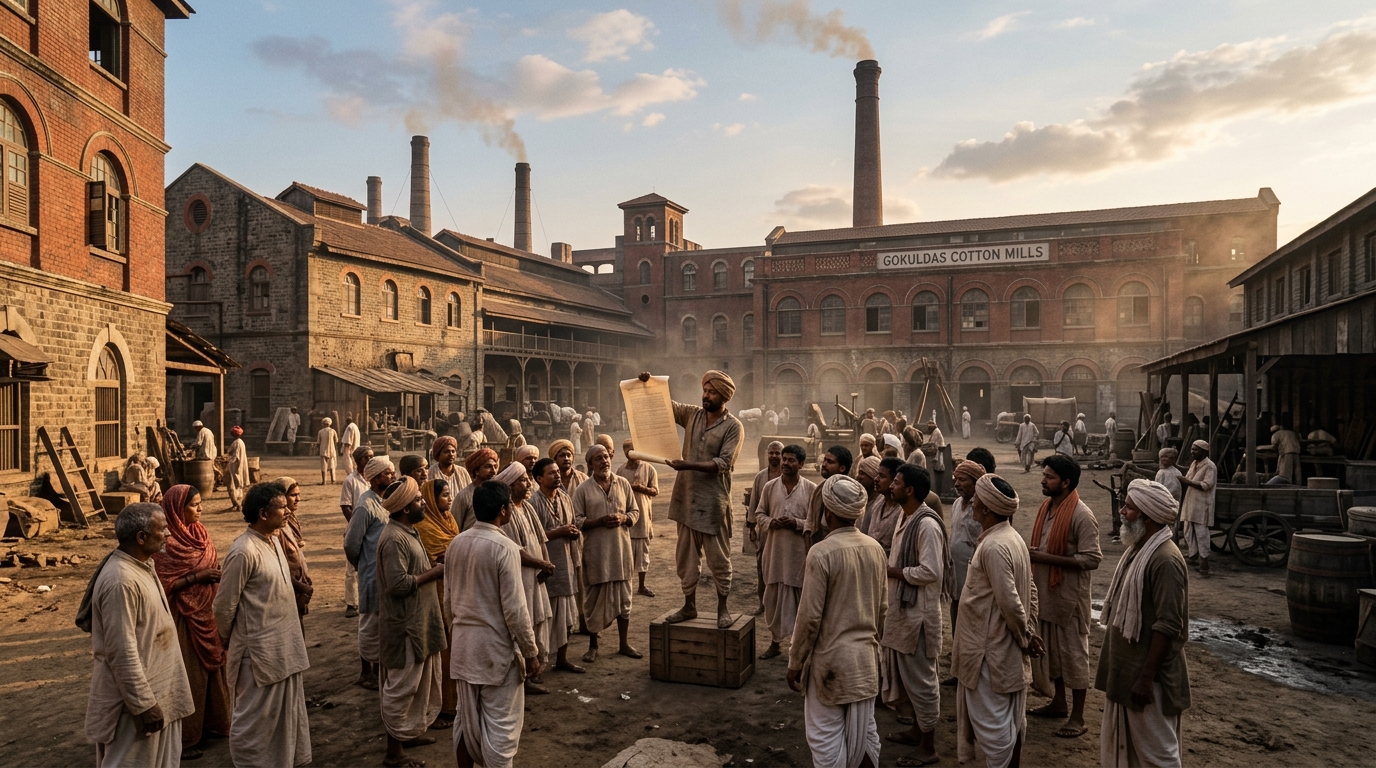
In 1884, a textile worker in Bombay stood outside his mill after a 14-hour shift, exhausted and unpaid for weeks. He joined thousands of other mill hands to sign a petition demanding a simple concession: a weekly day of rest. This single act of collective defiance marked the quiet beginning of a massive shift in how industries treated human labor in the subcontinent.
When did the Indian labor movement history actually begin?
Indian labor movement history started in the 1870s when unorganized factory workers began staging spontaneous strikes across industrial centers. These early protests focused entirely on immediate survival needs like wage payments and shorter hours, rather than broad political goals. They laid the essential groundwork for the organized unions that followed decades later.
The first strikes in Bombay and Calcutta (1870s-1880s)
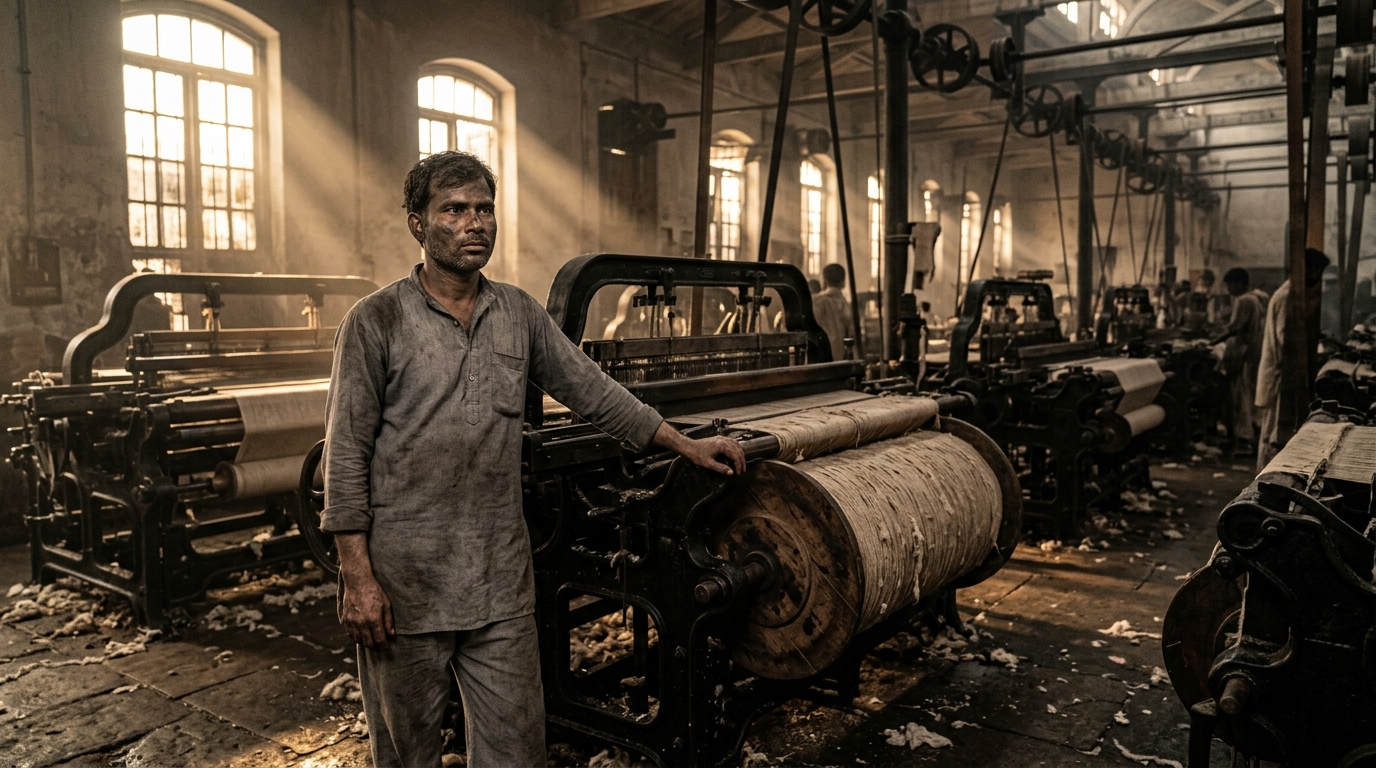
Industrialization arrived in India through cotton mills in Bombay and jute mills in Calcutta. The working conditions were punishing. Factory owners forced laborers to work from sunrise to sunset. Children as young as seven worked alongside adults. Factories lacked basic ventilation, and workplace injuries were common.
The first recorded strike happened in 1877 at the Empress Mills in Nagpur. Workers walked out over wage rates. This strike lacked formal leadership. It was a spontaneous reaction to wage cuts. Similar unorganized strikes erupted in Bombay in 1882 and 1889. Workers simply stopped working until managers agreed to basic demands. Once the immediate dispute ended, the workers dispersed. They did not form permanent organizations.
Narayan Meghaji Lokhande and the Bombay Mill Hands Association (1890)
Narayan Meghaji Lokhande changed how workers organized. He was a close associate of social reformer Jyotirao Phule. Lokhande saw that spontaneous strikes failed to create lasting change. In 1890, he established the Bombay Mill Hands Association.
This was not a trade union in the modern sense. It had no membership dues, no formal rules, and no strike funds. It functioned as a welfare organization. Lokhande held massive meetings for mill workers. He drafted petitions detailing their grievances. Through relentless pressure, he secured a major victory: the British government granted factory workers a weekly Sunday holiday. He also started the newspaper Deenbandhu to give workers a voice. Today, historians recognize Lokhande as the father of the labor movement in India.
How did World War I change Indian labor movement history?
World War I accelerated Indian labor movement history by creating massive economic pressure across the country. Prices for basic goods doubled, but factory wages remained stagnant. This severe economic distress pushed workers to form formal, dues-paying unions to demand fair compensation from factory owners who were making record wartime profits.
The rise of the Madras Labour Union (1918)
The economic strain of the war reached a breaking point in 1918. In Madras, workers at the Buckingham and Carnatic Mills faced abusive managers and terrible pay. They approached nationalist leader B.P. Wadia for help.
Wadia helped them form the Madras Labour Union in April 1918. This was India's first modern trade union. Unlike earlier welfare groups, this union collected regular monthly subscriptions from its members. It held regular meetings and maintained a formal leadership structure. The union successfully negotiated for a longer midday break and better wages. Wadia's success in Madras inspired workers across the country to adopt the formal trade union model.
The Ahmedabad textile strike and Gandhi's intervention (1918)
While Madras workers organized, a different labor dispute unfolded in Gujarat. Mill owners in Ahmedabad had given workers a "plague bonus" to keep them from fleeing the city during an outbreak. When the plague subsided in 1918, owners tried to revoke the bonus. The cost of living was still soaring. Workers demanded a 50% wage hike to compensate.
Mahatma Gandhi stepped in to mediate. He studied the mill owners' profits and the workers' living costs. He concluded a 35% increase was fair. When mill owners refused, Gandhi led the workers on a strike. He introduced the concept of a hunger strike to keep the workers united and peaceful. The mill owners eventually surrendered and granted the 35% raise. This event proved crucial in the Timeline of Mahatma Gandhi's Nonviolent Movements in India. It led to the formation of the Textile Labour Association in 1920, which championed the idea of resolving labor disputes through peaceful arbitration rather than class warfare.
What led to the formation of the All India Trade Union Congress (AITUC)?
The creation of the International Labour Organization (ILO) in 1919 forced Indian workers to organize nationally. To send a representative to the ILO in Geneva, India needed a central labor organization. This international requirement directly triggered the founding of the All India Trade Union Congress (AITUC) in Bombay in 1920.
The founding of AITUC in 1920
Before 1920, Indian labor unions operated in isolation. A jute union in Bengal had no contact with a cotton union in Bombay. The ILO charter changed this. It required member nations to send labor delegates chosen by the most representative worker organizations in the country.
To secure this representation, labor leaders convened in Bombay on October 31, 1920. Over 100 unions affiliated with the newly formed AITUC. This federation brought regional unions under one national umbrella. It gave Indian workers a unified voice to negotiate with the British colonial government and international bodies.
Lala Lajpat Rai's early leadership
Lala Lajpat Rai served as the first president of the AITUC. He brought immense political weight to the organization. Rai connected the struggles of Indian laborers directly to the broader fight against British imperialism.
In his presidential address, Rai argued that Indian workers faced a dual threat: foreign political domination and capitalist exploitation. He believed that political freedom meant nothing if workers remained locked in poverty. Under his leadership, the AITUC did not just negotiate wages. It demanded universal adult franchise, free education, and the nationalization of key industries.
The influence of the International Labour Organization (ILO)
The ILO served as a vital external catalyst for the Indian labor movement history. As a founding member of the League of Nations, India was a founding member of the ILO. The ILO published global standards on working hours, child labor, and workplace safety.
Indian labor leaders used these international standards to pressure the British government. When the ILO adopted a convention for a 60-hour maximum workweek, Indian leaders demanded the colonial government update the Indian Factories Act to match it. The ILO gave local labor leaders a powerful benchmark to measure their own working conditions against the rest of the world.
Why did the 1926 Trade Union Act matter for workers?
The 1926 Trade Union Act gave worker organizations legal recognition and immunity from civil and criminal prosecution for staging strikes. Before this law, factory owners could sue union leaders for organizing walkouts. The Act provided a secure legal framework for the trade union movement to expand nationwide without the constant threat of bankruptcy.
The Buckingham and Carnatic Mills lawsuit
The necessity for the 1926 Act became obvious during a 1920 strike in Madras. B.P. Wadia led a strike at the Buckingham and Carnatic Mills. The mill management retaliated with a devastating legal maneuver. They sued Wadia in the Madras High Court for inducing workers to break their employment contracts.
The court sided with the management. It issued an injunction against the union and ordered Wadia to pay massive damages. This ruling paralyzed the labor movement. It meant that any union leader calling a strike could be sued into poverty. Labor organizers realized they could not function without legal protection.
Legal recognition of trade unions
Labor leader N.M. Joshi fought relentlessly in the central legislature to fix this vulnerability. His efforts resulted in the Indian Trade Unions Act of 1926.
This law was a watershed moment. It allowed any seven workers to register a trade union. Most importantly, it granted registered unions immunity from civil suits related to trade disputes. Union leaders could no longer be sued for simply organizing a strike. The law also allowed unions to collect funds for political purposes. This legal security allowed unions to grow rapidly in the late 1920s.
The split between moderates and radicals
Legal protection led to rapid growth, but it also exposed deep ideological fractures. By the late 1920s, communist leaders gained significant influence within the AITUC. They favored aggressive, general strikes to overthrow the capitalist system. Moderate leaders like N.M. Joshi and V.V. Giri preferred negotiation and legislative reform.
The tension peaked at the 1929 AITUC session in Nagpur. The communist faction passed resolutions to boycott the Royal Commission on Labour and affiliate with international communist organizations. The moderates walked out. They formed a rival organization called the Indian Trades Union Federation (ITUF). This split weakened the bargaining power of Indian workers during a crucial period of economic depression.
How did the Royal Commission on Labour impact factory laws?
The Royal Commission on Labour, appointed in 1929, provided the most detailed investigation into Indian working conditions ever conducted. The resulting 1931 report exposed horrific abuses in factories, mines, and plantations. Its recommendations forced the government to pass a wave of protective labor legislation throughout the 1930s.
Investigating workplace conditions
The British government appointed the Commission, chaired by John Henry Whitley, to defuse growing labor unrest. The Commission traveled across India for two years. They visited textile mills in Bombay, coal mines in Bihar, and tea plantations in Assam.
They documented systemic abuses. They found coal miners working underground for 12 hours a day without safety equipment. They found women and children carrying heavy loads in unregulated factories. They noted that factory workers were heavily indebted to predatory moneylenders who waited outside factory gates on payday. The resulting Whitley Report was a damning indictment of industrial capitalism in colonial India.
Legislative reforms of the 1930s
The Commission's recommendations led to concrete legal changes. The government passed the Payment of Wages Act in 1936. This law required employers to pay wages on time and banned arbitrary wage deductions.
The government also amended the Factories Act in 1934 to reduce maximum working hours and improve factory inspections. While enforcement remained weak, these laws established the baseline regulatory framework that would eventually govern modern Indian industry. You can trace the long-term impact of these reforms through the Economic Milestones in Indian History: From 1947 to Present.
How did political leaders shape early labor rights?
Political leaders integrated labor rights into the broader fight for Indian independence. They realized that securing worker rights was essential for national progress. Leaders drafted legislation, formed political parties dedicated to workers, and ensured that labor protections were eventually written into the foundational documents of the new republic.
The role of Dr. B.R. Ambedkar
Dr. B.R. Ambedkar was a formidable champion of labor rights. He understood that caste oppression and economic exploitation were deeply connected. In 1936, he founded the Independent Labour Party (ILP) to represent the working classes in the provincial elections.
Ambedkar's greatest contributions to Indian labor movement history came during his tenure as the Labour Member in the Viceroy's Executive Council from 1942 to 1946. He successfully introduced the 8-hour workday in India. He established the principle of "equal pay for equal work" regardless of gender. He also created the tripartite labor conference framework, bringing government, employers, and workers to the same negotiating table. His work laid the foundation for India's post-independence labor codes. You can explore his broader impact in Dr. B.R. Ambedkar's Life: A Chronological Timeline of Legacy.
The integration with the broader freedom struggle
The Indian National Congress increasingly aligned itself with labor demands. In 1931, the Congress passed the Karachi Resolution. Drafted heavily by Jawaharlal Nehru, this resolution declared that political freedom must include economic freedom for the starving millions.
The resolution promised a living wage, healthy working conditions, and the right to form unions. Radical leaders like Subhas Chandra Bose and Jawaharlal Nehru actively presided over AITUC sessions. They viewed the organized working class as a vital weapon against British rule. When the Congress formed provincial ministries in 1937, they attempted to pass pro-labor legislation, though their efforts often clashed with the interests of Indian industrialists who funded the party.
What were the major strikes that defined this era?
Massive strikes across the railway and textile sectors defined this era of Indian labor history. These strikes proved that collective action could halt major colonial industries. They forced the British government to appoint commissions and pass labor laws to maintain control over the economy.
The Great Bombay Textile Strike of 1928
The Bombay textile strike of 1928 was one of the longest and most intense labor disputes in Indian history. Mill owners attempted to implement a "rationalization" scheme based on the Fawcett Committee's recommendations. This scheme required workers to operate more looms simultaneously, effectively cutting jobs and increasing workloads without matching pay increases.
The Girni Kamgar Union, led by communist organizers, called a general strike. Over 150,000 workers walked out. The strike lasted for six grueling months. Workers survived on meager union funds and community support. The strike paralyzed the Bombay textile industry and forced the mill owners to temporarily suspend the rationalization scheme. It demonstrated the sheer power of a united, well-organized workforce.
Railway strikes across the subcontinent
Railway workers held immense leverage. A railway strike could stop the movement of British troops and colonial exports. Recognizing this power, railway workers organized some of the most effective strikes of the 1920s.
The North Western Railway strike in 1925 and the Bengal Nagpur Railway strike in 1927 crippled transportation networks. Workers demanded better pay, secure housing, and an end to racial discrimination in promotions. British managers held the senior, high-paying jobs, while Indian workers performed the dangerous manual labor. These strikes often faced brutal police repression. If you want to explore how these specific transportation disputes evolved, you can read more about the history of Indian railway strikes.
The evolution of industrial safety and worker rights remains a critical issue today. The failure to maintain safe working environments has led to modern catastrophes, as detailed in December 1984: A Historical Timeline of the Bhopal Gas Tragedy. The early labor movement built the first defenses against such industrial negligence.
Key Milestones in Early Indian Labor History
| Year | Event | Significance |
|---|---|---|
| 1877 | Empress Mills Strike (Nagpur) | First recorded spontaneous industrial strike in India over wage disputes. |
| 1890 | Bombay Mill Hands Association | N.M. Lokhande forms India's first labor welfare organization. |
| 1918 | Madras Labour Union | B.P. Wadia establishes the first formal, dues-paying trade union. |
| 1920 | AITUC Formed | First national trade union federation created to represent India at the ILO. |
| 1926 | Trade Unions Act | Grants registered unions legal recognition and immunity from civil lawsuits. |
| 1936 | Payment of Wages Act | Legally requires timely wage payments and bans arbitrary employer deductions. |
| 1942 | 8-Hour Workday Adopted | Dr. B.R. Ambedkar secures the 8-hour workday limit during his tenure as Labour Member. |
Related Reading
- Milestones in Indian Women's History: A Chronological Guide
- 1,000 Years of Indian Medical History: A Chronological Guide
- Economic Milestones in Indian History: From 1947 to Present
- What Are the Major Events in Indian History? (FAQ Archive)
FAQ
Q: Who started the first labor union in India? B.P. Wadia started the first formal trade union in India. He founded the Madras Labour Union in 1918 to organize workers at the Buckingham and Carnatic Mills.
Q: When was the All India Trade Union Congress established? The All India Trade Union Congress (AITUC) was established on October 31, 1920, in Bombay. Lala Lajpat Rai served as its first president.
Q: What was the main cause of early labor strikes in India? Early strikes were driven by basic survival needs. Workers protested 14-hour workdays, unpaid wages, lack of weekly holidays, and brutal treatment by factory managers.
Q: How did the 1926 Trade Union Act help workers? The 1926 Act gave trade unions legal recognition. It protected union leaders from being sued or prosecuted simply for organizing a strike or advising workers to break employment contracts.
Q: Did Mahatma Gandhi support labor strikes? Yes, but with strict conditions. Gandhi led the 1918 Ahmedabad textile strike but insisted that strikes must be completely non-violent and rely on peaceful arbitration to resolve disputes.
To understand how these historical labor struggles shape your current workplace rights, review the specific labor codes applicable to your industry today. Start by reading the bare text of the Trade Unions Act of 1926 to see exactly which early protections still govern modern employee organizations. Map those historical rights against your current employment contract to ensure your fundamental workplace protections are being met.