19th Century India: Key Historical Events Captured in Period Art
The Quick Read
Period art from 19th century Indian history serves as a vital visual timeline of colonial expansion, resistance, and cultural shifts. Company School paintings, royal portraits, and early lithographs document key battles, the 1857 Uprising, and daily life, offering a vivid alternative to written colonial records.
Key Takeaways
- Company paintings provide the most detailed visual records of daily 19th-century Indian life.
- British artists documented military campaigns to justify colonial expansion to audiences back home.
- The 1857 Uprising sparked a massive shift in how artists portrayed Indian subjects.
- Royal portraits from princely states evolved to project power under British paramountcy.
- Mass-produced lithographs eventually turned elite historical art into accessible public news.
Most people believe 19th century Indian history is only preserved in dry colonial administrative records and grainy, early black-and-white photographs. The truth is, a massive archive of vivid watercolor paintings and lithographs captured the era's defining battles, cultural shifts, and daily realities as they happened. You can map the entire trajectory of the 1800s just by looking at what artists chose to paint.
Before the camera became ubiquitous in the subcontinent, the paintbrush and the lithograph stone were the primary tools for recording current events. East India Company officials, traveling British artists, and highly skilled Indian painters created a complex visual diary of a rapidly changing nation. These images shaped how the world viewed the subcontinent. They also reveal details about architecture, clothing, and military tactics that text documents often omit.
Understanding these visual records helps us piece together the 10 most searched dates in Indian history and why they matter. We can see exactly how the landscape shifted from the era of regional empires to the height of the British Raj.
How Did Company School Paintings Document 19th Century Indian History?
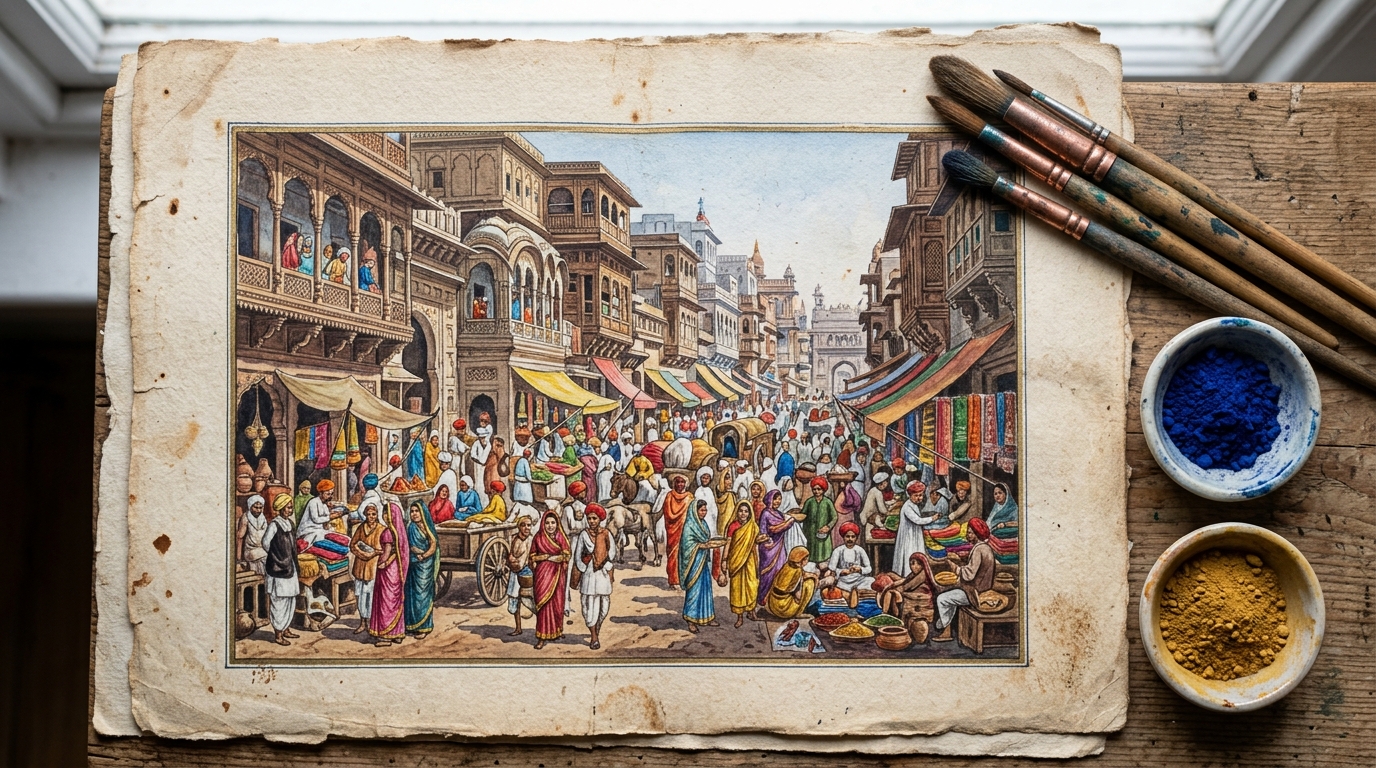
Company School paintings documented 19th century Indian history by blending European watercolor techniques with traditional Indian miniature styles. Local artists hired by East India Company officials created detailed visual catalogs of flora, trades, architecture, and daily life, capturing a society undergoing rapid colonial transformation.
The Shift from Court Patronage to Colonial Commissions
As regional powers like the Mughals and Marathas lost territory and wealth in the late 1700s and early 1800s, traditional court painters lost their primary patrons. These highly trained artists had to find new clients to survive. They found them in the British officials and merchants of the East India Company.
These new patrons wanted visual souvenirs of their time in India to send back to families in England. They demanded a shift in style. Traditional miniature painting featured flat perspectives and opaque gouache colors. British patrons wanted linear perspective, shading, and the use of transparent watercolors. The resulting hybrid style became known as Company Painting (Kampani Kalam).
This shift created a massive visual database of 19th century Indian history. Artists abandoned stylized court scenes to paint exactly what was in front of them.
Cataloging Trades and Daily Life
Company paintings serve as an unparalleled record of everyday life in the 1800s. British officials commissioned "mica paintings" and paper albums that categorized Indian society. These sets often featured dozens of individual portraits showing different professions.
You can find detailed paintings of water carriers, palanquin bearers, bangle sellers, and textile weavers. The artists captured the exact folds of garments, the specific tools of each trade, and the regional variations in dress. These were not just artistic exercises. They were early ethnographic studies. The British used these visual catalogs to understand and classify the massive population they were attempting to govern.
Botanical and Medical Illustrations
Another major focus of Company painting was natural history. British surgeons and botanists hired Indian artists to paint local plants, animals, and medical practices.
These artists produced thousands of highly accurate botanical drawings. They captured the exact structure of medicinal plants used in traditional Ayurveda. This visual documentation played a crucial role in shaping 1,000 years of Indian medical history: a chronological guide. The precision of these Indian artists often surpassed the work of European illustrators, providing the scientific community in London with exact records of the subcontinent's biodiversity.
The Visual Record of Colonial Expansion and Conflict
British and Indian artists recorded major military conflicts of the 1800s through sweeping landscape paintings and battle scenes. These artworks served as visual news reports for audiences in London, documenting the fall of regional powers and the consolidation of British rule across the subcontinent.
Painting the Anglo-Maratha Wars
The early 19th century was defined by the struggle between the East India Company and the Maratha Confederacy. The Second Anglo-Maratha War (1803–1805) and the Third Anglo-Maratha War (1817–1818) reshaped the map of India.
British military draftsmen accompanied the armies on these campaigns. They sketched fortresses, troop formations, and battlefields. Artists like William Purser and Robert Melville Grindlay turned these field sketches into grand oil paintings and aquatints. These images highlighted British military discipline while depicting Maratha strongholds as rugged, imposing obstacles that were ultimately overcome. The art was explicitly designed to celebrate colonial victories and justify the massive cost of these wars to the British public.
The Fall of the Sikh Empire in Art
The mid-1800s brought the Anglo-Sikh wars (1845–1849), leading to the annexation of the Punjab. This conflict was heavily documented by both sides.
Sikh court painters in Lahore had already established a rich tradition of portraiture under Maharaja Ranjit Singh. They painted the Sikh army's modern artillery and European-trained generals. When the British arrived, artists like Henry Yule and Charles Hardinge sketched the battlefields of Ferozeshah and Sobraon. Their lithographs show the brutal reality of the conflict. They depict the heavily fortified Sikh positions and the devastating toll of the artillery exchanges. These images freeze the final days of the last major independent Indian power of the 19th century.
Architectural Documentation as a Tool of Conquest
Painting architecture was a vital part of military intelligence. Before a fort could be besieged, it had to be drawn.
British draftsmen created exact scale drawings of city walls, gates, and defensive structures. They documented the grand monuments of conquered cities to signal control over the territory. This practice extended across the subcontinent, similar to how earlier European powers documented the Portuguese era in Goa: key dates and architectural milestones. By turning formidable Indian fortresses into tamed subjects on paper, the British visually asserted their dominance over the built environment of India.
What Does Art Reveal About the 1857 Uprising?
Art from the 1857 Uprising reveals a stark propaganda war fought through lithographs and sketches. British artists produced sensationalized illustrations of sieges and massacres to justify harsh retaliation, while Indian visual records from this period were largely suppressed or destroyed by colonial authorities.
The Siege of Lucknow in Sketches
The events of 1857 shattered the relative stability of 19th century Indian history. The rebellion against the East India Company was the most photographed and illustrated news event of its time.
The Siege of Lucknow became a central focus for British artists. Sketch artists embedded with the relief forces, such as George Francklin Atkinson, produced detailed drawings of the ruined Residency. His publication, The Campaign in India 1857-58, featured lithographs showing battered buildings and exhausted soldiers. These images were rushed back to London and printed in newspapers like The Illustrated London News. They provided the British public with real-time, highly partisan visual updates on the conflict.
The Missing Indian Perspective
Finding Indian-created art that documents the 1857 Uprising from the rebel perspective is incredibly difficult. Following the suppression of the rebellion, British authorities actively searched for and destroyed visual materials that glorified the uprising.
We know Indian artists painted the events. Some surviving sketches show Bahadur Shah Zafar holding court during the brief period the rebels held Delhi. However, the vast majority of the visual record is entirely one-sided. The surviving art from 1857 teaches us as much about censorship and the power of the colonial archive as it does about the events themselves. The victors controlled the printing presses, and therefore, they controlled the visual memory of the war.
Felice Beato and the Transition to Photography
The aftermath of 1857 marked a turning point in how history was recorded. The painter and sketch artist began to lose ground to the photographer.
Felice Beato arrived in India in 1858. He traveled to Kanpur, Lucknow, and Delhi, photographing the ruins of the uprising. His stark, unpopulated photographs of shattered buildings and execution sites introduced a new level of grim realism. While painters could romanticize a battle scene, Beato's camera captured the literal bones left behind. This marked the beginning of the end for the traditional battle painter in India. Photography soon became the dominant medium for recording historical events.
Portraits of Power in the Princely States
Royal portraits in the princely states evolved dramatically during the 1800s to project power under the watchful eye of the British paramountcy. Maharajas commissioned massive oil paintings blending traditional regalia with European realism to assert their legitimacy and wealth on a global stage.
The Influence of European Realism
After 1858, the British Crown took direct control of India. The surviving princely states were allowed to exist, but their military and political power was strictly curtailed. Stripped of the ability to wage war, Indian royals turned to visual culture to assert their status.
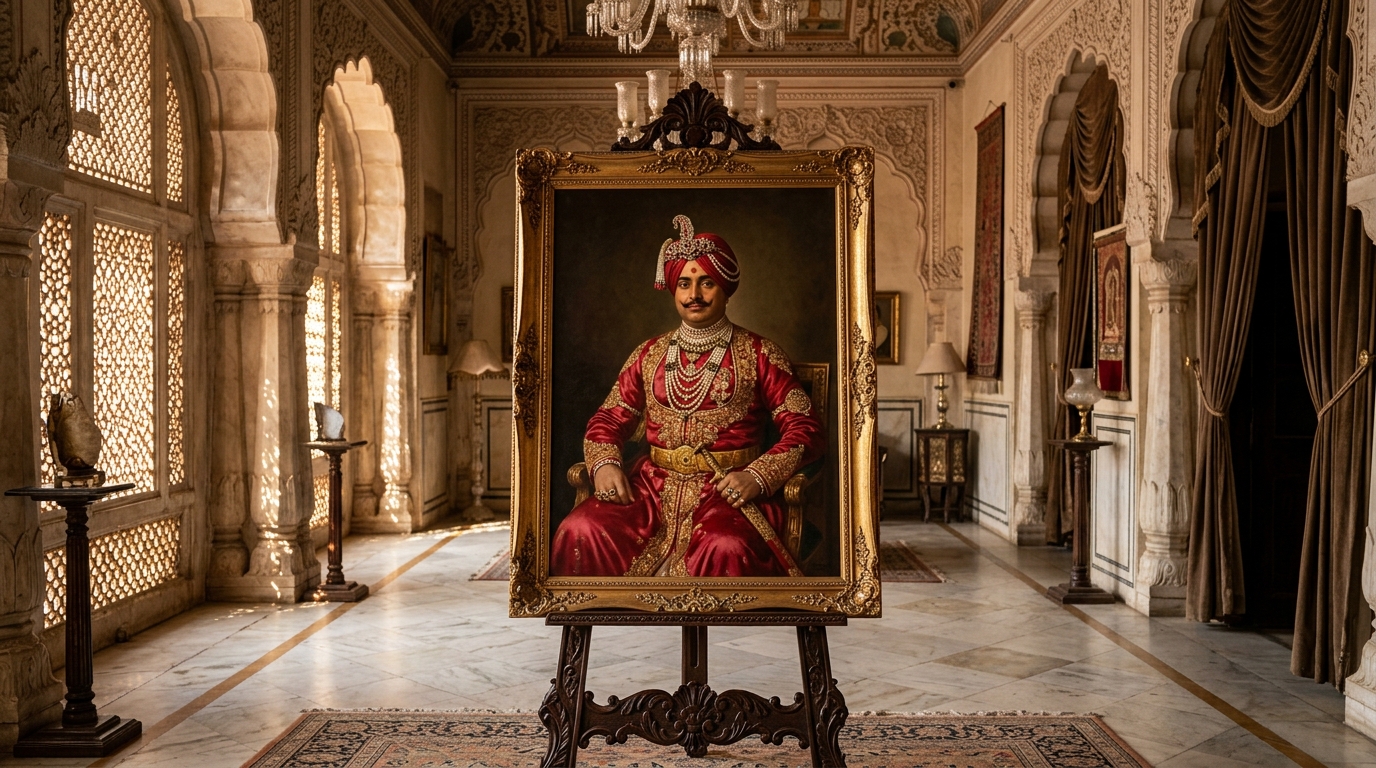
They began importing European painters to create massive, life-sized oil portraits. These paintings replaced the small, intimate miniature paintings of the past. Maharajas posed in full ceremonial dress, dripping with jewels, standing in palaces furnished with European antiques. The goal was to look like a modern, enlightened monarch who was equal in dignity to European royalty. This style of academic realism fundamentally changed the trajectory of Indian art.
Raja Ravi Varma's Historical Impact
No artist defined this era more than Raja Ravi Varma (1848–1906). He mastered the European technique of oil painting but applied it to Indian subjects.
Varma traveled across the subcontinent, painting portraits of royals from Mysore to Baroda. He captured the specific textiles, jewelry, and physical likenesses of the late 19th-century Indian elite with photographic precision. His portraits serve as an exact historical record of court life in the 1880s and 1890s. Varma proved that an Indian artist could beat the European portrait painters at their own game, commanding massive fees and national respect.
The Durbar Paintings of 1877
The Delhi Durbar of 1877 was a massive ceremonial gathering where Queen Victoria was proclaimed Empress of India. It was one of the most significant visual spectacles of 19th century Indian history.
The British commissioned massive oil paintings to document the event. These paintings show the Viceroy, Lord Lytton, seated on a dais, surrounded by dozens of Indian princes arranged strictly by their rank and gun-salute status. The art was designed to show the total subordination of the Indian royals to the British Crown. Every detail, from the placement of the chairs to the banners flying overhead, was painted to reinforce the new imperial hierarchy.
How Did Printmaking Change Historical Record-Keeping?
Printmaking changed historical record-keeping by allowing mass reproduction of historical events, making visual news accessible to the wider public. Lithography presses established in the mid-1800s transformed how ordinary people consumed history, turning elite oil paintings into affordable prints sold in local markets.
The Rise of the Lithography Press
For most of history, a painting was a unique object. Only the wealthy could afford to own visual records of current events. The introduction of the lithography press to India changed everything.
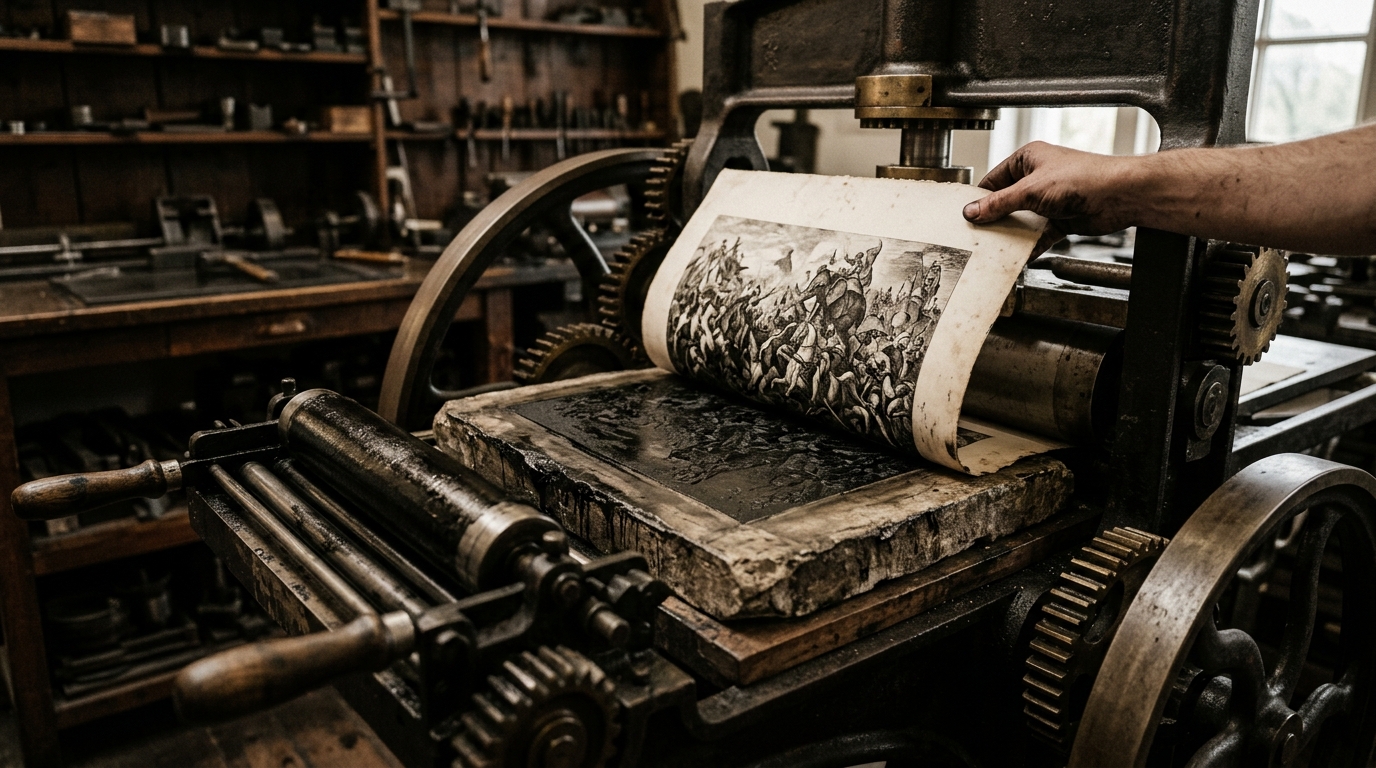
Lithography allowed an artist to draw directly onto a flat limestone block with a grease crayon. The block was treated with chemicals, inked, and run through a press. This process could produce thousands of identical copies of a single image rapidly and cheaply. By the 1870s, Indian-owned printing presses were operating in major cities like Calcutta, Bombay, and Poona. They began churning out prints of historical figures, religious icons, and contemporary events.
Comparing 19th Century Art Mediums
To understand how visual history evolved, look at the primary mediums used to record it.
| Art Medium | Primary Audience | Cost / Accessibility | Historical Function |
|---|---|---|---|
| Company Watercolor | British Officials | High / Single copies | Ethnographic and botanical cataloging. |
| Academic Oil Painting | Royalty & Elites | Very High / Single copies | Projecting power and establishing political legitimacy. |
| Lithograph Print | General Public | Very Low / Mass-produced | Spreading news, religious imagery, and early nationalist ideas. |
| Early Photography | Government & Elites | High / Limited copies | Creating objective records of architecture and war ruins. |
The Calcutta Art Studio and Mass Media
Founded in 1878, the Calcutta Art Studio was a pioneer in creating visual history for the masses. They produced highly detailed lithographs that blended European realism with Indian sensibilities.
These studios printed portraits of historical heroes like Shivaji and Rani Lakshmibai. For the first time, an ordinary merchant or teacher could buy a portrait of a historical figure and hang it in their home. This mass distribution of historical imagery played a crucial role in building a shared national consciousness. Seeing the same historical heroes printed on paper from Bengal to Maharashtra helped lay the visual groundwork for the early nationalist movement.
Mythological Art as Covert Political Resistance
As the 19th century drew to a close, direct political resistance against the British became increasingly dangerous. Sedition laws were strictly enforced. Indian artists found a workaround by using mythological lithographs to comment on current historical events.
Prints depicting the demon Mahishasura being slain by the goddess Durga were widely understood as allegories for the Indian struggle against colonial rule. The British authorities struggled to censor these images because they were technically religious art. You can trace the early history of the Indian independence movement by studying the subtle political messaging hidden in these late 19th-century mythological prints. For a deeper look at how print culture evolved, explore the evolution of indian lithography.
Related Reading
- Milestones in Indian Women's History: A Chronological Guide
- 1,000 Years of Indian Medical History: A Chronological Guide
- Economic Milestones in Indian History: From 1947 to Present
- What Are the Major Events in Indian History? (FAQ Archive)
FAQ
Q: What is Company School painting? Company School painting is a hybrid art style from the 18th and 19th centuries. It blends traditional Indian miniature painting techniques with European conventions like linear perspective and watercolor. East India Company officials commissioned these works to document Indian daily life, flora, and fauna.
Q: Why are there so few Indian paintings of the 1857 Uprising? Following the suppression of the 1857 Uprising, British authorities actively confiscated and destroyed visual materials that glorified the rebellion. As a result, the surviving visual record is heavily skewed toward British sketches and photographs that supported the colonial narrative.
Q: How did Raja Ravi Varma change Indian art? Raja Ravi Varma mastered European academic oil painting and applied it to Indian subjects and mythology. He made historical and mythological scenes highly realistic, and his establishment of a lithography press made these images affordable to the general public.
Q: What role did lithography play in 19th century India? Lithography democratized visual art by allowing the mass reproduction of images. It enabled the widespread distribution of portraits of historical figures and religious icons, which helped foster a shared cultural and early national identity across the subcontinent.
Q: Did photography replace painting in the 19th century? Photography began replacing painting for objective historical documentation after the 1850s, particularly for recording architecture and war ruins. However, painting remained the dominant medium for royal portraiture and mass-market religious prints until the end of the century.
Visit a local museum or browse an online digital archive today to search specifically for "Company School paintings" from your home state. You will immediately see the exact tools, clothing, and street scenes your ancestors experienced over 150 years ago.